

Certified Lithuanian Document Translation
Professional certified translations of Lithuanian documents including gimimo, santuokos, and mirties įrašų išrašai. Accepted by USCIS, UK Visas and Immigration, IRCC, and international authorities worldwide.
TrustpilotSelect Languages
Drag & drop your documents here
or
PDF, JPEG, PNG, WebP — Max 10MB per file. Word documents: please save as PDF first.
Certified translators · Accepted by governments, courts & universities worldwide · View sample
Select a destination country to view pricing
How Lithuanian Certified Translation Works
Submit Your Documents Securely
Upload clear scans of your Lithuanian documents through our encrypted portal. We accept PDF, JPEG, and PNG formats. Our intake specialists review each upload for legibility and completeness, ensuring that Lithuanian civil status seals, municipal stamps, and entries from older popieriniai liudijimai (paper certificates issued before 2017) or modern civilinės būklės akto įrašą liudijantys išrašai (civil status act attestation extracts) are fully readable before translation begins.
Translator Assignment
Your documents are matched with a certified translator experienced in Lithuanian legal and administrative terminology. Lithuanian documents use specific terms, diacritics (š, ž, ė, ų, ū, į, č, ą), and institutional formats — our translators understand the distinctions between Lithuanian civilinės metrikacijos dokumentai, Registrų centro išrašai, and the various civil status document types issued by Lithuanian civilinės metrikacijos skyriai (civil registry departments) across all municipalities.
Translation & Certification
The translator produces your certified translation and affixes their official signature, certification statement, and stamp confirming the translation is a complete and accurate rendering of the original Lithuanian document. A second linguist reviews terminology, formatting, and accuracy before final certification is applied, ensuring all Lithuanian legal terms and proper diacritics are rendered correctly in the target language.
Delivery with Full Certification
Receive your certified translation as a high-resolution PDF for immediate use, with the original hard copy shipped via tracked international courier. For documents requiring an apostille, DoVisa coordinates the full authentication process through the competent Lithuanian authorities — the Lietuvos notarų rūmai (Lithuanian Chamber of Notaries) or the Užsienio reikalų ministerijos Konsulinis departamentas (Consular Department of the Ministry of Foreign Affairs) — delivering the apostilled document directly to your address.
Lithuanian Translation Service Specifications
Popular Language Pairs
We support all languages — 100+ language pairs available for Lithuanian documents.
Common Documents
- Lithuanian birth record extracts (gimimo įrašą liudijantis išrašas)
- Marriage record extracts (santuokos įrašą liudijantis išrašas)
- Death record extracts (mirties įrašą liudijantis išrašas)
- Divorce record extracts (ištuokos įrašą liudijantis išrašas)
- Criminal record certificates (teistumo pažyma)
- Academic diplomas and transcripts (diplomas / pažymėjimas)
- Court judgments and legal documents (teismo sprendimas)
- Residence registration certificates (gyvenamosios vietos deklaracija)
- Employment references and contracts (darbo sutartis / rekomendacija)
- Company registration extracts from Registrų centras
Turnaround Time
Certification Details
Lithuanian Translation Requirements & Regulatory Framework
Embassy Acceptance
Notarization Process
Apostille Information
Legal Framework
Common Scenarios for Lithuanian Document Translation
Immigration & Visa Applications
Lithuanian nationals and residents applying for visas, permanent residency, or citizenship in the United States, Canada, Australia, the United Kingdom, or New Zealand require certified translations of Lithuanian gimimo įrašą liudijantys išrašai (birth record extracts), santuokos įrašai (marriage records), teistumo pažymos (criminal record certificates), and other civil status documents. Our certified translations meet the requirements of USCIS, IRCC, and the Australian Department of Home Affairs for all Lithuanian document types.
Marriage Registration Abroad
Lithuanian citizens marrying abroad or foreign nationals who need Lithuanian civil documents translated for marriage registration in another country require certified translations of birth record extracts, single-status declarations (pažyma apie šeiminę padėtį), and any prior divorce record extracts. Our translators accurately render Lithuanian civil registry terminology and Registrų centras document formats for acceptance by foreign registrars and consular offices.
University Admission & Credential Evaluation
Lithuanian academic documents including brandos atestatas (secondary school maturity certificate), university diplomas, and academic transcripts require certified translation for admission to foreign universities or credential evaluation by organizations such as WES, ECE, or UK ENIC-NARIC. Our academic translators understand the Lithuanian education system, grading scales, and qualification terminology to produce translations that credential evaluators can process efficiently.
Business & Corporate Documents
Lithuanian companies expanding internationally require certified translations of Registrų centro išrašai (Centre of Registers extracts), įstatai (articles of association), and board resolutions. Our corporate translators are experienced with Lithuanian commercial law terminology and produce translations accepted by foreign corporate registries, banks, and regulatory authorities across Europe and worldwide.
Legal Proceedings & Court Documents
Cross-border litigation, international family law cases, and enforcement of Lithuanian court judgments abroad require certified translations of teismo sprendimai (court judgments), nutartys (court orders), and procedural correspondence. Our legal translators handle Lithuanian judicial terminology from apylinkės teismas through Lietuvos Aukščiausiasis Teismas (Supreme Court of Lithuania) decisions, ensuring foreign courts receive accurate translations preserving the legal precision of the originals.
Understanding Lithuania's Sworn Translator System
Lithuania operates a court-regulated sworn translator system where translators must be registered with a Lithuanian apygardos teismas (regional court) as prisiekusieji vertėjai (sworn translators). This registration is essential for the legal validity of translations submitted to Lithuanian courts and government authorities. Only a registered prisiekusysis vertėjas may produce a prisiekusiojo vertėjo vertimas (sworn translation) bearing their court-registered seal, which carries legal weight in Lithuanian proceedings.
Candidates for sworn translator registration must demonstrate professional competence in the relevant language pair and knowledge of Lithuanian legal terminology. For certain legal acts — such as company formation documents filed with the Registrų centras or submissions to Lithuanian courts — a notaras (notary) may additionally need to certify the translator's signature under the Lietuvos Respublikos notariato įstatymas (Notary Law). This dual certification system ensures the highest level of document authentication for domestic Lithuanian proceedings.
For documents intended for use outside Lithuania — such as immigration applications to the United States, Canada, Australia, or the United Kingdom — DoVisa's certified translations are widely accepted without the need for a Lithuanian court-registered translator's seal. International authorities including USCIS, IRCC, and the Australian Department of Home Affairs accept certified translations with a translator's signed certification statement. When Lithuanian sworn translations are specifically required for domestic use, DoVisa coordinates through our network of registered prisiekusieji vertėjai to provide the appropriate certification level.

Lithuanian regional courts register prisiekusieji vertėjai for official sworn translations
Lithuania's Civil Registration and Vital Records System
Lithuanian vital records are managed through the civilinės metrikacijos (civil registration) system, administered by the Registrų centras (Centre of Registers) through municipal civilinės metrikacijos skyriai (civil registry departments) across Lithuania. Since 1 January 2017, traditional paper certificates — gimimo liudijimas (birth certificate), santuokos liudijimas (marriage certificate), and mirties liudijimas (death certificate) — are no longer issued. They have been replaced by civilinės būklės akto įrašą liudijantys išrašai (civil status act attestation extracts), which are standardized documents generated from the electronic registry.
The MEPIS (Metrikacijos paslaugų informacinė sistema — Civil Status Services Information System) platform enables citizens to request civil status documents electronically through the epaslaugos.lt portal and the Registrų centras self-service system. Four types of civil status records are maintained: gimimo įrašas (birth record), santuokos įrašas (marriage record), ištuokos įrašas (divorce record), and mirties įrašas (death record). Documents issued before 2017 in the older paper certificate format remain valid and can still be translated.
For international use, Lithuanian civil status documents may require an apostille from the Lietuvos notarų rūmai (Lithuanian Chamber of Notaries) before the certified translation can be accepted abroad. Within the European Union, many Lithuanian public documents benefit from the EU Public Documents Regulation (Regulation 2016/1191), which simplifies cross-border acceptance between EU member states and may reduce or eliminate the need for apostilles when submitting Lithuanian documents to authorities in other EU countries. However, a certified translation is still typically required when the receiving authority operates in a different language.

Registrų centras administers Lithuania's civil status records through the MEPIS electronic platform
Apostille Authentication for Lithuanian Documents
Lithuania is a party to the Hague Apostille Convention, having acceded on 5 November 1996 with the Convention entering into force on 19 July 1997. This means Lithuanian public documents can be authenticated with an apostille for use in over 120 other Convention member states, replacing the more cumbersome consular legalization process. Two competent authorities are designated to issue apostilles in Lithuania: the Lietuvos notarų rūmai (Lithuanian Chamber of Notaries), which has been issuing apostilles since 18 January 2016, and the Konsulinis departamentas prie Užsienio reikalų ministerijos (Consular Department of the Ministry of Foreign Affairs).
In practice, most apostille requests are handled by Lithuanian notaries through the Chamber of Notaries. Any notary in Lithuania can issue an apostille for public documents at a fee of EUR 15. The Consular Department issues apostilles at a fee of EUR 20 exclusively for documents originating from Lithuanian diplomatic missions and consular offices abroad. The Lithuanian apostille takes the form of a printed sticker with a handwritten signature of the official, an official seal, and a hologram for security.
DoVisa manages the complete apostille process for Lithuanian documents. We identify the correct competent authority based on the document type and origin, prepare the application, submit the documents, and deliver the apostilled translation to your address. Standard apostille processing takes 5-10 business days. For documents destined for countries that are not Hague Convention members, DoVisa coordinates the full consular legalization process through the Užsienio reikalų ministerija (Ministry of Foreign Affairs) and the destination country's embassy in Vilnius.
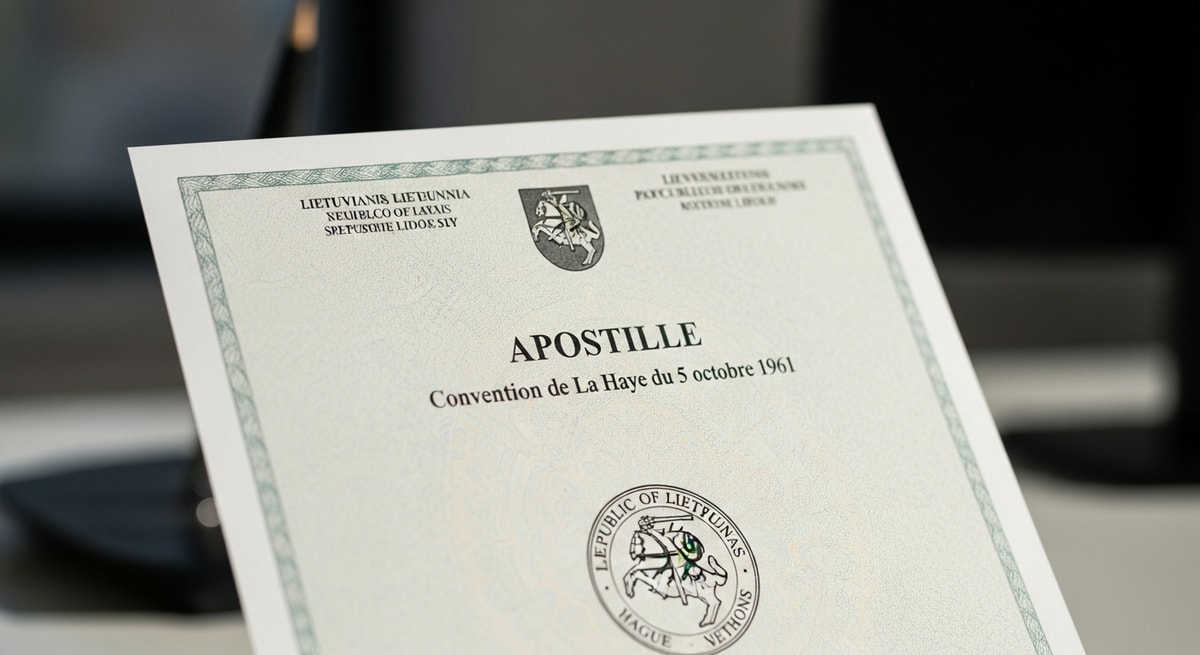
Lithuanian apostilles authenticate documents for acceptance in 120+ Hague Convention member countries
"Had my Lithuanian gimimo įrašo išrašas translated for a US green card application. USCIS accepted the translation without any request for additional evidence. The translator captured all the Lithuanian diacritics and civil status terminology perfectly."
"Needed my Lithuanian university diploma and transcript translated for WES credential evaluation in Canada. WES processed the evaluation without requesting any clarifications. Excellent attention to academic terminology."
"Good translation of my Lithuanian santuokos įrašo išrašas for a UK spouse visa. The Home Office accepted it without issues. Delivery was a day later than the original estimate, but the quality was excellent."
"DoVisa translated my Lithuanian birth record extract and criminal record certificate for an Australian skilled visa. The Department of Home Affairs accepted everything without questions. Very professional and efficient."
"Our company needed a Lithuanian Registrų centras extract and articles of association translated for a UK subsidiary registration. Companies House accepted the translations immediately. Corporate terminology was handled expertly."
"Translated my Lithuanian divorce record extract and birth certificate for an IRCC family sponsorship application in Canada. Both documents accepted, application moved forward without delays. Highly recommend."
"The translation of my Lithuanian employment reference was accurate but the express delivery took one day longer than promised. DoVisa offered a partial refund for the delay and the final product was correct. My New Zealand employer accepted it."
"Had three Lithuanian documents translated with apostille for use in Japan. The entire process from upload to receiving apostilled translations took about 14 days. Everything accepted without issues."
"Lithuanian brandos atestatas and university diploma translated for a job application in Singapore. The translations preserved the grading system accurately and my employer's HR accepted them promptly. Fair pricing."
"Needed my Lithuanian teistumo pažyma and birth record translated for a US work visa. USCIS accepted both without any issues. The translator handled the legal terminology with precision. Fast turnaround too."
"Translation of my Lithuanian court judgment for enforcement proceedings in the United States. The legal terminology was handled accurately and our US attorney was satisfied with the quality. Would use again."
"Had my Lithuanian gimimo įrašo išrašas translated for a US green card application. USCIS accepted the translation without any request for additional evidence. The translator captured all the Lithuanian diacritics and civil status terminology perfectly."
"Needed my Lithuanian university diploma and transcript translated for WES credential evaluation in Canada. WES processed the evaluation without requesting any clarifications. Excellent attention to academic terminology."
"Good translation of my Lithuanian santuokos įrašo išrašas for a UK spouse visa. The Home Office accepted it without issues. Delivery was a day later than the original estimate, but the quality was excellent."
Lithuanian Document Translation FAQs
What types of Lithuanian documents can be translated?
Do I need a sworn translator for Lithuanian documents?
How long does Lithuanian document translation take?
What languages can Lithuanian documents be translated into?
Are your translations accepted by USCIS and other immigration authorities?
Do I need notarization with my Lithuanian translation?
What is an apostille and do I need one for my Lithuanian documents?
How much does certified translation of Lithuanian documents cost?
Can you translate handwritten Lithuanian documents?
What format will I receive my translation in?
What changed with Lithuanian civil status documents in 2017?
Can Lithuanian documents benefit from EU simplified acceptance?
Get Your Lithuanian Documents Translated Today
Professional certified translations of Lithuanian documents accepted by international authorities worldwide