Certified Swedish Document Translation
Professional translations for Swedish documents issued by Skatteverket, Migrationsverket, and Swedish courts. Accepted by international authorities, embassies, and credential evaluation agencies worldwide.
TrustpilotSelect Languages
Drag & drop your documents here
or
PDF, JPEG, PNG, WebP — Max 10MB per file. Word documents: please save as PDF first.
Certified translators · Accepted by governments, courts & universities worldwide · View sample
Select a destination country to view pricing
How Swedish Certified Translation Works
Submit Your Documents Securely
Upload clear scans of your Swedish documents through our encrypted portal. We accept all standard formats including PDF, JPEG, and PNG. Our intake specialists review each upload for legibility, checking that Swedish-specific elements such as personnummer (personal identity number), official stamps, and Skatteverket seals are clearly visible before translation begins.
Translator Assignment
Your documents are matched with a qualified translator experienced in Swedish official documents. For submissions to Swedish domestic authorities, we coordinate with auktoriserade translatorer (authorized translators) holding active Kammarkollegiet certification. For international use, our certified translators produce translations accepted by USCIS, UK Visas and Immigration, IRCC, and credential evaluation agencies worldwide.
Translation & Certification
The translator produces your certified translation with a signed certification statement attesting to accuracy and completeness. Swedish documents such as personbevis, födelsebevis, and utbildningsbevis contain specific civil registration terminology that requires specialist knowledge. A second qualified linguist reviews the translation for terminology, formatting, and accuracy before certification is finalized.
Delivery with Full Certification
Receive your certified translation as a high-resolution PDF for immediate use, with the original signed hard copy shipped via tracked PostNord or international courier. If apostille certification is needed for use in another Hague Convention member state, DoVisa coordinates the full apostille process through a Swedish Notarius Publicus, delivering the complete apostilled package to your address.
Swedish Translation Service Specifications
Popular Language Pairs
We support all languages — 100+ language pairs available for Swedish documents.
Common Documents
- Population registration certificates (personbevis)
- Birth certificates (födelsebevis / födelseattest)
- Marriage certificates (vigselbevis)
- Death certificates (dödsfallsintyg)
- Academic diplomas and transcripts (examensbevis / utbildningsbevis)
- Police clearance certificates (utdrag ur belastningsregistret)
- Employment references and contracts (arbetsgivarintyg / anställningsavtal)
- Tax assessment notices (slutskattebesked)
- Court judgments and legal documents (domstolsbeslut)
- Corporate registration extracts (registreringsbevis)
Turnaround Time
Certification Details
Swedish Translation Requirements & Regulatory Framework
Embassy Acceptance
Notarization Process
Apostille Information
Legal Framework
Common Scenarios for Swedish Document Translation
Immigration & Visa Applications
Swedish residents applying for visas, permanent residency, or citizenship abroad need certified translations of personbevis, födelsebevis, utdrag ur belastningsregistret (police clearance), and other civil documents. USCIS, IRCC, UK Visas and Immigration, and the Australian Department of Home Affairs all accept DoVisa certified translations of Swedish documents. We format translations to meet each destination country's specific requirements, including proper rendering of personnummer and Swedish civil registration terminology.
Marriage & Family Documentation
Couples involving a Swedish national marrying abroad or registering a foreign marriage in Sweden need certified translations of vigselbevis (marriage certificate), personbevis showing marital status, and related family documents. For international marriages, DoVisa provides translations with apostille certification through a Swedish Notarius Publicus, creating a fully authenticated document package accepted in all Hague Convention member countries.
University Admission & Credential Evaluation
Swedish academic documents including examensbevis (degree certificates), betyg (transcripts), and gymnasieexamen (upper secondary school diplomas) require certified translation for foreign university admissions and credential evaluations. Organizations such as WES, ECE, and NACES members accept DoVisa certified translations. Our academic translators understand the Swedish grading system, including the VG/G/U scale and ECTS credit equivalencies.
Corporate & Business Filings
Swedish companies expanding internationally or foreign companies operating in Sweden need certified translations of registreringsbevis (company registration extracts) from Bolagsverket (Swedish Companies Registration Office), bolagsordning (articles of association), årsredovisning (annual reports), and board resolutions. Our corporate translators handle Swedish commercial terminology including references to aktiebolag (AB), handelsbolag (HB), and enskild firma (sole proprietorship) structures.
Legal Proceedings & Court Documents
Cross-border litigation and international legal matters require certified translations of Swedish court documents including tingsrättsbeslut (district court decisions), hovrättsdomar (court of appeal judgments), and kronofogdebeslut (enforcement authority decisions). Our legal translators maintain accuracy with Swedish procedural terminology and ensure translations are formatted for acceptance by foreign courts and legal proceedings under EU judicial cooperation frameworks.
The Kammarkollegiet Authorization System for Swedish Translators
Sweden operates a distinctive translator authorization system managed by Kammarkollegiet (the Legal, Financial and Administrative Services Agency), one of Sweden's oldest government agencies with roots dating back to 1539. Unlike many European countries that appoint sworn translators through the court system, Sweden centralizes translator authorization through this specialized government agency. The title auktoriserad translator (authorized translator) is legally protected and may only be used by individuals who have passed Kammarkollegiet's rigorous examination and maintain active authorization.
The authorization examination is administered annually at various locations across Sweden and covers approximately 30 language pairs to or from Swedish. The examination tests three categories of translation competence in a single day: general texts, financial documents, and legal documents. Candidates must achieve a passing standard in all three categories. Prior to authorization, Kammarkollegiet also conducts an integrity and suitability assessment. Once authorized, translators receive a unique translator number and an official stamp that must appear on all certified translations they produce.
Authorization is not permanent — it must be renewed every five years, ensuring that authorized translators maintain their competence throughout their careers. All authorized translators are bound by God translatorssed (Excellent Translation Practices), a set of professional conduct guidelines issued by Kammarkollegiet that covers accuracy standards, confidentiality obligations, and ethical requirements. Kammarkollegiet maintains a publicly searchable register of all authorized translators, allowing anyone to verify a translator's credentials, language pairs, and active status. This level of institutional oversight gives Swedish authorized translations a high degree of reliability and legal certainty for both domestic and international use.

Kammarkollegiet administers Sweden's authorized translator system with examinations in approximately 30 languages
Nordic Naming Conventions and Swedish Civil Registration
Translating Swedish civil registration documents requires specialist knowledge of Sweden's unique naming and registration system. Sweden's population register is maintained by Skatteverket (the Swedish Tax Agency), which issues the essential personbevis — a multipurpose population registration certificate that serves many of the functions covered by separate documents in other countries. A personbevis can confirm identity, birth details, marital status, address, and family relationships, making it one of the most frequently translated Swedish documents.
Swedish naming conventions present specific translation challenges. Historically, Sweden used a patronymic system where children took their father's first name plus -son or -dotter (e.g., Eriksson, Andersdotter). Although hereditary surnames became mandatory in 1901, patronymic naming persisted informally and many modern Swedish surnames reflect this heritage. The Namnlagen (Name Act) governs name changes and allows considerable flexibility, including choosing a spouse's surname, combining surnames with a hyphen, or reverting to a birth name after divorce. Translators must accurately render these naming patterns and any associated annotations in civil documents.
Swedish documents also use the personnummer (personal identity number), a 10-digit or 12-digit number in the format YYMMDD-XXXX or YYYYMMDD-XXXX that encodes the holder's date of birth and includes a gender indicator. The personnummer appears on virtually every official Swedish document and must be correctly formatted in translations. For individuals not registered in Sweden, a samordningsnummer (coordination number) is issued instead. Understanding these identification systems, along with Swedish administrative terminology and the relationship between different Skatteverket-issued documents, is essential for producing accurate certified translations that foreign authorities will accept without queries.
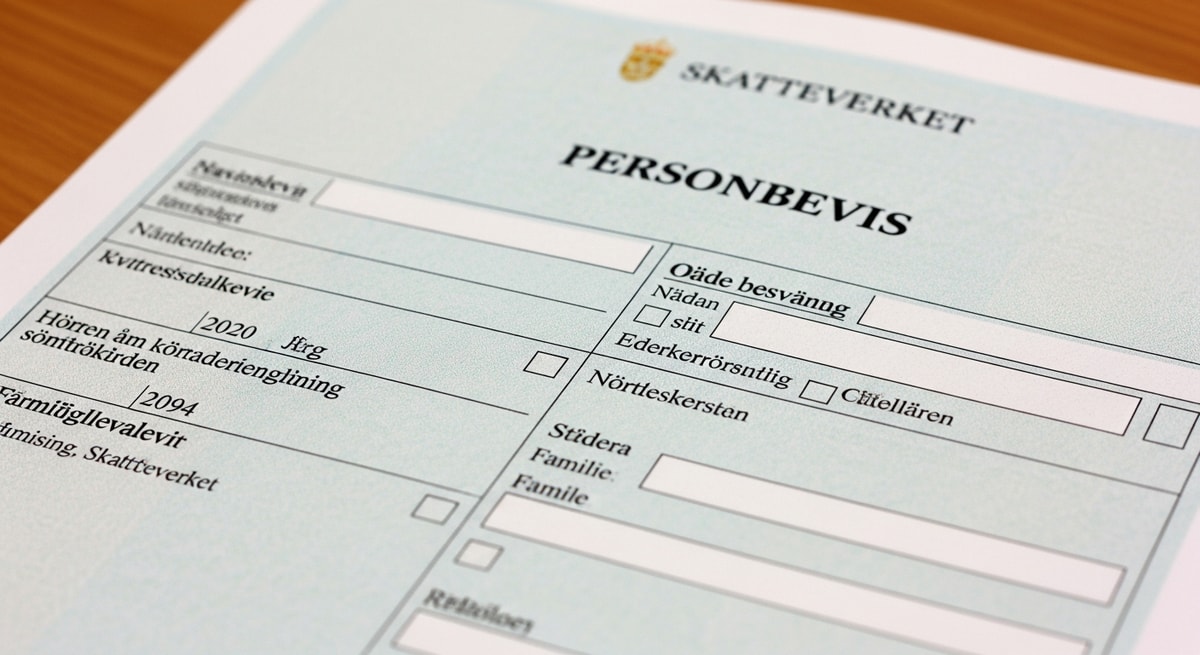
Sweden's personbevis from Skatteverket is the most commonly translated Swedish civil document
Apostille and Authentication for Swedish Documents
Sweden ratified the Hague Apostille Convention on 2 March 1999, with the convention entering into force on 1 May 1999. This means Swedish public documents bearing an apostille are recognized in over 125 Convention member states without the need for further legalization. Sweden's apostille system is notably decentralized — unlike many countries where a single ministry or court issues apostilles, Sweden designates all Notarius Publicus (Notaries Public) as competent authorities under the Convention.
There are approximately 250 Notaries Public across Sweden, each appointed by one of the 21 Länsstyrelser (County Administrative Boards). Each Notarius Publicus operates independently and can issue apostilles for any Swedish public document, including certified translations bearing an authorized translator's stamp. There is no centralized national register of all Notaries Public — individuals must contact their local Länsstyrelse to find an appointed notary, or use the lists published on each Länsstyrelse's website under Förteckning Notarius Publicus.
The apostille process for a certified translation involves the Notarius Publicus verifying the authenticity of the translator's certification and stamp before affixing the apostille certificate to the document. For documents destined for countries that are not Apostille Convention members, a full legalization process through the Ministry for Foreign Affairs (Utrikesdepartementet) and the destination country's embassy in Sweden is required instead. DoVisa manages the entire apostille workflow — identifying an available Notarius Publicus, submitting the document, tracking the process, and delivering the apostilled package. Standard apostille processing takes 1-5 business days; we maintain relationships with Notaries Public in Stockholm, Gothenburg, and Malmö for efficient turnaround.
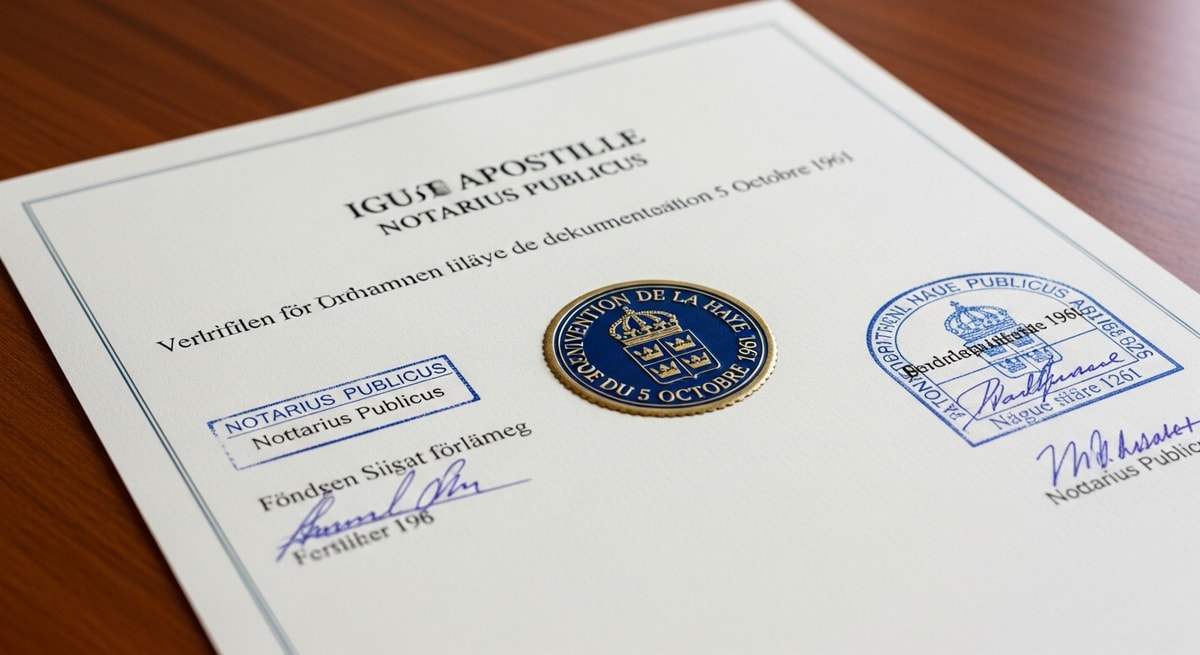
Swedish apostilles are issued by Notarius Publicus, with approximately 250 notaries across the country
"Needed my Swedish personbevis and födelsebevis translated to English for a USCIS green card application. The translator handled all the Skatteverket-specific formatting perfectly. USCIS accepted everything without a single request for evidence. Very professional service."
"DoVisa translated my Swedish university examensbevis and transcripts for WES credential evaluation in Canada. The translator correctly rendered all Swedish grading terminology and ECTS credits. WES processed my evaluation without any clarifications needed."
"Good translation of my Swedish vigselbevis for a UK spouse visa. The Home Office accepted it promptly. I would have preferred slightly faster delivery but the standard 5-day turnaround was within the quoted timeframe."
"Translated my Swedish polisutdrag (police clearance) and birth certificate for an Australian skilled worker visa. The Department of Home Affairs accepted both translations. The apostille from Notarius Publicus was coordinated seamlessly by DoVisa."
"Our company needed Swedish registreringsbevis and bolagsordning translated for establishing a subsidiary in the UK. The corporate terminology was handled expertly and Companies House accepted the translations without questions. Excellent business translation service."
"Swedish court judgment translated to English for a legal matter in the United States. The legal terminology was accurate and the US attorney confirmed the translation met all requirements. Delivery was on time at 4 business days."
"Swedish-to-Japanese translation of my personbevis for marriage registration in Tokyo. The translator understood both Swedish civil registration terminology and Japanese requirements perfectly. The ward office accepted the translation immediately."
"My Swedish födelsebevis translation had a minor personnummer formatting error in the initial version. DoVisa corrected it within a few hours and the revised translation was accepted by IRCC for my Canadian PR application. The correction was fast but the error was avoidable."
"Translated three Swedish Arbetsgivarintyg (employment certificates) to English for a work visa application in New Zealand. Immigration New Zealand accepted all three without any issues. Fast turnaround and accurate terminology throughout."
"Swedish academic transcripts from Lund University translated to Arabic for credential evaluation. The translator accurately converted the Swedish grading scale and course descriptions. The evaluation body in Abu Dhabi accepted everything on first submission."
"DoVisa handled translation and apostille for my Swedish dödsfallsintyg (death certificate) needed for estate proceedings in Spain. The Notarius Publicus apostille was coordinated quickly and the Spanish authorities accepted the complete package. Sensitive matter handled with care."
"Needed my Swedish personbevis and födelsebevis translated to English for a USCIS green card application. The translator handled all the Skatteverket-specific formatting perfectly. USCIS accepted everything without a single request for evidence. Very professional service."
"DoVisa translated my Swedish university examensbevis and transcripts for WES credential evaluation in Canada. The translator correctly rendered all Swedish grading terminology and ECTS credits. WES processed my evaluation without any clarifications needed."
"Good translation of my Swedish vigselbevis for a UK spouse visa. The Home Office accepted it promptly. I would have preferred slightly faster delivery but the standard 5-day turnaround was within the quoted timeframe."
Swedish Document Translation FAQs
What types of Swedish documents can be translated?
We translate all types of Swedish documents including personbevis (population registration certificates), födelsebevis (birth certificates), vigselbevis (marriage certificates), dödsfallsintyg (death certificates), academic diplomas and transcripts (examensbevis and betyg), police clearance certificates (utdrag ur belastningsregistret), employment references, corporate registration extracts from Bolagsverket, court judgments, tax assessment notices, and all other official Swedish documents. All translations are certified and accepted by government agencies and institutions worldwide.
Are the translations certified and accepted by authorities?
Yes. Our certified translations include a signed certification statement attesting to accuracy and completeness. They are accepted by international authorities including USCIS, UK Visas and Immigration, IRCC (Canada), the Australian Department of Home Affairs, and credential evaluation agencies such as WES and ECE. For submission to Swedish domestic authorities such as Migrationsverket or Skatteverket, a translation by a Kammarkollegiet-authorized translator (auktoriserad translator) may be required — DoVisa can coordinate this through our network of authorized translators.
Do I need a Kammarkollegiet-authorized translator for my Swedish documents?
It depends on where you are submitting the translation. For submission to Swedish domestic authorities such as Migrationsverket, Skatteverket, or Swedish courts, a translation by a Kammarkollegiet-authorized translator (auktoriserad translator) is typically required or strongly preferred under the Förvaltningslagen (Administrative Procedure Act). For international use — such as immigration applications in the US, UK, Canada, Australia, or for credential evaluations — our standard certified translations are accepted. DoVisa offers both options and can advise which level of certification is appropriate for your specific submission.
How long does certified Swedish translation take?
Standard certified translation of Swedish documents is delivered within 4-6 business days. Express processing is available for 2-3 business days, and rush delivery within 24 hours is available for select single-page documents such as birth certificates and personbevis. Turnaround begins after document review and payment confirmation. If apostille certification is also needed, allow an additional 1-5 business days for the Notarius Publicus to process the apostille.
What languages can Swedish documents be translated into?
We translate Swedish documents into 100+ languages including English, Arabic, French, Spanish, German, Finnish, Norwegian, Danish, Polish, Chinese, Japanese, Korean, Turkish, Portuguese, Russian, and many more. We also translate documents from any language into Swedish. The most requested language pair is Swedish to English, followed by Swedish to Arabic and Swedish to Finnish. All language pairs receive the same level of certified translation quality and certification.
Will my Swedish translation be accepted by USCIS?
Yes. USCIS accepts certified translations that include a signed certification statement from the translator or translation company attesting that the translation is complete and accurate. Our certified translations of Swedish documents meet all USCIS requirements for immigration petitions, adjustment of status applications, naturalization, and visa processing. We include the translator's certification statement with every translation. Our current acceptance rate at USCIS for Swedish document translations is consistent with our overall rate of 98.7% across all submissions.
Do I need notarization with my Swedish translation?
For most purposes, a certified translation with a signed certification statement is sufficient. However, some receiving authorities may require additional notarization by a Notarius Publicus, especially for use in countries that require extra authentication. In Sweden, approximately 250 Notaries Public are appointed by the 21 County Administrative Boards (Länsstyrelsen) and can notarize translations. DoVisa can coordinate notarization through a Swedish Notarius Publicus upon request as an add-on service.
What is an apostille and do I need one for Swedish documents?
An apostille is a standardized certificate that authenticates the origin of a public document for use in another country that is a member of the Hague Apostille Convention. Sweden ratified the Convention in 1999. If you need to use your Swedish document in another Convention member state, an apostille eliminates the need for further legalization. In Sweden, apostilles are issued by Notarius Publicus. You typically need an apostille when submitting Swedish documents to foreign government authorities, courts, or universities in Convention member countries. DoVisa handles the full apostille process with standard processing of 1-5 business days.
How much does certified Swedish translation cost?
Our Swedish certified translation pricing follows a transparent per-page structure with volume discounts that apply automatically for larger documents. Pricing varies based on document length, language pair, and processing speed selected. Express and rush service options are available for time-sensitive projects. Apostille processing through a Notarius Publicus is quoted separately. Upload your documents on our order page to receive an instant, detailed quote before work begins — no hidden fees or obligations.
Can you translate handwritten Swedish documents?
Yes, we translate handwritten Swedish documents including older civil registration records, personal letters, and historical documents. Handwritten Swedish documents can present challenges due to variations in handwriting style, older orthographic conventions, and historical Swedish terminology. Our translators experienced with historical Swedish documents can decipher and translate these accurately. For best results, provide the highest resolution scan possible and inform us of any context about the document's age or origin during upload.
What format will I receive the translation in?
You will receive your certified translation in two formats: a high-resolution PDF delivered to your email for immediate digital use, and a physical hard copy with the original signed certification shipped to your address via tracked PostNord (within Sweden) or international courier. The PDF is suitable for online submissions, email attachments, and preliminary reviews. Many authorities accept the digital version, but some require the physical original with wet-ink signature. If apostille certification is included, the apostille certificate is attached to the physical hard copy.
What is a personbevis and why is it important for translation?
A personbevis is a population registration certificate issued by Skatteverket (the Swedish Tax Agency). It is one of the most versatile Swedish official documents, serving as proof of identity, birth details, marital status, registered address, and family relationships. Because a personbevis combines information that many other countries issue as separate certificates, it is frequently requested by foreign authorities as a substitute for individual birth, marriage, or residency certificates. Accurate translation of personbevis requires understanding of Swedish civil registration terminology, personnummer formatting, and the specific information fields used by Skatteverket.
Can Swedish documents be used internationally without an apostille?
It depends on the destination country and the receiving authority. Many international institutions accept certified translations without an apostille, particularly for immigration applications in the US, UK, Canada, and Australia. However, for use in other Hague Convention member states, an apostille from a Swedish Notarius Publicus provides the highest level of authentication and is often required by government authorities, courts, and civil registry offices. For countries that are not Convention members, full consular legalization through the Ministry for Foreign Affairs (Utrikesdepartementet) may be required instead. DoVisa can advise on the appropriate level of authentication for your specific destination.
Get Your Swedish Documents Translated Today
Professional certified translations accepted by international authorities worldwide, with apostille available through Swedish Notarius Publicus