
Certified German Document Translation
Beglaubigte Übersetzungen by sworn translators recognized across Germany, Austrian authorities, Swiss cantons, and all Schengen-area institutions. Compliant with German judicial and administrative standards.
TrustpilotSelect Languages
Drag & drop your documents here
or
PDF, JPEG, PNG, WebP — Max 10MB per file. Word documents: please save as PDF first.
Certified translators · Accepted by governments, courts & universities worldwide · View sample
Select a destination country to view pricing
How German Certified Translation Works
Submit Your Documents Securely
Upload clear scans of your German or foreign-language documents through our encrypted portal. We accept all standard formats including PDF, JPEG, and PNG. Our intake specialists review each upload for legibility and completeness, contacting you immediately if a rescan is needed before translation begins.
Sworn Translator Assignment
Your documents are matched with a beeidigte Übersetzerin or beeidigter Übersetzer (sworn translator) officially appointed by a German Regional Court (Landgericht). German law requires that certified translations for official use be produced exclusively by court-appointed sworn translators. We verify each translator's active court appointment before every assignment.
Translation with Beglaubigung
The sworn translator produces your certified translation (beglaubigte Übersetzung) and affixes their official stamp, signature, and certification clause (Beglaubigungsvermerk). A second qualified linguist performs a thorough review of terminology, formatting, and legal accuracy. The certification clause confirms the translation's completeness and correctness under German law.
Delivery with Full Certification
Receive your beglaubigte Übersetzung as a high-resolution PDF for immediate use, with the original wet-ink-stamped hard copy shipped to your address via tracked Deutsche Post or international courier. German authorities typically require the physical certified copy with original stamp, so we include priority shipping within Germany at no extra charge.
German Translation Service Specifications
Popular Language Pairs
We support all languages — 100+ language pairs available for German documents.
Common Documents
- German birth certificates (Geburtsurkunde)
- Marriage certificates (Heiratsurkunde / Eheurkunde)
- Divorce decrees (Scheidungsurteil / Scheidungsbeschluss)
- Academic diplomas and transcripts (Zeugnis / Diplom / Urkunde)
- German police clearance (Führungszeugnis)
- Residence registration (Meldebescheinigung)
- Employment references (Arbeitszeugnis)
- Notarial deeds (Notarielle Urkunde)
- German trade register extracts (Handelsregisterauszug)
- Social insurance records (Sozialversicherungsnachweis)
Turnaround Time
Certification Details
German Translation Requirements & Regulatory Framework
Embassy Acceptance
Notarization Process
Apostille Information
Legal Framework
Common Scenarios for German Document Translation
Blue Card & Skilled Worker Visa Applications
The EU Blue Card and Germany's Fachkräfteeinwanderungsgesetz (Skilled Immigration Act) require certified German translations of foreign academic degrees, professional certificates, and employment contracts. The Ausländerbehörde and the Federal Employment Agency (Bundesagentur für Arbeit) review these translations during the approval process. DoVisa provides translations formatted specifically for Blue Card and skilled worker applications, including proper rendering of degree equivalencies referenced in the anabin database.
Marriage Registration at the Standesamt
Foreign nationals marrying in Germany must submit certified translations of their birth certificate, passport, single-status certificate (Ledigkeitsbescheinigung), and any prior divorce decrees to the local Standesamt. Each Standesamt may have slightly different procedural requirements, and our translators are experienced with the variations across German cities. We ensure every translation meets Standesamt formatting expectations, including proper German equivalents for foreign civil status terminology.
University Admission & Credential Evaluation
German universities and the uni-assist evaluation service require sworn translations of foreign academic transcripts, diplomas, and secondary school certificates. The Kultusministerkonferenz (KMK) credential evaluation process for professional recognition also mandates certified translations. Our academic translators understand the German Notensystem (grading system) equivalencies and use terminology that credential evaluators expect to see, facilitating smoother evaluation outcomes.
Company Formation & Handelsregister Filings
Foreign entrepreneurs establishing a GmbH, UG, or AG in Germany must provide sworn translations of their passport, proof of address, corporate documents from their home country, and shareholder resolutions. These translations are submitted to the Notar handling the company formation and subsequently filed with the Handelsregister (commercial register) at the local Amtsgericht. Our corporate translators are fluent in German commercial law terminology and Handelsgesetzbuch (HGB) provisions.
Family Reunification & Visa Applications
Spouses, children, and parents of German residents applying for family reunification visas (Familiennachzug) must present certified translations of birth certificates, marriage certificates, custody agreements, and financial support declarations at German embassies abroad. BAMF (Federal Office for Migration and Refugees) case officers review these translations during the approval process. Our translations meet the strict requirements of German consular sections worldwide.
German Court Document Translation for International Cases
Cross-border litigation, international divorce proceedings, and child custody cases under the Brussels II Regulation require certified translations of German court judgments, orders, and correspondence. Our legal translation team handles complex German procedural law terminology from Amtsgericht through Bundesgerichtshof decisions, ensuring that foreign courts and attorneys receive accurate translations that preserve the legal precision of the original German judicial language.
The German Sworn Translator System Explained
Germany operates one of the world's most regulated translation certification systems. Unlike countries where any professional translator can issue a certified translation, Germany restricts official certified translations to beeidigte Übersetzer (sworn translators) or ermächtigte Übersetzer (authorized translators) who have been formally appointed by the president of a Regional Court (Landgericht) or Higher Regional Court (Oberlandesgericht). The appointment process requires demonstrating advanced linguistic competence through university qualifications or state examinations, knowledge of German legal and administrative systems, and personal reliability verified through a police clearance certificate.
Once appointed, sworn translators receive an official stamp (Dienstsiegel) bearing their name, language combination, and the appointing court. Every certified translation must include a Beglaubigungsvermerk (certification clause) in which the translator attests under their official appointment that the translation is complete and accurate. This clause, combined with the translator's stamp and handwritten signature, gives the translation its legal force. German authorities, courts, and institutions will not accept translations lacking this formal certification from a court-appointed translator.
The appointment is specific to each language pair and each federal state, though translations by sworn translators are generally accepted nationwide. DoVisa maintains a network of sworn translators covering all 16 German federal states and over 40 language combinations, ensuring we can provide properly certified translations regardless of the language pair or the German authority that will receive the document. Our internal verification process confirms each translator's active appointment status before every project to guarantee the legal validity of your translation.

German Landgericht courts appoint sworn translators who provide legally valid certified translations
Apostille and Legalization for German Documents
Germany ratified the Hague Apostille Convention in 1966, making it one of the earliest members. An apostille is a standardized certificate issued by a designated competent authority that authenticates the origin of a public document for use in another Convention member state. For German documents, the competent authority varies by document type and federal state: the Landgericht president typically apostilles sworn translations and notarial deeds, while the Regierungspräsidium or Bezirksregierung handles administrative documents, and the Bundesverwaltungsamt handles federal-level documents.
The apostille process for a certified translation involves several steps. First, the sworn translator produces the certified translation with their official stamp and certification clause. The translation, along with the original document, is then submitted to the competent authority, which verifies the translator's appointment and stamp before issuing the apostille. The apostille is physically attached to the translation document, creating a chain of authentication. For documents destined for countries that are not Apostille Convention members, a full legalization process through the German Federal Foreign Office (Auswärtiges Amt) and the destination country's embassy in Germany is required instead.
DoVisa manages the complete apostille process from start to finish. We identify the correct competent authority for your specific document and translator combination, prepare and submit the apostille application, track processing, and deliver the apostilled document to your address. Our experience with apostille offices across Germany allows us to anticipate potential issues, such as the requirement in some states that the sworn translator's signature be separately notarized before apostille issuance. Standard apostille processing is 3-7 business days; we offer expedited service in Berlin, Munich, Hamburg, and Frankfurt.
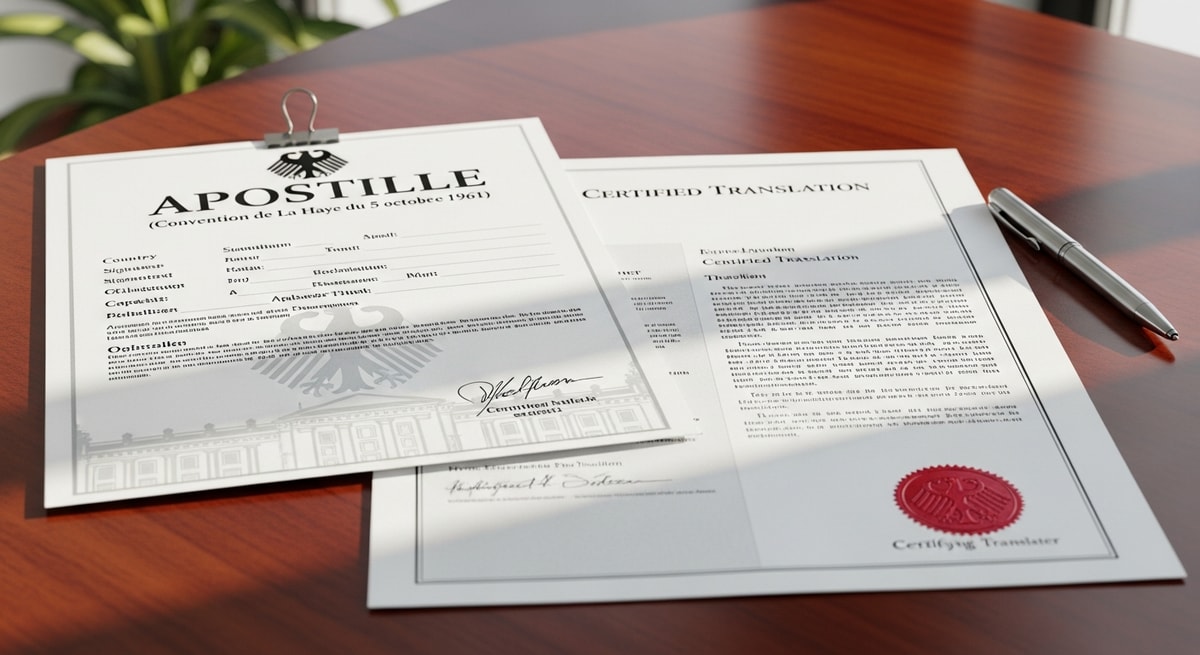
German apostilles authenticate sworn translations for international recognition in 125+ countries
Navigating German Bureaucratic Document Requirements
Germany's administrative system is thorough and documentation-intensive, with each authority (Behörde) maintaining specific requirements for translated documents. The Standesamt (civil registry office) is perhaps the most demanding, requiring sworn translations of all foreign vital records for marriage registrations, birth registrations, and name changes. Each Standesamt may request different supporting documents depending on the nationality of the applicant, and some may require translations to include specific formatting elements or supplementary declarations from the translator.
The Ausländerbehörde (foreigners' authority) handles residence permits, settlement permits, and naturalization applications. Document requirements vary significantly between the 400+ Ausländerbehörden across Germany. Berlin's Landesamt für Einwanderung has different procedural expectations than Munich's Kreisverwaltungsreferat or Hamburg's Einwohner-Zentralamt. Our translators maintain familiarity with the major city immigration offices' preferences and can format translations to match local expectations. For naturalization applications (Einbürgerung), the Ausländerbehörde requires particularly comprehensive documentation including translated birth certificates, police clearances from every country of residence, and proof of German language proficiency.
For professional recognition under the Anerkennungsgesetz (Recognition Act), foreign professionals must submit sworn translations of their qualifications to the competent recognition body. Doctors apply to the Landesprüfungsamt, engineers to the relevant Ingenieurkammer, and lawyers to the Justizprüfungsamt. Each body has specific terminology expectations. Our specialized translators produce translations that use the German professional terminology that recognition assessors expect, increasing the likelihood of a smooth evaluation. We have particular expertise in medical, engineering, legal, and teaching credential translations for the German recognition process.
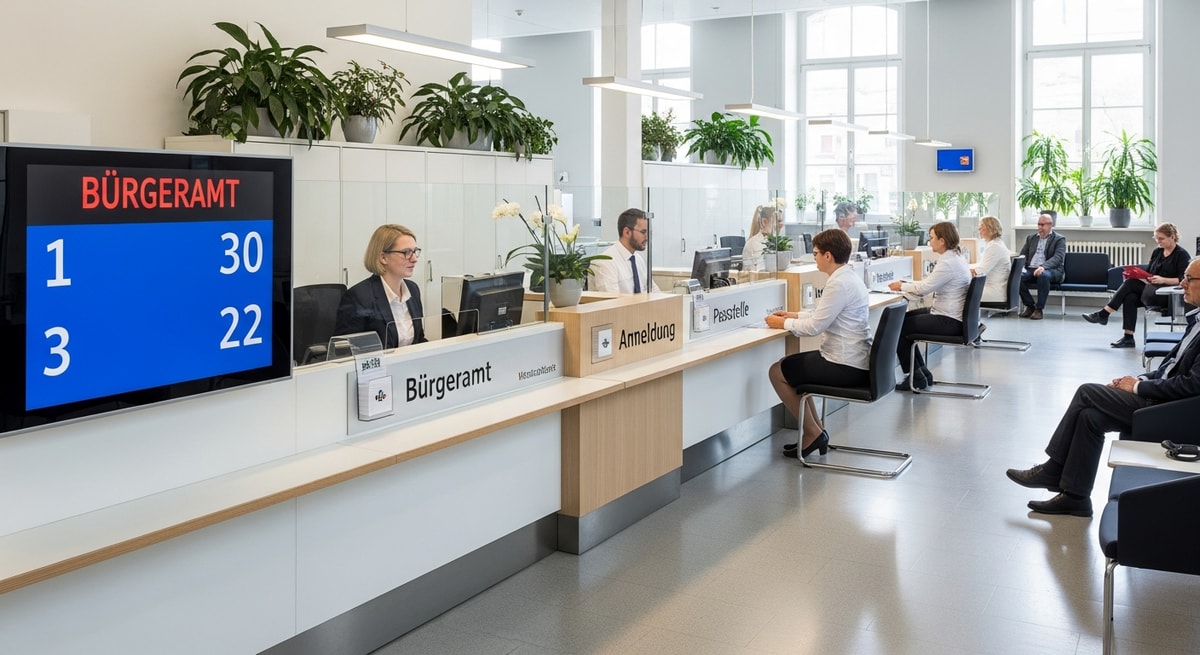
German Behörden require sworn translations meeting precise formatting and certification standards
"Needed my German university diploma and transcripts translated for WES credential evaluation. The translator captured all the academic terminology perfectly — Vordiplom, Hauptstudium, Leistungsnachweise. WES processed my evaluation without any clarifications needed."
"DoVisa handled the translation and apostille for my German Heiratsurkunde (marriage certificate) for an immigration case in the United States. The entire process from upload to receiving the apostilled English translation took 8 days. USCIS accepted everything without a single RFE."
"Good translation of my German Familienbuch for a UK spouse visa. The Home Office accepted everything. Only giving 4 stars because express was not available for my language pair and I had to wait the standard 5 days."
"Translated my German Führungszeugnis, university degree, and employment references for my Canadian Express Entry application. Five documents total including birth certificate and transcripts. IRCC processed my PR application without requesting any corrections to the translations. Excellent quality."
"German-to-Japanese translation of my Geburtsurkunde (birth certificate) for marriage registration in Tokyo. The translator understood both German civil registry documents and Japanese requirements perfectly. The ward office in Shibuya accepted the translation right away. Very impressed."
"Used DoVisa for translating a German Arbeitszeugnis (employment reference) to English for a job application in London. Good translation that captured the specific coded language German references are known for. Delivery was on time."
"German Abschlusszeugnis and transcripts translated for a US graduate school application. DoVisa delivered in 3 days with perfect academic terminology. My university processed the application without any follow-up questions. Thank you!"
"German Geburtsurkunde translation was accurate but the initial delivery had a small date format error. They corrected it within hours. The final version was perfect and accepted for my Australian partner visa, but the error should not have happened."
"Our company needed German GmbH formation documents translated to English: Gesellschaftsvertrag, Handelsregisterauszug, and Vollmachten. The English translations were impeccable and our UK solicitors used them for subsidiary registration at Companies House without any issues."
"Moved from Germany to Australia and needed my German Führungszeugnis (police clearance) and Geburtsurkunde translated to English for the Australian skilled visa. Both translations were accepted by the Department of Home Affairs. Quick turnaround and fair pricing."
"German court documents translated to Arabic with apostille for a UAE legal proceeding. The translators handled complex legal content professionally and the apostilled certification met all requirements of the Ministry of Justice in Abu Dhabi."
"German nursing diploma translated to English for NMC registration in the UK. The NMC accepted the translations and my qualifications were recognized within standard processing time. DoVisa made the hardest part of my registration easy."
"Needed my German university diploma and transcripts translated for WES credential evaluation. The translator captured all the academic terminology perfectly — Vordiplom, Hauptstudium, Leistungsnachweise. WES processed my evaluation without any clarifications needed."
"DoVisa handled the translation and apostille for my German Heiratsurkunde (marriage certificate) for an immigration case in the United States. The entire process from upload to receiving the apostilled English translation took 8 days. USCIS accepted everything without a single RFE."
"Good translation of my German Familienbuch for a UK spouse visa. The Home Office accepted everything. Only giving 4 stars because express was not available for my language pair and I had to wait the standard 5 days."
German Document Translation FAQs
What is a beglaubigte Übersetzung and why does it matter?
A beglaubigte Übersetzung (certified/sworn translation) is a translation produced by a translator who has been officially appointed and sworn in by a German court (Landgericht or Oberlandesgericht). The translator affixes their court-issued stamp, handwritten signature, and a formal certification clause (Beglaubigungsvermerk) to the translation, attesting under their official appointment that the translation is complete and accurate. This certification gives the translation legal force under German law. German authorities, courts, Standesämter, Ausländerbehörden, universities, and professional recognition bodies only accept translations with this formal sworn certification. Translations produced by non-sworn translators, regardless of their quality, are not legally valid for official purposes in Germany.
Do all DoVisa German translators hold court appointments?
Yes. Every translator in our German network is a beeidigte/r Übersetzer/in (sworn translator) or ermächtigte/r Übersetzer/in (authorized translator) holding an active appointment from a German Landgericht or Oberlandesgericht. Before each project assignment, we verify the translator's current appointment status in the relevant federal state's sworn translator database. Appointment requirements include university-level linguistic qualifications, demonstrated knowledge of German legal and administrative terminology, a clean criminal record, and in most states, successful completion of a state examination or equivalent competency assessment. Our network covers all 16 German federal states and over 40 language pairs.
How much does certified German translation cost?
Our German certified translation pricing follows a transparent per-page structure with volume discounts that apply automatically for larger documents. Pricing varies based on document length, language pair, and the processing speed you select. Express and rush service options are available for time-sensitive projects. Apostille processing through the relevant Landgericht is quoted separately based on the federal state. Hard-copy shipping within Germany is included free of charge; international shipping is quoted based on destination. Upload your documents on our order page to receive an instant, detailed quote before work begins — no hidden fees.
Can I use a German sworn translation in Austria or Switzerland?
German sworn translations are generally well-accepted in Austria, though Austrian authorities technically require translations by Austrian court-certified translators (gerichtlich beeidete Dolmetscher und Übersetzer). In practice, many Austrian Behörden accept German sworn translations, but it is advisable to confirm with the specific receiving authority. For Switzerland, acceptance varies by canton and language region. German-speaking cantons often accept German sworn translations, while French and Italian cantons may require translators registered in their respective regions. DoVisa can provide translations by Austrian or Swiss-registered translators when specifically required. For use in other Schengen or EU countries, German sworn translations with an apostille are widely accepted under the Hague Convention framework.
What documents do I need translated for a German Blue Card application?
The EU Blue Card (Blaue Karte EU) application typically requires certified German translations of: your university degree certificate and academic transcript (the degree must be recognized in the anabin database or evaluated by the KMK/ZAB); your employment contract or binding job offer from a German employer showing the required minimum salary; your passport biographical page; and in some cases, previous employment references or a CV. If your degree is from a non-German-speaking country, the Ausländerbehörde will require sworn translations of all academic documents. Some Ausländerbehörden also request translations of your birth certificate and marriage certificate if applicable. DoVisa offers a Blue Card translation package covering all standard documents at a bundled rate.
How long does the apostille process take for German translations?
The apostille processing time depends on the federal state and the competent authority. Most Landgericht offices process apostille applications within 3-7 business days after receiving the complete submission. Some states, particularly larger ones like North Rhine-Westphalia and Bavaria, may take up to 10 business days during peak periods. Berlin and Hamburg typically process within 3-5 days. The apostille carries a nominal administrative fee that varies by federal state. DoVisa handles the entire process including identifying the correct competent authority, preparing the application, submitting documents, and forwarding the apostilled translation to your address. Express processing is available in select locations for an additional fee.
What is the difference between beeidigte and ermächtigte Übersetzer?
The terminology varies by German federal state, but both designations refer to translators officially authorized to produce legally valid certified translations. Beeidigte/r Übersetzer/in (sworn translator) is the term used in most states, indicating the translator has taken a formal oath before the court. Ermachtigte/r Übersetzer/in (authorized translator) is used in some states where the appointment process involves authorization rather than an oath. In practical terms, there is no difference in the legal validity of translations produced by either type. Both carry the same official stamp, certification clause, and recognition across Germany. The Federal Association of Interpreters and Translators (BDU) recognizes both designations equally.
Do I need original documents or are copies sufficient?
For the translation process itself, clear digital scans or photographs are sufficient. Our translators work from the digital copies you upload through our secure portal. However, the receiving German authority may require you to present the original document alongside the certified translation during your appointment. The sworn translator's certification clause states that the translation was produced from the document presented, so the certified translation is typically bound together with a copy of the source document. For apostille purposes, the competent authority may request to see the original document briefly. We recommend keeping your originals safe and accessible for in-person appointments at German Behörden, even though the translation process only requires digital copies.
Can DoVisa translate German Arbeitszeugnisse (employment references)?
Yes, and German Arbeitszeugnisse require particular translation expertise. German employment references use a coded language system where seemingly positive phrases carry specific performance ratings understood by German HR professionals. For example, 'stets zu unserer vollsten Zufriedenheit' (always to our fullest satisfaction) indicates top performance, while 'zu unserer Zufriedenheit' (to our satisfaction) signals below-average performance. Our translators preserve these nuances by providing both an accurate English translation and explanatory notes about the German reference grading convention when requested. This is especially valuable for German professionals applying for positions in English-speaking countries where the coded reference system is unfamiliar to hiring managers.
What if the Standesamt rejects my translation?
DoVisa offers an acceptance guarantee for all German sworn translations. If a Standesamt, Ausländerbehörde, court, or other German authority rejects our translation due to a formatting, terminology, or certification issue, we will revise and reissue the translation at no additional cost within 24 hours. In our experience, rejections are extremely rare (under 0.6% of submissions) and typically relate to individual Standesamt preferences rather than translation errors. Some Standesämter request specific supplementary information or alternative formatting. When this occurs, our translators promptly adjust the document to meet the particular office's expectations. If a revision does not resolve the issue, we provide a full refund. Please note that rejections based on the content of the original document or missing source documents are outside this guarantee's scope.
How do you handle German Umlauts and special characters in translations?
German contains special characters (Umlaute: ä, ö, ü and the Eszett: ß) that must be handled correctly in both directions of translation. When translating into German, our translators use proper German characters throughout. When translating from German to English, names and terms containing Umlaute are transliterated according to standard conventions (ä becomes ae, ö becomes oe, ü becomes ue, ß becomes ss) unless the individual's passport or official documents show a different preferred spelling. The translator notes any transliterations in the certification clause. For technical and legal documents, we maintain German terms alongside their English translations where the original term carries specific legal meaning, such as Handelsregister (Commercial Register) or Grundbuch (Land Register).
Can I get a translation for German naturalization (Einbürgerung)?
Yes, the Einbürgerung process typically requires a comprehensive set of translated documents. The standard naturalization document package includes: birth certificate, marriage certificate (if applicable), divorce decree (if applicable), police clearance certificates from every country where you have resided for more than six months, academic and professional certificates, current employment documentation, and in some cases, military service records or proof of renunciation of previous nationality. Each Ausländerbehörde may have additional requirements based on individual circumstances. DoVisa offers a naturalization translation package at a bundled rate, and our project managers can review your specific Ausländerbehörde's requirements list to ensure all documents are translated before your scheduled appointment.
Are digital PDF translations accepted by German authorities?
German authorities generally require the physical original of a sworn translation bearing the translator's wet-ink stamp and handwritten signature. Digital PDF copies are useful for preliminary submissions, pre-checks, and personal records, but most Behörden will request the hard-copy original during your in-person appointment. This is why DoVisa includes free priority shipping within Germany for all certified translations. For international customers, we ship via tracked courier. Some German institutions are gradually accepting digital submissions, particularly since COVID-era digitalization efforts, but this varies by authority. We recommend always having the physical original available. Our certified PDFs include high-resolution scans of the stamped and signed translation for your digital records.
How do I verify a German sworn translator's credentials?
German sworn translators are listed in official public databases maintained by each federal state's justice administration. The most comprehensive national directory is the Justizportal database (www.justiz-dolmetscher.de) operated by the German judiciary, which lists all court-appointed translators by language pair and state. You can search by the translator's name to verify their active appointment. Additionally, professional associations such as the BDU (Bundesverband der Dolmetscher und Übersetzer) maintain member directories. Every DoVisa certified translation includes the sworn translator's full name, appointment details, and the appointing court, allowing you to independently verify their credentials. We encourage customers to verify if they wish; transparency is fundamental to our service quality.
Get Your German Certified Translation Today
Beglaubigte Übersetzungen by court-appointed sworn translators, accepted by every German Behörde, court, and institution