

Certified Austrian Document Translation
Professional certified translations of Austrian documents including Geburtsurkunden, Heiratsurkunden, and Staatsbürgerschaftsnachweise. Accepted by USCIS, UK Visas and Immigration, IRCC, and international authorities worldwide.
TrustpilotSelect Languages
Drag & drop your documents here
or
PDF, JPEG, PNG, WebP — Max 10MB per file. Word documents: please save as PDF first.
Certified translators · Accepted by governments, courts & universities worldwide · View sample
Select a destination country to view pricing
How Austrian Certified Translation Works
Submit Your Documents Securely
Upload clear scans of your Austrian documents through our encrypted portal. We accept PDF, JPEG, and PNG formats. Our intake specialists review each upload for legibility and completeness, ensuring that Austrian civil registry stamps, court seals, and handwritten entries are fully readable before translation work begins.
Translator Assignment
Your documents are matched with a certified translator experienced in Austrian legal and administrative terminology. Austrian documents use specific terms and formats distinct from German equivalents — our translators understand the differences between Austrian Personenstandsurkunden, Standesamt conventions, and the Zentrales Personenstandsregister (ZPR) system introduced in 2014.
Translation & Certification
The translator produces your certified translation and affixes their official signature, certification statement, and stamp confirming the translation is a complete and accurate rendering of the original Austrian document. A second linguist reviews terminology, formatting, and accuracy before final certification is applied.
Delivery with Full Certification
Receive your certified translation as a high-resolution PDF for immediate use, with the original hard copy shipped via tracked international courier. For documents requiring an apostille, DoVisa coordinates the full authentication process through the competent Austrian authority, delivering the apostilled document directly to your address.
Austrian Translation Service Specifications
Popular Language Pairs
We support all languages — 100+ language pairs available for Austrian documents.
Common Documents
- Austrian birth certificates (Geburtsurkunde)
- Marriage certificates (Heiratsurkunde)
- Death certificates (Sterbeurkunde)
- Citizenship certificates (Staatsbürgerschaftsnachweis)
- Criminal record extracts (Strafregisterbescheinigung)
- Academic diplomas and transcripts (Zeugnis / Diplom)
- Divorce decrees (Scheidungsbeschluss)
- Partnership certificates (Partnerschaftsurkunde)
- Residence registration (Meldebestätigung)
- Employment references (Dienstzeugnis)
Turnaround Time
Certification Details
Austrian Translation Requirements & Regulatory Framework
Embassy Acceptance
Notarization Process
Apostille Information
Legal Framework
Common Scenarios for Austrian Document Translation
Immigration & Visa Applications
Austrian nationals and residents applying for visas, permanent residency, or citizenship in the United States, Canada, Australia, the United Kingdom, or New Zealand require certified translations of Austrian Geburtsurkunden, Heiratsurkunden, Staatsbürgerschaftsnachweise, and Strafregisterbescheinigungen. Our certified translations meet the requirements of USCIS, IRCC, and the Australian Department of Home Affairs for all Austrian document types.
Marriage Registration Abroad
Austrian citizens marrying abroad or foreign nationals who need Austrian civil documents translated for marriage registration in another country require certified translations of birth certificates, single-status declarations (Familienstandsbescheinigung), and any prior divorce decrees. Our translators accurately render Austrian civil registry terminology and Personenstandsurkunden formats for acceptance by foreign registrars.
University Admission & Credential Evaluation
Austrian academic documents including Matura-Zeugnis (secondary school leaving certificate), university diplomas, and transcripts require certified translation for admission to foreign universities or credential evaluation by organizations such as WES, ECE, or UK ENIC-NARIC. Our academic translators understand the Austrian education system, grading scales, and qualification terminology to produce translations that credential evaluators can process efficiently.
Business & Corporate Documents
Austrian companies expanding internationally require certified translations of Firmenbuchauszüge (commercial register extracts), Gesellschaftsverträge (articles of association), Gewerbescheine (trade licenses), and board resolutions. Our corporate translators are experienced with Austrian commercial law terminology under the Unternehmensgesetzbuch (UGB) and produce translations accepted by foreign corporate registries, banks, and regulatory authorities.
Legal Proceedings & Court Documents
Cross-border litigation, international family law cases, and enforcement of Austrian court judgments abroad require certified translations of Gerichtsbeschlüsse, Urteile, and procedural correspondence. Our legal translators handle Austrian judicial terminology from Bezirksgericht through Oberster Gerichtshof decisions, ensuring foreign courts receive accurate translations preserving the legal precision of the original Austrian documents.
Understanding Austria's Sworn Translator System
Austria operates a court-regulated sworn translator system under the Sachverständigen- und Dolmetschergesetz (SDG), Federal Law Gazette No. 137/1975. Translators who wish to produce legally binding translations for use before Austrian courts and authorities must be registered as allgemein beeidete und gerichtlich zertifizierte Dolmetscher (generally sworn and court-certified interpreters). The registration process requires candidates to demonstrate advanced linguistic competence, knowledge of Austrian legal and administrative systems, and professional reliability. Candidates must pass examinations and meet educational prerequisites before being entered into the official translator register maintained by the Bundesministerium für Justiz (Federal Ministry of Justice).
Once registered, sworn translators receive a court-issued seal (Rundstempel) and are authorized to produce beglaubigte Übersetzungen (certified/sworn translations) that carry legal force in Austrian proceedings. The professional association ÖVGD (Österreichischer Verband der allgemein beeideten und gerichtlich zertifizierten Dolmetscher), founded in 1920, represents these translators and promotes quality standards across the profession. Austrian authorities — including the Standesamt, Bezirksgericht, Landesgericht, and administrative bodies — require translations bearing the seal of a registered allgemein beeideter Dolmetscher for all official proceedings.
For documents intended for use outside Austria — such as immigration applications to the United States, Canada, Australia, or the United Kingdom — DoVisa's certified translations are widely accepted without the need for an Austrian sworn translator's seal. International authorities including USCIS, IRCC, and the Australian Department of Home Affairs accept certified translations with a translator's signed certification statement. When Austrian sworn translations are specifically required, DoVisa coordinates through our network of SDG-registered translators to provide the appropriate certification level.

Austrian courts certify sworn translators under the Sachverständigen- und Dolmetschergesetz (SDG)
Austria's Civil Registration and Vital Records System
Austrian vital records are managed through the Zentrales Personenstandsregister (ZPR), a centralized civil status registry introduced in 2014 that replaced the previous paper-based Personenstandsbücher maintained by individual Standesämter. The ZPR is administered by the Bundesministerium für Inneres (Federal Ministry of the Interior) and records all births, marriages, registered partnerships, and deaths occurring in Austria. Each Standesamt (civil registry office) — located at the Bezirk (district) level — accesses the ZPR to issue Personenstandsurkunden (civil status certificates) including Geburtsurkunden (birth certificates), Heiratsurkunden (marriage certificates), Sterbeurkunden (death certificates), and Partnerschaftsurkunden (registered partnership certificates).
Austrian civil documents contain specific fields and formatting conventions that differ from German equivalents despite using the same language. For example, Austrian birth certificates list the Sprengel (registry district) rather than the German Standesamtsbezirk, and may include references to the Staatsbürgerschaftsnachweis (certificate of citizenship) as a separate document rather than embedding nationality within the birth record. Older Austrian documents issued before the ZPR transition may use different formats, handwritten entries in Kurrentschrift (old Austrian cursive), or reference historical administrative divisions. Our translators are trained to accurately interpret both modern ZPR-generated documents and older Austrian civil records, ensuring correct translation of archival entries, marginal annotations (Randvermerke), and historical administrative terminology.
For international use, Austrian vital records may require an apostille from the competent authority before the certified translation can be accepted abroad. Since Austria offers both physical apostilles and e-Apostilles (available since 2015), DoVisa can coordinate the appropriate authentication method based on the destination country's requirements. The apostille confirms the authenticity of the Standesamt's official seal and signature, creating a chain of authentication that foreign authorities can verify.

Austrian Standesämter issue vital records through the Zentrales Personenstandsregister (ZPR)
Apostille and e-Apostille Authentication for Austrian Documents
Austria has been a Contracting Party to the Hague Apostille Convention since 1968, making it one of the earliest European members. The Convention simplifies the authentication of public documents for international use by replacing the traditional consular legalization chain with a single apostille certificate. Austria designates multiple competent authorities for issuing apostilles depending on the document type: the Bundesministerium für europäische und internationale Angelegenheiten (BMEIA) handles documents issued by federal authorities, the presidents of civil courts of first instance (Bezirksgerichte) handle court documents, notarial deeds, and bar association documents, and provincial governors (Landeshauptleute) handle documents issued by provincial authorities.
Since 1 June 2015, Austria has also offered e-Apostilles (electronic apostilles), making it one of the relatively few countries worldwide to provide digital authentication. The e-Apostille carries the same legal validity as a paper apostille and is recognized by all Hague Convention member states, though the BMEIA recommends verifying with the destination country's competent authority whether digitally signed documents are accepted. The e-Apostille is issued by the same competent authorities that handle paper apostilles and can be verified electronically by the receiving authority.
DoVisa manages the complete apostille process for Austrian documents. We identify the correct competent authority based on the document type and issuing institution, prepare the application including the required fee of approximately EUR 24.20 per document plus a one-time processing fee, submit the documents, and deliver the apostilled translation to your address. For certified translations that have been produced by an Austrian sworn translator, the apostille authenticates the translator's seal. Standard apostille processing takes 5-10 business days; the e-Apostille option may offer a faster turnaround for eligible documents. For documents destined for countries that are not Hague Convention members, DoVisa coordinates the full consular legalization process through the BMEIA and the destination country's embassy in Vienna.
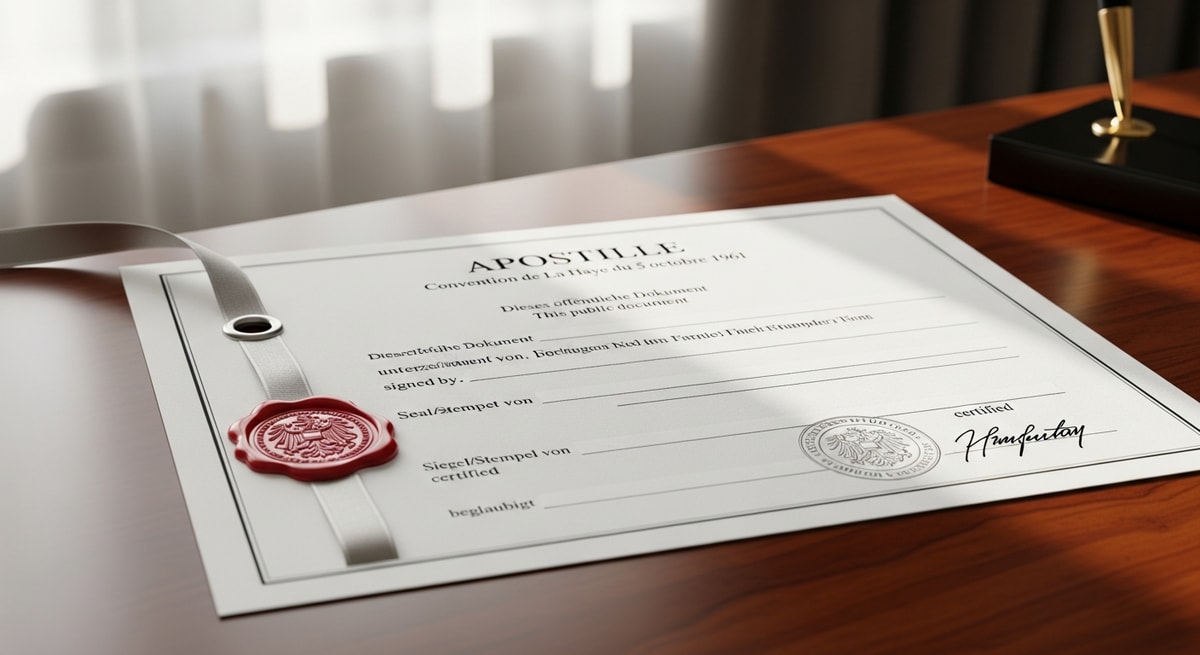
Austrian apostilles and e-Apostilles authenticate documents for acceptance in 125+ countries
"Had my Austrian Geburtsurkunde and Staatsbürgerschaftsnachweis translated for a US green card application. USCIS accepted both translations without any RFE. The translator captured all the Austrian-specific terminology perfectly."
"Needed my Austrian Matura-Zeugnis and university diploma translated for WES credential evaluation in Canada. The translations were thorough and WES processed my evaluation without requesting any clarifications. Excellent turnaround time."
"Good translation of my Austrian Heiratsurkunde for a UK spouse visa application. The Home Office accepted it without issues. Would have liked express delivery to be faster, but the quality was very good overall."
"DoVisa translated my Austrian Strafregisterbescheinigung and birth certificate for an Australian skilled visa. The Department of Home Affairs accepted everything without questions. Very professional service from start to finish."
"Our company needed an Austrian Firmenbuchauszug and Gesellschaftsvertrag translated to English for a UK subsidiary registration. The corporate terminology was handled expertly and our solicitors had no issues with the translations at Companies House."
"Translated my Austrian divorce decree and birth certificate for an IRCC family sponsorship application in Canada. Both documents were accepted and my application moved forward without delays. Highly recommend DoVisa."
"The translation of my Austrian Dienstzeugnis was accurate but took one extra day beyond the standard delivery estimate. DoVisa apologized and the final product was correct. My New Zealand employer accepted it without issues, but the delay was inconvenient."
"Had three Austrian documents translated with apostille for use in the UAE. The whole process from upload to receiving the apostilled translations took about 12 days. Everything was accepted by the Ministry of Foreign Affairs in Abu Dhabi. Great coordination."
"Austrian university transcript and diploma translated for a job application in Singapore. The translations were detailed and preserved the grading system accurately. My employer's HR department verified and accepted them quickly."
"Moved from Vienna to Australia and needed my Geburtsurkunde, Meldebestätigung, and Strafregisterbescheinigung translated. All three translations were accepted by the Department of Home Affairs for my partner visa. Fast, affordable, and reliable."
"Needed my Austrian court judgment translated to English for enforcement proceedings in the United States. The legal terminology was handled with precision and our US attorney was impressed with the translation quality."
"Translation of my Austrian Partnerschaftsurkunde for a British visa application. The translation was accurate and the Home Office accepted it. Pricing was fair and the process was straightforward."
"Had my Austrian Geburtsurkunde and Staatsbürgerschaftsnachweis translated for a US green card application. USCIS accepted both translations without any RFE. The translator captured all the Austrian-specific terminology perfectly."
"Needed my Austrian Matura-Zeugnis and university diploma translated for WES credential evaluation in Canada. The translations were thorough and WES processed my evaluation without requesting any clarifications. Excellent turnaround time."
"Good translation of my Austrian Heiratsurkunde for a UK spouse visa application. The Home Office accepted it without issues. Would have liked express delivery to be faster, but the quality was very good overall."
Austrian Document Translation FAQs
What types of Austrian documents can be translated?
Do I need a sworn translator for Austrian documents?
How long does Austrian document translation take?
What languages can Austrian documents be translated into?
Are your translations accepted by USCIS and other immigration authorities?
What is an apostille and do I need one for my Austrian documents?
How much does certified translation of Austrian documents cost?
Can you translate handwritten Austrian documents?
What format will I receive my translation in?
Is there a difference between Austrian and German certified translations?
Can DoVisa coordinate an e-Apostille for Austrian documents?
What documents do I need for a credential evaluation of Austrian qualifications?
How do I verify an Austrian sworn translator's credentials?
Get Your Austrian Documents Translated Today
Professional certified translations of Austrian documents accepted by international authorities worldwide