

Certified Swiss Document Translation
Professional certified translations in all four Swiss national languages — German, French, Italian, and Romansh — accepted by the State Secretariat for Migration (SEM), cantonal authorities, Swiss courts, and universities. Notarized translations compliant with federal and cantonal requirements across all 26 cantons.
TrustpilotSelect Languages
Drag & drop your documents here
or
PDF, JPEG, PNG, WebP — Max 10MB per file. Word documents: please save as PDF first.
Certified translators · Accepted by governments, courts & universities worldwide · View sample
Select a destination country to view pricing
How Swiss Certified Translation Works
Submit Your Documents Securely
Upload clear scans of your Swiss or foreign-language documents through our encrypted portal. We accept all standard formats including PDF, JPEG, and PNG. Since Swiss documents may be issued in German, French, Italian, or Romansh depending on the canton of origin, our intake specialists identify the source language and verify legibility before translation begins. We handle multilingual Swiss documents that contain text in more than one official language.
Professional Translator Assignment
Your documents are matched with a qualified translator experienced in the specific document type and the relevant Swiss language region. For translations between Swiss official languages (e.g., German to French for intercantonal use), we assign translators with expertise in Swiss administrative terminology. For international language pairs, we select translators familiar with Swiss document formats, which differ from their German, French, or Italian counterparts in terminology and structure.
Translation with Certification
The assigned translator produces your certified translation with a formal declaration of accuracy (Vollständigkeitserklärung / déclaration de fidélité / dichiarazione di conformità), their professional credentials, signature, and date. A second qualified linguist reviews the translation for terminology accuracy, proper rendering of Swiss legal terms and proper nouns, and completeness. For official use in Switzerland, the translation can be notarized by a Swiss Notar or notaire to give it full legal force before cantonal and federal authorities.
Delivery with Full Certification
Receive your certified translation as a high-resolution PDF for immediate use, with the original signed hard copy shipped to your address via tracked Swiss Post or international courier. For documents requiring notarization, DoVisa coordinates the process through our network of notaries across all Swiss language regions. For international use, apostille certification can be arranged through the Federal Chancellery (Bundeskanzlei) or the relevant cantonal Staatskanzlei.
Swiss Translation Service Specifications
Popular Language Pairs
We support all languages — 100+ language pairs available for Swiss documents, including translations between Switzerland's four official languages.
Common Documents
- Swiss birth certificates (Geburtsurkunde / acte de naissance / atto di nascita)
- Marriage certificates (Heiratsurkunde / acte de mariage / atto di matrimonio)
- Divorce decrees (Scheidungsurteil / jugement de divorce / sentenza di divorzio)
- Academic diplomas and transcripts (Diplom / diplôme / diploma)
- Swiss criminal record extract (Strafregisterauszug / extrait du casier judiciaire / estratto del casellario giudiziale)
- Residence permits (Aufenthaltsbewilligung / permis de séjour / permesso di dimora)
- Employment references (Arbeitszeugnis / certificat de travail / certificato di lavoro)
- Notarial deeds (Notarielle Urkunde / acte notarié / atto notarile)
- Commercial register extracts (Handelsregisterauszug / extrait du registre du commerce / estratto del registro di commercio)
- Swiss certificates of origin (Heimatschein / acte d'origine / attestato di origine)
Turnaround Time
Certification Details
Swiss Translation Requirements & Regulatory Framework
Embassy Acceptance
Notarization Process
Apostille Information
Legal Framework
Common Scenarios for Swiss Document Translation
Residence Permits & Naturalization Applications
Foreign nationals applying for Swiss residence permits (Aufenthaltsbewilligung B / permis de séjour B) or settlement permits (Niederlassungsbewilligung C / permis d'établissement C) must submit certified translations of their personal documents to cantonal migration offices. Naturalization applications require an even more comprehensive set: birth certificates, marriage certificates, police clearances from every country of residence, academic credentials, and employment documentation — all translated into the official language of the applicant's canton of residence. The State Secretariat for Migration (SEM) reviews federal-level applications, while cantonal authorities handle ordinary naturalization. DoVisa provides translations formatted specifically for SEM and all 26 cantonal migration offices.
Marriage Registration at the Zivilstandsamt
Foreign nationals marrying in Switzerland must submit certified translations of their birth certificate (Geburtsurkunde / acte de naissance), single-status certificate (Ledigkeitszeugnis / certificat de célibat), passport, and any prior divorce decrees to the local Zivilstandsamt (office de l'état civil / ufficio dello stato civile). Documents must be translated into the official language of the canton where the marriage will take place. Each Zivilstandsamt may have specific requirements regarding translation format and certification, and our translators are experienced with the variations across Swiss cantons and language regions.
University Admission & Credential Recognition
Swiss universities and SWISSUNIVERSITIES require certified translations of foreign academic transcripts, diplomas, and secondary school certificates. The State Secretariat for Education, Research and Innovation (SERI/SBFI) handles professional credential recognition and mandates certified translations. For ETH Zurich, EPFL, the University of Zurich, and other leading institutions, translations must be into one of Switzerland's official languages or English, depending on the program. Our academic translators understand the Swiss grading system equivalencies and use terminology that credential evaluators at Swiss institutions expect.
Company Formation & Handelsregister Filings
Foreign entrepreneurs establishing a GmbH (Sàrl/Sagl), AG (SA/SA), or other business entities in Switzerland must provide certified translations of their identity documents, proof of address, corporate documents from their home country, and shareholder resolutions. These translations are submitted to the Notar handling the company formation and subsequently filed with the Handelsregister (registre du commerce / registro di commercio) at the cantonal commercial registry office. Switzerland's business-friendly environment attracts international entrepreneurs, and our corporate translators are fluent in Swiss commercial law terminology across all three main languages.
Family Reunification & Visa Applications
Spouses, children, and parents of Swiss residents or citizens applying for family reunification must present certified translations of birth certificates, marriage certificates, custody agreements, and financial support declarations to Swiss representations abroad or directly to cantonal migration offices. SEM case officers review these translations during the approval process. Documents must be translated into the official language of the canton where the sponsor resides — German for Zurich, French for Geneva, Italian for Ticino. Our translations meet the requirements of Swiss consular sections worldwide.
Cross-Cantonal Legal Proceedings
Switzerland's multilingual court system means that legal documents issued in one language region often require certified translation for proceedings in another region. A court judgment from the Tribunal cantonal in Lausanne (French) needed for enforcement in Zurich (German) requires certified translation under the ZPO. Similarly, international litigation involving Swiss parties requires translation of foreign court documents into the relevant cantonal language. Our legal translation team handles complex Swiss procedural and substantive law terminology across all official languages, ensuring accurate translations for proceedings from Bezirksgericht through Bundesgericht level.
Switzerland's Unique Multilingual Translation Landscape
Switzerland's four official languages — German, French, Italian, and Romansh — create a translation landscape unlike any other country in Europe. With 26 cantons operating in different language regions, document translation in Switzerland serves not only international purposes but also critical domestic intercantonal functions. A birth certificate issued in Lugano (Italian-speaking Ticino) needs certified translation into German for use in Zurich, or into French for proceedings in Geneva. This intercantonal dimension makes translation a fundamental part of Switzerland's legal and administrative infrastructure.
Unlike Germany, which has a nationwide system of court-appointed sworn translators (beeidigte Übersetzer), Switzerland takes a more decentralized approach consistent with its federal structure. In most cantons, certified translations are produced by qualified professional translators whose work is then notarized by a cantonal Notar (German-speaking cantons), notaire (French-speaking cantons), or notaio (Italian-speaking cantons). The notary authenticates the translator's identity and signature, giving the translation official legal status. Only the cantons of Geneva and Neuchâtel maintain formal registers of sworn translators (traducteurs assermentés) who can directly certify translations with court-recognized authority.
This cantonal variation means that understanding which certification format is required by the specific receiving authority is essential. A translation destined for a Zurich Migrationsamt may need different notarization than one for the Service de la population in Vaud. DoVisa maintains expertise across all 26 cantons and all four language regions, ensuring your translation carries the correct certification for its intended recipient. Our network includes notaries and, where applicable, sworn translators in every major Swiss city.

The Bundeshaus in Bern houses Switzerland's multilingual federal administration operating in German, French, and Italian
Apostille and Legalization for Swiss Documents
Switzerland acceded to the Hague Apostille Convention on 10 January 1973, making it one of the earlier European signatories. An apostille is a standardized certificate that authenticates the origin of a public document for use in another Convention member state. Switzerland's federal structure means that apostille competence is shared between federal and cantonal authorities. The Federal Chancellery (Bundeskanzlei / Chancellerie fédérale) in Bern handles apostilles for federal documents such as federal diplomas, patents, and documents issued by federal authorities. For all other documents — including notarized translations, cantonal court decisions, civil registry documents, and notarial deeds — the cantonal Staatskanzlei (chancellerie d'État / cancelleria dello stato) of the canton where the document was issued or notarized is the competent authority.
The apostille process for a certified translation in Switzerland typically follows these steps: a qualified translator produces the certified translation, the translation is notarized by a cantonal notary, and the notarized translation is then submitted to the relevant cantonal Staatskanzlei for apostille issuance. The Staatskanzlei verifies the notary's appointment and signature before issuing the apostille. The cost ranges from CHF 15 to CHF 30 (approximately EUR 15-28) depending on the canton, with processing times of 3-7 business days. For documents destined for countries that are not Apostille Convention members, a full legalization process through the Swiss Federal Department of Foreign Affairs (EDA/DFAE) and the destination country's embassy in Switzerland is required.
DoVisa manages the complete apostille process for Swiss documents. We identify the correct competent authority — whether the Federal Chancellery or the specific cantonal Staatskanzlei — prepare and submit the apostille application, track processing, and deliver the apostilled document to your address. Our experience across all 26 cantons allows us to navigate the minor procedural differences that exist between cantonal chancelleries, ensuring efficient processing regardless of where your document originates.
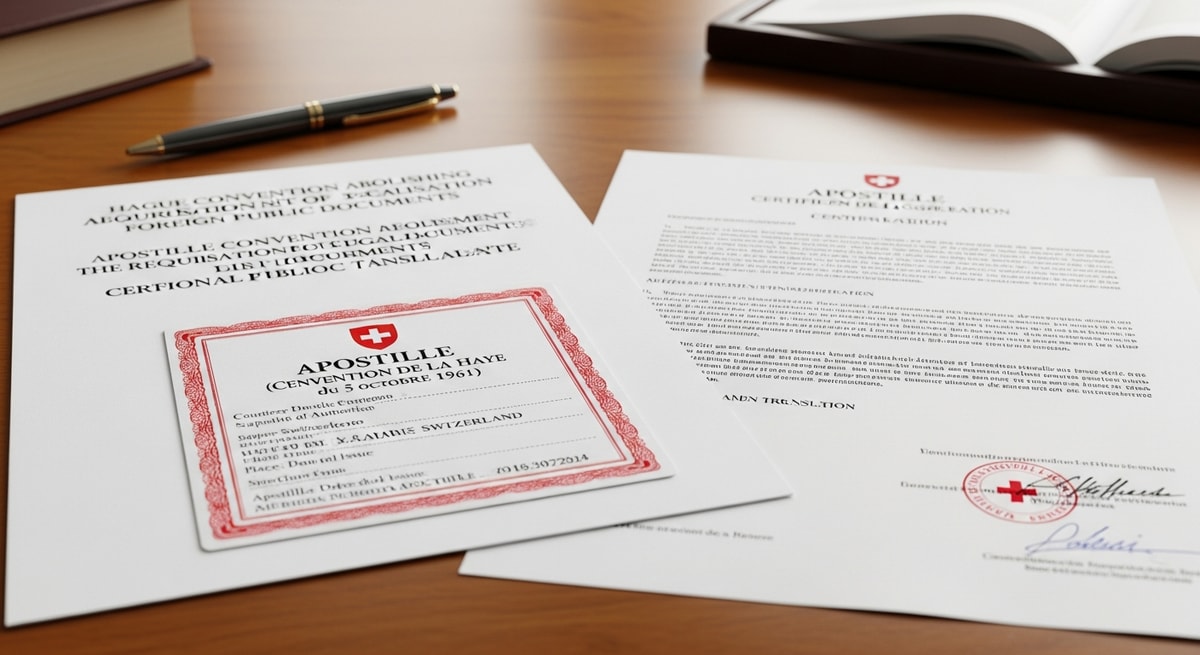
Swiss apostilles are issued by the Federal Chancellery or cantonal Staatskanzlei for international document recognition
Navigating Swiss Cantonal Document Requirements
Switzerland's 26 cantons each maintain their own administrative procedures, and document requirements for translated materials can vary significantly between cantons and language regions. The Zivilstandsamt (office de l'état civil / ufficio dello stato civile) in a German-speaking canton like Zurich or Bern will expect translations in German with specific formatting conventions, while the same type of office in Lausanne or Geneva will require French-language translations following Romandie administrative standards. Ticino's uffici dello stato civile operate entirely in Italian.
For immigration matters, each canton's Migrationsamt (office de la population / ufficio della migrazione) processes residence permit and settlement permit applications with its own procedural preferences. The Migrationsamt des Kantons Zürich, the Service de la population du canton de Vaud, and the Sezione della popolazione e delle migrazioni del Cantone Ticino all accept certified translations, but formatting expectations and supplementary documentation requirements may differ. For federal-level immigration decisions, the State Secretariat for Migration (SEM) accepts documents in any of the three main official languages.
For professional recognition, the State Secretariat for Education, Research and Innovation (SERI/SBFI) coordinates the recognition of foreign professional qualifications across Switzerland. Medical professionals apply through MEBEKO (the Swiss Medical Profession Commission), engineers through the relevant cantonal authority, and legal professionals through cantonal bar admission bodies. Each recognition pathway has specific translation requirements. DoVisa's specialized translators produce translations using the Swiss professional terminology that recognition assessors expect, whether the documents are submitted in German, French, or Italian. We have particular expertise in medical, engineering, financial, and academic credential translations for the Swiss recognition process.

Swiss cantons like Zurich maintain their own administrative procedures requiring translations in the cantonal official language
"Indian university transcripts and degree translated into German for a job application in Zurich. DoVisa delivered in 3 days and the Migrationsamt des Kantons Zürich accepted everything. The translator handled Swiss German administrative terminology correctly. Highly recommend."
"Had my birth certificate and marriage certificate translated from English to French for the Service de l'état civil in Lausanne. The notarized translations were perfectly formatted and accepted immediately. DoVisa understood the specific requirements for Vaud canton. Excellent service."
"German-to-Italian translation of employment contracts for filing with the Ufficio della migrazione in Bellinzona. Good quality translation that captured all the legal terminology. Took the full 5 days for standard delivery — would have preferred it faster, but the quality was solid."
"Japanese birth certificate and university diploma translated into French for EPFL admission. The translator understood both Japanese academic documents and Swiss university requirements perfectly. EPFL processed my application without any follow-up questions. Thank you DoVisa!"
"Needed my Geburtsurkunde from canton Bern translated to English with apostille for a US immigration case. DoVisa handled the translation, notarization, and apostille through the Staatskanzlei des Kantons Bern seamlessly. USCIS accepted everything. The whole process took 10 days including apostille."
"French divorce judgment from the Tribunal de Genève translated into German for remarriage at the Zivilstandsamt in Basel. The translator was experienced with Swiss legal documents and cross-cantonal requirements. Accepted on first submission."
"SEM required certified translations of my police clearances from India and the UK for naturalization. Both were well done and accepted by the cantonal migration office in Bern. Four stars because I had to ask for a formatting correction, but fixed same day."
"Our company needed Swiss GmbH formation documents — Gesellschaftsvertrag, Handelsregisterauszug, and Vollmachten — translated from German to English for our UK parent company. The corporate legal terminology was impeccable. Our London solicitors used them for due diligence without any issues."
"Translated my Swiss Arbeitszeugnis and diplomas from French to English for a job application in Canada. The translator preserved all the nuances of the Swiss certificat de travail format. IRCC accepted the translations for my Express Entry PR application. Very professional service."
"Italian-to-German translation of my atto di nascita from Ticino for use in Zurich. Accurate but initially certified with the wrong notarization format. DoVisa had a Zurich-based notary redo the certification within 48 hours. Final result was fine but the initial error was frustrating."
"Had to translate a German court judgment from Munich for enforcement proceedings at the Bezirksgericht Zürich. DoVisa's legal translator handled the complex procedural terminology expertly and delivered within the 48-hour express window. The court accepted the translation without any objections."
"Moroccan birth certificate and marriage certificate translated into French for the Service de la population in canton Vaud. The translator knew both Moroccan documents and Swiss requirements well. Notarization arranged in Lausanne. Accepted on first submission."
"Indian university transcripts and degree translated into German for a job application in Zurich. DoVisa delivered in 3 days and the Migrationsamt des Kantons Zürich accepted everything. The translator handled Swiss German administrative terminology correctly. Highly recommend."
"Had my birth certificate and marriage certificate translated from English to French for the Service de l'état civil in Lausanne. The notarized translations were perfectly formatted and accepted immediately. DoVisa understood the specific requirements for Vaud canton. Excellent service."
"German-to-Italian translation of employment contracts for filing with the Ufficio della migrazione in Bellinzona. Good quality translation that captured all the legal terminology. Took the full 5 days for standard delivery — would have preferred it faster, but the quality was solid."
Swiss Document Translation FAQs
Does Switzerland have sworn translators like Germany?
Switzerland does not have a nationwide sworn translator system like Germany. In most of Switzerland's 26 cantons, certified translations are produced by qualified professional translators and then notarized by a cantonal notary public (Notar / notaire / notaio) to give them legal force. The notary authenticates the translator's identity and signature. However, the cantons of Geneva and Neuchâtel are exceptions — they maintain formal registers of sworn translators (traducteurs assermentés) who are registered with cantonal courts and can directly certify translations without separate notarization. DoVisa can provide translations through either pathway depending on which canton's authority will receive your documents.
Which language should my translation be in for Swiss authorities?
Your translation must be in the official language of the canton where the receiving authority is located. German-speaking cantons (Zurich, Bern, Basel, Lucerne, St. Gallen, etc.) require German translations. French-speaking cantons (Geneva, Vaud, Neuchâtel, etc.) require French. Italian-speaking Ticino requires Italian. Bilingual cantons like Bern, Fribourg, and Valais may accept documents in either of their official languages. The trilingual canton of Graubünden accepts German, Italian, or Romansh depending on the municipality. Federal authorities such as the SEM (State Secretariat for Migration) accept documents in German, French, or Italian. DoVisa ensures your translation is in the correct language for the intended recipient.
How much does certified translation cost for Swiss documents?
Our Swiss certified translation pricing follows a transparent per-page structure with volume discounts that apply automatically for larger documents. Pricing varies based on document length, language pair, and the processing speed you select. Translations between Swiss official languages (e.g., German to French) and translations involving English are our most common pairs. Express and rush service options are available for time-sensitive projects. Notarization by a Swiss notary and apostille processing through the Federal Chancellery or cantonal Staatskanzlei are quoted separately. Upload your documents on our order page to receive an instant, detailed quote before work begins — no hidden fees.
Can I use a translation notarized in one canton in another canton?
Generally, yes. A translation notarized by a licensed notary in any Swiss canton is recognized across Switzerland, as the notary's authority derives from cantonal law but is respected federally. However, some receiving authorities may prefer or specifically request notarization by a notary in their own canton or language region. For example, a Zurich Zivilstandsamt may prefer a translation notarized by a Zurich-based Notar rather than one notarized in Geneva. In practice, cross-cantonal acceptance is the norm, but DoVisa can arrange notarization in the specific canton of the receiving authority when requested to avoid any potential issues.
What documents do I need translated for Swiss naturalization?
Swiss naturalization (Einbürgerung / naturalisation / naturalizzazione) requires a comprehensive set of translated documents. The standard package includes: your birth certificate, marriage certificate (if applicable), divorce decree (if applicable), police clearance certificates from every country where you have resided, academic and professional certificates, current employment documentation, and proof of identity. All documents must be translated into the official language of your canton of residence. Ordinary naturalization requires a C settlement permit and at least 10 years of residence. Requirements vary by canton and municipality — some communes require additional documents or conduct interviews. DoVisa offers a naturalization translation package at a bundled rate.
How does the apostille process work in Switzerland?
Switzerland's apostille process involves two types of competent authorities. For federal documents (federal diplomas, patents, federal court decisions), the Federal Chancellery (Bundeskanzlei) in Bern issues the apostille. For cantonal documents (notarized translations, cantonal court decisions, civil registry documents), the Staatskanzlei (chancellerie d'État) of the relevant canton issues the apostille. The process typically involves submitting the document with a completed application form and the fee of CHF 15-30. Processing takes 3-7 business days depending on the canton. You can visit in person without an appointment or send documents by post. DoVisa handles the entire process, identifying the correct authority and tracking your application to completion.
Do Swiss universities accept translations in English?
Many Swiss universities accept academic documents in English in addition to Switzerland's official languages, particularly for international programs and master's/doctoral programs taught in English. ETH Zurich, EPFL, the University of Zurich, and the University of Geneva generally accept English-language certified translations. However, some undergraduate programs and cantonal universities may require translations in the specific language of instruction. The SWISSUNIVERSITIES admissions guidelines specify accepted languages for each institution. DoVisa recommends checking with the specific university's admissions office and can provide translations in any required language.
What if the canton's Migrationsamt rejects my translation?
DoVisa offers an acceptance guarantee for all Swiss certified translations. If a Migrationsamt, Zivilstandsamt, court, or other Swiss authority rejects our translation due to a formatting, terminology, or certification issue, we will revise and reissue the translation at no additional cost within 24 hours. In our experience, rejections are extremely rare and typically relate to individual cantonal office preferences rather than translation errors. Some offices request specific supplementary information or alternative notarization formats. When this occurs, our translators promptly adjust the document to meet the particular office's expectations. If a revision does not resolve the issue, we provide a full refund.
How do you handle translations between Swiss official languages?
Intercantonal translations between Swiss official languages — such as German to French, French to Italian, or Italian to German — are one of our core specialties. These translations serve the daily functioning of Switzerland's multilingual administration. Our translators for these pairs are native speakers of the target language with deep familiarity with Swiss-specific terminology, which differs from standard German (Hochdeutsch), metropolitan French, and standard Italian. Swiss German administrative terms like Gemeinde, Kanton, and Zivilstandsamt have specific French and Italian equivalents (commune, canton, office de l'état civil) that our translators use consistently. We also handle the less common Romansh language pairs for documents from Graubünden.
Are digital PDF translations accepted by Swiss authorities?
Acceptance of digital translations varies across Swiss cantons and authorities. Some cantonal offices, particularly in digitally advanced cantons like Zurich and Zug, increasingly accept high-quality PDF scans of notarized translations for preliminary review and processing. However, many authorities still require the physical original with the notary's wet-ink stamp and signature for final submission. SEM and most Zivilstandsämter generally request original hard copies for official filings. DoVisa provides both the certified PDF for immediate digital use and the physical original shipped via tracked Swiss Post (within Switzerland) or international courier. We recommend having the physical original available for in-person appointments.
Can DoVisa translate Swiss Arbeitszeugnisse (employment references)?
Yes, and Swiss Arbeitszeugnisse (certificats de travail / certificati di lavoro) require specific translation expertise. Like their German counterparts, Swiss employment references use a coded language system where carefully worded phrases carry specific performance implications. A Swiss Arbeitszeugnis stating 'stets zu unserer vollsten Zufriedenheit' or 'a toujours donné entière satisfaction' signals top performance. Our translators preserve these nuances and, when requested, provide explanatory notes about the Swiss reference convention. This is especially valuable for Swiss professionals relocating to English-speaking countries where the coded reference system is unfamiliar to hiring managers.
Do I need original documents or are copies sufficient?
For the translation process itself, clear digital scans or photographs are sufficient. Our translators work from the digital copies you upload through our secure portal. However, the receiving Swiss authority may require you to present the original document alongside the certified translation during your appointment. For apostille purposes, the cantonal Staatskanzlei or Federal Chancellery may request to see the original document. Some Swiss Zivilstandsämter specifically require original documents with apostille or legalization from the issuing country. We recommend keeping your originals safe and accessible for in-person appointments at Swiss authorities, even though the translation process only requires digital copies.
Get Your Swiss Certified Translation Today
Professional certified translations in German, French, Italian, and Romansh — accepted by every Swiss authority, court, and institution across all 26 cantons