Certified Danish Document Translation
Professional translations for Danish documents issued by Danish civil authorities, Udlændingestyrelsen, and Familieretshuset. Accepted by Danish and international authorities, embassies, and credential evaluation agencies worldwide.
TrustpilotSelect Languages
Drag & drop your documents here
or
PDF, JPEG, PNG, WebP — Max 10MB per file. Word documents: please save as PDF first.
Certified translators · Accepted by governments, courts & universities worldwide · View sample
Select a destination country to view pricing
How Danish Certified Translation Works
Submit Your Documents Securely
Upload clear scans of your Danish documents through our encrypted portal. We accept PDF, JPEG, and PNG formats. Our intake specialists review each upload for legibility, checking that Danish-specific elements such as CPR-nummer (civil registration number), official stamps from Folkekirken (the Danish National Church), and municipal seals are clearly visible before translation begins.
Translator Assignment
Your documents are matched with a qualified translator experienced in Danish official documents and civil registration terminology. Our translators understand Danish administrative language, including terms specific to the CPR (Det Centrale Personregister) system, Folkekirken parish records, and documents from Familieretshuset (the Agency of Family Law). Each translator is selected based on the document type and target language for your specific submission.
Translation & Certification
The translator produces your certified translation with a signed certification statement attesting to accuracy and completeness. Danish documents such as fødselsattester, vielsesattester, and straffeattester contain specific civil registration terminology and CPR-nummer formatting that requires specialist knowledge. A second qualified linguist reviews the translation for terminology, formatting, and accuracy before certification is finalized.
Delivery with Full Certification
Receive your certified translation as a high-resolution PDF for immediate use, with the original signed hard copy shipped via tracked PostNord or international courier. If apostille certification is needed for use in another Hague Convention member state, DoVisa coordinates the full apostille process through the Udenrigsministeriet (Ministry of Foreign Affairs) Legalisation Office, delivering the complete apostilled package to your address.
Danish Translation Service Specifications
Popular Language Pairs
We support all languages — 100+ language pairs available for Danish documents.
Common Documents
- Birth certificates (fødselsattest / fødsels- og dåbsattest)
- Marriage certificates (vielsesattest)
- Divorce decrees (skilsmissebevilling)
- Personal data certificates (personattest)
- Criminal record certificates (straffeattest)
- Academic diplomas and transcripts (eksamensbevis)
- Employment references and contracts (ansættelseskontrakt)
- Driving licenses (kørekort)
- Court judgments and legal documents (domstolsafgørelser)
- Corporate registration extracts from Erhvervsstyrelsen
Turnaround Time
Certification Details
Danish Translation Requirements & Regulatory Framework
Embassy Acceptance
Notarization Process
Apostille Information
Legal Framework
Common Scenarios for Danish Document Translation
Immigration & Visa Applications
Foreign nationals applying for residence and work permits in Denmark through Udlændingestyrelsen or SIRI need certified translations of their documents into Danish or English. Similarly, Danish nationals emigrating abroad need certified translations of their fødselsattester, straffeattester, and other civil documents. DoVisa certified translations are accepted by USCIS, UK Visas and Immigration, IRCC, and the Australian Department of Home Affairs, as well as by Danish immigration authorities for incoming applications.
Marriage & Family Documentation
Couples involving a Danish national marrying abroad or registering a foreign marriage in Denmark through Familieretshuset need certified translations of vielsesattester (marriage certificates), personattester, and related family documents. Denmark's popular wedding tourism from non-EU couples also generates translation needs for supporting documents submitted to Danish municipal authorities for prøvelsesattest (certificate of marital capacity) issuance.
University Admission & Credential Evaluation
Danish academic documents including eksamensbevis (degree certificates), karakterudskrifter (transcripts), and gymnasiebevis (upper secondary school diplomas) require certified translation for foreign university admissions and credential evaluations. Organizations such as WES, ECE, and NACES members accept DoVisa certified translations. Our academic translators understand the Danish 7-trins-skala (7-point grading scale) and ECTS credit equivalencies used in Danish higher education.
Corporate & Business Filings
Danish companies expanding internationally or foreign companies registering in Denmark need certified translations of corporate documents from Erhvervsstyrelsen (the Danish Business Authority), including registreringsbevis (company registration extracts), vedtægter (articles of association), årsrapporter (annual reports), and board resolutions. Our corporate translators handle Danish commercial terminology including references to aktieselskab (A/S), anpartsselskab (ApS), and interessentskab (I/S) structures.
Legal Proceedings & Court Documents
Cross-border litigation and international legal matters require certified translations of Danish court documents including byretsdommer (district court judgments), landsretsdommer (high court decisions), and fogedretskendelser (bailiff court orders). Our legal translators maintain accuracy with Danish procedural terminology and ensure translations are formatted for acceptance by foreign courts under EU judicial cooperation frameworks and the Lugano Convention.
Denmark's Civil Registration System and the CPR
Translating Danish civil documents requires specialist knowledge of Denmark's centralized registration system built around the CPR (Det Centrale Personregister). Established by the CPR Act of 1968, every person residing in Denmark receives a unique 10-digit CPR-nummer (civil registration number) in the format DDMMYY-XXXX, where the first six digits represent the date of birth and the last four are sequence digits that also encode the century of birth and gender. The CPR-nummer appears on virtually every official Danish document and must be correctly formatted in all translations.
Danish civil registration certificates come in several forms that translators must distinguish carefully. The fødselsattest (birth certificate) or fødsels- og dåbsattest (birth and baptism certificate) is issued by the Folkekirken (Danish National Church) parish for individuals baptized in the church, or by the municipal civil registration office (personregisterføreren) for those who are not members. Since 2002, the personattest (personal data certificate) has replaced many functions of the traditional birth certificate, providing an extract from the CPR showing name, date of birth, civil status, and parentage. The vielsesattest (marriage certificate) is issued either by the municipality for civil marriages or by the Folkekirken for church weddings, while skilsmissebevilling (divorce decrees) are issued by Familieretshuset (the Agency of Family Law).
A distinctive feature of the Danish system is the role of the Folkekirken in civil registration. Until 2017, the Evangelical Lutheran Church of Denmark served as the official civil registration authority for all births, marriages, and deaths in its parish areas — even for non-members. Although civil registration has been progressively transferred to the municipalities and the digital personregistrering.dk system, many older documents still bear Folkekirken parish stamps and handwritten entries in older Danish orthographic forms. Our translators are experienced with both modern digitally issued Danish documents and historical parish records requiring knowledge of older Danish spelling conventions and ecclesiastical terminology.
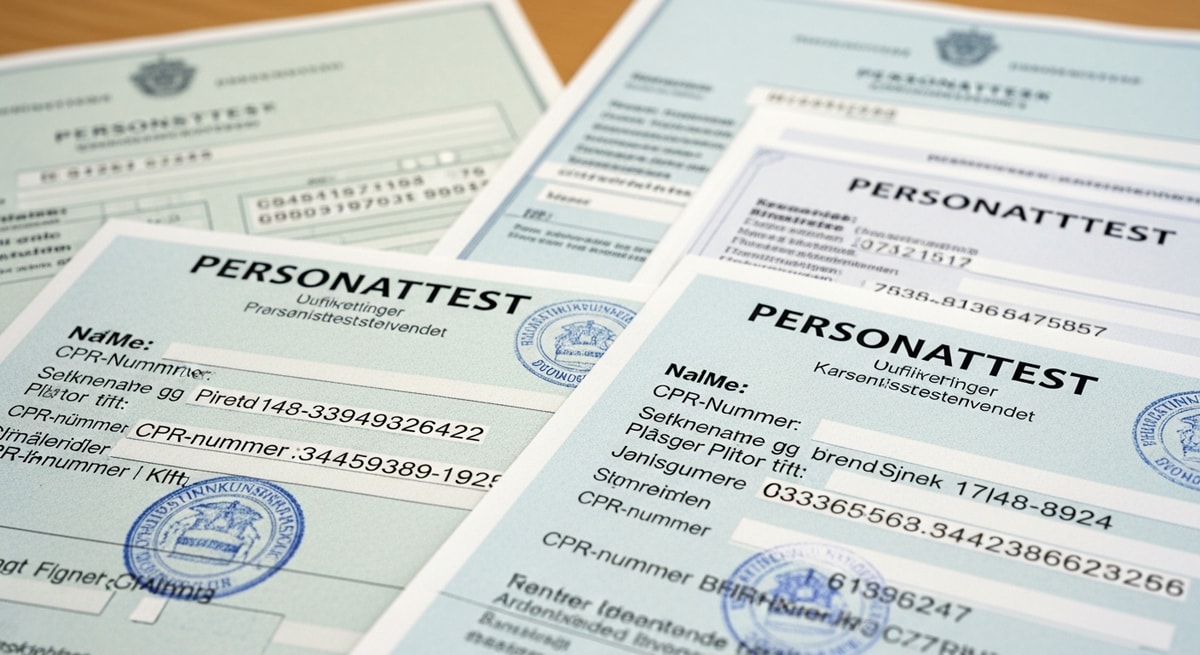
Denmark's CPR system underpins all civil documentation, requiring precise formatting in translations
Apostille and Authentication for Danish Documents
Denmark acceded to the Hague Apostille Convention on 30 October 2006, with the convention entering into force on 29 December 2006. This means Danish public documents bearing an apostille are recognized in all 125+ Convention member states without further legalization. Unlike Sweden's decentralized system of Notaries Public, Denmark has a single centralized competent authority: the Legalisation Office (Legaliseringskontoret) of the Udenrigsministeriet (Ministry of Foreign Affairs), located at Asiatisk Plads 2 in Copenhagen.
The apostille process for certified translations follows a specific chain. First, the certified translation must be produced and signed by the translator. Then, a Danish notar (notary at the local byretten, or district court) verifies the translator's identity and certifies the signature. Finally, the notarized translation is submitted to the Legalisation Office, which affixes the apostille. The fee is 250 DKK per document. Personal applications are accepted Monday through Friday from 9:00 to 12:00, and on Tuesdays and Thursdays from 13:30 to 15:30. Postal applications are also accepted and typically processed within 5-7 business days.
Denmark also offers an e-Apostille service for documents bearing a certified digital signature. Specifically, criminal record certificates (straffeattester) from the National Police and certain transcripts from the Erhvervsstyrelsen (Danish Business Authority) can be uploaded directly through the Ministry's webshop and endorsed with an electronic apostille, which can be downloaded immediately. This makes Denmark one of the relatively few countries offering digital apostille processing. For documents destined for countries that are not Hague Convention members, full consular legalization through the Udenrigsministeriet and the destination country's embassy in Denmark is required instead. DoVisa manages the entire authentication workflow, whether physical apostille, e-Apostille, or full consular legalization.
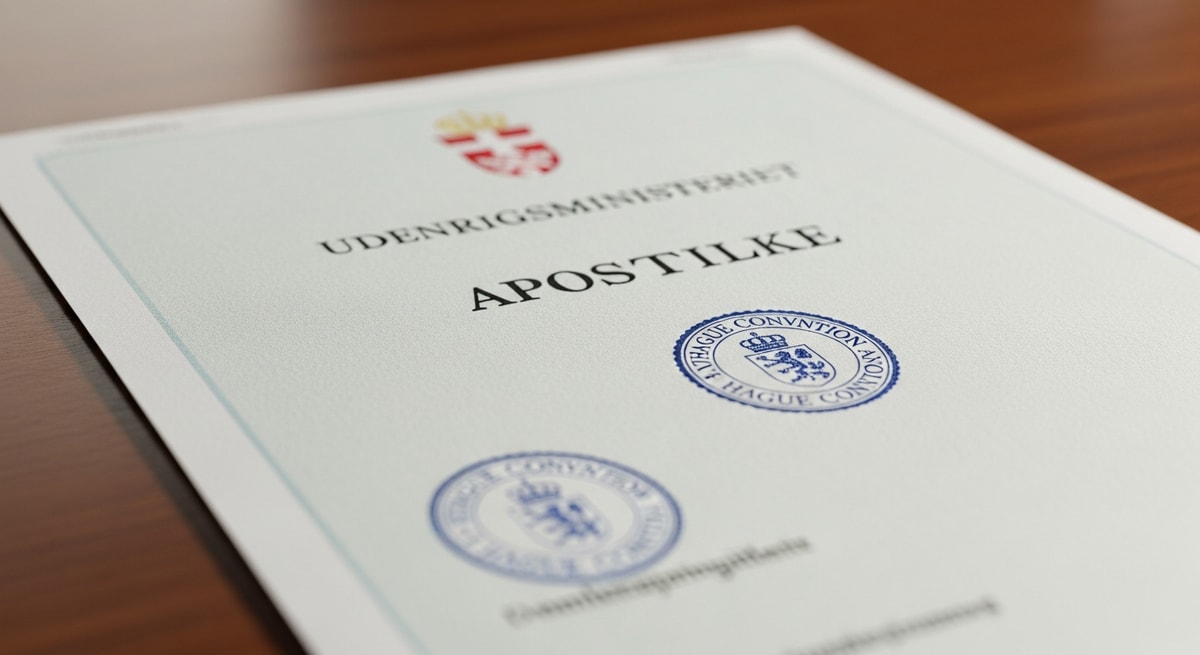
The Udenrigsministeriet Legalisation Office is Denmark's sole competent authority for apostilles
Denmark's Post-2016 Translation Landscape
Denmark's translation landscape underwent a significant change on 1 January 2016 when the 1966 Lov om translatører og tolke (Act on State-Authorized Translators and Interpreters) was repealed. Before the repeal, the title statsautoriseret translatør (state-authorized translator) was a legally protected designation granted by the Erhvervsstyrelsen (Danish Business Authority) to individuals who passed a rigorous state examination. The repeal removed this state authorization, meaning Denmark no longer has a government-regulated sworn translator system comparable to Germany's beeidigte Übersetzer or France's traducteur assermenté.
In response to the abolition, the Translatørforeningen (Danish Association of Certified Translators and Interpreters, known internationally as DACTI), founded in 1910, established its own private certification scheme to maintain professional standards. DACTI-certified translators must hold a Master's degree in languages and pass the association's professional examination, or hold a Master's in another relevant field with at least five years of professional translation experience. Certified members are authorized to use DACTI's official stamp bearing the Danish royal crown, which serves as a quality mark recognized by Danish authorities and institutions.
This deregulation has practical implications for individuals needing certified translations of Danish documents. Unlike in countries with mandatory sworn translator systems, Danish authorities generally accept certified translations from qualified professional translators accompanied by a signed declaration of accuracy — the translator does not need to hold a specific state-issued license. This makes the process more flexible while maintaining quality through the DACTI certification framework. For international use requiring apostille authentication, the same two-step process applies regardless of the translator's affiliation: notarization of the translator's signature by a Danish notar (notary at the byretten), followed by apostille from the Udenrigsministeriet. DoVisa's certified translations meet these standards and are accepted by both Danish and international authorities.
DACTI maintains professional standards for Danish translators following the 2016 deregulation
"Needed my Danish fødselsattest and straffeattest translated to English for a USCIS green card application. The translator handled all the CPR-nummer formatting perfectly. USCIS accepted everything without a request for evidence."
"DoVisa translated my Danish university eksamensbevis and karakterudskrift for WES credential evaluation in Canada. The translator correctly rendered the 7-point grading scale and ECTS credits. WES processed my evaluation without issues."
"Good translation of my Danish vielsesattest for a UK spouse visa application. The Home Office accepted it promptly. Delivery took the full 6 days on standard processing but was within the quoted timeframe."
"Translated my Danish personattest and police clearance for an Australian skilled worker visa. The Department of Home Affairs accepted both without queries. The apostille from the Udenrigsministeriet was coordinated seamlessly by DoVisa."
"Our company needed Danish vedtægter and registreringsbevis from Erhvervsstyrelsen translated for establishing a subsidiary in Germany. The corporate terminology was handled expertly. Highly professional service."
"Danish court judgment translated to English for legal proceedings in the United States. The legal terminology was accurate throughout and the US attorney confirmed it met all requirements. Delivered on time at 4 business days."
"Danish-to-Arabic translation of my personattest and vielsesattest for use in the UAE. The translator understood Danish civil registration terminology and Arabic legal conventions. Accepted by the UAE Ministry of Foreign Affairs without issues."
"My Danish fødsels- og dåbsattest translation had a minor error in the parish name romanization. DoVisa corrected it within a few hours and the revised translation was accepted by IRCC for my Canadian PR application. Quick fix but the error was avoidable."
"Translated three Danish ansættelseskontrakter to English for a work visa application in New Zealand. Immigration New Zealand accepted all three without any issues. Fast turnaround and accurate employment terminology throughout."
"Danish academic transcripts from Aarhus University translated to French for credential evaluation in Belgium. The translator accurately converted the Danish grading scale. The evaluation body accepted everything on first submission."
"DoVisa handled translation and e-Apostille coordination for my Danish straffeattest needed for a job application in Spain. The digital apostille process through the Udenrigsministeriet webshop was explained clearly and the turnaround was remarkably fast."
"Needed my Danish skilsmissebevilling from Familieretshuset translated for remarriage proceedings in Italy. The translator accurately rendered all the family law terminology. The Italian comune accepted the apostilled translation immediately."
"Needed my Danish fødselsattest and straffeattest translated to English for a USCIS green card application. The translator handled all the CPR-nummer formatting perfectly. USCIS accepted everything without a request for evidence."
"DoVisa translated my Danish university eksamensbevis and karakterudskrift for WES credential evaluation in Canada. The translator correctly rendered the 7-point grading scale and ECTS credits. WES processed my evaluation without issues."
"Good translation of my Danish vielsesattest for a UK spouse visa application. The Home Office accepted it promptly. Delivery took the full 6 days on standard processing but was within the quoted timeframe."
Danish Document Translation FAQs
What types of Danish documents can be translated?
We translate all types of Danish documents including fødselsattester (birth certificates), fødsels- og dåbsattester (birth and baptism certificates), vielsesattester (marriage certificates), skilsmissebevillinger (divorce decrees), personattester (personal data certificates), straffeattester (criminal record certificates), academic diplomas and transcripts (eksamensbevis and karakterudskrift), employment contracts, court judgments, corporate documents from Erhvervsstyrelsen, and all other official Danish documents. All translations are certified and accepted by Danish and international authorities.
Are the translations certified and accepted by Danish authorities?
Yes. Our certified translations include a signed certification statement attesting to accuracy and completeness. Since Denmark abolished its state-authorized translator system on 1 January 2016, Danish authorities accept certified translations accompanied by a translator's declaration of accuracy. Our translations are accepted by Udlændingestyrelsen (the Danish Immigration Service), SIRI, Familieretshuset, Danish municipalities, and Danish courts, as well as by international authorities including USCIS, UK Visas and Immigration, and IRCC. Our current acceptance rate for Danish document translations is 98.5%.
Does Denmark require sworn translators like Germany or France?
No. Denmark abolished its state-authorized translator (statsautoriseret translatør) system on 1 January 2016 when the 1966 Act on State-Authorized Translators and Interpreters was repealed. Unlike Germany (beeidigte Übersetzer) or France (traducteur assermenté), Denmark no longer requires translations to be performed by a state-licensed translator. The Translatørforeningen (DACTI) now operates a private certification scheme for professional translators. Danish authorities accept certified translations with a signed declaration of accuracy from a qualified translator, making the process more flexible than in sworn-translator countries.
How long does certified Danish translation take?
Standard certified translation of Danish documents is delivered within 4-6 business days. Express processing is available for 2-3 business days, and rush delivery within 24 hours is available for select single-page documents such as birth certificates and personattester. Turnaround begins after document review and payment confirmation. If apostille certification is also needed, allow an additional 5-7 business days for the Udenrigsministeriet Legalisation Office to process the apostille, or choose e-Apostille for eligible documents for near-instant processing.
What languages can Danish documents be translated into?
We translate Danish documents into 100+ languages including English, German, Arabic, Swedish, Norwegian, French, Spanish, Turkish, Polish, Chinese, Japanese, Korean, Portuguese, Russian, and many more. We also translate documents from any language into Danish. The most requested language pair is Danish to English, followed by Danish to German and Danish to Arabic. All language pairs receive the same level of certified translation quality and certification.
Will my Danish translation be accepted by USCIS?
Yes. USCIS accepts certified translations that include a signed certification statement from the translator or translation company attesting that the translation is complete and accurate. Our certified translations of Danish documents meet all USCIS requirements for immigration petitions, adjustment of status applications, naturalization, and visa processing. We include the translator's certification statement with every translation. Our current acceptance rate at USCIS for Danish document translations is consistent with our overall rate of 98.5% across all submissions.
Do I need notarization with my Danish translation?
For most purposes, a certified translation with a signed certification statement is sufficient. However, if your translation needs an apostille for use in another Hague Convention member country, the translation must first be notarized by a Danish notar (notary at the local byretten, or district court), who verifies the translator's identity and certifies the signature. The notarized translation is then submitted to the Udenrigsministeriet Legalisation Office for apostille. DoVisa coordinates the full notarization and apostille process upon request.
What is an apostille and do I need one for Danish documents?
An apostille is a standardized certificate that authenticates the origin of a public document for use in another country that is a member of the Hague Apostille Convention. Denmark acceded to the Convention on 30 October 2006, with entry into force on 29 December 2006. If you need to use your Danish document in another Convention member state, an apostille eliminates the need for further legalization. In Denmark, apostilles are issued exclusively by the Udenrigsministeriet (Ministry of Foreign Affairs) Legalisation Office at a fee of 250 DKK per document. Standard processing takes 5-7 business days by post. Denmark also offers e-Apostille for digitally signed documents such as straffeattester. DoVisa handles the full apostille process.
What is an e-Apostille and can I get one for Danish documents?
Denmark offers e-Apostille (electronic apostille) for documents bearing a certified digital signature. Specifically, straffeattester (criminal record certificates) from the National Police and certain transcripts from the Erhvervsstyrelsen (Danish Business Authority) can be uploaded through the Udenrigsministeriet's online webshop and endorsed with an e-Apostille, which can be downloaded immediately. This is significantly faster than the physical apostille process. Note that e-Apostilles are not available for all document types — only those with verified digital signatures qualify. The receiving authority in the destination country determines whether it accepts e-Apostilles.
How much does certified Danish translation cost?
Our Danish certified translation pricing follows a transparent per-page structure with volume discounts that apply automatically for larger documents. Pricing varies based on document length, language pair, and processing speed selected. Express and rush service options are available for time-sensitive projects. Apostille processing through the Udenrigsministeriet is quoted separately, and e-Apostille for eligible documents is available at a different rate. Upload your documents on our order page to receive an instant, detailed quote before work begins — no hidden fees or obligations.
Can you translate handwritten Danish documents?
Yes, we translate handwritten Danish documents including older Folkekirken (Danish National Church) parish records, personal correspondence, and historical documents. Older Danish documents can present challenges due to Gothic script (fraktur), older orthographic conventions (such as the use of aa instead of å before the 1948 spelling reform), and ecclesiastical Latin terminology in church records. Our translators experienced with historical Danish documents can decipher and translate these accurately. For best results, provide the highest resolution scan possible and inform us of any context about the document's age or origin during upload.
What format will I receive the translation in?
You will receive your certified translation in two formats: a high-resolution PDF delivered to your email for immediate digital use, and a physical hard copy with the original signed certification shipped to your address via tracked PostNord (within Denmark and Scandinavia) or international courier. The PDF is suitable for online submissions, email attachments, and preliminary reviews. Many authorities accept the digital version, but some require the physical original with wet-ink signature. If apostille or e-Apostille certification is included, the authentication is attached to or embedded in the document accordingly.
What is a personattest and why is it important for translation?
A personattest (personal data certificate) is an extract from Denmark's CPR (Det Centrale Personregister) system showing key personal details including name, date of birth, CPR-nummer, civil status, and parentage. Since 2002, the personattest has replaced many functions of the traditional birth certificate in Denmark and is one of the most frequently translated Danish documents. It is issued by the municipal civil registration office or through the digital personregistrering.dk portal. Accurate translation of a personattest requires understanding of CPR-nummer formatting, Danish civil status terminology, and the specific data fields used in the Danish registration system.
Get Your Danish Documents Translated Today
Professional certified translations accepted by Danish and international authorities, with apostille and e-Apostille available through the Udenrigsministeriet