Simple 4-step process — most applications approved within 24-72 hours
1
Complete the online application
Fill out our user-friendly application form with your personal and travel information. Our intelligent validation system checks every field in real-time, ensuring accuracy and catching common errors before submission to Thai Immigration authorities.
2
Upload your documents
Submit your passport scan (bio page clearly visible with at least 6 months validity), a recent passport-sized photograph meeting Thai specifications, and your confirmed flight itinerary. Our document specialists verify everything meets Thailand Immigration requirements.
3
We submit to Thai Immigration
Your verified application is transmitted directly through Thailand's official electronic visa system. We monitor processing status continuously and keep you informed via email and SMS notifications at every stage of the approval process.
4
Receive your Thailand visa
Your approved visa arrives by email as a downloadable PDF. Print it clearly on A4 paper and present it at Thai immigration alongside your passport. Sawadee krub/ka — welcome to the Land of Smiles!
Visa types needed for Thailand
Available visa products
Thailand Tourist Visa - 90 days, Single entry Most Popular
Thailand Digital Arrival Card - 30 days, Single entry
Thailand Non-Immigrant O Retirement Visa - 90 days, Single entry
Thailand Non-Immigrant O Retirement Visa - 1 year, Multiple entry
Thailand Non-Immigrant O-A Long Stay Visa - 1 year, Multiple entry
Thailand Tourist Visa - 90 days, Single entry
The Thailand Tourist eVisa provides access to Bangkok's temples, northern hill tribes, and southern islands. Valid for 90 Days with single entry, this visa allows stays up to 60 days. Perfect for tourism and leisure.
Applicants must submit the following documents:
🛂 Passport: Valid for at least 6 months with blank pages
Thailand Digital Arrival Card - 30 days, Single entry
The Thailand Travel Form provides access to Bangkok's temples, northern hill tribes, and southern islands. Valid for 30 Days with single entry, this visa allows stays up to 30 days. Perfect for streamlined entry.
Applicants must submit the following documents:
🛂 Passport: Valid for at least 6 months with blank pages
Thailand Non-Immigrant O Retirement Visa - 90 days, Single entry
Thailand's Non-Immigrant O visa for retirees aged 50 and over: a 90-day single-entry visa applied for entirely online through the official Thai e-Visa system — no embassy visit. It is the standard first step for retiring in Thailand: after arrival it can be extended in-country to a full year at Thai Immigration. No health insurance, medical certificate or police clearance is required at this stage, and your funds may remain in your home-country bank.
Applicants must submit the following documents:
🛂 Passport: Valid at least 6 months with blank pages
📸 Passport Photo: Biometric, taken within the last 6 months
🏠 Proof of Residence: Document showing residence in your country
💰 Financial Evidence: 800,000 THB balance or 65,000 THB monthly income
Important to know
You must be 50 years or older on the day of application
The government fee is not refunded if the application is refused
Extension to 1 year in Thailand requires 800,000 THB in a Thai bank account (2 months seasoning)
Thailand Non-Immigrant O Retirement Visa - 1 year, Multiple entry
Thailand's multiple-entry Non-Immigrant O visa for retirees aged 50 and over: valid for one year with stays of up to 90 days per entry, applied for entirely online through the official Thai e-Visa system. Ideal for retirees who travel in and out of Thailand — every border crossing grants a fresh 90-day stay. No health insurance, medical certificate or police clearance is required, and your funds may remain in your home-country bank.
Applicants must submit the following documents:
🛂 Passport: Valid at least 6 months with blank pages
📸 Passport Photo: Biometric, taken within the last 6 months
🏠 Proof of Residence: Document showing residence in your country
💰 Financial Evidence: 800,000 THB balance or 65,000 THB monthly income
Important to know
You must be 50 years or older on the day of application
Not every Royal Thai Embassy issues the multiple-entry Non-O — we confirm availability for your country of residence before filing
The government fee is not refunded if the application is refused
Thailand Non-Immigrant O-A Long Stay Visa - 1 year, Multiple entry
Thailand's Non-Immigrant O-A Long Stay visa for retirees aged 50 and over: one year of multiple-entry validity with a stay of up to one year per entry, applied for entirely online through the official Thai e-Visa system. The most complete retirement visa obtainable from abroad — it requires health insurance, a medical certificate and a police clearance, and in return grants a full year of residence from day one, renewable in Thailand.
Applicants must submit the following documents:
🛂 Passport: Valid at least 18 months
💰 Financial Evidence: 800,000 THB balance or 65,000 THB monthly income
👮 Police Clearance: Issued within the last 3 months
🏥 Medical & Insurance: Medical certificate + USD 100,000 health insurance
Important to know
You must be 50 years or older on the day of application
Health insurance of at least USD 100,000 (3,000,000 THB) covering the whole stay is mandatory
The government fee is not refunded if the application is refused
Thailand welcomes over 40 million international visitors annually, offering one of Southeast Asia's most accessible visa systems. The Kingdom provides multiple entry options ranging from visa-free access for many nationalities to electronic visas and traditional consular visas for extended stays.
Visa-Free Entry & Visa Exemptions
Thailand offers visa-free entry to citizens of 64 countries and territories. Passport holders from the United States, United Kingdom, European Union nations, Australia, Canada, and many Asian countries can enter Thailand without a visa for stays up to 30 days (extendable by an additional 30 days at Thai Immigration offices). Some nationalities, particularly from ASEAN member states and certain bilateral agreement countries, enjoy longer visa-free periods of up to 90 days. This visa exemption is ideal for short holidays, beach vacations, temple tours, and brief business meetings.
Electronic Visa on Arrival (eVOA)
The electronic Visa on Arrival system provides expedited entry for citizens of 21 eligible countries including China, India, Taiwan, Saudi Arabia, and several Eastern European nations. The eVOA allows stays of up to 15 days and can be applied for online before departure, significantly reducing wait times at Thai airports. While traditional Visa on Arrival is still available at airports, the eVOA pre-approval means you can proceed directly to immigration counters without queuing at separate VOA lanes.
Wat Phra Kaew — Thailand's most sacred Buddhist temple in Bangkok
Tourist & Non-Immigrant Visas
Tourist Visa (TR) — Single & Multiple Entry
For travelers planning longer stays or those from countries not eligible for visa exemption, the Tourist Visa offers stays of up to 60 days per entry. Single-entry tourist visas are valid for 3 months from issue date with one 60-day stay permitted. Multiple-entry tourist visas are valid for 6 months with unlimited entries, each allowing 60-day stays. Both can be extended once for 30 additional days at Immigration offices throughout Thailand. Tourist visas require more documentation than visa-free entry, including proof of accommodation, sufficient funds (20,000 THB per person or 40,000 THB per family), and confirmed return travel.
Non-Immigrant Visas
Thailand's Non-Immigrant visa category covers various purposes beyond tourism:
• Non-Immigrant B (Business): For business activities, meetings, conferences, and employment. Requires employer sponsorship for work purposes.
• Non-Immigrant ED (Education): For students enrolled in Thai educational institutions, language schools, or cultural study programs.
• Non-Immigrant O (Other): For retirement (age 50+), visiting Thai family members, volunteer work, or medical treatment.
• Non-Immigrant O-A (Long Stay): For retirees with proof of pension income or significant savings, allowing 1-year stays.
Maya Bay — One of Thailand's most stunning beach destinations
Long-Stay & Elite Options
Thailand Elite Visa Program
For those seeking premium long-term access, Thailand Elite offers membership-based visas ranging from 5 to 20 years. Benefits include expedited immigration processing, airport lounge access, VIP services, and dedicated member support. Packages start at 600,000 THB (approximately $17,000 USD) for 5-year membership.
Essential Requirements
All visitors to Thailand must meet these fundamental requirements:
• Passport validity: Minimum 6 months beyond your intended arrival date with at least 2 blank pages for stamps
• Proof of funds: Immigration may request evidence of 20,000 THB per person (approximately $600 USD) or 40,000 THB per family
• Onward travel: Confirmed return or onward flight ticket (airlines typically check this before boarding)
• Accommodation: Confirmed hotel booking or invitation letter if staying with friends/family
• Photograph: Recent passport-sized photo (4x6cm) with white background for visa applications
Chiang Mai — Thailand's cultural capital in the northern highlands
Entry Points & Regulations
Entry Points & Immigration
Thailand has numerous international entry points. Major airports include Suvarnabhumi (BKK) and Don Mueang (DMK) in Bangkok, Phuket International (HKT), Chiang Mai (CNX), Krabi (KBV), and Samui (USM). Land borders are open with Malaysia, Cambodia, Laos, and Myanmar at designated checkpoints, though some visa types are restricted to air entry only. Immigration processing at major airports is generally efficient, with dedicated lanes for eVOA holders and frequent visitors.
Overstay Penalties
Thailand strictly enforces visa regulations. Overstaying results in fines of 500 THB per day (maximum 20,000 THB) and potential detention. Overstays exceeding 90 days trigger automatic re-entry bans ranging from 1-10 years depending on duration. Immigration officers check databases carefully at departure — it's essential to track your permitted stay and extend or exit before expiration.
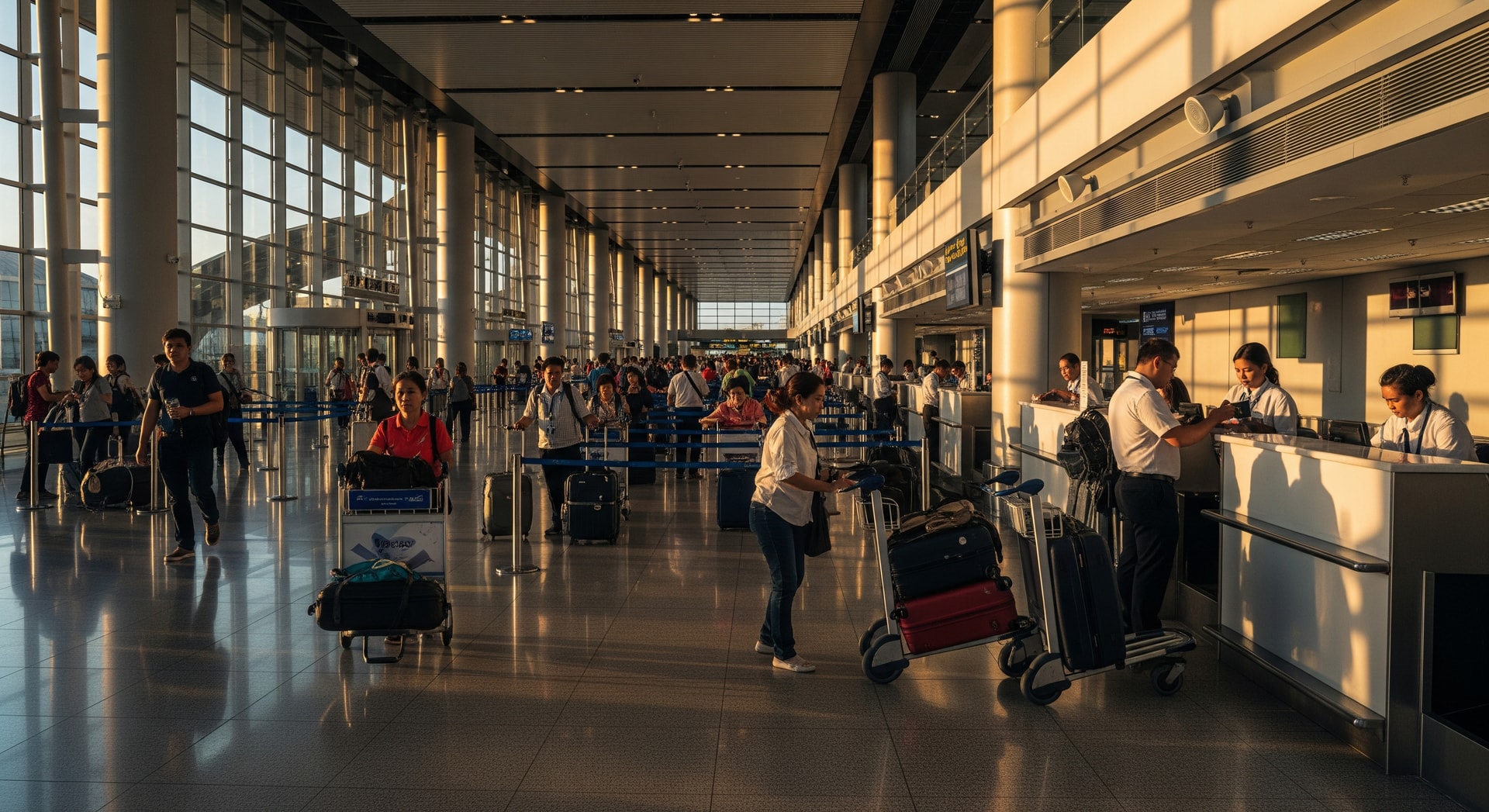
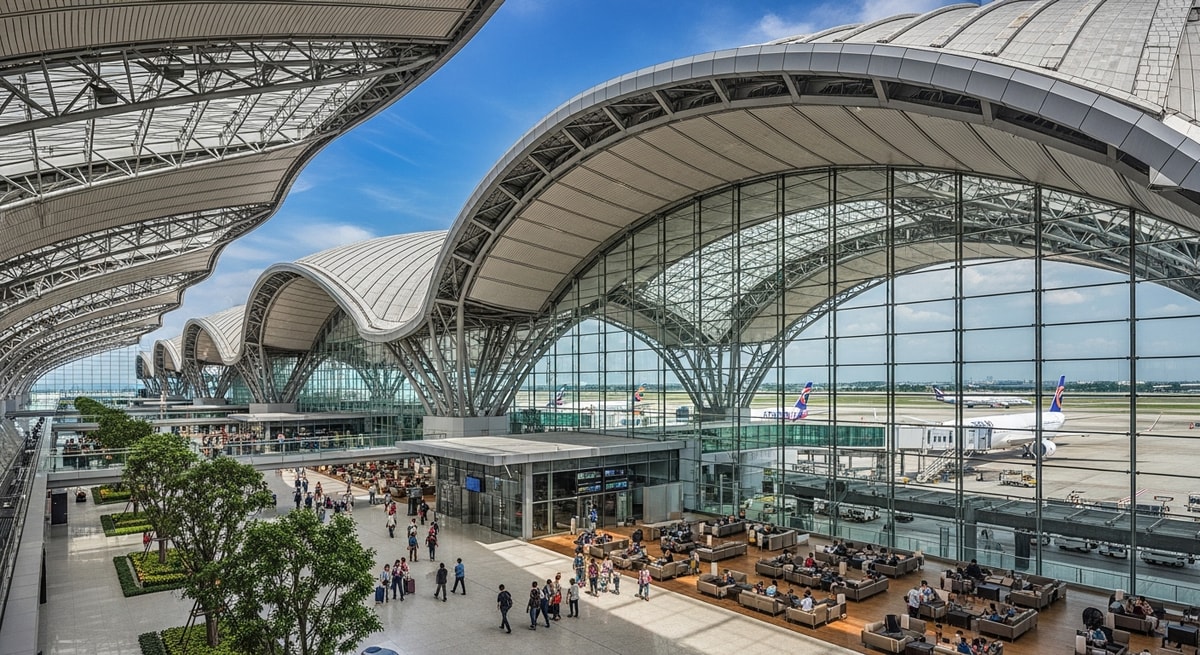
Suvarnabhumi Airport — Thailand's main international gateway in Bangkok
Why Choose DoVisa?
See the difference between applying yourself vs using our expert service
Travelers to Thailand rated this product 4.7 out of 5 based on 10 reviews.
4.7/ 5
Based on 10 verified reviews
Filter by rating
Chris H.Jan 19, 2026
"Super fast! Applied for my Thailand visa on Tuesday evening and had approval by Thursday morning. Immigration at Suvarnabhumi was a breeze — no waiting in long queues!"
Anna M.Jan 15, 2026
"This is my third Thailand trip using DoVisa. The process gets easier every time. Love that they remember my details and the support team speaks Thai if needed!"
Tom W.Jan 10, 2026
"Family of 4, all visas approved in 36 hours. The family discount was a nice bonus. Already planning our next Thailand adventure!"
Sandra K.Jan 3, 2026
"Good service. Had a minor issue with my photo but support helped me fix it quickly. Visa approved next day. Would use again."
Michael R.Dec 28, 2025
"Excellent experience! The step-by-step guide made the application process crystal clear. Got my visa in just 3 days. Thailand here I come!"
Jennifer L.Dec 22, 2025
"I was nervous about applying online but the DoVisa team walked me through everything. Support responded within minutes when I had questions."
David P.Dec 18, 2025
"Solid service, reasonable price. Processing took the full 5 days but I got my visa as promised. Would recommend starting early."
Emma S.Dec 14, 2025
"Best visa service I've used! The interface is so user-friendly and I love getting real-time updates on my application status."
Robert J.Dec 8, 2025
"Applied for the 60-day tourist visa for an extended Muay Thai training trip. Everything processed smoothly and I got great tips about visa extensions too."
Lisa T.Dec 2, 2025
"Digital nomad spending winter in Chiang Mai. DoVisa helped me understand which visa option was best for my situation. Very knowledgeable team!"
Chris H.Jan 19, 2026
"Super fast! Applied for my Thailand visa on Tuesday evening and had approval by Thursday morning. Immigration at Suvarnabhumi was a breeze — no waiting in long queues!"
Anna M.Jan 15, 2026
"This is my third Thailand trip using DoVisa. The process gets easier every time. Love that they remember my details and the support team speaks Thai if needed!"
Tom W.Jan 10, 2026
"Family of 4, all visas approved in 36 hours. The family discount was a nice bonus. Already planning our next Thailand adventure!"
Thailand Visa FAQs
What types of visas are available for Thailand?
Thailand offers a comprehensive range of visa options to suit different travel purposes. Visa exemption (30-60 days depending on nationality) is available for citizens of 64 countries. Electronic Visa on Arrival (eVOA) allows 15-day stays for 21 eligible nationalities with pre-approval online. Tourist visas come in single-entry (60 days) and multiple-entry (60 days per entry, 6-month validity) variants for longer holidays. Non-Immigrant visas cover business (Type B), education (Type ED), retirement and family (Type O), and long-stay retirement (Type O-A). Special Tourist Visa (STV) was introduced for long-stay tourism allowing up to 270 days. The Thailand Elite program offers 5-20 year memberships for premium long-term access. Each visa type has specific requirements, permitted activities, and extension possibilities.
Do I need a visa to visit Thailand?
Whether you need a visa depends on your nationality and intended length of stay. Visa-free entry is available for citizens of 64 countries including the US, UK, EU nations, Australia, Canada, Japan, and South Korea — typically allowing 30-day stays (some nationalities get 90 days) extendable by 30 days at Immigration offices. Visa on Arrival or eVOA is available for 21 countries including China, India, Taiwan, and several Eastern European nations — allowing 15-day stays. Citizens of countries not covered by exemption or VOA schemes must obtain a visa before travel. Even if you qualify for visa-free entry, you may want a tourist visa if planning stays longer than 30 days or multiple entries. Use our visa checker tool to see exactly what applies to your passport.
What's the difference between visa exemption, eVOA, and tourist visa?
These three options serve different needs. Visa exemption requires no pre-application — simply arrive with a valid passport from an eligible country and receive a 30-day stamp (or longer for some nationalities). Best for short holidays requiring minimal planning. eVOA (Electronic Visa on Arrival) is pre-approved online for 21 nationalities, allowing 15-day stays. It provides faster airport processing than traditional VOA by eliminating queue time at separate VOA counters. Tourist visa must be applied for before travel and allows 60-day stays (extendable by 30 days). Required for nationalities not covered by exemption/VOA and ideal for travelers wanting longer stays. Tourist visas involve more documentation but provide greater flexibility. Multiple-entry tourist visas allow unlimited entries over 6 months, perfect for regional travel with Thailand as a base.
What is a Thailand business visa and who needs one?
The Non-Immigrant B (Business) visa is required for any professional activities in Thailand beyond casual business meetings. This includes: attending conferences and trade shows, establishing business contacts, conducting market research, negotiating contracts, supervising projects, providing training, and of course, employment (which also requires a work permit). Business visas are issued as single-entry (90-day validity) or multiple-entry (1-year validity) and allow stays of 90 days per entry. Required documentation includes: invitation letter from a Thai company on letterhead, your company's registration documents, employer letter explaining business purpose, detailed itinerary, and sometimes proof of business relationship. If you plan to work and receive salary in Thailand, you'll need both a Business visa and a Work Permit — the visa alone doesn't authorize employment.
Can I extend my Thailand visa?
Yes, most visa types can be extended within Thailand. Visa exemption stamps can be extended once for 30 days (total 60 days) at Immigration offices for 1,900 THB. VOA/eVOA can be extended by 7 days for the same fee. Tourist visas (60-day) can be extended once for 30 days (total 90 days). Non-Immigrant visas may be extended for various periods depending on type and circumstances — retirement visas can be extended annually. Extension process: Visit your nearest Immigration office before your current permission expires, bring your passport, departure card (TM.6), completed TM.7 extension form, passport photos, and 1,900 THB fee. Some offices require proof of accommodation and funds. Processing is usually same-day. Important: Extensions are discretionary — while routine for tourists, Immigration can decline without explanation. Never overstay assuming you'll get an extension.
What are the financial requirements for entering Thailand?
Thai Immigration may request proof of funds upon arrival — though random checks aren't common, they do occur. Official requirements: 20,000 THB per person (approximately $600 USD) or 40,000 THB per family (approximately $1,200 USD) for tourist entries. This can be demonstrated through cash, traveler's checks, credit cards with recent statements, or bank statements. When checks are more likely: Budget appearance, one-way tickets, previous overstays, arrival from certain countries, or random selection. Practical advice: Carry at least 20,000 THB equivalent in mixed cash and cards, have bank statement screenshots accessible on your phone, and bring proof of accommodation bookings. While thousands enter daily without being asked, being prepared prevents potential entry denial. Business and long-stay visa applicants face stricter financial documentation requirements during the application process.
Do I need proof of onward travel for Thailand?
Technically, yes — Thai Immigration requires proof you'll leave within your permitted stay, and airlines often check this before boarding. If you can't show a confirmed departure ticket, some airlines may deny boarding or make you purchase an onward ticket at the airport. What counts as proof: Return flight to your home country, onward flight to another destination, bus/train tickets to neighboring countries (Malaysia, Cambodia, Laos), or ferry tickets. Solutions for flexible travelers: Book a fully refundable flight and cancel after arrival, use services that provide temporary flight reservations, or book a cheap regional flight (Bangkok to Kuala Lumpur flights can be under $50). Land border entries are more relaxed about onward travel, but air arrivals should have documentation ready. If questioned at Immigration without onward travel proof, you may be asked to book something on the spot or face entry denial.
What documents do I need for a Thailand visa application?
Requirements vary by visa type, but tourist visa applications typically require: passport valid for at least 6 months with 2+ blank pages; completed visa application form; recent passport photo (4x6cm, white background); confirmed round-trip flight itinerary; proof of accommodation (hotel bookings or invitation letter); proof of sufficient funds (bank statement showing 20,000+ THB equivalent); and the visa fee. Business visa additional requirements: Invitation letter from Thai company, employer support letter, company registration documents, and business itinerary. Education visa requirements: Acceptance letter from Thai educational institution and proof of enrollment. Retirement visa (O-A) requirements: Age 50+, police clearance certificate, medical certificate, proof of income (65,000 THB/month) or savings (800,000 THB in Thai bank). All documents should be in English or Thai — other languages require certified translations.
What is the Thailand Elite visa program?
Thailand Elite is a membership-based long-term visa program offering privileged access to the Kingdom. Launched by the Tourism Authority of Thailand, it provides multi-year visas with premium services. Membership tiers range from 5 to 20 years, starting at 600,000 THB (approximately $17,000 USD) for Elite Easy Access (5 years). Higher tiers like Elite Superiority Extension (20 years, 1 million THB) include additional benefits like annual health checkups and golf green fees. Benefits include: Multiple-entry visa throughout membership; unlimited entries with stays up to 1 year per entry; expedited VIP immigration processing with dedicated lanes; airport limousine transfers; 24/7 member contact center; government concierge services. Ideal for: Retirees wanting hassle-free long stays, digital nomads, frequent visitors to Thailand, and those who don't qualify for standard long-stay visas. The program doesn't include work authorization — employment still requires separate work permits.
When is the best time to visit Thailand?
Thailand's tropical climate creates three seasons, with ideal timing depending on your destination. Cool/Dry Season (November-February): Best overall weather with comfortable temperatures (25-32°C), low humidity, and minimal rainfall. Peak tourist season with higher prices and crowds at popular destinations. Perfect for beaches, temples, and outdoor activities. Hot Season (March-May): Temperatures reach 35-40°C with high humidity. Songkran water festival in April is a highlight. Beach destinations remain popular; northern Thailand becomes very hot. Lower hotel prices outside Easter holidays. Rainy/Green Season (June-October): Monsoon brings daily afternoon showers lasting 1-2 hours, rarely all-day rain. Lush green landscapes, waterfall season, fewer tourists, and significant discounts (30-50% off peak rates). Diving is best on the Andaman coast (east side) during this period. Regional variations: Southern islands have different monsoon patterns — Phuket/Krabi best November-April, Koh Samui/Koh Phangan best January-September.
What happens if I overstay my Thailand visa?
Thailand takes visa overstays seriously with escalating penalties. Fines: 500 THB per day of overstay, capped at 20,000 THB (40 days). Payable at Immigration when departing. Detention: Overstays discovered during random police checks (common in tourist areas) result in detention at Immigration Detention Centers until deportation processing — conditions are basic and process can take days to weeks. Re-entry bans: Overstays exceeding 90 days trigger automatic bans: 90 days-1 year overstay = 1-year ban; 1-3 years = 3-year ban; 3-5 years = 5-year ban; over 5 years = 10-year ban. If arrested for overstay (versus voluntary departure), bans are significantly longer. Blacklisting: Repeated overstays or working illegally can result in permanent blacklisting. Avoiding problems: Track your permitted stay date carefully (stamped in passport), use calendar reminders, extend before expiration, or exit and re-enter for fresh permission. One day overstay due to flight cancellation can usually be explained, but Immigration discretion applies.
Can I work in Thailand with a tourist visa?
No, tourist visas, visa exemptions, and VOA entries explicitly prohibit any form of employment or work. This includes: paid employment, volunteering for Thai organizations, freelance work for Thai clients, teaching (even informally), and running a business from Thailand. Digital nomads: Working remotely for non-Thai employers while on tourist status exists in a gray area. Officially unauthorized, it's rarely enforced for quiet remote workers not taking jobs from Thais. However, conducting client meetings in Thailand, accepting Thai clients, or any work visibly done in Thailand risks deportation. Legal work authorization requires: Non-Immigrant B (Business) visa + Work Permit from the Ministry of Labour. Process typically takes 2-3 months and requires employer sponsorship. Penalties for working illegally include fines, detention, deportation, and re-entry bans. The Thai government periodically conducts workplace raids, particularly at language schools and tourist businesses.
What if my Thailand visa application is rejected?
Visa rejections for Thailand are uncommon (under 2% of applications) but can occur. Common rejection reasons: Insufficient proof of funds; missing or unclear documents; passport validity issues; previous overstays or immigration violations; incomplete application forms; inconsistent travel dates; or concerns about purpose of visit. If rejected: You'll typically receive a generic refusal letter without detailed explanation. You can reapply immediately with improved documentation — there's no waiting period. Common fixes include: clearer bank statements showing higher balances, more detailed accommodation bookings, confirmed return flights, and comprehensive cover letters explaining your trip. DoVisa's approach: Our pre-submission review catches most issues before they cause rejections. If your visa is rejected despite our processing and the rejection stems from our error, we provide a full refund of service fees. We also offer complimentary reapplication guidance to help resolve issues for a successful second attempt.
Do I need travel insurance for Thailand?
Travel insurance isn't mandatory for most Thailand visas, but it's strongly recommended and sometimes required. When required: Some long-stay visa categories (O-A retirement visa, certain extensions) require proof of medical insurance covering at least 400,000 THB for outpatient and 40,000 THB for inpatient treatment from Thai-approved insurers. Why it's essential even when optional: Thai healthcare is excellent but expensive for foreigners — a simple hospital visit can cost 5,000-10,000 THB; serious accidents or illness easily reach hundreds of thousands of THB. Motorbike accidents (very common among tourists) often aren't covered by basic travel insurance if you lack a valid motorcycle license. Recommended coverage: Minimum $50,000 USD medical coverage including emergency evacuation, trip cancellation, personal liability, and adventure activities if relevant. COVID-19: While entry requirements have relaxed, some insurers and visa types may still require COVID coverage. Check current requirements before travel.
Can I re-enter Thailand multiple times?
Yes, but the mechanism depends on your visa type. Visa exemption holders: Each entry grants a fresh 30-day permission (60 or 90 days for some nationalities). No limit on entries per se, but Immigration may question frequent "visa runs" — consecutive short stays with brief exits suggest you're living in Thailand without proper long-stay authorization. Expect scrutiny after 180+ days within a 12-month period. Single-entry tourist visa: Valid for one entry only. If you exit Thailand (even briefly), the visa is used. For regional travel from a Thailand base, you need a multiple-entry tourist visa or re-entry permit. Re-entry permits: Available at airports and Immigration offices (1,000 THB single, 3,800 THB multiple) — these preserve your existing permission during temporary exits. Essential if you have a long-stay visa and need to travel abroad. Multiple-entry visas: Allow unlimited entries within validity period (typically 6-12 months), each entry starting a fresh stay period.





 With DoVisa