Certified Belarusian Document Translation
Professional translation of Belarusian and Russian-language documents with multi-authority apostille coordination. Accepted by USCIS, UKVI, IRCC, and authorities worldwide.
TrustpilotSelect Languages
Drag & drop your documents here
or
PDF, JPEG, PNG, WebP — Max 10MB per file. Word documents: please save as PDF first.
Certified translators · Accepted by governments, courts & universities worldwide · View sample
Select a destination country to view pricing
How Belarusian Certified Translation Works
Submit Your Documents Securely
Upload clear scans of your Belarusian documents through our encrypted portal. We accept PDF, JPEG, and PNG formats. Our intake specialists review each upload for legibility and identify the document type — whether it is a свидетельство о рождении (birth certificate) from ZAGS, an аттестат (school certificate) from the Ministry of Education, or a court document from the Ministry of Justice.
Translator Assignment
Your documents are matched with a translator experienced in both Belarusian and Russian administrative terminology. Belarusian vital records contain text in both official languages — Belarusian (беларуская мова) and Russian (русский язык). Our translators handle the Cyrillic scripts of both languages and understand the distinctive ZAGS document formats used across Belarus's 148 civil registry offices.
Translation & Certification
The translator produces your certified translation with a signed certification statement. Belarus uses a notarized translation system (нотариально заверенный перевод) under Article 92 of the Law On Notaries and Notarial Activity — the notary certifies the translator's identity, qualifications, and signature. DoVisa coordinates with qualified translators and notaries in Minsk for domestic authentication.
Delivery with Full Certification
Receive your certified translation as a high-resolution PDF via email, suitable for immediate submission to authorities worldwide. Physical copies shipped via tracked courier. For apostille processing, DoVisa coordinates with the appropriate competent authority — Belarus has four designated apostille authorities depending on the document type.
Belarus Translation Service Specifications
Popular Language Pairs
We support all languages — 100+ language pairs available for Belarusian documents. Most Belarusian official documents contain text in both Belarusian and Russian.
Common Documents
- Birth certificates — свидетельство о рождении / пасведчанне аб нараджэнні
- Marriage certificates — свидетельство о браке / пасведчанне аб шлюбе
- Death certificates — свидетельство о смерти / пасведчанне аб смерці
- Divorce certificates — свидетельство о расторжении брака
- Academic diplomas — диплом о высшем образовании / дыплом аб вышэйшай адукацыі
- School certificates — аттестат об общем среднем образовании
- Police clearance certificates — справка о несудимости / даведка аб несудзімасці
- Powers of attorney — доверенность / даверанасць
- Employment contracts and references
- Court judgments and legal documents
Turnaround Time
Certification Details
Belarus Translation Requirements & Regulatory Framework
Embassy Acceptance
Notarization Process
Apostille Information
Legal Framework
Common Scenarios for Belarusian Document Translation
Immigration & Visa Applications
Belarusian nationals applying for US green cards, UK settlement visas, Canadian PR, or Australian skilled migration need certified English translations of birth certificates (свидетельство о рождении), police clearance certificates (справка о несудимости), and academic credentials. DoVisa's certified translations meet all USCIS, UKVI, IRCC, and Australian DHA requirements.
Marriage & Family Documents
Marriage certificates (свидетельство о браке), divorce certificates (свидетельство о расторжении брака), and birth certificates issued by ZAGS civil registry offices need certified translation for spousal visa applications, family reunification, and civil registry proceedings abroad. Belarusian documents contain text in both Belarusian and Russian.
Academic Credential Evaluation
Belarusian university diplomas (диплом о высшем образовании), school certificates (аттестат), and academic transcripts require certified translations for WES, ECE, and NACES-member credential evaluation agencies. DoVisa accurately renders Belarusian grading systems and degree nomenclature for international evaluators.
Business & Corporate Documents
Companies operating in or with Belarus need certified translations of commercial registrations, employment contracts, tax documents, and corporate governance materials. Belarus's position between the EU and Russia creates specific translation needs for businesses navigating cross-border compliance.
Legal Proceedings
Belarusian court documents, powers of attorney (доверенность), and legal judgments require certified translation for international legal proceedings. DoVisa translators handle the specialized Belarusian and Russian legal terminology used in judicial documents, including decisions from the Supreme Court of Belarus.
Belarus's ZAGS Civil Registry: Bilingual Vital Records
Belarusian vital records are managed by ZAGS (ЗАГС — органы записи актов гражданского состояния), the civil registry offices operating under the Ministry of Justice (Міністэрства юстыцыі Рэспублікі Беларусь). Belarus has 148 civil registry offices, three Houses of Civil Ceremonies, one Wedding Palace, and seven civil registry archives across the country.
A distinctive feature of Belarusian vital records is their bilingual nature. All certificates — birth (свидетельство о рождении / пасведчанне аб нараджэнні), marriage (свидетельство о браке / пасведчанне аб шлюбе), and death (свидетельство о смерти / пасведчанне аб смерці) — contain two information pages: one in Russian and one in Belarusian. Both languages use the Cyrillic script but with different vocabulary, spelling conventions, and grammar.
Translating Belarusian vital records requires expertise in both Cyrillic scripts. Name spellings may differ between the Russian and Belarusian pages of the same document — for example, a name might appear as "Александр" in Russian and "Аляксандр" in Belarusian. DoVisa's translators accurately handle both language versions and maintain consistent name transliteration into the target language.
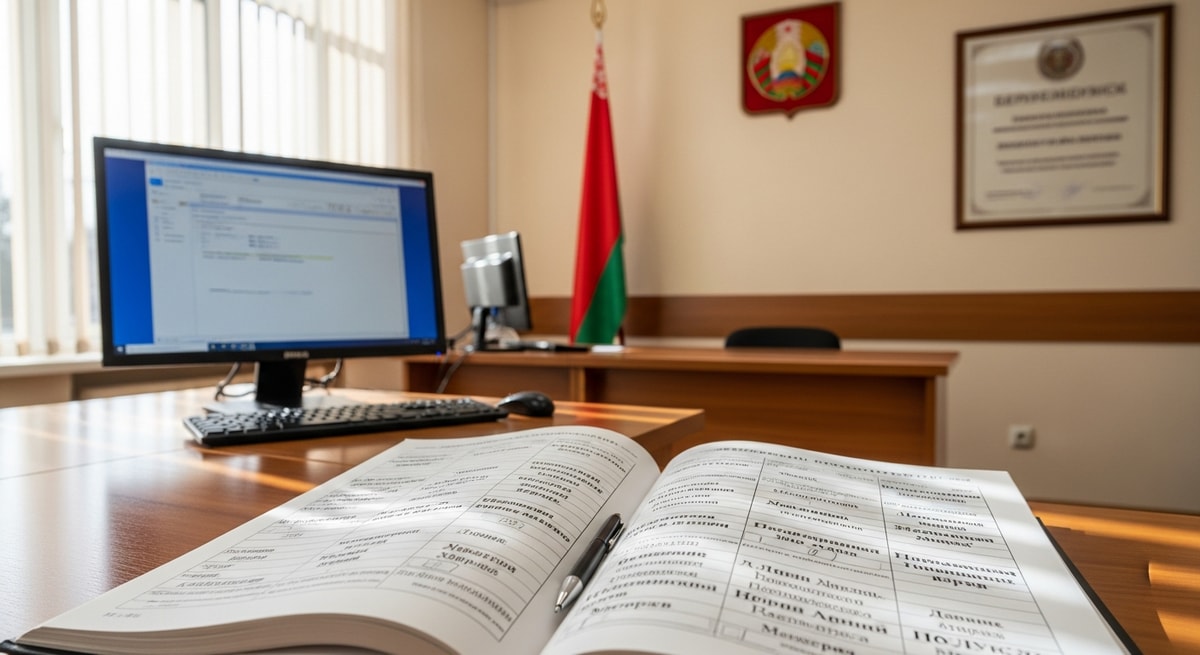
Belarus's 148 ZAGS offices issue bilingual vital records in both Russian and Belarusian
Belarus's Notarized Translation Process: Physical Binding and Sealing
Belarus's notarized translation process is distinctive for its physical binding requirement. Under Article 92 of the Law On Notaries and Notarial Activity and Ministry of Justice Resolution No. 64, the completed translation must be physically sewn together with the original document (or notarized copy) using red or white thread. The stitched document is then sealed and signed by the notary, who indicates the total number of sheets.
The translator must be physically present at the notary office to sign the translation. The notary does not verify the translation's accuracy — instead, they confirm the translator's identity, verify their qualifications (supported by documents of specialized education), and certify the translator's signature. Belarus has no licensing system for translators — any person with appropriate language education can perform translations.
For documents destined for international use, the notarized translation then proceeds to apostille from the relevant competent authority. The Ministry of Justice handles court and notarial documents, the Ministry of Education handles academic documents, the Department of Archives handles archival documents, and the Ministry of Foreign Affairs handles all others. DoVisa coordinates both the notarization and apostille processes, eliminating the need for multiple in-person visits to offices in Minsk.

Belarusian notarized translations must be physically sewn together with the original document and sealed by a notary
"Belarusian birth certificate and police clearance translated for USCIS. Both accepted on first submission. The bilingual Russian-Belarusian document was handled perfectly."
"Marriage certificate from ZAGS translated with Ministry of Justice apostille for my UK spouse visa. UKVI accepted without questions. Excellent end-to-end coordination."
"University diploma and transcript translated from Russian to English for WES credential evaluation. Accurate academic terminology and WES processed without corrections. Good turnaround."
"Belarusian divorce certificate and birth certificates translated for Canadian PR application. IRCC accepted everything. The name transliteration from Cyrillic was consistent across all documents."
"Court judgment translated from Russian for an international legal proceeding. The legal terminology was rendered accurately. The certified translation was accepted by the court immediately."
"School certificate (аттестат) translated with Ministry of Education apostille for university application in Germany. The German university accepted the certified translation. Good quality."
"Corporate documents translated for business registration in Poland. Commercial extracts and bylaws — all accepted by Polish authorities. Professional and reliable service."
"Belarusian power of attorney translated for use in the UK. Notarized translation handled correctly with proper binding. The solicitor accepted the document without any questions."
"Police clearance certificate (справка о несудимости) translated for Australian skilled migration. Department of Home Affairs accepted immediately. Reliable service."
"Death certificate translated for a US probate proceeding. Sensitive document handled with complete professionalism. Both Russian and Belarusian pages were accurately translated."
"Belarusian employment contracts translated for a work visa in the UAE. Arabic translations were precise and accepted by the UAE embassy. Very satisfied with the quality."
"Birth certificate translated for USCIS. Final translation was accurate, but the apostille from the Ministry of Foreign Affairs took longer than expected — approximately 6 weeks total."
"Belarusian birth certificate and police clearance translated for USCIS. Both accepted on first submission. The bilingual Russian-Belarusian document was handled perfectly."
"Marriage certificate from ZAGS translated with Ministry of Justice apostille for my UK spouse visa. UKVI accepted without questions. Excellent end-to-end coordination."
"University diploma and transcript translated from Russian to English for WES credential evaluation. Accurate academic terminology and WES processed without corrections. Good turnaround."
Belarus Document Translation FAQs
What types of Belarusian documents can be translated?
Are your Belarus translations certified?
How long does Belarusian document translation take?
Are Belarusian documents in Russian or Belarusian?
Will my translated Belarusian documents be accepted by immigration authorities?
Do I need notarization with my Belarus translation?
What is an apostille and can Belarusian documents get one?
How much does certified Belarusian document translation cost?
Can you translate Soviet-era Belarusian documents?
What format will I receive my translated Belarusian document in?
Which Belarusian authority apostilles my specific document type?
Get Your Belarusian Documents Translated Today
Professional certified translations with multi-authority apostille coordination — accepted worldwide