Simple 4-step process — most applications processed within 10-15 business days
1
Complete the online application
Fill out our comprehensive application form with your personal details, travel itinerary, and purpose of visit. Our smart validation system ensures accuracy and compliance with German Embassy requirements, catching potential issues before submission.
2
Upload your documents
Submit your passport scan (minimum 6 months validity beyond intended stay), recent biometric photograph meeting Schengen specifications, proof of accommodation, travel insurance, and financial documents. Our document specialists verify everything meets strict German consular standards.
3
We process your application
Your complete application package is prepared according to German Embassy guidelines. We schedule your visa appointment at the nearest German consulate or visa application center, and guide you through the biometric enrollment process required for Schengen visas.
4
Receive your Germany visa
After your appointment and processing, collect your passport with the Schengen visa sticker from the visa center. Your visa grants access to all 27 Schengen countries. Willkommen in Deutschland — welcome to Germany!
Visa types needed for Germany
Available visa products
ETIAS Travel Authorisation - 3 years, Multiple entry Most Popular
ETIAS Travel Authorisation - 3 years, Multiple entry
ETIAS is the upcoming EU travel authorisation for visa-exempt travellers visiting the Schengen area. It is not yet in operation: order now and we prepare your application and file it with the EU the moment the system launches. Once issued, ETIAS is valid for 3 years (or until your passport expires) and covers unlimited short stays across all ETIAS countries.
Applicants must submit the following documents:
🛂 Passport: Scan of your passport bio page, valid for your trip
💳 Payment: Credit or debit card for the fee
Important to know
Presale: ETIAS is not yet in operation — we file your application when the EU launches the system
For visa-exempt (visa waiver) nationalities only
One authorisation per traveller, linked to your passport
Germany is a founding member of the Schengen Area, offering seamless travel across 27 European countries with a single visa. Understanding Germany's entry requirements is essential for planning your European adventure.
Visa-Free Travel to Germany
Citizens of over 60 countries enjoy visa-free access to Germany and the Schengen Area for stays up to 90 days within any 180-day period. This includes travelers from the United States, Canada, United Kingdom, Australia, New Zealand, Japan, South Korea, and many Latin American nations. Visa-free visitors can engage in tourism, business meetings, cultural events, and family visits but cannot work or study. The 90/180-day rule applies across the entire Schengen zone — days spent in France, Italy, or other Schengen countries count toward your German allowance.
EU/EEA Citizens
Citizens of European Union and European Economic Area countries have unrestricted access to Germany under freedom of movement principles. No visa is required regardless of stay duration, and EU/EEA nationals can live, work, and study in Germany without permits. Switzerland, although not an EU member, has bilateral agreements providing similar rights.
Neuschwanstein Castle — Bavaria's fairy-tale landmark and Disney inspiration
Schengen Short-Stay Visas
Schengen Tourist Visa (Type C)
Travelers from countries requiring visas must apply for a Schengen short-stay visa at a German Embassy or Consulate. This visa allows stays of up to 90 days within 180 days for tourism, family visits, cultural events, or business activities. Germany processes approximately 2 million Schengen visa applications annually with an approval rate exceeding 85%.
Business & Conference Visas
Business travelers attending meetings, trade fairs, conferences, or negotiations apply for the same Type C Schengen visa with business-specific documentation. Required documents include invitation letters from German companies, proof of business relationships, and conference registration confirmations. Major events like Hannover Messe, ITB Berlin, and Frankfurt Book Fair attract thousands of business visa applicants annually.
Multiple-Entry Schengen Visas
Frequent travelers may qualify for multiple-entry Schengen visas valid for 1-5 years, allowing unlimited entries with the standard 90/180-day stay limitation per visit. Eligibility typically requires a positive visa history, demonstrating return to your home country, and legitimate reasons for frequent travel such as ongoing business relationships or family ties in Germany.
Cologne Cathedral — Gothic masterpiece and UNESCO World Heritage Site
Long-Stay & National Visas
National Visa (Type D)
Stays exceeding 90 days require a German National Visa rather than a Schengen visa. This applies to students, employees, family reunification, and long-term visitors. National visas are processed directly by German Embassies with longer processing times (typically 4-12 weeks) and more extensive documentation requirements.
Student Visa
Germany is one of the world's top destinations for international students, with many universities offering tuition-free education. Student visa applicants need university admission confirmation, proof of financial resources (approximately EUR 11,208 per year in a blocked account), health insurance, and academic credentials. The visa converts to a residence permit after arrival.
Working Holiday Visa
Germany has bilateral Working Holiday agreements with Australia, New Zealand, Canada, Japan, South Korea, Hong Kong, Taiwan, Chile, Argentina, and Israel. Applicants aged 18-30 (35 for Canadians and Australians) can live and work in Germany for up to 12 months. This popular program combines cultural exchange with work opportunities, ideal for young travelers wanting extended German experiences.
Job Seeker Visa
Qualified professionals can apply for a 6-month Job Seeker Visa to search for employment in Germany. Requirements include a recognized university degree, professional qualifications, and proof of funds to support yourself during the job search (approximately EUR 947/month).
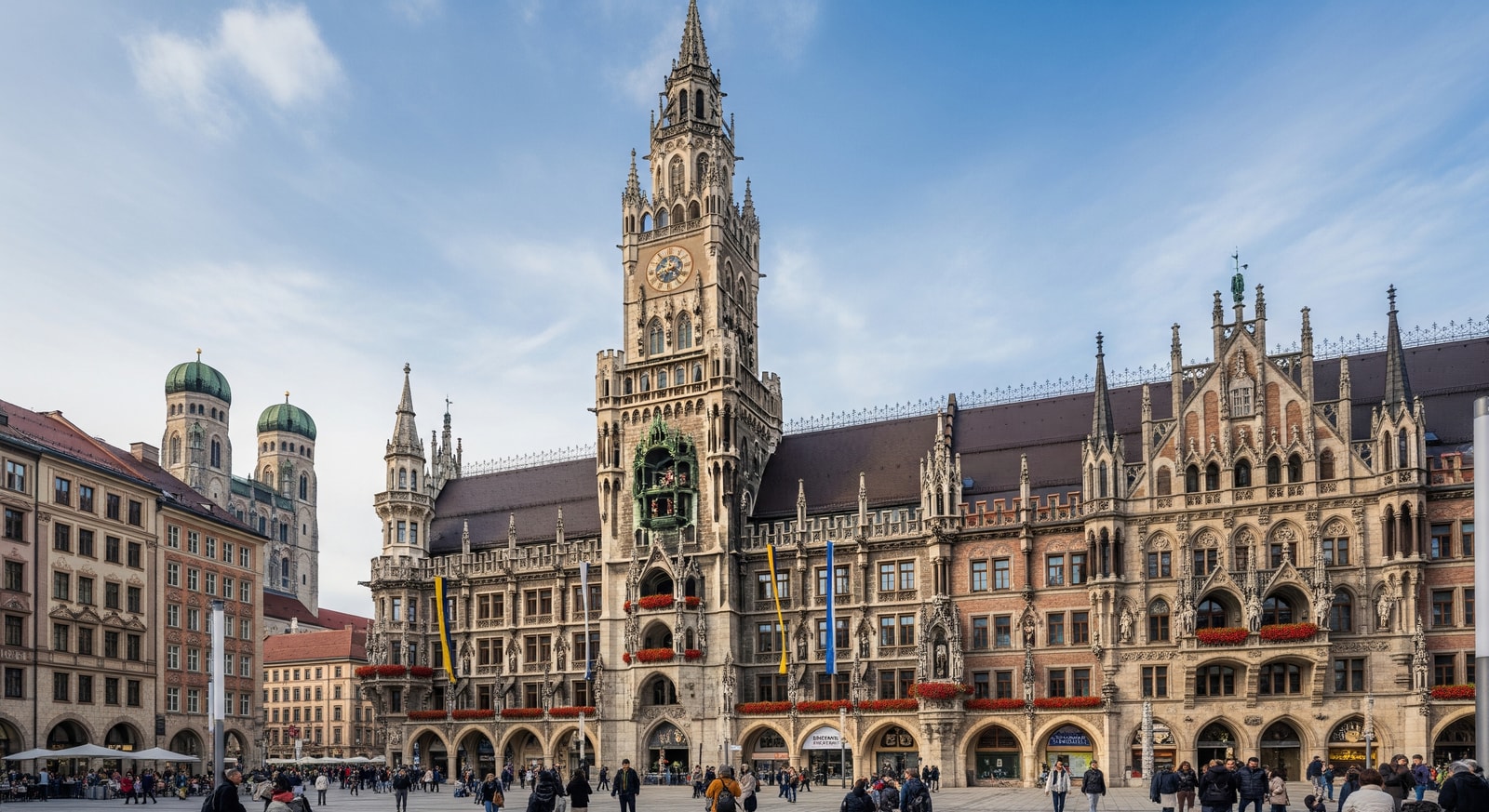
Marienplatz — Munich's historic central square and cultural heart of Bavaria
Entry Points & Practical Information
International Airports
Germany has several major international airports serving as Schengen entry points. Frankfurt Airport (FRA) is Germany's largest and Europe's fourth-busiest, serving as a major Lufthansa hub. Munich Airport (MUC) is Bavaria's gateway with excellent connections to Alpine regions. Berlin Brandenburg Airport (BER) serves the capital region. Dusseldorf (DUS), Hamburg (HAM), and Cologne/Bonn (CGN) handle significant international traffic. Immigration processing at German airports is typically efficient, with dedicated EU/EEA lanes and automated passport control for eligible travelers.
Processing Times & Tips
Schengen visa applications should be submitted 15-45 days before travel (some consulates accept applications up to 6 months ahead). Standard processing takes 10-15 calendar days, though peak seasons may extend this. Schedule appointments early, especially before summer holidays, Oktoberfest season (September-October), and Christmas markets (November-December). Ensure all documents are complete and properly translated — incomplete applications are the primary cause of delays. German consulates are known for thorough document review, so attention to detail is essential.
Frankfurt Airport — Germany's busiest international gateway and European hub
Why Choose DoVisa?
See the difference between applying yourself vs using our expert service
Travelers to Germany rated this product 4.7 out of 5 based on 12 reviews.
4.7/ 5
Based on 12 verified reviews
Filter by rating
Marcus T.Jan 18, 2026
"DoVisa made my Schengen application so much easier. They helped me organize all the documents and my visa was approved in just 8 days!"
Priya S.Jan 12, 2026
"First time applying for a German visa and I was nervous. The team guided me through every step. Now I am planning my trip to Munich!"
James L.Jan 5, 2026
"Good service overall. The appointment scheduling could have been faster, but the document checklist was very helpful."
Elena K.Dec 28, 2025
"Applied for a business visa to attend a conference in Frankfurt. DoVisa prepared everything perfectly. Highly recommend!"
David M.Dec 19, 2025
"Excellent experience! Got my multiple-entry Schengen visa after using DoVisa. Now I can visit Germany and other EU countries easily."
Sophie W.Dec 10, 2025
"Very thorough document review caught an error in my insurance coverage before I submitted. Saved me from a potential rejection."
Ahmed R.Nov 25, 2025
"The interview preparation tips were invaluable. My consulate appointment went smoothly and visa was stamped within 2 weeks."
Linda C.Nov 8, 2025
"Family of 4 applying together. DoVisa coordinated all our appointments on the same day. So convenient and well organized!"
Robert H.Oct 22, 2025
"Solid visa service. Processing took the full 15 days but everything was handled professionally. Would use again for future trips."
Maria G.Sep 30, 2025
"Traveling to Berlin for Christmas markets. DoVisa helped me get my visa approved quickly so I could book everything else!"
Chen W.Aug 15, 2025
"Student visa application was complex but DoVisa support team answered all my questions. Now studying in Hamburg!"
Anna B.Jun 20, 2025
"Good experience applying for tourist visa. The online form was easy to complete and support responded quickly to questions."
Marcus T.Jan 18, 2026
"DoVisa made my Schengen application so much easier. They helped me organize all the documents and my visa was approved in just 8 days!"
Priya S.Jan 12, 2026
"First time applying for a German visa and I was nervous. The team guided me through every step. Now I am planning my trip to Munich!"
James L.Jan 5, 2026
"Good service overall. The appointment scheduling could have been faster, but the document checklist was very helpful."
Germany Visa FAQs
What types of visas are available for Germany?
Germany offers several visa categories depending on your purpose and duration of stay. Schengen Short-Stay Visa (Type C) covers tourism, business, and family visits for up to 90 days within 180 days. National Long-Stay Visa (Type D) is for stays exceeding 90 days including work, study, and family reunification. Transit Visa is for airport layovers when continuing to non-Schengen destinations. Working Holiday Visa allows youth from partner countries to work and travel for up to 12 months. Student Visa is for enrollment in German universities or language courses. Job Seeker Visa gives qualified professionals 6 months to find employment in Germany. Each visa type has specific requirements and processing procedures through German diplomatic missions.
Do I need a visa to visit Germany?
Whether you need a visa depends on your nationality and the purpose and duration of your visit. Visa-free access is available for citizens of over 60 countries including the United States, Canada, United Kingdom, Australia, Japan, and most Latin American nations for stays up to 90 days within any 180-day period. EU/EEA citizens have unrestricted access and can live and work in Germany without any visa. Visa-required nationals from countries like India, China, Pakistan, Nigeria, and many others must obtain a Schengen visa before travel. Use our visa checker tool to determine your specific requirements based on your passport nationality and travel purpose.
What is the Schengen visa and how does it work?
The Schengen visa is a short-stay visa allowing travel within the 27 Schengen Area countries with a single visa. Germany, as a Schengen member, issues visas valid for the entire zone including France, Italy, Spain, Netherlands, Austria, and 21 other countries. The standard Schengen visa allows stays of up to 90 days within any 180-day period. This means if you use all 90 days, you must wait outside the Schengen Area for 90 days before returning. When applying, you should apply to the country that is your main destination or, if visiting multiple countries equally, the country of first entry. Your German Schengen visa grants access to all member states during its validity.
What documents are required for a Germany Schengen visa?
A complete Germany Schengen visa application requires: Passport valid at least 3 months beyond your planned Schengen departure with 2 blank pages; Completed application form signed and dated; Two recent biometric photographs (35x45mm, white background); Travel medical insurance with minimum EUR 30,000 coverage valid in all Schengen countries; Flight itinerary showing entry and exit from Schengen; Proof of accommodation (hotel bookings, rental agreement, or host invitation); Proof of financial means (bank statements, payslips, tax returns showing approximately EUR 45 per day); Employment verification or business registration; Cover letter explaining your travel purpose and itinerary. Additional documents may be required based on your specific circumstances and the consulate's requirements.
How long can I stay in Germany with a tourist visa?
With a Schengen tourist visa, you can stay in Germany and the Schengen Area for a maximum of 90 days within any 180-day rolling period. This limit applies to the entire Schengen zone, not just Germany — time spent in France, Italy, or other Schengen countries counts toward your 90 days. Your visa validity period (the dates printed on the visa sticker) may be longer than 90 days, but you can only physically remain in the Schengen Area for 90 days total. Multiple-entry visas valid for 1-5 years still limit each visit to the 90/180-day rule. Visa-free visitors from exempt countries follow the same 90/180-day rule. Exceeding your permitted stay results in fines, deportation, and potential entry bans.
Can I extend my Germany visa while in the country?
Schengen short-stay visa extensions are only granted in exceptional circumstances such as force majeure (natural disasters, medical emergencies), humanitarian reasons, or serious personal situations. Extensions are not available for tourism purposes or because you want more time to travel. To request an extension, visit the local Auslanderbehorde (Foreigners Authority) before your current permission expires with documentation supporting your exceptional circumstances. The maximum extension brings your total stay to 90 days — you cannot extend beyond this limit. For longer stays, you must leave the Schengen Area and apply for a National Visa (Type D) from outside the region. Planning your trip within the 90-day limit from the start is essential.
Can I work in Germany with a tourist visa?
No, Schengen tourist visas and visa-free entries strictly prohibit employment, paid work, or business activities beyond meetings and conferences. This includes freelance work, remote employment for German companies, volunteering with German organizations, and any compensated activities. For employment, you need a German Work Visa (National Visa Type D) which requires a job offer from a German employer, recognition of your qualifications, and typically employer sponsorship. Digital nomads working remotely for non-German employers occupy a legal gray area — while technically not authorized, enforcement varies. However, conducting visible work activities, taking German clients, or establishing a business presence risks visa violations. The EU Blue Card offers an expedited path for highly skilled workers with university degrees and qualifying job offers.
Do I need travel insurance for a Germany visa?
Yes, travel medical insurance is mandatory for all Schengen visa applications. Your insurance must meet specific requirements: Minimum coverage of EUR 30,000 for medical emergencies and hospital treatment; valid in all Schengen member states (not just Germany); covering the entire duration of your intended stay with additional buffer days recommended; including emergency medical evacuation and repatriation coverage. The insurance certificate must be presented at the visa application and may be requested at the border. Many standard travel insurance policies meet Schengen requirements, but verify coverage amounts and territorial validity before purchase. Insurance from providers specifically offering Schengen-compliant policies ensures all requirements are met.
What if my Germany visa application is rejected?
Germany Schengen visa rejections occur for various reasons with an overall approval rate around 85%. Common rejection reasons include: insufficient proof of financial means, inadequate travel insurance, doubts about returning to your home country, incomplete documentation, unclear travel purpose, or previous visa violations. If rejected, you receive a letter citing the specific reason(s). You have the right to appeal within one month by submitting a written appeal to the German Embassy with additional documentation addressing the rejection reasons. Alternatively, you can submit a new application immediately with improved documentation — there is no mandatory waiting period. DoVisa's document review service helps identify and address potential issues before submission, significantly reducing rejection risk. If rejected despite our service due to documentation errors on our part, we offer reapplication support at no additional cost.
How long does Germany visa processing take?
Standard processing time for Germany Schengen visas is 10-15 calendar days from your appointment date. However, processing times can vary significantly based on several factors: Peak seasons (summer holidays, Oktoberfest period, Christmas) may extend processing to 20-30 days due to high application volumes. Complex cases requiring additional verification or missing documents take longer. Nationality-based security checks for certain passport holders may add processing time. Applications can be submitted 15-180 days before travel, and starting early is strongly recommended. Schedule your visa appointment at least 4-6 weeks before your intended departure to allow buffer time. Some German consulates offer premium services with faster processing for additional fees. Track your application status through the visa center's online portal.
Do I need to print my visa for Germany?
The German Schengen visa is a physical sticker affixed in your passport, not an electronic document. You must present your passport containing the visa sticker at immigration checkpoints and when boarding flights. Keep your passport safe as the visa cannot be reprinted if lost. Additionally, you should carry printed copies of supporting documents: flight itinerary, hotel confirmations, travel insurance certificate, and proof of funds. While border officers can access electronic records, having printed documentation speeds processing and addresses any technical issues. After visa approval, collect your passport from the visa application center — do not travel until you have physically received and verified the visa in your passport.
When is the best time to visit Germany?
Germany offers distinct experiences throughout the year. Spring (April-May) brings mild temperatures, blooming gardens, and fewer tourists. Perfect for Rhine Valley wine regions and outdoor activities. Summer (June-August) offers warm weather ideal for Alpine hiking, lake swimming, and outdoor festivals. This is peak tourist season with higher prices and crowds. Autumn (September-October) features Oktoberfest in Munich (late September to early October), wine harvest festivals, and stunning fall foliage in Bavaria and the Black Forest. Christmas markets are the highlight of Winter (November-December), particularly in Nuremberg, Dresden, and Cologne. January-February is the quietest period with cold weather but lower prices and uncrowded museums. Ski resorts in the Bavarian Alps are popular December through March.
What happens if I overstay my Germany visa?
Overstaying your Schengen visa in Germany has serious consequences. Immediate penalties include fines up to EUR 4,000 and potential deportation at your expense. Entry bans are imposed on overstayers — short overstays may result in 1-3 year bans, while longer overstays can trigger 5-10 year bans from the entire Schengen Area. Your overstay is recorded in the Schengen Information System (SIS), visible to all member countries and affecting future visa applications throughout Europe. Criminal charges may apply for extended overstays or repeated violations. If you realize you will overstay due to circumstances beyond your control (medical emergency, cancelled flights), immediately contact the Auslanderbehorde to document the situation. Always track your permitted stay carefully and plan departure before expiration.
Can I visit other European countries with my Germany visa?
Yes, a German Schengen visa grants access to all 27 Schengen member countries: Austria, Belgium, Czech Republic, Denmark, Estonia, Finland, France, Greece, Hungary, Iceland, Italy, Latvia, Liechtenstein, Lithuania, Luxembourg, Malta, Netherlands, Norway, Poland, Portugal, Slovakia, Slovenia, Spain, Sweden, and Switzerland. You can travel freely between these countries without additional visas or border checks. Important limitations: Your Germany visa should be applied for when Germany is your main destination or first entry point. Spending more time in another country than Germany may raise questions on future applications. Non-Schengen EU countries (Ireland, Bulgaria, Romania, Cyprus, Croatia) require separate visas or have their own entry rules. The UK is not part of Schengen or the EU for travel purposes and requires a separate visa for many nationalities.
What are the photo requirements for Germany visa applications?
Germany Schengen visa photos must meet strict biometric standards. Specifications: Size 35mm x 45mm; recent (taken within last 6 months); white or light gray background; face centered and covering 70-80% of the frame; neutral expression with mouth closed; eyes clearly visible (no tinted glasses or heavy frames); head coverings only for religious reasons. Quality requirements: Sharp focus, proper lighting without shadows on face or background, no retouching or filters, printed on high-quality photo paper. Common rejection reasons: Incorrect size, shadows, poor lighting, glasses reflections, expressions other than neutral, and low print quality. Many visa application centers have photo booths meeting exact specifications. Professional passport photo services familiar with Schengen requirements are recommended over self-taken photos.
Do I need a visa appointment for Germany?
Yes, Schengen visa applications require an in-person appointment at a German Embassy, Consulate, or authorized Visa Application Center (VFS Global or similar). During the appointment, you submit documents, provide biometric data (fingerprints and digital photograph), and pay the visa fee. Appointment scheduling: Book through the official embassy website or authorized visa center portal. Appointments can fill quickly during peak seasons — schedule 4-8 weeks ahead if possible. What to bring: Printed application form, passport, required documents, appointment confirmation, and fee payment. Some locations accept card payments; others require cash or bank transfers. Children under 12 are exempt from fingerprinting but must still attend. Biometric data is stored for 59 months — repeat applicants within this period may have expedited processing.
Still have questions?
Our team is here to help 24/7
Get Visa Tips & Exclusive Deals
Join 1,000+ travelers. No spam, unsubscribe anytime.







 With DoVisa