Thailand departure tax plans under public consultation would initially charge 1,000 baht whenever a traveller leaves the country by air, with land and sea exits exempt at first.
Thailand’s Finance Ministry is reviewing a draft Departure Tax Act that would initially impose a 1,000-baht charge on every air departure from the country, regardless of nationality. The proposal is not yet law and remains open for public comment until 29 October 2026.
Draft departure tax opens for public consultation
Thailand is considering a new departure tax that would apply each time a traveller leaves the country by air. The Finance Ministry’s Revenue Department has published the principles of a proposed Departure Tax Act, replacing the framework created under legislation dating back to 1983.
Public consultation on the draft runs from 30 September to 29 October 2026. Under the proposal, the tax would cover travellers of all nationalities departing Thailand, with an initial rate of 1,000 baht for air travel. Departures by land and sea would be exempt during the first phase, while the law would allow a maximum statutory rate of 5,000 baht per departure.
Officials say the draft is intended to modernise tax collection for current economic conditions, remain within Thailand’s fiscal-discipline framework and give the government more room to respond in emergencies. That marks a departure from the 1983 emergency decree, which applied only to Thai citizens and foreigners with permanent residence, and was designed to curb excessive capital outflows and support the balance of payments.
How the charge would be collected
The previous system set charges at 1,000 baht for air departures and 500 baht for exits by land or sea. Land and sea travel were exempted from 1 May 1986, followed by air travel from 1 July 1991. The Revenue Department says the current regime is exempt in all cases.
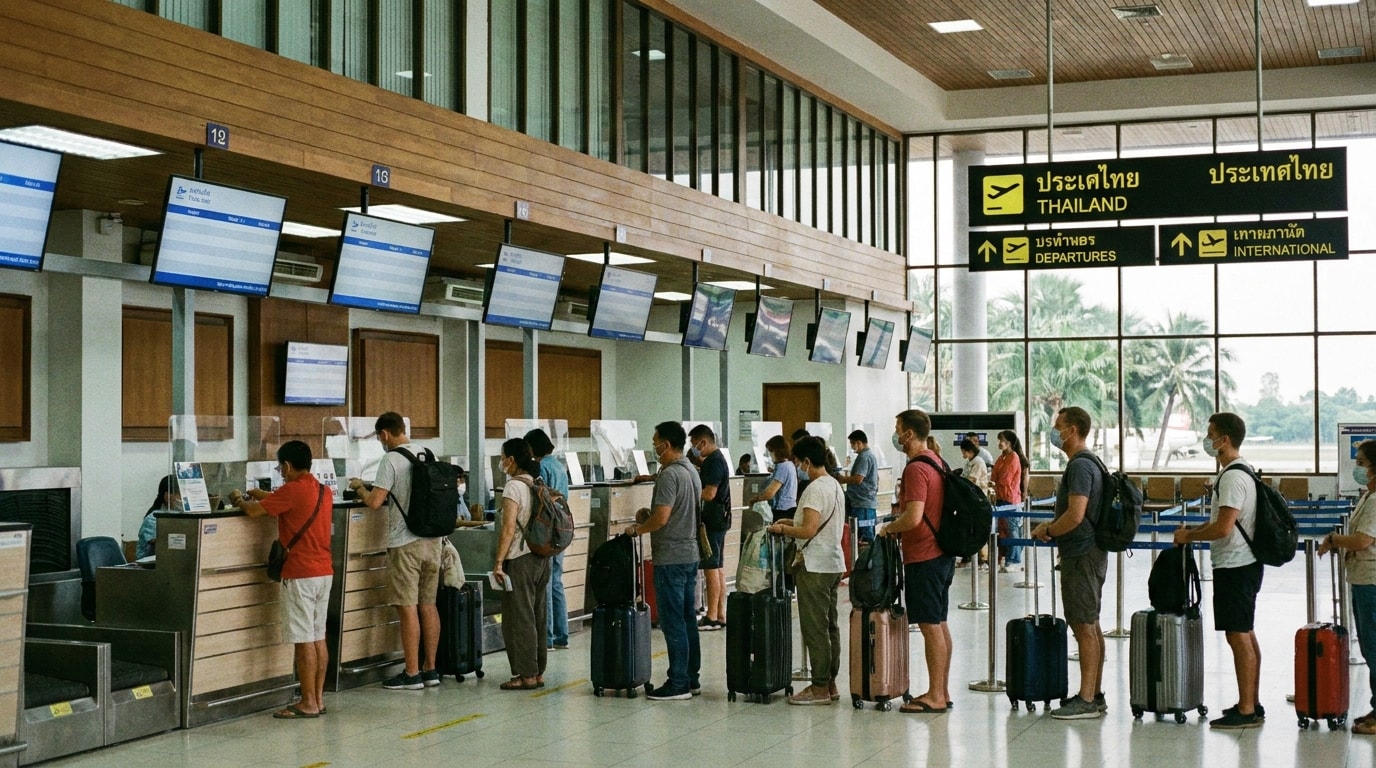
If the new draft is enacted, airlines or ticket agents would collect the 1,000-baht air departure tax as part of the fare. Where no ticket is issued, payment would follow procedures set by the director-general of the Revenue Department. Future rates could be set by ministerial regulation, but could not exceed 5,000 baht.
- Proposed exemptions broadly mirror those used for the airport Passenger Service Charge.
- Exempt groups include specified members of the royal family and their entourages, the Supreme Patriarch, foreign heads of state and official government guests.
- Children aged two or under, certain transit passengers remaining in designated areas, and crew travelling on duty without paying a fare would also be exempt.
The law would take effect 180 days after publication in the Royal Gazette. Travellers who purchased tickets before that effective date would not have to pay, even if their actual departure comes later. Failure to pay could lead to a penalty of up to twice the tax due, plus a surcharge of 1.5 percent per month.
Separate 450-baht tourist arrival fee also under review
The departure-tax proposal is moving alongside a separate plan for a foreign tourist arrival charge. On 6 October, Tourism and Sports Minister Surasak Phancharoenworakul chaired discussions on a 450-baht fee for eligible foreign visitors. Air arrivals would be charged first, while collection for land and sea arrivals would be delayed by about one year.
Officials are targeting the first quarter of 2027, subject to approval by the National Tourism Policy Committee and the Cabinet. An online consultation held from 24 August to 28 September received 5,954 responses, with 80.5 percent supporting the draft announcement and 78.3 percent supporting the 450-baht rate.
Surasak and ministry officials say the tourist fee would finance visitor insurance covering death and medical expenses, support the restoration and development of attractions, and leave at least about 8 billion baht annually for the Tourism Promotion Fund after collection and insurance costs. They also argue it would reduce reliance on the annual state budget and help address unrecovered medical bills involving foreign patients, discussed at the meeting as roughly 7 billion baht a year, though the ministry is still verifying the scope of that estimate with public-health agencies.
Industry concerns focus on cumulative costs
Earlier in 2026, the same minister had also raised the idea of reviving the 1983 departure levy only for Thai travellers, estimating it could generate around 10 billion baht a year to subsidise domestic trips under a “Thai travel Thai” scheme, while avoiding charging foreign tourists twice.
Critics, including foreign visitors and businesses that rely on them, view the proposed departure tax and arrival fee as stacked costs. International air tickets already include an airport Passenger Service Charge of about 700–730 baht. Private-sector participants at the 6 October meeting also noted that more than 80 percent of tourists from Europe and America already have travel insurance, making bundled coverage appear unnecessary to some travellers.
Hotel operators have warned that 450 baht would weigh more heavily on backpackers than on higher-spending tourists. They cited Khao San Road occupancy falling from about 70 percent early in the year to around 50 percent, arguing that a new fee could add friction while arrivals remain weak. Former finance minister Suchart Thada-Thamrongvech told Thai media that average foreign spending is around 47,000 baht per trip, making 450 baht small by comparison, but warned that inconvenience could reduce arrivals and cost more revenue than the fee raises.
Neither the departure tax nor the tourist arrival fee is currently in force. For travellers and the tourism industry, the immediate impact is uncertainty: ticket prices and trip costs are unchanged for now, but Thailand’s fee proposals could affect future budgeting, airline ticketing and perceptions of value if they proceed.
Sources