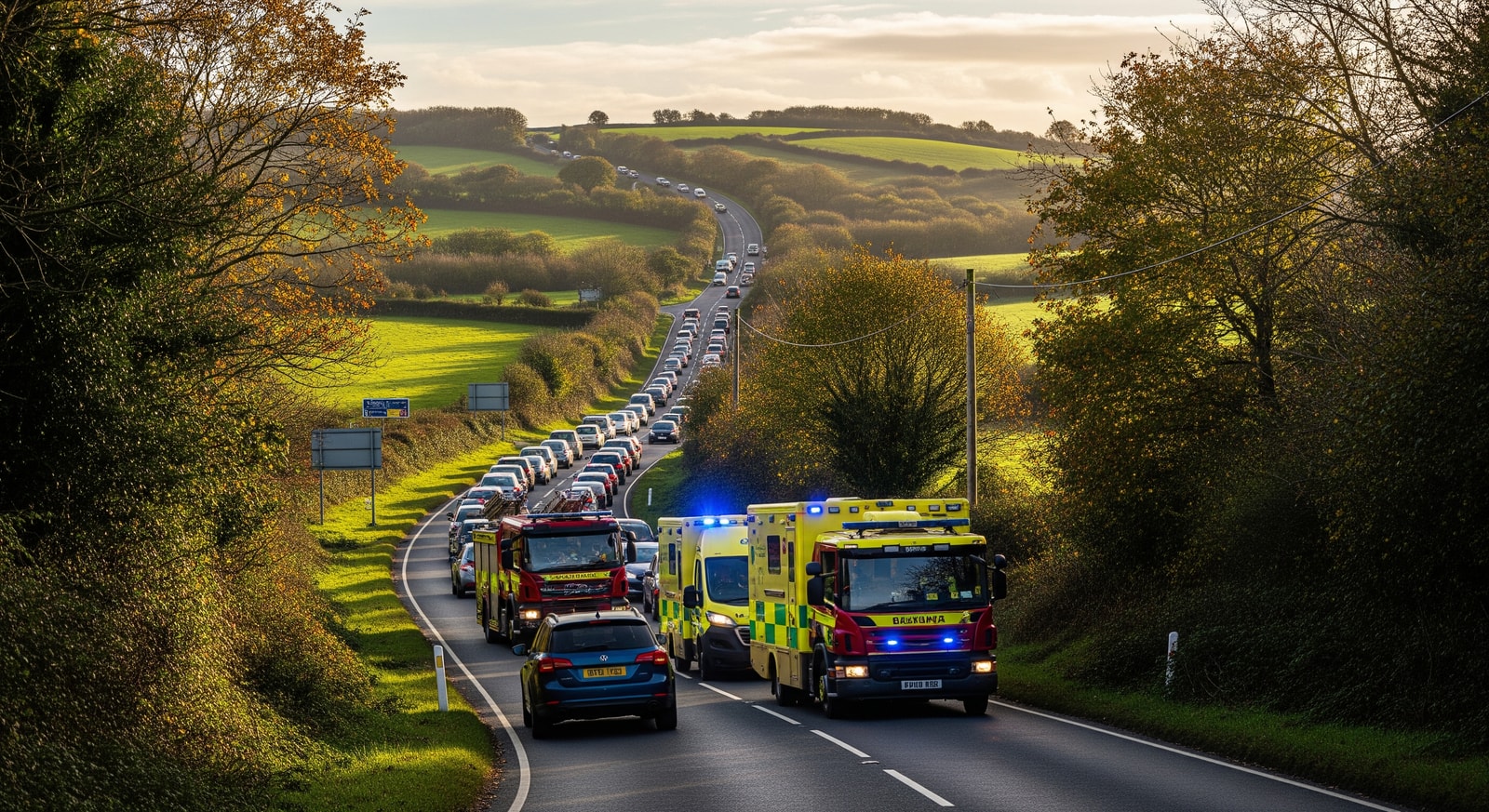
The A391 St Austell road closure has halted traffic between Bilberry and the Bodwen turn-off at Lockengate after a serious collision on 6 February 2026, causing major disruption for motorists and local services.
Summary: The A391 St Austell road closure has left the highway impassable in both directions after a serious collision on 6 February 2026. The affected section runs from Bilberry to the Bodwen turn-off at Lockengate, creating long tailbacks and forcing major diversions.
Local residents and through travellers faced severe disruption on 6 February 2026 after a significant collision led to an A391 St Austell road closure. The incident closed the main carriageway in both directions between Bilberry and the Bodwen turn-off at Lockengate, halting traffic on the primary link between the south coast and the A30.
Extent of the closure and traffic impact
Traffic monitoring systems and regional road reports show the blockage stretches from the centre of Bilberry through to the Bodwen/Lockengate junction. Mapping platforms recorded extended queues and near-stationary traffic as the primary corridor into St Austell was cut off, with sensors indicating 'red' congestion levels that have begun to affect nearby secondary roads.
Why the A391 matters to mid-Cornwall
The A391 serves as a vital artery for Mid-Cornwall, carrying both freight and passenger traffic into and out of St Austell. The Fairview junction, in particular, feeds traffic toward northern Cornwall; when it becomes blocked, local lanes and rural routes quickly become congested because they are not designed for high volumes or heavy goods vehicles.
- Closed section: Bilberry through to the Bodwen turn-off at Lockengate
- Both directions affected; long queues reported on approach roads
- Traffic sensors showing 'red' congestion with spillover to nearby lanes
Emergency response and site procedures
Devon and Cornwall Police have secured the scene while multiple agencies coordinate recovery and safety tasks. Although authorities have not released detailed findings on the cause of the collision, standard procedures are in effect to protect responders and allow for a methodical investigation before reopening the road.
- Medical and safety assessments to check all involved and stabilise vehicles
- Forensic documentation of the scene for legal and safety records
- Removal of debris and recovery of disabled vehicles
- Highway integrity checks by Cornwall Council contractors before reopening
Recommended diversions and travel advice
Motorists in the St Austell area are advised to use alternative primary routes and avoid side lanes that are unsuitable for heavy traffic. National Highways and Cornwall Council are monitoring diversion routes and the network impact in real time.
- A390: suggested for journeys toward Liskeard and east Cornwall
- A38: for traffic bound for the Plymouth area
- A30: access via alternative junctions; avoid the Bodwen turn-off
Public transport users should expect delays or cancellations as local bus services that normally use the A391 are being rerouted or held, which may create gaps in timetables. Travellers are urged to check Cornwall Council transport updates and National Highways regional alerts for live information.
What this means for travellers and local industry
The closure of a key A-road like the A391 can have immediate effects on commuter journeys, freight deliveries and tourism-related travel in Cornwall. Businesses relying on punctual deliveries and visitors planning onward connections should factor in extra time or consider alternate routes until authorities confirm the road is clear and safe for normal traffic.
So what? If you are travelling in or through the St Austell area, expect delays, follow official diversion signs, and avoid attempting to drive through cordoned-off sections. Monitoring Cornwall Council’s Twitter feed and the National Highways regional alerts page will provide the most up-to-date travel guidance as recovery work progresses.
Sources