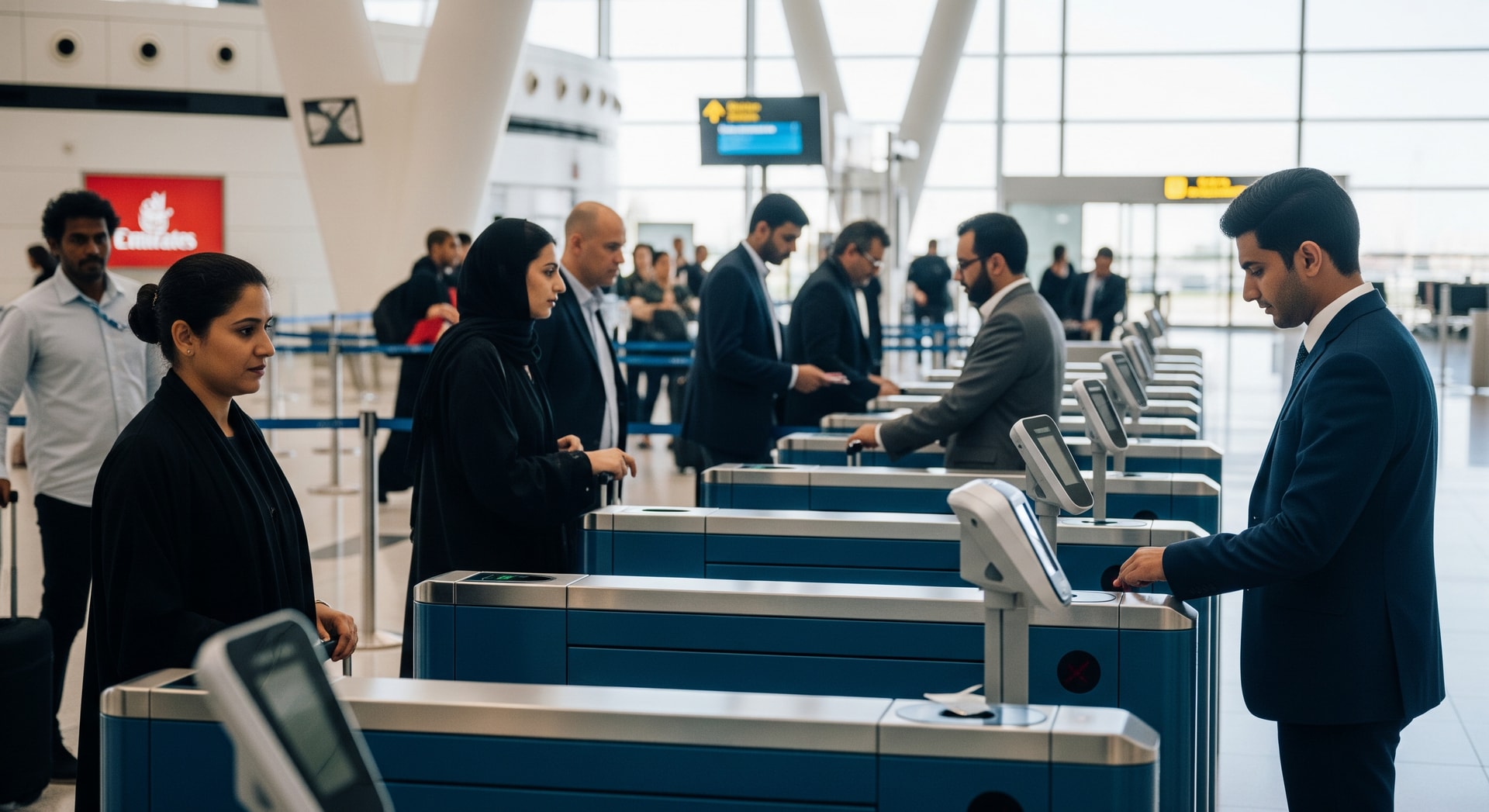
The One-Point Air Travellers project enables passengers to complete entry formalities before departure, reducing airport congestion and speeding cross-border travel between the UAE and Bahrain.
Summary: The UAE and Bahrain have launched a One-Point Air Travellers pilot allowing pre-departure completion of entry formalities. The programme aims to reduce arrival terminal congestion, speed up entry times, strengthen security through integrated technologies, and boost tourism and bilateral trade.
The United Arab Emirates and Bahrain have started a pilot called the One-Point Air Travellers project that lets citizens complete entry procedures at their departure airport, rather than on arrival. One-Point Air Travellers is designed to cut waiting times at arrival terminals and streamline cross-border journeys between the two countries.
How the One-Point Air Travellers pilot works
Under the programme, travellers departing from participating airports can clear immigration and other entry checks before boarding. Their identity and travel status are verified and recorded ahead of arrival, allowing them to bypass many standard arrival procedures and move through the destination airport more quickly.
Technologies and airports involved
The pilot relies on electronic connectivity between authorities in both countries and uses biometric verification, surveillance tools, e-gates, advanced passenger data processing, and integrated data exchange. The initiative's first phase will operate at Zayed International Airport in the UAE and Bahrain International Airport.
- Pre-departure clearance of immigration and related checks
- Use of biometrics and e-gates for identity verification
- Secure electronic data exchange between UAE and Bahraini authorities
- Deployment initially at Zayed International Airport and Bahrain International Airport
Authorities say the integrated approach reduces the need for duplicate checks on arrival and enhances the accuracy and security of passenger screening without adding arrival-side delays.

Who is leading the project
Implementation is being coordinated by the UAE's Federal Authority for Identity, Citizenship, Customs, and Port Security, while Bahrain's Ministry of Interior leads the Bahraini side. The Gulf Cooperation Council (GCC) and other relevant entities are also involved in the cross-border collaboration.
Expected economic and security benefits
Officials and experts say the pilot should make travel faster and more predictable while also supporting broader economic ties. Smoother entry processes can encourage tourism, ease business travel, and reduce friction in bilateral trade.
- Reduced terminal congestion and shorter arrival queues
- Quicker entry for travellers whose data are pre-cleared
- Boosts to tourism and more efficient business travel
- Stronger border security through integrated technologies
- Potential for improved regional transport and infrastructure links
The future: regional model for smart mobility
If the pilot proves successful, stakeholders expect it could be rolled out to additional airports across the GCC. The project is positioned as a potential blueprint for other countries seeking to modernise cross-border travel while protecting traveller data and maintaining high security standards.
Why this matters: For travellers, airlines, and governments, the One-Point Air Travellers pilot signals a shift toward more integrated, technology-driven border management. Passengers can expect shorter arrival procedures and less time in terminal queues; airlines and businesses may benefit from smoother connections and faster throughput; and authorities gain improved data accuracy and security.
Sources