Certified Sinhala & Tamil Document Translation
Professional translations from Sinhala and Tamil for Sri Lankan civil, academic, and legal documents. Accepted by USCIS, UK Home Office, Canada IRCC, and Australian immigration. Consular legalization coordinated through the Ministry of Foreign Affairs e-DAS platform.
TrustpilotSelect Languages
Drag & drop your documents here
or
PDF, JPEG, PNG, WebP — Max 10MB per file. Word documents: please save as PDF first.
Certified translators · Accepted by governments, courts & universities worldwide · View sample
Select a destination country to view pricing
How Sri Lankan Certified Translation Works
Submit Your Documents Securely
Upload clear scans of your Sri Lankan documents through our encrypted portal. We accept documents in Sinhala (සිංහල), Tamil (தமிழ்), and English — the three languages used in Sri Lankan official records. Our intake specialists identify the script, verify legibility of registrar stamps, divisional secretariat endorsements, and handwritten entries, and confirm completeness before translation begins. We accept PDF, JPEG, and PNG formats.
Script-Specific Translator Assignment
Your documents are matched with a translator fluent in the source language and its script. A Sinhala birth certificate from the Registrar General's Department requires different expertise than a Tamil marriage certificate registered in the Northern Province. Sri Lankan documents frequently contain bilingual or trilingual elements — headers in all three official languages with content in the registrar's working language — and our translators handle these mixed-language formats accurately.
Translation & Certification
The assigned translator produces your certified translation with a formal statement of accuracy, their professional credentials, signature, and date. A second qualified linguist reviews the translation for terminology accuracy, proper transliteration of Sinhala and Tamil names into the Latin alphabet, and completeness. The certification statement confirms the translation faithfully represents the original Sri Lankan document in its entirety.
Delivery with Full Documentation
Receive your certified translation as a high-resolution PDF for immediate use, with the original signed hard copy shipped via tracked international courier. For documents requiring authentication for international use, DoVisa can coordinate consular legalization through the Ministry of Foreign Affairs Consular Affairs Division and its Electronic Document Attestation System (e-DAS), followed by destination country embassy legalization as required.
Sri Lankan Translation Service Specifications
Popular Language Pairs
We support all languages — 100+ language pairs available for Sri Lankan documents, including Sinhala, Tamil, and English to any target language.
Common Documents
- Birth certificates (උප්පැන්න සහතිකය / பிறப்புச் சான்றிதழ்)
- Marriage certificates (විවාහ සහතිකය / திருமணச் சான்றிதழ்)
- Death certificates (මරණ සහතිකය / இறப்புச் சான்றிதழ்)
- Academic transcripts and degree certificates
- O/L and A/L examination certificates
- Police clearance certificates
- National Identity Card (NIC) documents
- Court orders and affidavits
- Property deeds and land registry documents
- Driving licenses and vehicle registration
Turnaround Time
Certification Details
Sri Lankan Translation Requirements & Regulatory Framework
Embassy Acceptance
Notarization Process
Apostille Information
Legal Framework
Common Scenarios for Sri Lankan Document Translation
US Immigration with Sri Lankan Documents
Sri Lankan nationals applying for US visas, green cards, or citizenship submit certified English translations of Sinhala and Tamil documents to USCIS. Common documents include birth certificates, marriage certificates, police clearance certificates, academic transcripts, and employment references. USCIS requires a translator's certificate of accuracy — DoVisa's certified translations meet this standard for all application types including family-based petitions (I-130), adjustment of status (I-485), and diversity visa lottery winners.
UK & Australian Visa Applications
The UK Home Office and the Australian Department of Home Affairs require certified English translations of all non-English Sri Lankan documents for visa and settlement applications. Sri Lankan nationals commonly submit translated birth certificates, marriage certificates, academic qualifications, and financial documents. DoVisa handles documents in both Sinhala and Tamil scripts and produces translations meeting UKVI and DHA requirements including translator credentials and signed accuracy statements.
Canadian Express Entry & PR Applications
Sri Lanka is a significant source country for Canadian permanent residency. IRCC requires certified translations of academic credentials, employment references, police clearances, and civil documents. Educational Credential Assessments (ECA) through WES require translated degree certificates and transcripts. DoVisa produces translations formatted specifically for IRCC and WES requirements, handling documents from all Sri Lankan provinces regardless of the language.
Academic Credential Evaluation
Sri Lankan academic documents — O/L and A/L certificates, university degree certificates, and transcripts — submitted to WES, ECE, NACES members, or UK ENIC may require certified English translations when issued in Sinhala or Tamil. Sri Lankan universities issue documents in the language of instruction, which varies by institution. DoVisa's academic translators understand the Sri Lankan grading system, degree nomenclature, and the distinction between government and private university credentials.
Gulf Country Employment Documentation
Hundreds of thousands of Sri Lankan workers in the UAE, Saudi Arabia, Qatar, Kuwait, and other Gulf countries require translated and authenticated documents for employment visas, family visas, and professional licensing. Common documents include educational certificates, marriage certificates, and police clearance certificates. DoVisa provides translations paired with consular legalization through the Ministry of Foreign Affairs e-DAS platform for Gulf employment documentation.
Cross-Border Family Law & Property Matters
International family law cases involving Sri Lankan documents — divorce decrees, custody orders, succession certificates, and property deeds — require certified translations for foreign court proceedings. Sri Lankan family law encompasses three parallel systems: general law, Kandyan law (applicable to Kandyan Sinhalese), and Muslim law — each with distinct documentation. DoVisa's legal translators handle complex Sri Lankan legal terminology across these systems.
Sinhala and Tamil Scripts: Sri Lanka's Dual Writing Systems
Sri Lanka's documents present a distinctive translation challenge due to the country's two official scripts. Sinhala script (සිංහල අක්ෂර) is an abugida derived from ancient Brahmi script, with 60 characters including 18 vowels, 42 consonants, and numerous conjunct forms. Tamil script (தமிழ் எழுத்து) is also an abugida with 12 vowels, 18 consonants, and 216 compound characters. Both scripts are visually complex, with characters that can be easily confused by translators unfamiliar with the specific writing system.
Official documents from the Registrar General's Department are typically issued in the language of the administrative district where the event was registered. Documents from the Western, Southern, Central, Sabaragamuwa, North Western, and Uva Provinces are predominantly in Sinhala, while documents from the Northern and Eastern Provinces are predominantly in Tamil. Many Sri Lankan official documents contain trilingual headers (Sinhala, Tamil, and English) with the substantive content in the registrar's working language. Some modern documents, particularly those from Colombo and major cities, are issued in English or as bilingual Sinhala-English or Tamil-English formats.
DoVisa maintains translators proficient in both Sinhala and Tamil scripts, each trained in Sri Lankan administrative terminology. Transliteration of Sinhala and Tamil names into the Latin alphabet follows the individual's passport spelling as the primary reference. Sri Lankan naming conventions differ between Sinhalese and Tamil communities — Sinhalese names typically include a given name and surname, while Tamil names may follow the patronymic system with the father's name preceding the given name. Our translators ensure consistent romanization across all translated documents.
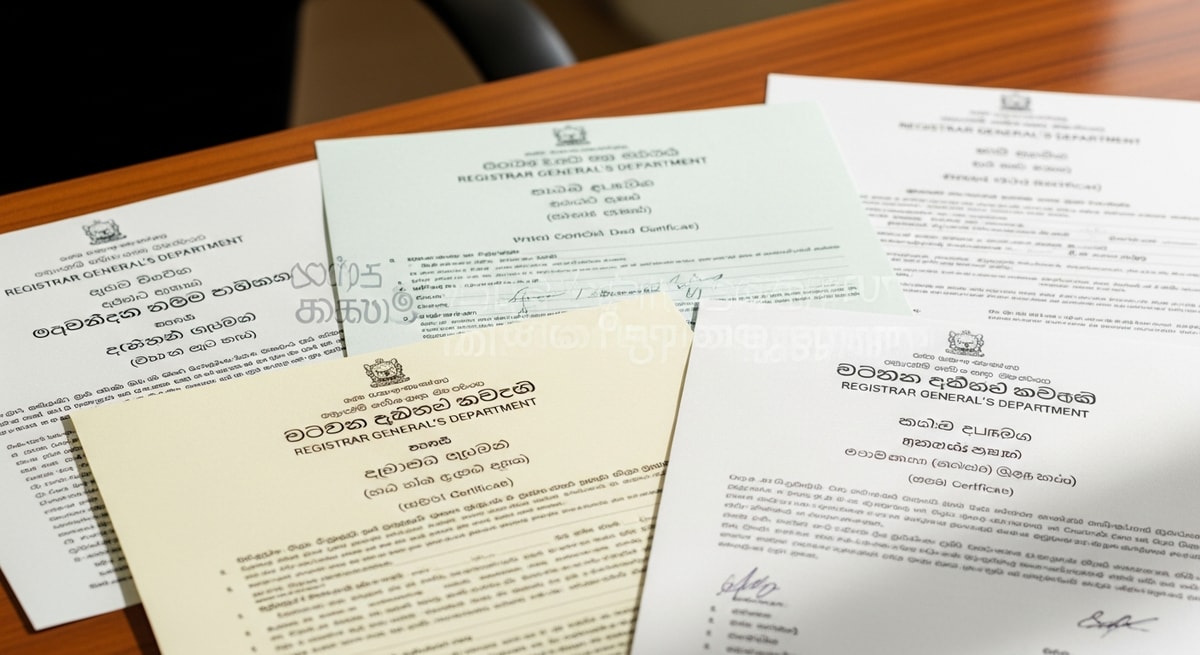
Sri Lankan documents arrive in Sinhala, Tamil, or English — often with trilingual headers
Consular Legalization: Authenticating Sri Lankan Documents for International Use
Sri Lanka is not a member of the Hague Apostille Convention. This means Sri Lankan documents cannot receive an apostille for international recognition. Instead, documents intended for use abroad must undergo consular legalization — a multi-step authentication process. The first step is authentication by the Consular Affairs Division of the Ministry of Foreign Affairs in Colombo. In February 2017, the Ministry launched the Electronic Document Attestation System (e-DAS), a cloud-based platform that reduced attestation processing time from approximately 5 hours to under 15 minutes per document. The e-DAS has attested over 250,000 documents and serves both domestic applicants and the approximately 2 million Sri Lankans living abroad.
After Ministry authentication through e-DAS, the document must be legalized by the embassy or consulate of the destination country in Sri Lanka. This second step varies by destination — some embassies process legalization within 1-2 business days, while others may take 1-2 weeks. The complete consular legalization chain typically takes 5-10 business days from initial submission to final legalization. For documents being sent to countries with Sri Lankan diplomatic missions, the process is straightforward; for countries without direct representation, documents may need to pass through a third-country embassy.
DoVisa coordinates the complete consular legalization process, managing both the Ministry of Foreign Affairs e-DAS authentication and the destination embassy legalization. This includes document preparation, submission scheduling, tracking, and delivery. For certified translations paired with legalization, DoVisa handles both services as a single coordinated workflow, ensuring the translated document and its authentication are delivered together.
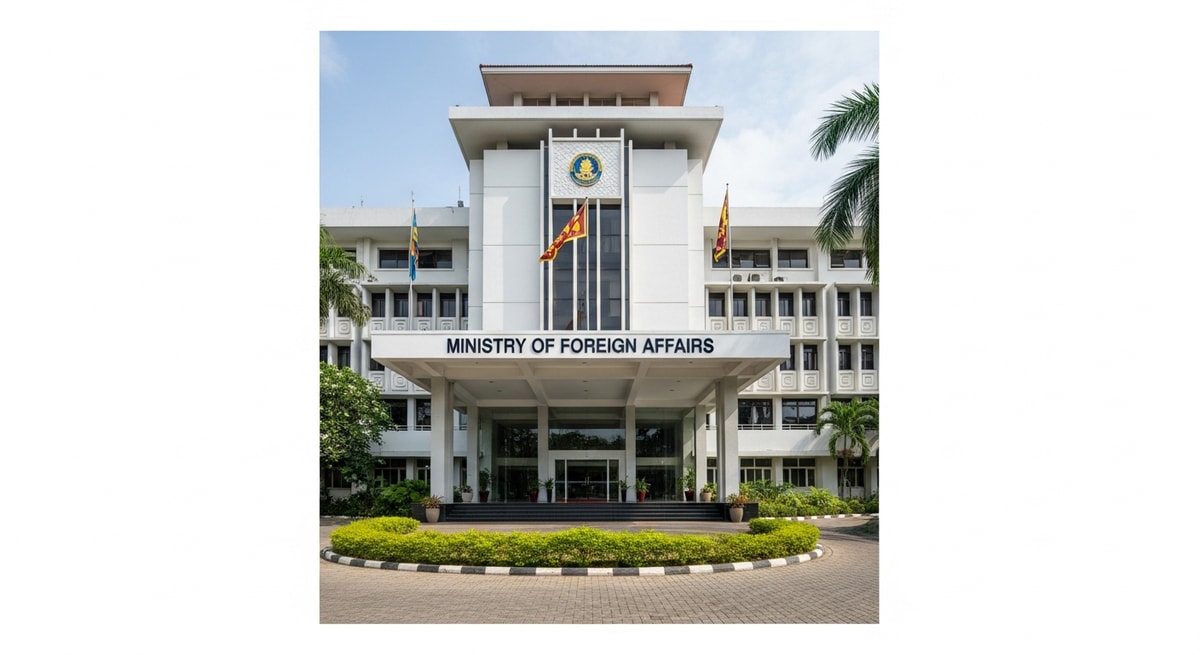
The Ministry of Foreign Affairs authenticates documents through its e-DAS electronic platform launched in 2017
Sri Lanka's Civil Registration and Vital Records System
Sri Lanka's civil registration system is administered by the Registrar General's Department (rgd.gov.lk), established under the Births and Deaths Registration Act (originally Ordinance No. 17 of 1951). The Department operates through 334 Divisional Secretariats across the island, each with appointed Registrars of Births, Marriages, and Deaths. Civil registration has been maintained since 1867, making Sri Lanka one of the earliest South Asian countries to establish a formal registration system.
Sri Lanka's marriage registration system is notably complex due to the coexistence of three parallel legal frameworks: the General Marriage Registration Ordinance (applicable to most citizens), Kandyan Marriage and Divorce Act (applicable to Kandyan Sinhalese in the central highlands), and Muslim Marriage and Divorce Act (applicable to Muslim citizens). Each system produces different certificate formats, in different languages, with different registrar designations. A Kandyan marriage certificate from Kandy may be in Sinhala under the Kandyan registrar, while a general law marriage certificate from Colombo may be in English under the general registrar. DoVisa's translators are familiar with all three marriage registration systems and their respective documentation formats.
The Registrar General's Department launched the eBMD Online Portal (online.ebmd.rgd.gov.lk) for requesting certified copies of birth, marriage, and death certificates online. This modernization effort has improved access to vital records, but older documents — particularly those predating digitalization or from conflict-affected Northern and Eastern Provinces — may require special handling. DoVisa's team is experienced with both modern standardized formats and legacy handwritten Sri Lankan civil documents dating back to the colonial era.
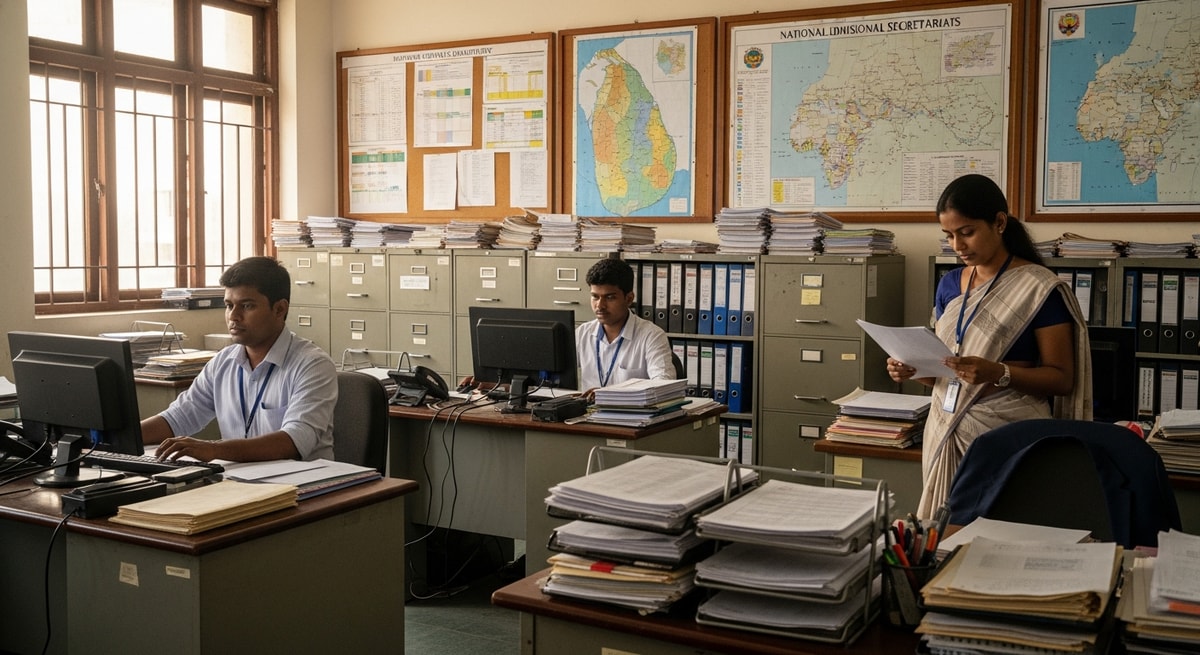
The Registrar General's Department has maintained Sri Lanka's civil records since 1867
"Sinhala birth certificate and marriage certificate translated for my US green card application. DoVisa delivered both in 3 days. USCIS accepted everything without a single RFE. The translator handled the Sinhala script perfectly."
"Tamil academic transcripts from University of Jaffna translated for WES credential evaluation in Canada. The translator captured all the grading terminology accurately. WES processed my ECA without any clarifications needed."
"Sinhala marriage certificate translated for my UK spouse visa application. The Home Office accepted the translation without issues. Giving 4 stars because standard delivery took the full 6 days, but the quality was excellent."
"Four documents translated from Sinhala for my Australian skilled visa — birth certificate, degree, transcript, and police clearance. Department of Home Affairs accepted all translations on first submission. Very professional service."
"Tamil birth certificate from Batticaloa translated for my Canadian PR application. IRCC accepted the translation immediately. The translator correctly romanized my Tamil name to match my passport spelling — important detail."
"Sinhala degree certificate from University of Colombo translated for a job application in the UK. The employer accepted the translation. Good quality work, though I wish express delivery was a bit faster."
"Needed my Sinhala birth certificate and NIC documents translated for USCIS naturalization. The translator handled all the Sinhala script accurately and the certification met USCIS requirements. Accepted at my N-400 interview."
"Tamil marriage certificate translated for Australian partner visa. The initial delivery had a minor spelling error in a place name. DoVisa corrected it within a few hours after I flagged it. The corrected version was accepted by Home Affairs."
"Sinhala police clearance certificate and birth certificate translated with Ministry of Foreign Affairs authentication for employment in Qatar. DoVisa coordinated the e-DAS attestation and embassy legalization together. Everything accepted by the Qatari employer."
"Bilingual Sinhala-English Kandyan marriage certificate translated for a Canadian family sponsorship application. The translator understood the Kandyan marriage registration format and handled it professionally. IRCC accepted without questions."
"Tamil academic certificates from Eastern University translated for WES evaluation. The translator properly handled the university-specific grading system and degree nomenclature. WES processed my assessment smoothly. Satisfied with the service."
"Sinhala birth certificate and marriage certificate translated for my US green card application. DoVisa delivered both in 3 days. USCIS accepted everything without a single RFE. The translator handled the Sinhala script perfectly."
"Tamil academic transcripts from University of Jaffna translated for WES credential evaluation in Canada. The translator captured all the grading terminology accurately. WES processed my ECA without any clarifications needed."
"Sinhala marriage certificate translated for my UK spouse visa application. The Home Office accepted the translation without issues. Giving 4 stars because standard delivery took the full 6 days, but the quality was excellent."
Sri Lankan Document Translation FAQs
What types of Sri Lankan documents can DoVisa translate?
DoVisa translates all types of Sri Lankan documents including birth certificates (උප්පැන්න සහතිකය / பிறப்புச் சான்றிதழ்), marriage certificates (under general, Kandyan, and Muslim marriage laws), death certificates, academic transcripts and degree certificates, O/L and A/L examination certificates, police clearance certificates, court orders, affidavits, property deeds, and National Identity Card (NIC) documents. We handle documents in Sinhala, Tamil, and English, including bilingual and trilingual formats issued by the Registrar General's Department.
Are the translations certified or sworn?
DoVisa provides certified translations with a formal statement of accuracy, translator credentials, signature, and date. These certified translations are accepted by international immigration authorities including USCIS, UK Home Office, Canada IRCC, and Australian Department of Home Affairs. Sri Lanka separately maintains a sworn translator system through the Ministry of Justice — sworn translators pass a written examination and take an oath before a District Court Judge. For submission to Sri Lankan domestic authorities, a sworn translation may be required. DoVisa can coordinate sworn translations through our network of Ministry of Justice-registered sworn translators upon request.
Do I need a sworn translator for Sri Lankan documents?
It depends on where the translated document will be used. For submission to international immigration authorities (USCIS, UK Home Office, IRCC, Australian DHA), DoVisa's certified translations are accepted without a sworn translator. For submission to Sri Lankan domestic authorities such as courts, government ministries, or the Registrar General's Department, a sworn translation by a Ministry of Justice-registered sworn translator is typically required. Sri Lanka's sworn translators cover language pairs including Sinhala/English, Tamil/English, and Sinhala/Tamil. DoVisa can arrange sworn translations through our network when needed.
How long does Sri Lankan document translation take?
Standard certified translation is delivered within 4-6 business days. Express processing is available for 2-3 business days, and rush delivery within 24 hours is available for single-page vital records such as birth, marriage, and death certificates. If consular legalization through the Ministry of Foreign Affairs is also required, the additional authentication process typically takes 5-10 business days after translation is complete.
What languages does DoVisa translate Sri Lankan documents to and from?
DoVisa translates Sri Lankan documents from Sinhala, Tamil, and English into over 100 target languages. The most common translation pairs for Sri Lankan documents are Sinhala to English, Tamil to English, and English to Sinhala or Tamil. We also provide translations into Arabic (for Gulf country employment), German, French, Italian, Japanese, Korean, and many other languages. Our translators are proficient in both the Sinhala script (සිංහල අක්ෂර) and Tamil script (தமிழ் எழுத்து).
Will the translation be accepted by USCIS and other immigration authorities?
Yes. DoVisa's certified translations of Sri Lankan documents are accepted by all major immigration authorities worldwide. USCIS requires each translation to include a translator's certificate of accuracy — our translations meet this standard for all visa and immigration application types. The UK Home Office (UKVI), Canada IRCC, Australian Department of Home Affairs, and New Zealand Immigration all accept our certified translations. Our current acceptance rate at these authorities is 98.5%.
Can Sri Lankan documents get an apostille?
No. Sri Lanka is not a member of the Hague Apostille Convention. Documents from Sri Lanka cannot receive an apostille. Instead, documents intended for international use must undergo consular legalization: first, authentication by the Ministry of Foreign Affairs Consular Affairs Division through the Electronic Document Attestation System (e-DAS), and then legalization by the destination country's embassy or consulate in Sri Lanka. This process typically takes 5-10 business days. DoVisa coordinates the complete consular legalization chain for Sri Lankan documents.
How much does certified Sri Lankan translation cost?
DoVisa's Sri Lankan translation pricing follows a transparent per-page structure with volume discounts that apply automatically for larger projects. Pricing varies based on document length, source language (Sinhala or Tamil), and processing speed. Express and rush service options are available at additional rates. Consular legalization through the Ministry of Foreign Affairs is quoted separately. Upload your documents on our order page for an instant, detailed quote — no hidden fees.
Can DoVisa translate handwritten Sri Lankan documents?
Yes. Many older Sri Lankan civil documents, particularly those issued before the Registrar General's Department digitalized its records, contain handwritten entries in Sinhala or Tamil script. Older birth certificates, marriage registers, and property deeds from the colonial era may be partially or fully handwritten in Sinhala, Tamil, or English. Our translators are experienced with legacy Sri Lankan document formats from all regions. For very old or degraded documents where portions are illegible, the translator notes any unreadable sections in the certification statement. We recommend uploading the highest-quality scan possible.
What format will I receive the translation in?
You will receive your certified translation as a high-resolution PDF via email for immediate use, followed by the original signed hard copy shipped via tracked international courier. The PDF includes the certified translation, the translator's certificate of accuracy with credentials and signature, and a copy of the original source document. For immigration applications, most authorities accept the PDF version while some may require the original signed copy — we provide both as standard.
My Sri Lankan document is bilingual — do I still need a translation?
Some Sri Lankan documents, particularly modern ones from Colombo and major cities, are issued in bilingual format (Sinhala-English or Tamil-English). If the English portion is complete, legible, and contains all required information, some authorities may accept it without additional translation. USCIS generally accepts the English portion of bilingual documents if it is comprehensive. However, if the English portion is incomplete, illegible, or omits required fields, a certified translation of the full document is necessary. DoVisa can review your bilingual document and advise whether a translation is needed.
What is the e-DAS system and how does it help with document authentication?
The Electronic Document Attestation System (e-DAS) is Sri Lanka's digital platform for document authentication, launched by the Ministry of Foreign Affairs in February 2017. It replaced the manual attestation process, reducing processing time from approximately 5 hours to under 15 minutes per document. The e-DAS enables diplomatic missions and foreign institutions to directly verify the authenticity of attested Sri Lankan documents online, reducing the risk of fraud. The system has processed over 250,000 documents and serves both domestic applicants and the approximately 2 million Sri Lankans living abroad. DoVisa submits documents for authentication through the e-DAS platform as part of our consular legalization service.
Get Your Sri Lankan Documents Translated Today
Professional certified translations from Sinhala and Tamil, accepted by USCIS, UK Home Office, Canada IRCC, and Australian immigration