
Certified Bengali Document Translation
Professional certified translations of Bangladeshi documents accepted by immigration authorities, courts, and embassies worldwide. Apostille and e-Apostille services available through the Bangladesh Ministry of Foreign Affairs.
TrustpilotSelect Languages
Drag & drop your documents here
or
PDF, JPEG, PNG, WebP — Max 10MB per file. Word documents: please save as PDF first.
Certified translators · Accepted by governments, courts & universities worldwide · View sample
Select a destination country to view pricing
How Bangladesh Certified Translation Works
Submit Your Documents Securely
Upload clear scans of your Bangladeshi documents through our encrypted portal. We accept PDF, JPEG, and PNG formats. Our intake specialists review each upload for legibility, checking that Bengali script (বাংলা লিপি) text, stamps, and signatures are fully visible. If a rescan is needed, we contact you immediately before translation begins.
Professional Translator Assignment
Your documents are matched with a certified translator who is fluent in Bengali (বাংলা) and your target language. Our translators have expertise in Bangladeshi legal terminology, civil registration documents issued by the Office of the Registrar General (রেজিস্ট্রার জেনারেলের কার্যালয়), and academic credentials from Bangladeshi universities and boards. We verify each translator's qualifications before assignment.
Translation & Certification
The translator produces your certified translation, carefully rendering Bengali text into the target language while preserving the legal meaning and structure of the original document. A second qualified linguist reviews terminology, formatting, and accuracy. The certification statement attests to the completeness and accuracy of the translation, suitable for submission to government authorities worldwide.
Delivery with Full Certification
Receive your certified translation as a high-resolution PDF for immediate use, with the original hard copy shipped via tracked international courier. If you require an apostille or e-Apostille from the Bangladesh Ministry of Foreign Affairs, DoVisa coordinates the entire process. Documents are delivered in formats accepted by USCIS, UK Visas and Immigration, IRCC, and embassies worldwide.
Bangladesh Translation Service Specifications
Popular Language Pairs
We support all languages — 100+ language pairs available for Bangladesh documents.
Common Documents
- Birth registration certificates (জন্ম নিবন্ধন সনদ)
- Marriage registration certificates (বিবাহ নিবন্ধন সনদ / কাবিননামা)
- Death certificates (মৃত্যু সনদ)
- Academic transcripts and diplomas (শিক্ষাগত সনদপত্র)
- Police clearance certificates (পুলিশ ক্লিয়ারেন্স সার্টিফিকেট)
- National identity cards (জাতীয় পরিচয়পত্র)
- Passport biodata pages
- Court judgments and legal documents (আদালতের রায়)
- Employment certificates and experience letters
- Medical certificates and health reports
Turnaround Time
Certification Details
Bangladesh Translation Requirements & Regulatory Framework
Embassy Acceptance
Notarization Process
Apostille Information
Legal Framework
Common Scenarios for Bangladesh Document Translation
Immigration & Visa Applications
Bangladeshi nationals applying for visas, permanent residency, or citizenship in countries such as the United States, Canada, United Kingdom, and Australia require certified translations of birth certificates (জন্ম নিবন্ধন সনদ), police clearance certificates, academic credentials, and marriage certificates. USCIS, IRCC, and the UK Home Office all require certified English translations accompanying original Bengali-language documents. DoVisa provides translations formatted to meet each immigration authority's specific requirements.
Overseas Employment & BMET Processing
Bangladesh is one of the world's largest labor-exporting countries, with millions of workers employed in the Middle East, Southeast Asia, and beyond. The Bureau of Manpower, Employment and Training (BMET) and the Ministry of Expatriates' Welfare and Overseas Employment require translated employment contracts, skills certificates, and medical reports for overseas worker processing. DoVisa translates these documents into Arabic, Malay, Korean, Japanese, and other languages required by destination countries.
Marriage Registration & Family Documents
Cross-border marriages involving Bangladeshi nationals require certified translations of কাবিননামা (Muslim marriage contracts), বিবাহ নিবন্ধন সনদ (marriage registration certificates), divorce decrees, and birth certificates for spousal or family reunification visa applications. Our translators understand the specific terminology used in Bangladeshi marriage documents across Muslim, Hindu, and special marriage registrations, ensuring accurate translations accepted by foreign authorities.
Academic Credential Evaluation
Bangladeshi students and professionals applying to foreign universities or seeking credential evaluation through WES, ECE, or other NACES-member agencies need certified translations of Secondary School Certificates (SSC), Higher Secondary Certificates (HSC), university transcripts, and degree certificates issued by the Bangladesh Education Board or universities. Our academic translators are familiar with the Bangladeshi education system's grading conventions and institutional terminology.
Business & Corporate Documentation
Companies operating in Bangladesh or Bangladeshi businesses expanding internationally require translations of trade licenses, articles of incorporation, board resolutions, tax identification certificates, and regulatory filings. Documents issued by the Registrar of Joint Stock Companies and Firms (RJSC), the National Board of Revenue (NBR), and the Bangladesh Investment Development Authority (BIDA) frequently require certified translation for foreign partners, investors, and regulatory bodies.
Bengali Script: Translating the Bangla Writing System
Bengali (বাংলা) is written in the Bangla script (বাংলা লিপি), an abugida descended from the ancient Brahmi script. The script contains 11 vowels (স্বরবর্ণ) and 39 consonants (ব্যঞ্জনবর্ণ), but the real complexity lies in its extensive system of conjunct consonants (যুক্তবর্ণ) — over 300 combined character forms created when consonants cluster together. For example, the word ত্রিভুজ (triangle) contains the conjunct ত্র, which merges ত and র into a single visual form. Translators must recognize these conjuncts accurately, as misreading a single conjunct can change the meaning of a word entirely.
Bangladeshi official documents present additional challenges beyond standard Bengali text. Many civil registration documents use formal or legal Bengali (সাধু ভাষা or formal চলিত ভাষা) that differs from everyday spoken Bengali. Birth certificates issued by the Office of the Registrar General contain standardized fields in Bengali, but handwritten entries — especially in older documents — may use regional spelling variations or informal script styles that require specialized knowledge to decipher. Marriage certificates (কাবিননামা) for Muslim marriages often contain a mix of Bengali and Arabic text, as religious invocations and certain legal terms are traditionally written in Arabic script.
DoVisa's Bengali translators are native speakers with expertise in reading both printed and handwritten Bengali documents. They understand regional variations in spelling and terminology across Bangladesh's eight administrative divisions, from Dhaka and Chittagong to Sylhet and Rajshahi. For documents containing mixed scripts — Bengali, Arabic, and occasionally English — our translators handle the full document without requiring multiple specialists, ensuring consistency and accuracy throughout the translation.
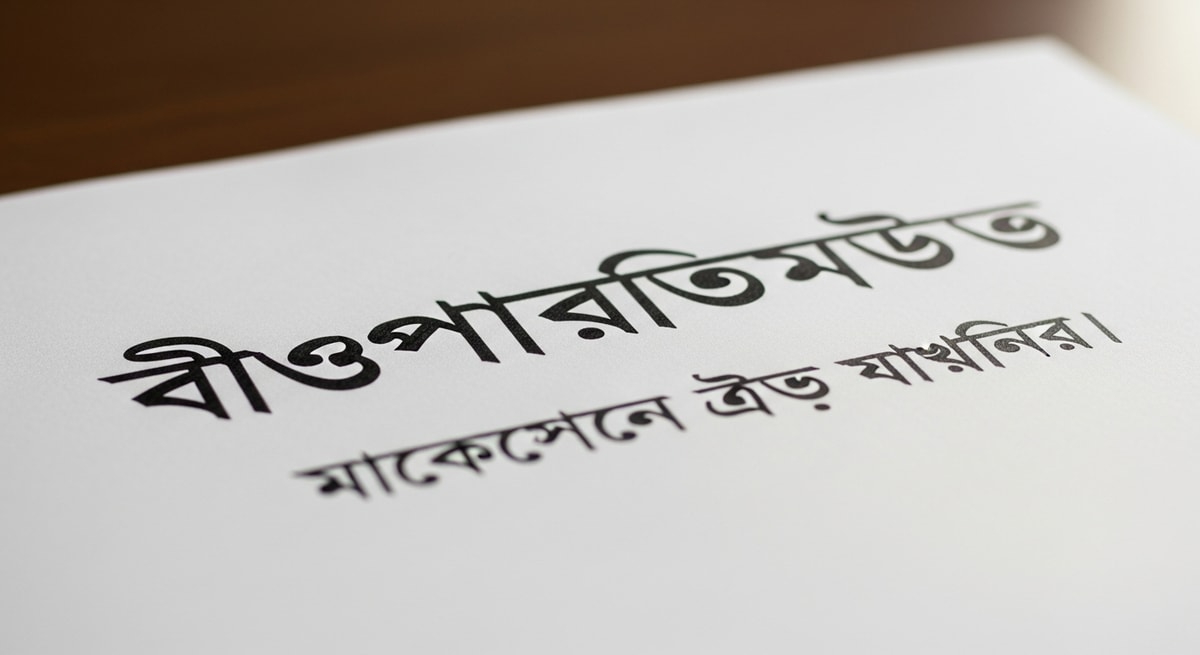
Bengali script's conjunct consonant system requires specialized translator expertise for accurate document translation
Bangladesh's Document Authentication System and the New Apostille Framework
Bangladesh's entry into the Hague Apostille Convention on 30 March 2025 marked a significant shift in how Bangladeshi documents are authenticated for international use. Previously, the authentication process required a multi-step chain: (1) notarization by a notary public under the Notaries Ordinance, 1961, (2) attestation by the Ministry of Foreign Affairs, and (3) legalization by the destination country's embassy in Dhaka. This process could take several weeks and involved multiple government offices. The new apostille system simplifies international document authentication to a single step through the Ministry of Foreign Affairs.
The Ministry of Foreign Affairs, through its Director General (Consular and Welfare) at the Segunbagicha office in Dhaka, is the sole competent authority for issuing apostilles in Bangladesh. Uniquely, Bangladesh launched its apostille system with a fully digital e-Apostille platform integrated into the government's MyGov portal. The e-Apostille system uses end-to-end encryption, digital signatures, and QR code verification, allowing recipients anywhere in the world to instantly verify the authenticity of an apostilled document online. Standard processing through the e-Apostille system takes approximately 5 business days.
An important consideration for Bangladeshi document holders: five countries — Belgium, Finland, Austria, Czech Republic, and Germany — have formally objected to Bangladesh's accession to the Convention. This means apostilles issued by Bangladesh are not recognized by these five countries, and documents destined for use there still require the traditional consular legalization process. DoVisa monitors these objections and advises clients on the correct authentication path for their specific destination country, ensuring documents are processed through the appropriate channel.
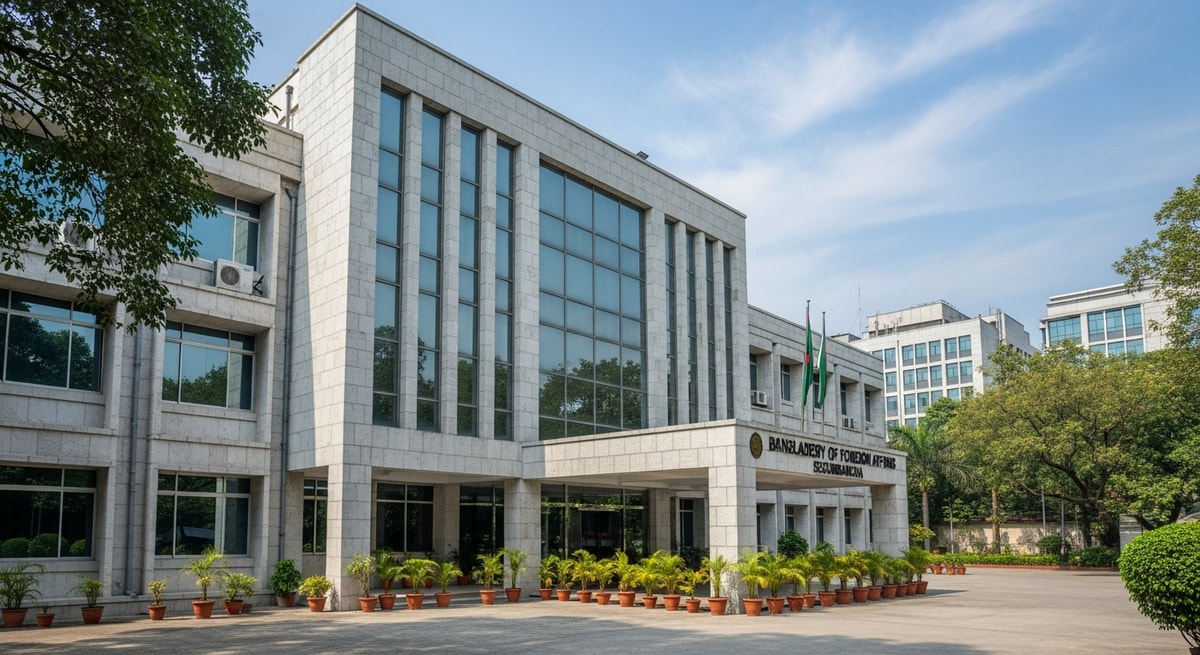
The Ministry of Foreign Affairs in Dhaka serves as Bangladesh's sole competent authority for apostille issuance
Bangladesh's Civil Registration System and Vital Records Translation
Bangladesh's civil registration system is managed by the Office of the Registrar General, Birth and Death Registration (রেজিস্ট্রার জেনারেলের কার্যালয়, জন্ম ও মৃত্যু নিবন্ধন), which operates under the Ministry of Local Government, Rural Development, and Co-operatives. The Birth and Death Registration Act, 2004 (amended in 2013) made birth and death registration compulsory throughout Bangladesh. Birth registration certificates (জন্ম নিবন্ধন সনদ) are issued through the Bangladesh Birth and Death Registration Information System (BDRIS), an online portal that has digitized much of the registration process since its launch.
Translating Bangladeshi vital records requires understanding the specific format and content of these documents. A standard জন্ম নিবন্ধন সনদ includes the registrant's name in Bengali, parents' names, date of birth (typically in both Bengali and English numerals), place of birth at the union/municipality level, and a unique 17-digit registration number. Marriage registration follows different pathways depending on religious tradition: Muslim marriages are registered under the Muslim Marriages and Divorces (Registration) Act, 1974, producing a কাবিননামা; Hindu marriages are registered under the Hindu Marriage Registration Act, 2012; and special marriages (inter-faith or civil) follow the Special Marriage Act, 1872. Each type of marriage document has distinct formatting, terminology, and legal provisions that translators must render accurately.
Older Bangladeshi documents — particularly those issued before the BDRIS digitization — may be handwritten in Bengali on pre-printed government forms. These legacy documents sometimes contain stamps from local union councils (ইউনিয়ন পরিষদ) or municipal offices with varying levels of legibility. DoVisa's translators have extensive experience with both modern digitally-issued certificates and older handwritten documents from all eight divisions of Bangladesh, ensuring accurate translation regardless of the document's age or format.
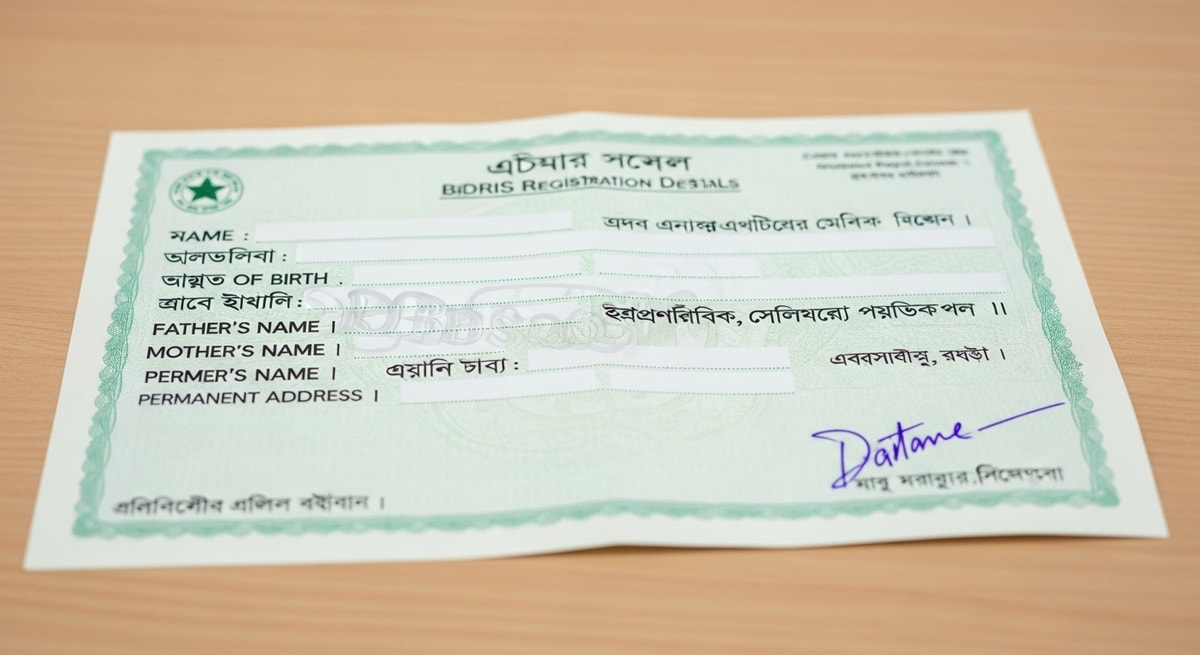
Bangladesh's BDRIS system issues digital birth certificates that require specialized Bengali-to-English translation
"Needed my Bangladeshi birth certificate (জন্ম নিবন্ধন সনদ) translated to English for my USCIS green card application. The translator handled the Bengali script flawlessly and USCIS accepted the translation without any RFE. Excellent work."
"DoVisa translated my কাবিননামা (Muslim marriage certificate) for a UK spouse visa. The Home Office accepted the translation immediately. They even correctly handled the Arabic text sections within the Bengali document."
"Good translation of my Bangladeshi police clearance certificate for IRCC Express Entry. The translation was accurate and accepted by Canadian immigration. Would have liked slightly faster delivery but standard turnaround was as promised."
"Had my HSC and university transcripts translated for WES credential evaluation in Canada. DoVisa correctly rendered all the Bangladeshi grading terminology and WES processed my evaluation without requesting any revisions."
"Translated my employment contract and skills certificate from Bengali to Arabic for BMET clearance for a job in Saudi Arabia. The Arabic translation was perfect and accepted by the Saudi embassy in Dhaka without issues."
"Bengali to English translation of my Bangladeshi academic transcripts for an Australian skilled visa application. Department of Home Affairs accepted the translations. Formatting was clean and professional."
"Needed birth certificates for my entire family translated for our New Zealand residency application. Four documents total, all in Bengali. DoVisa delivered within 5 days and Immigration New Zealand accepted everything on first submission."
"My Bangladeshi death certificate translation had a small error in the romanization of a village name. DoVisa corrected it within a few hours after I flagged it. The corrected version was accepted by the UK probate court, but the initial error was disappointing."
"Corporate documents for our Dhaka-based company translated to English for a UK business partner. Trade license, articles of incorporation, and board resolutions — all translated accurately with proper legal terminology. Companies House accepted everything."
"Translated my Bangladeshi divorce decree from Bengali to English for a USCIS immigration petition. The legal terminology was handled well and the translation was accepted. Good service overall."
"DoVisa translated my medical certificates and employment references from Bengali for my Malaysian work permit application. The Malaysian immigration authority accepted the translations without any follow-up. Very professional service."
"Needed my Bangladeshi birth certificate (জন্ম নিবন্ধন সনদ) translated to English for my USCIS green card application. The translator handled the Bengali script flawlessly and USCIS accepted the translation without any RFE. Excellent work."
"DoVisa translated my কাবিননামা (Muslim marriage certificate) for a UK spouse visa. The Home Office accepted the translation immediately. They even correctly handled the Arabic text sections within the Bengali document."
"Good translation of my Bangladeshi police clearance certificate for IRCC Express Entry. The translation was accurate and accepted by Canadian immigration. Would have liked slightly faster delivery but standard turnaround was as promised."
Bangladesh Document Translation FAQs
What types of Bangladeshi documents can be translated?
We translate all types of Bangladeshi documents including birth registration certificates (জন্ম নিবন্ধন সনদ), marriage certificates (বিবাহ নিবন্ধন সনদ and কাবিননামা), death certificates (মৃত্যু সনদ), academic transcripts and diplomas from Bangladeshi education boards and universities, police clearance certificates (পুলিশ ক্লিয়ারেন্স সার্টিফিকেট), national identity cards, court judgments, employment certificates, medical reports, trade licenses, and corporate documents. All translations are certified and accepted by government agencies worldwide.
Are the translations certified and accepted internationally?
Yes. Every DoVisa translation includes a signed certification statement attesting to the accuracy and completeness of the translation. Our certified translations are accepted by USCIS (United States), UK Visas and Immigration, IRCC (Canada), the Australian Department of Home Affairs, Immigration New Zealand, credential evaluation agencies (WES, ECE, NACES members), and embassies worldwide. For additional authentication, Bangladesh is a member of the Hague Apostille Convention and we can arrange apostille or e-Apostille certification through the Ministry of Foreign Affairs.
How long does certified translation of Bangladeshi documents take?
Standard certified translation is delivered within 4-6 business days. Express processing is available for 2-3 business days, and rush delivery within 24 hours is offered for select document types such as single-page birth certificates and police clearance certificates. Turnaround time depends on document length, complexity, and the language pair. Bengali documents with handwritten entries or mixed scripts (Bengali and Arabic) may require slightly longer processing. If you also need apostille certification, the Ministry of Foreign Affairs processing adds approximately 5 business days.
What languages can Bangladeshi documents be translated into?
We translate Bangladeshi documents from Bengali (বাংলা) into English and over 100 other languages. The most commonly requested language pairs for Bangladesh include Bengali to English, Bengali to Arabic (for Gulf state employment), Bengali to Malay (for Malaysian work permits), Bengali to Korean (for the EPS program), Bengali to Japanese, and Bengali to French. We also translate documents from English and other languages into Bengali for use within Bangladesh.
Will the translation be accepted by immigration authorities?
Yes. Our certified translations meet the requirements of all major immigration authorities. USCIS requires a certified English translation for any foreign-language document, and our certification statement meets their specific formatting requirements. IRCC (Canada), UK Visas and Immigration, and the Australian Department of Home Affairs all accept our certified translations. For Gulf state employment through BMET, we provide Arabic translations that meet the requirements of Saudi, UAE, Qatari, Kuwaiti, and other destination country authorities. Our current acceptance rate at immigration authorities is 98.5%.
Do I need notarization with my Bangladeshi document translation?
It depends on the destination and purpose. Many international authorities — including USCIS, IRCC, and UK Visas and Immigration — accept certified translations without notarization. However, if you need an apostille from the Bangladesh Ministry of Foreign Affairs, the translation must first be notarially attested under the Notaries Ordinance, 1961. Some destination countries and specific institutions may also require notarization. DoVisa can arrange notarial attestation by a Bangladesh-qualified notary public when needed, as part of our full-service document authentication process.
Can Bangladeshi documents get an apostille?
Yes. Bangladesh became a member of the Hague Apostille Convention on 30 March 2025. The Ministry of Foreign Affairs in Dhaka is the designated competent authority, and apostilles are issued through the Director General (Consular and Welfare). Bangladesh also offers an e-Apostille system via the MyGov platform with digital signatures and QR code verification. Standard processing takes approximately 5 business days. However, five countries — Belgium, Finland, Austria, Czech Republic, and Germany — have objected to Bangladesh's accession and do not currently recognize Bangladeshi apostilles. For these countries, traditional consular legalization remains required.
How much does certified translation of Bangladeshi documents cost?
Our pricing follows a transparent per-page structure with automatic volume discounts for larger documents. The cost depends on document length, language pair, and processing speed selected. Express and rush service options are available for time-sensitive projects. Apostille processing through the Ministry of Foreign Affairs is quoted separately. Upload your documents on our order page to receive an instant, detailed quote before any work begins — there are no hidden fees.
Can you translate handwritten Bangladeshi documents?
Yes. Many older Bangladeshi documents — particularly birth certificates issued before the BDRIS digitization, court records, and land documents — are handwritten in Bengali on pre-printed government forms. Our translators are experienced with handwritten Bengali script, including regional spelling variations and older handwriting styles found across Bangladesh's eight divisions. For legibility, we recommend uploading the highest quality scan possible. If any portion of a handwritten document is unclear, our team will contact you before proceeding to discuss the specific section and ensure accuracy.
What format will I receive the translation in?
You will receive your certified translation as a high-resolution PDF delivered via email, which includes the full translation, certification statement, and a copy of the original document. This digital version is suitable for online submissions to most immigration authorities and credential evaluation agencies. A physical hard copy with original signatures is shipped via tracked international courier to your address. If an apostille or e-Apostille is requested, the apostilled document is included with the hard-copy shipment, or the e-Apostille is provided as a digitally signed PDF with a QR verification code.
How do you handle the Bengali and Arabic mixed text in Bangladeshi marriage certificates?
Bangladeshi Muslim marriage certificates (কাবিননামা) typically contain a mix of Bengali text for personal details and legal provisions, and Arabic text for religious invocations (বিসমিল্লাহ) and Quranic references. Our translators are proficient in both Bengali and Arabic scripts, allowing them to translate the complete document without requiring multiple specialists. The Arabic religious text is translated and annotated to explain its ceremonial function in the document. Hindu marriage certificates registered under the Hindu Marriage Registration Act, 2012 are primarily in Bengali, and special marriage certificates under the Special Marriage Act, 1872 may contain English alongside Bengali.
What is the e-Apostille system for Bangladesh?
Bangladesh launched a fully digital e-Apostille system through the government's MyGov platform when the Apostille Convention entered into force on 30 March 2025. The system allows online submission, processing, and issuance of apostilles by the Ministry of Foreign Affairs. Each e-Apostille carries a digital signature and a QR code that can be scanned by receiving authorities anywhere in the world to instantly verify the document's authenticity online. The platform uses end-to-end encryption and integrates with national government databases for document verification. Processing typically takes 5 business days. DoVisa can submit apostille applications through this system on your behalf.
Are there countries that do not accept Bangladeshi apostilles?
Yes. Five countries — Belgium, Finland, Austria, Czech Republic, and Germany — formally objected to Bangladesh's accession to the Hague Apostille Convention. This means these countries do not recognize apostilles issued by Bangladesh. For documents destined for use in any of these five countries, the traditional consular legalization process is required: notarization, attestation by the Bangladesh Ministry of Foreign Affairs, and legalization by the destination country's embassy in Dhaka. DoVisa handles both the apostille and consular legalization pathways and will advise you on the correct process based on your destination country.
Get Your Bangladesh Documents Translated Today
Professional certified Bengali translations accepted by immigration authorities, courts, and embassies worldwide