Certified Arabic Document Translation for Saudi Arabia
Professional certified translations for Saudi government submissions, MOFA apostille processing, court filings, and international use. Arabic–English and 100+ language pairs with full legal certification.
TrustpilotSelect Languages
Drag & drop your documents here
or
PDF, JPEG, PNG, WebP — Max 10MB per file. Word documents: please save as PDF first.
Certified translators · Accepted by governments, courts & universities worldwide · View sample
Select a destination country to view pricing
How Saudi Arabia Certified Translation Works
Submit Your Documents Securely
Upload clear scans of your Arabic or foreign-language documents through our encrypted portal. We accept PDF, JPEG, and PNG formats. Our intake specialists review each upload for legibility and confirm whether your documents require MOJ-accredited legal translation for Saudi domestic use or standard certified translation for international use — such as immigration filings with USCIS, UKVI, or IRCC.
Professional Translator Assignment
Your documents are matched with a qualified translator experienced in Arabic legal and administrative terminology. For documents intended for Saudi government submission, we coordinate with Ministry of Justice-accredited translation offices (مكاتب ترجمة معتمدة) to ensure the translation carries the required MOJ stamp and certification. For Saudi documents going abroad, our certified translators provide translations accepted by USCIS, UKVI, IRCC, and authorities worldwide.
Translation & Quality Review
The translator produces your certified translation with full attention to Arabic legal conventions, Hijri and Gregorian date formats, and official Saudi terminology. A second qualified linguist reviews terminology, formatting, and legal accuracy. Each translation includes the translator's signature, certification statement, and relevant stamps required by the receiving authority.
Delivery with Full Certification
Receive your certified translation as a high-resolution PDF for immediate use, with the original stamped hard copy shipped via tracked courier. For documents requiring a Saudi apostille, DoVisa coordinates the MOFA apostille process — including submission through the MOFA online portal, payment of the 30 SAR fee, and delivery of the apostilled document with its unique QR code for international verification.
Saudi Arabia Translation Service Specifications
Popular Language Pairs
We support all languages — 100+ language pairs available for Saudi Arabia documents.
Common Documents
- Birth certificates (شهادة ميلاد — Shahādat Mīlād)
- Marriage contracts (عقد زواج — ʿAqd Zawāj)
- Death certificates (شهادة وفاة — Shahādat Wafāh)
- Family record (سجل الأسرة — Sijill al-Usrah)
- Iqama / residency permits (إقامة — Iqāmah)
- Graduation certificates (شهادة تخرج — Shahādat Takharruj)
- National ID (بطاقة الهوية الوطنية — Biṭāqat al-Hawiyyah)
- Police clearance certificates (شهادة حسن سيرة وسلوك)
- Powers of attorney (وكالة — Wakālah)
- Commercial registration extracts (سجل تجاري — Sijill Tijārī)
Turnaround Time
Certification Details
Saudi Arabia Translation Requirements & Regulatory Framework
Embassy Acceptance
Notarization Process
Apostille Information
Legal Framework
Common Scenarios for Saudi Arabia Document Translation
Immigration & Visa Applications
Saudi residents and nationals emigrating abroad need certified translations of birth certificates (شهادة ميلاد), marriage contracts (عقد زواج), family records (سجل الأسرة), and police clearances for visa applications with USCIS, UK Visas and Immigration, IRCC, and other immigration authorities. DoVisa provides translations with MOFA apostille coordination for seamless international acceptance across all 129+ Hague Convention member states.
Employment & Iqama Processing
Expatriates relocating to Saudi Arabia for work require certified Arabic translations of educational certificates, professional qualifications, and police clearance certificates for Jawazat (الجوازات) and the Ministry of Human Resources and Social Development (MOHRSD). Iqama (إقامة) processing and renewal often requires MOJ-certified translations of foreign academic credentials for equivalency verification by the Ministry of Education.
Marriage & Family Documentation
Foreign nationals marrying in Saudi Arabia must provide certified Arabic translations of birth certificates, single-status certificates, and passport pages for the civil affairs authority (الأحوال المدنية). Saudi family records and marriage contracts being used abroad — for spouse visa applications or family reunification — require certified translation with MOFA apostille for international recognition.
Academic Credential Evaluation
Students and professionals seeking credential equivalency in Saudi Arabia must submit certified translations of academic transcripts, diplomas, and degree certificates to the Ministry of Education. The Mosadaqa (مصادقة) digital verification platform validates educational credentials from 50+ countries. Saudi graduates applying to international universities also need certified English translations of their شهادة تخرج (graduation certificates) and transcripts.
Business & Corporate Setup
Foreign investors establishing businesses in Saudi Arabia — whether through SAGIA (now MISA, the Ministry of Investment) or in special economic zones — need certified Arabic translations of articles of incorporation, board resolutions, financial statements, and commercial registration extracts (سجل تجاري). The Ministry of Commerce requires all corporate documents to be translated by MOJ-accredited offices.
Court & Legal Proceedings
Cross-border litigation, contract disputes, and personal status cases in Saudi courts require MOJ-certified Arabic translations of all foreign-language evidence. Saudi court judgments and legal documents being submitted to foreign courts also require certified translation with MOFA apostille. DoVisa handles Arabic legal terminology for documents ranging from commercial contracts to family law orders and arbitration awards.
The Arabic Language in Saudi Official Documents: Script, Calendar, and Translation Challenges
Translating Saudi Arabian documents presents unique challenges rooted in the Arabic language's complexity and Saudi Arabia's distinctive administrative conventions. Arabic is a right-to-left (RTL) script with 28 base letters, each having up to four positional forms (initial, medial, final, and isolated). Saudi official documents frequently use Modern Standard Arabic (MSA / الفصحى) in its most formal register, with legal and administrative terminology that differs significantly from colloquial usage.
A critical challenge for Saudi document translation is the dual calendar system. Saudi Arabia officially uses the Hijri (Islamic) calendar (التقويم الهجري) — based on lunar months — for all government and legal documents. Birth certificates, marriage contracts, court judgments, and official correspondence are dated in Hijri, while many commercial and international documents include both Hijri and Gregorian dates. Translators must accurately convert and annotate both calendar systems, as errors in date conversion can cause visa applications to be rejected or legal documents to be questioned.
Saudi documents also use distinctive formatting conventions: names follow a patronymic structure (given name + father's name + grandfather's name + family name), national ID numbers follow a specific 10-digit format, and official seals combine Arabic calligraphy with institutional logos. Our translators are trained in these Saudi-specific conventions to ensure translations are both linguistically accurate and administratively correct for the receiving authority.

Saudi official documents use formal Modern Standard Arabic with Hijri calendar dating and distinctive administrative formatting
Saudi Arabia's New Apostille Capability: From Attestation Chain to Simplified Legalization
Saudi Arabia's accession to the Hague Apostille Convention, which entered into force on December 7, 2022, represents a transformative shift in how Saudi documents are authenticated for international use. Prior to this date, Saudi documents destined for use abroad required a lengthy multi-step attestation chain: authentication by the issuing authority, attestation by the relevant ministry (Ministry of Education for academic documents, Ministry of Justice for legal documents), MOFA attestation, and finally legalization by the destination country's embassy in Riyadh.
Under the Apostille Convention, this entire chain is replaced by a single MOFA apostille — a standardized certificate issued by the Ministry of Foreign Affairs as the designated competent authority under Article 6. The apostille costs just 30 SAR and can be requested through the MOFA online portal. Each apostille bears a unique QR code for digital verification, allowing receiving authorities in any of the 129+ Convention member states to confirm the document's authenticity online.
However, since Saudi Arabia's membership is relatively recent, many individuals and even some institutions abroad remain unaware that Saudi documents can now carry an apostille. DoVisa helps bridge this gap — we prepare your Saudi documents with the correct certified translation, coordinate the MOFA apostille, and provide a cover letter explaining the apostille's legal basis when needed. For the few countries that are not party to the Convention, the traditional attestation chain through embassies still applies, and DoVisa manages that process as well.
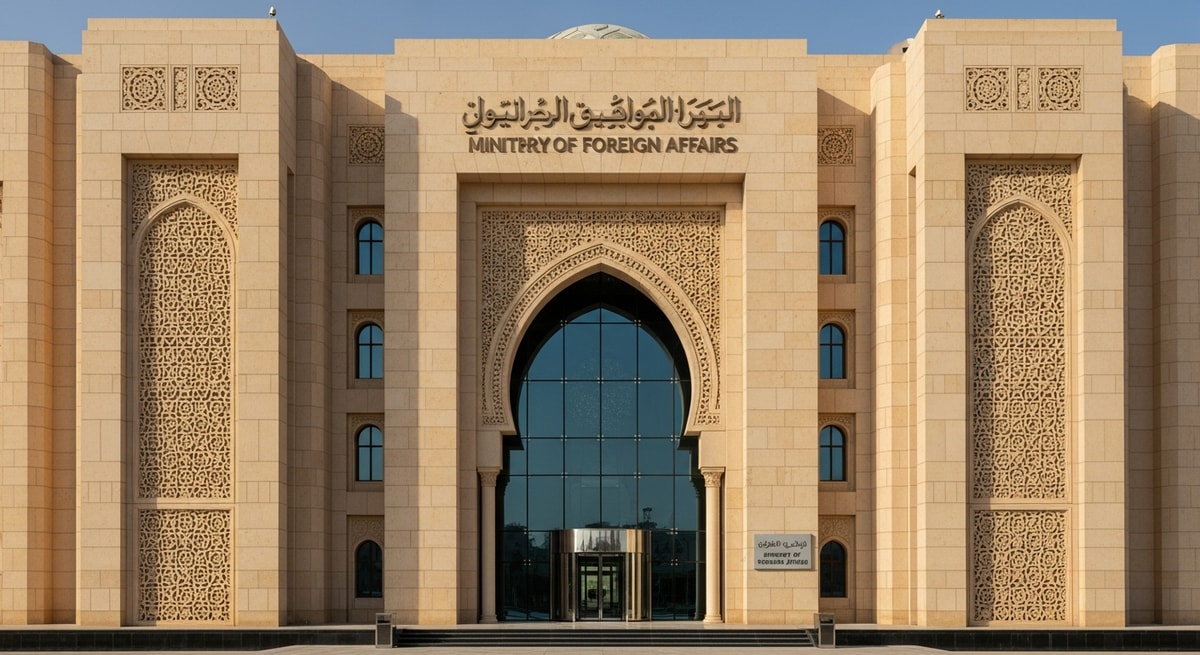
The Ministry of Foreign Affairs (MOFA) is Saudi Arabia's sole competent authority for issuing apostilles since December 2022
Navigating Saudi Arabia's Civil Registration and Vital Records System
Saudi Arabia's vital records are managed by the Ministerial Agency of Civil Affairs (وكالة الأحوال المدنية), operating under the Ministry of Interior. This agency — commonly referred to as Ahwal Madaniyya — is responsible for issuing birth certificates (شهادة ميلاد), death certificates (شهادة وفاة), national identity cards (بطاقة الهوية الوطنية), and the family record (سجل الأسرة), which serves as a comprehensive family registration document unique to the Saudi system.
The سجل الأسرة (Family Record) is a particularly important document for translation. Unlike a simple marriage certificate, it is a booklet-style record maintained by the head of the household that lists all family members, their national ID numbers, birth dates (in Hijri), and relationships. It is used extensively for family visa applications, inheritance proceedings, sponsorship transfers, and school enrollment. Translating this document requires careful attention to the multi-page format, patronymic naming conventions, and accurate Hijri-to-Gregorian date conversions for each family member listed.
For expatriates, the iqama (إقامة) — the residency permit issued by the General Directorate of Passports (الجوازات / Jawazat) — is the single most frequently translated Saudi document. The iqama contains the holder's name, nationality, occupation, sponsor details, and expiry date, all in Arabic. Certified translations of the iqama are commonly required for visa applications to other countries, opening bank accounts abroad, and credential evaluation submissions. DoVisa processes hundreds of iqama translations, ensuring consistent formatting and accurate rendering of all data fields.
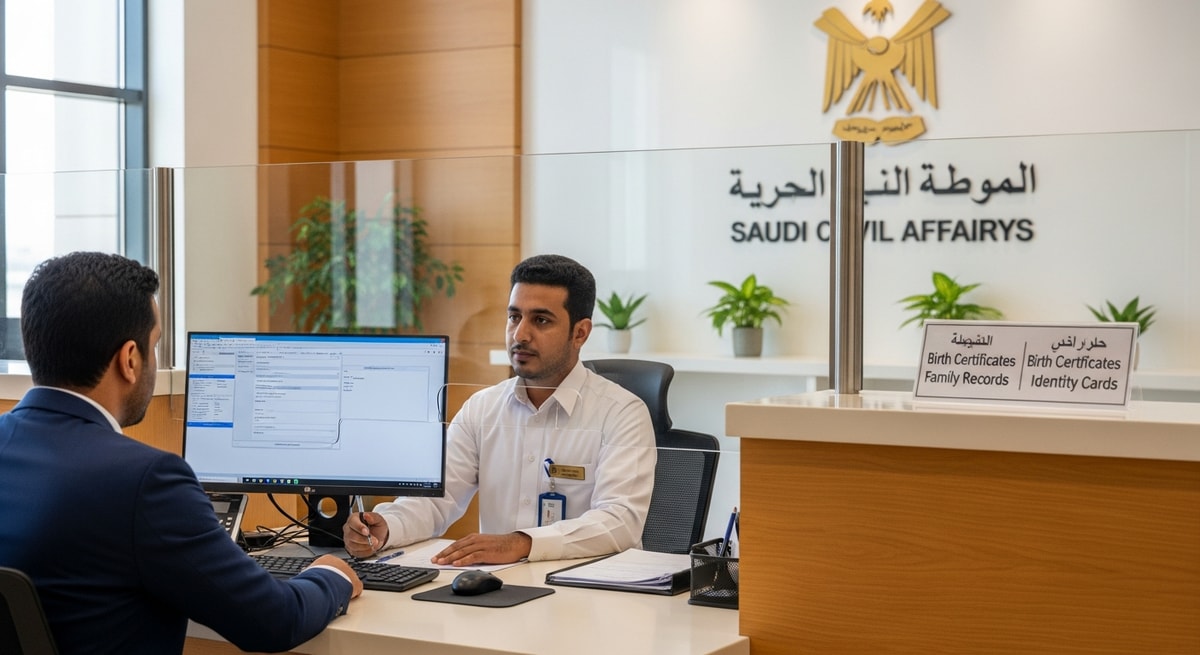
The Ministerial Agency of Civil Affairs (Ahwal Madaniyya) manages all vital records including birth certificates, family records, and national IDs
"Needed my Saudi birth certificate and family record translated from Arabic to English for a USCIS immigration petition. Both documents were accepted without any issues — the Hijri date conversions were handled perfectly."
"Arabic to English translation of my Saudi university degree and transcripts for WES credential evaluation. The academic terminology was precise and WES processed my evaluation without requesting any corrections."
"Translated my Saudi marriage contract for a UK spouse visa. UKVI accepted the certified translation. Delivery took one day longer than the estimate, but the quality was excellent and all Arabic legal terms were properly rendered."
"DoVisa translated my iqama and police clearance certificate from Arabic to English for an Australian skilled migration visa. The Department of Home Affairs accepted everything on first submission. Very professional service."
"Corporate documents translated from English to Arabic for our company registration with MISA — memorandum of association, board resolutions, and financial statements. All translations were MOJ-certified and accepted immediately."
"Saudi family record translated from Arabic to English for a Canadian PR application through IRCC. The multi-page format with all family members was handled well. Good quality, though I wished the express option was slightly faster."
"Needed my Saudi death certificate translated for a legal proceeding in the United States. Sensitive document handled with complete professionalism. The certified translation was accepted by the court without question."
"French to Arabic translation of my academic transcripts for Ministry of Education equivalency in Saudi Arabia. The translation was accurate and properly formatted for MOE submission. Solid service overall."
"DoVisa coordinated the MOFA apostille on my Saudi commercial registration extract along with the certified translation. The apostille QR code was verified instantly by the receiving authority in Germany. Impressive end-to-end service."
"Arabic to English translation of my Saudi power of attorney for use in a New Zealand legal matter. The final translation was accurate, but the first draft had an error in the patronymic name order that needed correction before delivery."
"Iqama and Saudi birth certificates translated for a USCIS green card petition. The translator accurately converted all Hijri dates and the Arabic name formatting was spot-on. USCIS approved our petition without any RFE."
"Saudi graduation certificate translated from Arabic to English for credential evaluation with ECE. The translation captured all the academic details correctly and ECE completed my evaluation promptly. Reliable service."
"Needed my Saudi birth certificate and family record translated from Arabic to English for a USCIS immigration petition. Both documents were accepted without any issues — the Hijri date conversions were handled perfectly."
"Arabic to English translation of my Saudi university degree and transcripts for WES credential evaluation. The academic terminology was precise and WES processed my evaluation without requesting any corrections."
"Translated my Saudi marriage contract for a UK spouse visa. UKVI accepted the certified translation. Delivery took one day longer than the estimate, but the quality was excellent and all Arabic legal terms were properly rendered."
Saudi Arabia Document Translation FAQs
What types of Saudi Arabia documents can be translated?
We translate all types of Saudi documents including birth certificates (شهادة ميلاد), marriage contracts (عقد زواج), death certificates (شهادة وفاة), the family record (سجل الأسرة), iqama residency permits (إقامة), graduation certificates (شهادة تخرج), national ID cards, police clearances (شهادة حسن سيرة وسلوك), powers of attorney (وكالة), commercial registration extracts (سجل تجاري), court judgments, and corporate documents. We handle both Arabic-to-English and English-to-Arabic translations, as well as Arabic paired with 100+ other languages.
Are your Saudi Arabia translations certified?
Yes. Every translation includes a signed certification statement attesting to accuracy and completeness, with the translator's credentials and contact details. For documents intended for Saudi domestic use — courts, the Ministry of Education, Jawazat, or the Ministry of Human Resources — we coordinate with Ministry of Justice-accredited translation offices (مكاتب ترجمة معتمدة) in Riyadh, Jeddah, and Dammam. For international use, our certified translations are accepted by USCIS, UK Visas and Immigration, IRCC, the Australian Department of Home Affairs, and credential evaluation agencies worldwide.
How long does Saudi Arabia document translation take?
Standard certified translation is delivered within 4-6 business days. Express processing is available for 2-3 business days, and rush delivery within 24 hours for select single-page documents. If MOFA apostille processing is included, additional time of 3-5 business days should be expected for the apostille issuance. We provide a complete timeline estimate at the time of your order.
What languages do you translate Saudi documents to and from?
While Arabic–English is the most common language pair for Saudi documents, we provide direct translations between Arabic and French, German, Hindi, Urdu, Chinese, Spanish, Japanese, Korean, Turkish, Russian, Portuguese, and many other languages. Direct translation avoids quality loss from translating through an intermediary language. This is particularly useful given Saudi Arabia's large expatriate population from South Asia, Southeast Asia, and the Middle East.
Will my translated Saudi documents be accepted by immigration authorities?
Yes. Our certified translations of Saudi documents are accepted by USCIS (United States), UK Visas and Immigration (UKVI), IRCC (Canada), the Australian Department of Home Affairs, and immigration authorities in New Zealand, Japan, and other countries. Each translation includes the translator's signed certification statement confirming accuracy and completeness as required by these authorities. For additional authentication, we can coordinate a MOFA apostille — recognized in all 129+ Hague Convention member states.
Do I need notarization with my Saudi Arabia translation?
For documents submitted to Saudi courts, government ministries, and federal agencies, Arabic translations must be produced by a translator licensed through a Ministry of Justice-accredited translation office. These translations bear an official MOJ certification stamp that carries full legal weight in Saudi Arabia. DoVisa coordinates with MOJ-registered offices to provide compliant translations for domestic use. For international submissions to authorities like USCIS or UKVI, our standard certified translation is typically sufficient without additional notarization.
What is an apostille and can Saudi Arabia documents get one?
An apostille is a standardized international certificate that authenticates the origin of a public document for use in other countries. Saudi Arabia joined the Hague Apostille Convention on December 7, 2022, making it one of the newer members. The Ministry of Foreign Affairs (MOFA) is the sole competent authority that issues apostilles for Saudi documents, at a fee of 30 SAR per document. Apostilled Saudi documents are accepted in all 129+ Convention member states without additional embassy legalization. DoVisa coordinates the MOFA apostille process on your behalf, from document preparation through delivery of the apostilled document with its QR code for online verification.
How much does certified translation for Saudi Arabia documents cost?
Our Saudi document translation pricing follows a transparent per-page structure with volume discounts that apply automatically for larger projects. Pricing varies based on document type, language pair, and processing speed selected. MOFA apostille processing and express delivery surcharges are quoted separately. Upload your documents on our order page to receive an instant, detailed quote with no hidden fees.
Can you translate handwritten Saudi documents?
Yes. Many older Saudi documents — particularly handwritten court records, traditional marriage contracts, and historical family records — use Arabic handwriting styles that require specialized expertise to decipher. Our Arabic translators are experienced in reading both modern printed and handwritten Saudi documents, including documents that combine typed text with handwritten annotations, marginal notes, and official stamps. If a document's legibility is compromised, we will notify you before proceeding and suggest solutions such as higher-resolution scanning.
What format will I receive my translated Saudi document in?
You will receive your certified translation as a high-resolution PDF delivered via email, suitable for immediate digital submission to immigration authorities, credential evaluation agencies, and most government portals. The PDF includes the translated document, the certification statement, and the translator's credentials. If you need a physical hard copy with original stamps and signatures — for example, for court submission in Saudi Arabia or for MOFA apostille processing — we ship via tracked international courier with delivery confirmation.
How does the Hijri calendar affect my Saudi document translation?
Saudi official documents — birth certificates, marriage contracts, court judgments, and government correspondence — use the Hijri (Islamic) calendar (التقويم الهجري) as the primary dating system. Since the Hijri calendar is lunar-based, dates do not correspond directly to the Gregorian calendar. Our translators accurately convert all Hijri dates to their Gregorian equivalents and clearly annotate both dates in the translation, preventing confusion or rejection by receiving authorities unfamiliar with the Islamic calendar system.
What is the Mosadaqa platform and do I need it for Saudi credential verification?
The Mosadaqa (مصادقة) platform is a digital verification system used by Saudi Arabia to authenticate foreign educational credentials. It is mandatory for professionals and students seeking employment or higher education admission in the Kingdom. The process requires educational documents to be attested by the home country's relevant authorities and then verified through the Mosadaqa portal, which operates in 50+ countries. DoVisa provides certified Arabic translations of academic documents formatted for Mosadaqa submission, ensuring your credentials meet Saudi verification standards.
Do I still need embassy legalization for Saudi documents?
For most countries — no. Since Saudi Arabia joined the Hague Apostille Convention on December 7, 2022, documents authenticated with a MOFA apostille are accepted in all 129+ Convention member states without further embassy legalization. This includes major destinations such as the United States, United Kingdom, Canada, Australia, Germany, France, Japan, and most of Europe. However, for the small number of countries that are not party to the Convention, the traditional embassy legalization chain is still required. DoVisa manages both processes and will advise on the correct authentication path for your destination country.
Get Your Saudi Arabia Documents Translated Today
Professional certified translations with MOFA apostille coordination — accepted by authorities worldwide