
Certified Arabic Document Translation for Qatar
Professional certified translations for Qatari government submissions, MOFA attestation coordination, court filings, and international use. Arabic–English and 100+ language pairs with MOJ-accredited certification.
TrustpilotSelect Languages
Drag & drop your documents here
or
PDF, JPEG, PNG, WebP — Max 10MB per file. Word documents: please save as PDF first.
Certified translators · Accepted by governments, courts & universities worldwide · View sample
Select a destination country to view pricing
How Qatar Certified Translation Works
Submit Your Documents Securely
Upload clear scans of your Arabic or foreign-language documents through our encrypted portal. We accept PDF, JPEG, and PNG formats. Our intake specialists review each upload for legibility and confirm whether your documents require MOJ-accredited legal translation for Qatar domestic use or standard certified translation for international submissions to authorities like USCIS, UKVI, or IRCC.
Professional Translator Assignment
Your documents are matched with a qualified translator experienced in Arabic legal and administrative terminology. For documents intended for Qatar government submission, we coordinate with Ministry of Justice-accredited translation offices (مكاتب ترجمة معتمدة) in Doha to ensure the translation carries the required MOJ stamp and certification as mandated by Law No. 7 of 2019 on Protection of the Arabic Language.
Translation & Quality Review
The translator produces your certified translation with full attention to Arabic legal conventions, Hijri and Gregorian date formats, and official Qatari terminology. A second qualified linguist reviews terminology, formatting, and legal accuracy. Each translation includes the translator's signature, certification statement, and relevant stamps required by the receiving authority.
Delivery with Full Certification
Receive your certified translation as a high-resolution PDF for immediate use, with the original stamped hard copy shipped via tracked courier. For documents requiring MOFA attestation and consular legalization for use abroad, DoVisa coordinates the complete authentication chain — from initial ministry verification through MOFA attestation and destination embassy legalization.
Qatar Translation Service Specifications
Popular Language Pairs
We support all languages — 100+ language pairs available for Qatar documents.
Common Documents
- Birth certificates (شهادة ميلاد — Shahādat Mīlād)
- Marriage contracts (عقد زواج — ʿAqd Zawāj)
- Death certificates (شهادة وفاة — Shahādat Wafāh)
- Family booklets (دفتر العائلة — Daftar al-ʿĀʾilah)
- Qatar ID cards (البطاقة الشخصية — al-Biṭāqah al-Shakhṣiyyah)
- Residence permits (تصريح إقامة — Taṣrīḥ Iqāmah)
- Graduation certificates (شهادة تخرج — Shahādat Takharruj)
- Police clearance certificates (شهادة حسن سيرة وسلوك)
- Powers of attorney (وكالة — Wakālah)
- Commercial registration extracts (سجل تجاري — Sijill Tijārī)
Turnaround Time
Certification Details
Qatar Translation Requirements & Regulatory Framework
Embassy Acceptance
Notarization Process
Apostille Information
Legal Framework
Common Scenarios for Qatar Document Translation
Immigration & Visa Applications
Qatar residents and nationals emigrating abroad need certified translations of birth certificates (شهادة ميلاد), marriage contracts (عقد زواج), family booklets (دفتر العائلة), and police clearances for visa applications with USCIS, UK Visas and Immigration, IRCC, and other immigration authorities. DoVisa provides certified translations with MOFA attestation coordination for international acceptance.
Employment & Residence Permits
Expatriates relocating to Qatar for work require certified Arabic translations of educational certificates, professional qualifications, and police clearance certificates for the General Directorate of Immigration (إدارة الهجرة). Residence permit (تصريح إقامة) processing and renewal frequently require MOJ-certified translations of foreign academic credentials for equivalency verification by the Ministry of Education and Higher Education.
Marriage & Family Documentation
Foreign nationals marrying in Qatar must provide certified Arabic translations of birth certificates, single-status certificates, and passport pages for submission to the Sharia Court (المحكمة الشرعية). Qatari family documents being used abroad — for spouse visa applications or family reunification — require certified translation with MOFA attestation and consular legalization.
Academic Credential Evaluation
Students and professionals seeking credential equivalency need certified translations of academic transcripts, diplomas, and degree certificates. The Ministry of Education and Higher Education requires Arabic translations of all foreign qualifications. Qatari graduates applying to international universities need certified English translations of their شهادة تخرج (graduation certificates) and transcripts for institutions and agencies like WES.
Business & Corporate Setup
Foreign investors establishing businesses in Qatar — whether in the Qatar Financial Centre (QFC), Qatar Free Zones Authority, or the general commercial market — need certified Arabic translations of articles of incorporation, board resolutions, financial statements, and commercial registration extracts. The Ministry of Commerce and Industry requires all corporate documents to be translated by MOJ-accredited offices.
Consular Legalization: Getting Qatari Documents Accepted Abroad
Since Qatar is not a member of the Hague Apostille Convention, Qatari documents intended for use in foreign countries cannot receive a simple apostille stamp. Instead, they must undergo a full consular legalization process — a multi-step authentication chain that verifies the document's authenticity at each level.
The legalization process works as follows: (1) The original document is authenticated by the issuing Qatari authority — for example, the Ministry of Public Health for birth certificates or the Sharia Court for marriage contracts. (2) The Ministry of Foreign Affairs (MOFA / وزارة الخارجية) Consular Affairs Department then attests the document, confirming the authentication is legitimate. (3) The destination country's embassy or consulate in Doha places its own legalization stamp for acceptance in that country's jurisdiction.
For documents originating outside Qatar and destined for use within the country, the process works in reverse: the document is first authenticated in its country of origin (via apostille if the origin country is a Hague Convention member, or via its own foreign ministry), then legalized by the Qatar embassy or consulate in that country, and finally attested by MOFA upon arrival in Qatar. The complete legalization process typically takes 7-15 business days depending on the destination country's embassy processing times. DoVisa coordinates the entire chain, including certified translation at the appropriate stage.
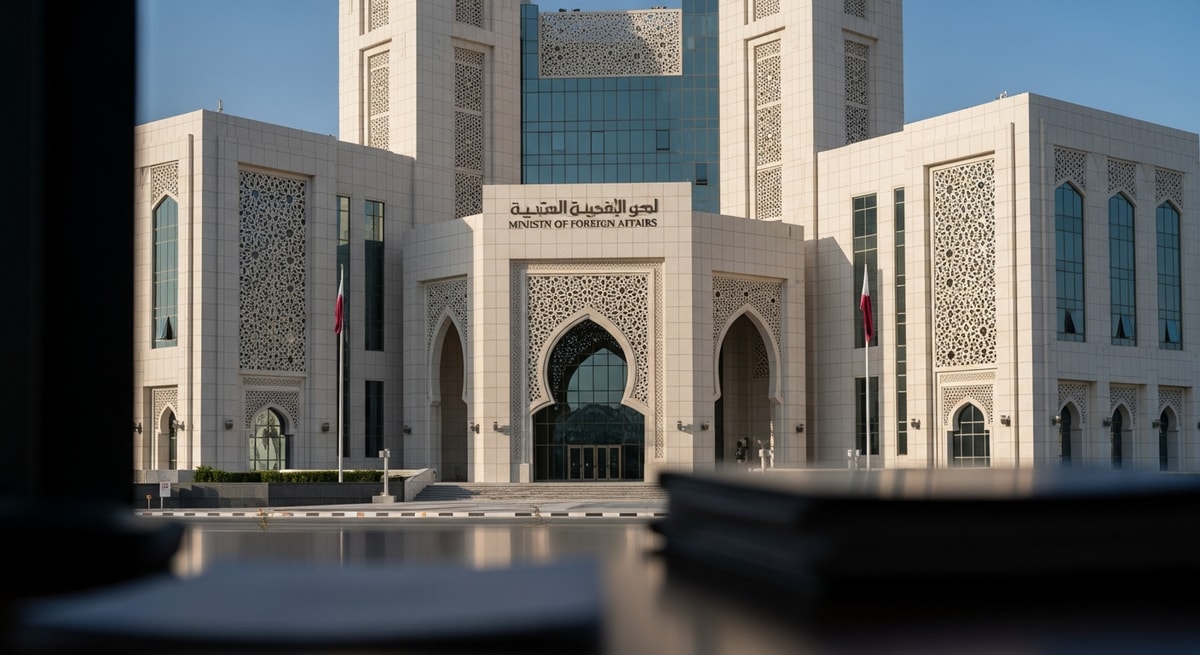
The Ministry of Foreign Affairs (MOFA) Consular Affairs Department handles all document attestation for international use
Navigating Qatar's Civil Registration and Vital Records System
Qatar's vital records system involves multiple government agencies depending on the document type. The Ministry of Public Health (وزارة الصحة العامة) is responsible for registering births and deaths in Qatar. Birth certificates (شهادة ميلاد) are issued through the Ministry's Birth Registration System, and the original certificate is produced as an Arabic-language document with official seals.
Marriage registration in Qatar follows a dual-track system. Muslim marriages are registered through the Sharia Court (المحكمة الشرعية), which issues the marriage contract (عقد زواج) — a legally binding document that records the terms agreed between both parties, the mahr (dowry), and the witnesses' attestation. Non-Muslim marriages are registered through their respective religious courts or community churches. The Sharia Court also handles divorce proceedings, inheritance cases, and child custody matters, all of which generate Arabic-language documents that frequently require certified translation for international use.
The General Directorate of Immigration (إدارة الهجرة), operating under the Ministry of Interior (وزارة الداخلية), issues residence permits (تصريح إقامة) for Qatar's large expatriate population — which constitutes approximately 85% of the country's residents. The Qatar ID card (البطاقة الشخصية) issued by the Ministry of Interior is the primary identification document for all residents and citizens. These documents are among the most frequently translated Qatari records, typically required for visa applications, bank account openings abroad, and credential evaluation submissions.
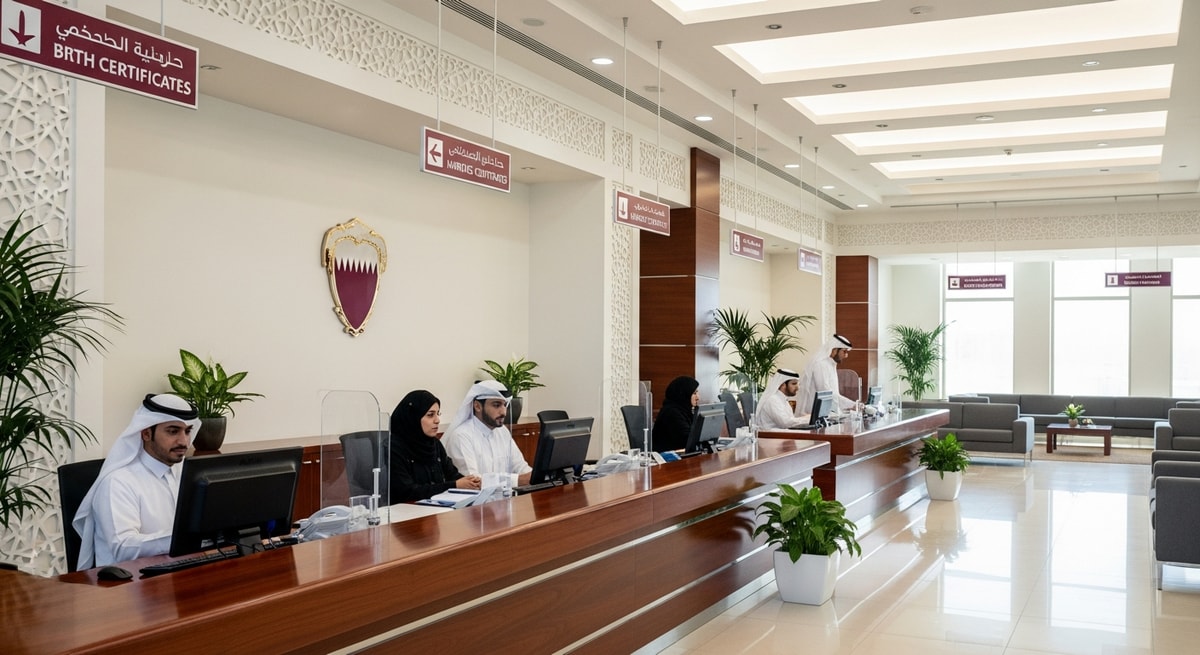
Qatar's vital records are managed by the Ministry of Public Health, Sharia Courts, and the General Directorate of Immigration
Law No. 7 of 2019: Arabic Language Protection and Translation Requirements
Law No. 7 of 2019 on Protection of the Arabic Language (قانون رقم 7 لسنة 2019 بشأن حماية اللغة العربية) is the foundational legislation governing language use in Qatar's public sector. The law mandates that Arabic is the primary language for all official government transactions, correspondence, contracts, and institutional documentation. Every foreign-language document submitted to any Qatari ministry, court, or public institution must be accompanied by a certified Arabic translation from a Ministry of Justice-accredited translation office.
The law applies broadly to government correspondence, public signage, corporate names, advertising, product labeling, and official publications. For translation purposes, the critical provision is that non-Arabic documents have no legal standing in Qatari courts and administrative proceedings unless accompanied by an MOJ-certified Arabic translation. Violations of the law carry penalties of up to QR 50,000 (approximately USD 13,700).
For individuals and companies dealing with Qatar, this means that employment contracts, corporate filings, academic credentials, court documents, and personal status documents all require certified Arabic translation by an accredited office. DoVisa coordinates with MOJ-accredited translation offices in Doha to ensure all translations meet the requirements of Law No. 7, bearing the appropriate certification stamps and meeting the formal standards expected by Qatari authorities.
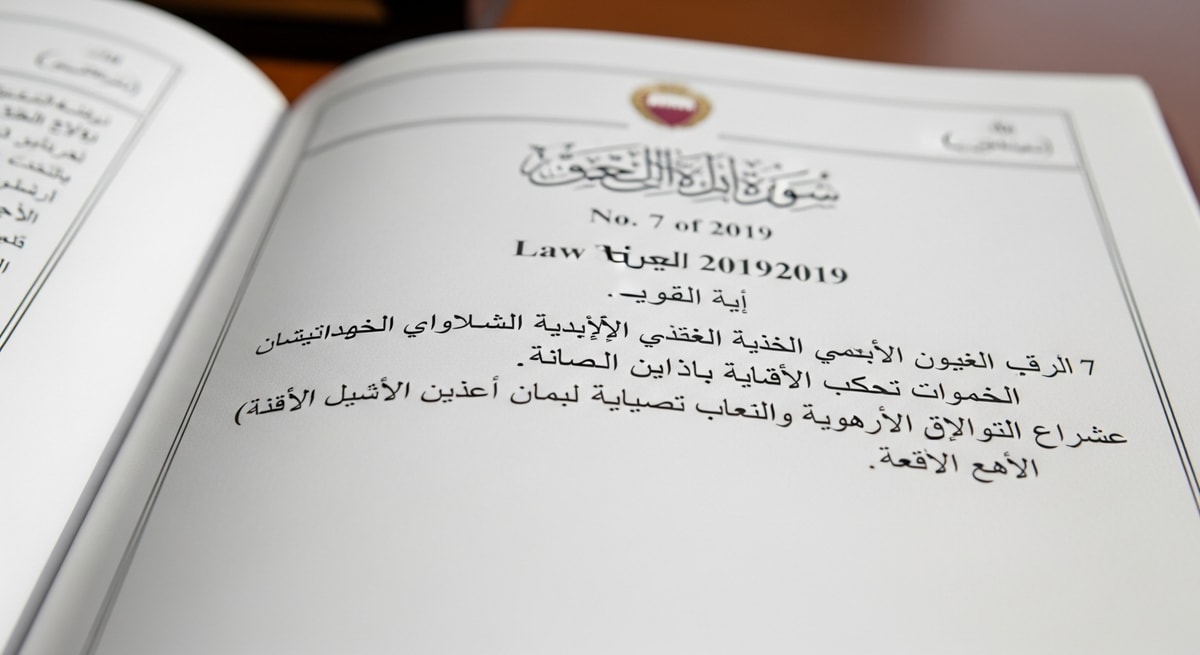
Law No. 7 of 2019 mandates Arabic for all official transactions, requiring certified translations of all foreign-language documents
"Needed my Qatari birth certificate and marriage contract translated from Arabic to English for a USCIS immigration petition. Both documents were accepted without issues — the Hijri date conversions were handled perfectly."
"Hindi to Arabic translation of my academic transcripts for Ministry of Education equivalency in Qatar. The MOJ-certified translation was properly formatted and accepted immediately. Very professional service."
"Arabic to English translation of my Qatar police clearance certificate for a Canadian PR application through IRCC. Good quality and accurate rendering of Arabic legal terms. Took one extra day beyond the estimate."
"DoVisa translated my Qatari university degree and transcripts from Arabic to English for WES credential evaluation. The academic terminology was precise and WES processed my evaluation without corrections."
"English to Arabic translation of our company's articles of incorporation for Qatar Financial Centre registration. The MOJ-accredited translation met all requirements and was accepted on first submission."
"Translated my Qatari family booklet from Arabic to English for an Australian skilled migration visa. The multi-page format was handled well and the Department of Home Affairs accepted it. Solid service overall."
"Needed certified Arabic translations of my Indian degree certificates for my Qatar residence permit renewal. The translations carried the MOJ stamp and were accepted by the General Directorate of Immigration."
"Arabic to English translation of my Qatari death certificate for a legal proceeding in the United Kingdom. Sensitive document handled professionally. UKVI accepted the certified translation immediately."
"DoVisa coordinated the MOFA attestation on my Qatari commercial registration extract along with the certified English translation. The full legalization process took about 10 business days. Good communication."
"Spanish to Arabic translation of my birth certificate for use in Qatar. The final translation was accurate, but the first draft had a minor error in the transliteration of my surname that needed correction."
"Qatari marriage contract and birth certificates translated for a USCIS green card petition. The translator accurately converted all dates and the Arabic name formatting was spot-on. Approved without any RFE."
"Needed my Qatari birth certificate and marriage contract translated from Arabic to English for a USCIS immigration petition. Both documents were accepted without issues — the Hijri date conversions were handled perfectly."
"Hindi to Arabic translation of my academic transcripts for Ministry of Education equivalency in Qatar. The MOJ-certified translation was properly formatted and accepted immediately. Very professional service."
"Arabic to English translation of my Qatar police clearance certificate for a Canadian PR application through IRCC. Good quality and accurate rendering of Arabic legal terms. Took one extra day beyond the estimate."
Qatar Document Translation FAQs
What types of Qatar documents can be translated?
We translate all types of Qatari documents including birth certificates (شهادة ميلاد), marriage contracts (عقد زواج), death certificates (شهادة وفاة), family booklets (دفتر العائلة), Qatar ID cards (البطاقة الشخصية), residence permits (تصريح إقامة), graduation certificates (شهادة تخرج), police clearances (شهادة حسن سيرة وسلوك), powers of attorney (وكالة), commercial registration extracts (سجل تجاري), court judgments, and corporate documents. We handle both Arabic-to-English and English-to-Arabic translations, as well as Arabic paired with 100+ other languages.
Are your Qatar translations certified?
Yes. Every translation includes a signed certification statement attesting to accuracy and completeness, with the translator's credentials and contact details. For documents intended for Qatar domestic use — courts, the Ministry of Education and Higher Education, the General Directorate of Immigration, or the Ministry of Labour — we coordinate with Ministry of Justice-accredited translation offices (مكاتب ترجمة معتمدة) in Doha. For international use, our certified translations are accepted by USCIS, UK Visas and Immigration, IRCC, the Australian Department of Home Affairs, and credential evaluation agencies worldwide.
How long does Qatar document translation take?
Standard certified translation is delivered within 4-6 business days. Express processing is available for 2-3 business days, and rush delivery within 24 hours for select single-page documents. If MOFA attestation and embassy legalization are included, additional time of 7-15 business days should be expected depending on the destination country. We provide a complete timeline estimate at the time of your order.
What languages do you translate Qatar documents to and from?
While Arabic-English is the most common language pair for Qatari documents, we provide direct translations between Arabic and French, German, Hindi, Urdu, Tagalog, Chinese, Spanish, Japanese, Korean, Nepali, and many other languages. Direct translation avoids quality loss from translating through an intermediary language. This is particularly useful given Qatar's large expatriate population — approximately 85% of residents are foreign nationals from South Asia, Southeast Asia, and around the world.
Will my translated Qatar documents be accepted by immigration authorities?
Yes. Our certified translations of Qatari documents are accepted by USCIS (United States), UK Visas and Immigration (UKVI), IRCC (Canada), the Australian Department of Home Affairs, and immigration authorities in New Zealand, Japan, and other countries. Each translation includes the translator's signed certification statement confirming accuracy and completeness. For additional authentication, we can coordinate MOFA attestation and embassy legalization for the destination country.
Do I need notarization with my Qatar translation?
For documents submitted to Qatari courts, government ministries, and public agencies, Arabic translations must be produced by a translator licensed through a Ministry of Justice-accredited translation office. These translations bear an official MOJ certification stamp that carries full legal weight in Qatar, as required under Law No. 7 of 2019 on Protection of the Arabic Language. DoVisa coordinates with MOJ-registered offices to provide compliant translations for domestic use. For international submissions to authorities like USCIS or UKVI, our standard certified translation is typically sufficient without additional notarization.
Can Qatar documents get an apostille?
No — Qatar is not a member of the Hague Apostille Convention. Qatari documents intended for use abroad cannot receive an apostille. Instead, they must undergo consular legalization, which involves: (1) authentication by the issuing Qatari authority, (2) attestation by the Ministry of Foreign Affairs (MOFA) Consular Affairs Department, and (3) legalization by the destination country's embassy or consulate in Doha. This process typically takes 7-15 business days. DoVisa manages the entire legalization chain on your behalf, including certified translation at the appropriate stage.
How much does certified translation for Qatar documents cost?
Our Qatar document translation pricing follows a transparent per-page structure with volume discounts that apply automatically for larger projects. Pricing varies based on document type, language pair, and processing speed selected. MOFA attestation and embassy legalization fees are quoted separately based on the destination country. Upload your documents on our order page to receive an instant, detailed quote with no hidden fees.
Can you translate handwritten Qatar documents?
Yes. Many Qatari documents — particularly handwritten Sharia Court records, traditional marriage contracts, and older civil documents — use Arabic handwriting styles that require specialized expertise to decipher. Our Arabic translators are experienced in reading both modern printed and handwritten Qatari documents, including documents that combine typed text with handwritten annotations, marginal notes, and official stamps. If a document's legibility is compromised, we will notify you before proceeding.
What format will I receive my translated Qatar document in?
You will receive your certified translation as a high-resolution PDF delivered via email, suitable for immediate digital submission to immigration authorities, credential evaluation agencies, and most government portals. The PDF includes the translated document, the certification statement, and the translator's credentials. If you need a physical hard copy with original stamps and signatures — for example, for court submission in Qatar or for MOFA attestation processing — we ship via tracked international courier with delivery confirmation.
What is Law No. 7 of 2019 and how does it affect my translation?
Law No. 7 of 2019 on Protection of the Arabic Language mandates Arabic as the primary language for all official government transactions, correspondence, contracts, and documentation in Qatar. Every foreign-language document submitted to any Qatari ministry, court, or public institution must be accompanied by a certified Arabic translation from an MOJ-accredited translation office. Violations carry penalties of up to QR 50,000. DoVisa ensures your translations comply with this law by coordinating with accredited translation offices in Doha.
How does the MOFA attestation process work for Qatar documents?
The Ministry of Foreign Affairs (وزارة الخارجية) attestation is the second step in Qatar's consular legalization process for documents going abroad. After your document is authenticated by the issuing Qatari authority, MOFA's Consular Affairs Department verifies the authentication and places its own attestation stamp, confirming the document's legitimacy for international use. The document then proceeds to the destination country's embassy in Doha for final legalization. Standard MOFA processing takes 3-4 working days. DoVisa handles the entire process, from initial authentication through MOFA attestation and embassy legalization.
Get Your Qatar Documents Translated Today
Professional certified translations with MOFA attestation coordination — accepted by authorities worldwide