Certified Thai Document Translation
Professional English-to-Thai and Thai-to-English certified translations accepted by Thai government agencies, courts, and embassies worldwide. Delivered digitally with hard-copy option.
TrustpilotSelect Languages
Drag & drop your documents here
or
PDF, JPEG, PNG, WebP — Max 10MB per file. Word documents: please save as PDF first.
Certified translators · Accepted by governments, courts & universities worldwide · View sample
Select a destination country to view pricing
How Thai Document Translation Works
Upload Your Documents
Scan or photograph your documents and upload them through our secure portal. We accept Thai and English originals in PDF, JPEG, PNG, or TIFF formats. Our system automatically detects the source language and suggests the appropriate translation pair for your Thai documents.
Translator Assignment
Your documents are assigned to a native Thai linguist who specializes in the relevant document type. All our Thai translators hold degrees from accredited Thai universities and maintain active memberships with the Thai Translators and Interpreters Association for quality assurance.
Translation & Quality Review
Your translator produces a faithful certified translation while a second linguist performs an independent quality review. Every translation undergoes terminology verification, formatting checks, and accuracy validation before receiving our official certification stamp and translator declaration.
Certified Delivery
Receive your completed certified translation as a digitally signed PDF within the agreed turnaround time. Hard copies with wet-ink signatures and embossed seals are available upon request and can be shipped to any address in Thailand or internationally via tracked courier.
Thai Translation Service Details
Popular Language Pairs
We support all languages — 100+ language pairs available for Thai documents.
Common Documents
- Thai birth certificates (Sor. Chor. 1)
- Thai marriage certificates (Kor. Ror. 3)
- House registration books (Tabien Baan)
- Thai ID cards (Bat Prachachon)
- Academic transcripts from Thai universities
- Thai driving licenses
- Company registration certificates (Bor. Or. Jor. 5)
- Thai court orders and legal judgments
- Medical records from Thai hospitals
- Military service records (Sor. Dor. 43)
Turnaround Time
Certification Details
Thailand Translation Requirements & Legal Framework
Embassy Acceptance
Notarization Process
Apostille Information
Legal Framework
When You Need Thai Document Translation
Thai Marriage Registration for Foreign Spouses
Foreign nationals marrying a Thai citizen must submit translated versions of their passport, birth certificate, and single-status affidavit to the local Amphoe (district office). The translations must be certified and presented alongside the originals. DoVisa provides these translation packages within 48 hours to keep your wedding timeline on track.
Work Permit Applications in Thailand
The Thai Ministry of Labour requires certified Thai translations of foreign academic degrees, professional certificates, and employment contracts when applying for or renewing a Thai work permit. Our translators are familiar with the specific terminology and formatting requirements that the Department of Employment expects in these submissions.
Thai Property Purchases by Foreign Buyers
Purchasing a condominium unit in Thailand as a foreign national involves contracts, title deeds, and land office documentation primarily written in Thai. Certified English translations ensure you fully understand your legal obligations, payment schedules, and ownership conditions before signing any binding agreements at the Land Department office.
Academic Credential Evaluation
Thai graduates seeking employment or further education abroad need certified English translations of their transcripts, degree certificates, and recommendation letters issued by Thai universities. Our translations meet the formatting standards required by credential evaluation services such as WES, ECE, and NACES member organizations.
Thai Court Document Translation
Divorce decrees, custody orders, and civil judgments issued by Thai courts must be translated by a qualified translator for recognition in foreign jurisdictions. Our legal translation specialists handle complex Thai legal terminology and ensure that the translated document preserves the exact legal meaning and structure of the original court order.
Immigration & Visa Document Packages
Whether applying for a retirement visa extension at Thai Immigration or submitting Thai documents to a foreign embassy, our immigration translation packages cover house registration books, police clearance certificates, income verification letters, and bank statements with the specific certified formatting that immigration officers require.
The Thai Script and Translation Challenges
The Thai script is an abugida writing system with 44 consonant symbols, 15 vowel symbols that combine into at least 28 vowel forms, and four tonal markers. Unlike Latin-based scripts, Thai writing does not use spaces between words, relying instead on context and reader knowledge to determine word boundaries. This characteristic makes accurate translation particularly challenging, as a single misread word boundary can alter the entire meaning of a legal clause or certificate entry.
Thai official documents frequently use formal registers of the language known as Royal Thai or Rachasap in court documents, and specialized bureaucratic language in government forms. Birth certificates issued by the Thai National Registration Office use standardized but highly abbreviated Thai terminology that requires specialized knowledge to translate correctly. Our Thai translators maintain glossaries of over 3,000 official Thai government terms to ensure consistent and accurate translations of administrative documents.
Numbers, dates, and proper nouns in Thai documents present additional complexity. Thailand officially uses the Buddhist Era (BE) calendar, which is 543 years ahead of the Gregorian calendar. A date written as 2568 in a Thai document corresponds to 2025 CE. Thai romanization of personal names varies significantly, as there is no single standard system. Our translators cross-reference the official Royal Thai General System of Transcription while respecting the name spellings that individuals use on their passports and other identification documents.
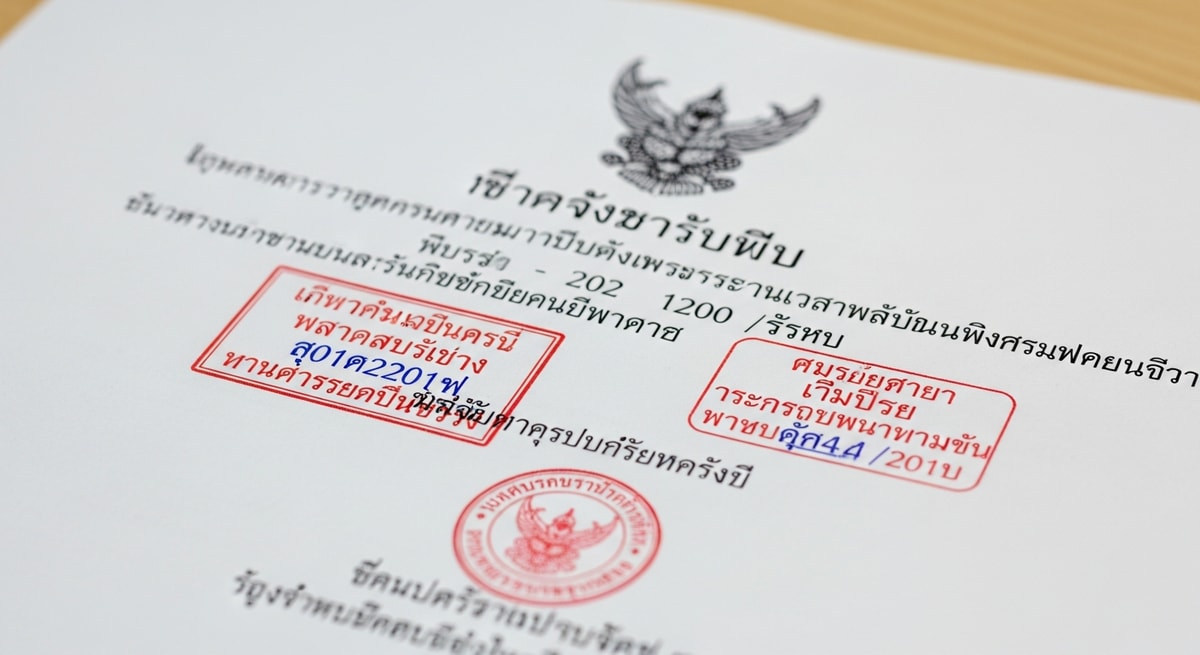
Thai official documents use specialized administrative language and the Buddhist Era dating system
Legalization Process for Thai Documents Going Abroad
Thailand's Cabinet approved accession to the 1961 Hague Apostille Convention in December 2025, but the instrument of accession has not yet been deposited and the convention is not yet in force. Until it enters into force, Thai documents intended for use in foreign countries must undergo a full legalization chain rather than receiving a simple apostille stamp. This process begins with obtaining a certified translation, followed by authentication at the Thai Ministry of Foreign Affairs (MFA) Department of Consular Affairs on Chaeng Watthana Road in Bangkok or at regional MFA offices in Chiang Mai, Songkhla, Khon Kaen, and Phuket.
After MFA authentication, the document must be further legalized by the embassy or consulate of the destination country located in Thailand. Each embassy has its own requirements, processing times, and fees. For example, the US Embassy in Bangkok requires documents to be presented with a cover letter and specific application form, while the German Embassy requires prior appointment booking through its online system. DoVisa maintains current procedural knowledge for all major embassies in Bangkok and can guide you through the complete legalization chain or handle the entire process on your behalf.
For Thai nationals taking documents abroad, the reverse process applies when returning: foreign documents must be authenticated by the issuing country's authorities, legalized by the Thai embassy in that country, and then translated into Thai by a certified translator before Thai authorities will accept them. This dual-direction legalization requirement makes professional translation an essential component of any cross-border document process involving Thailand.
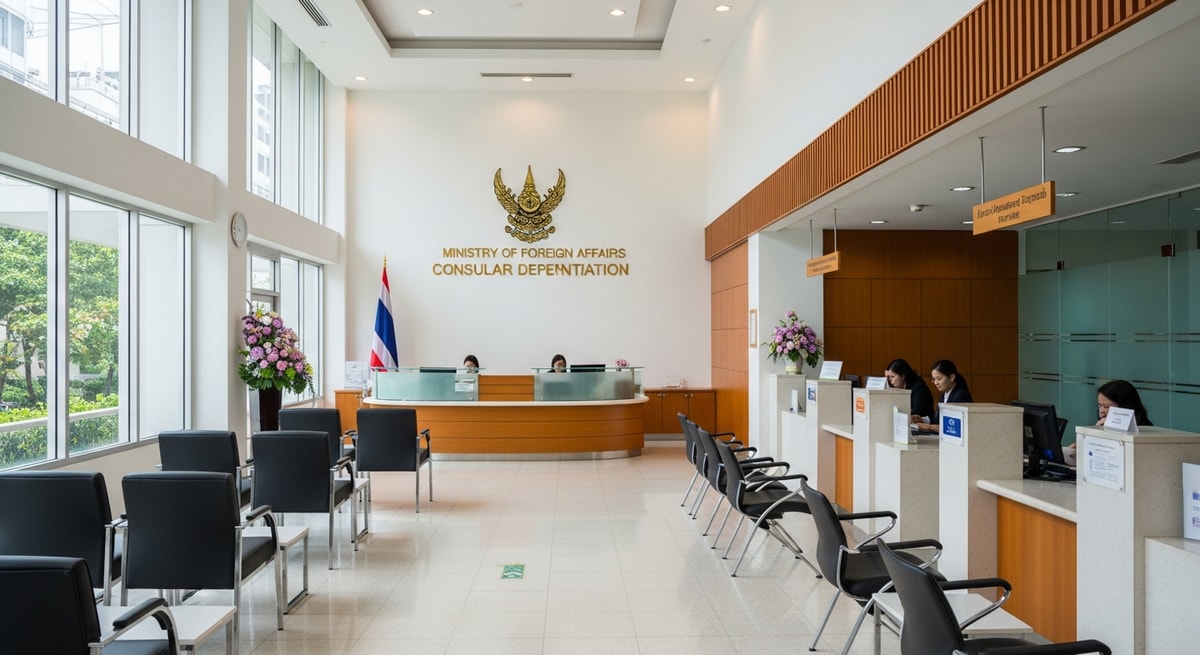
Thai Ministry of Foreign Affairs handles document authentication for international use
Thai Business and Corporate Document Translation
Thailand's Department of Business Development (DBD) under the Ministry of Commerce requires that all foreign-language corporate documents be accompanied by certified Thai translations when filed with the registrar. This includes articles of association, board resolutions, shareholder meeting minutes, and powers of attorney. Foreign companies establishing a Thai subsidiary or representative office must provide translated versions of their parent company's incorporation documents, audited financial statements, and board authorization letters.
The Board of Investment (BOI) promotional certificate applications require bilingual documentation for companies seeking investment privileges under the Thailand 4.0 economic strategy. Technology transfer agreements, joint venture contracts, and intellectual property licensing arrangements must be translated into Thai for BOI review. Our corporate translation team understands BOI-specific terminology and the particular formatting requirements that expedite application processing at One Start One Stop Investment Center (OSOS).
For ongoing compliance, the Revenue Department requires Thai translations of transfer pricing documentation prepared in foreign languages, and the Securities and Exchange Commission (SEC) mandates Thai translations of prospectuses and offering documents for foreign securities listed on the Stock Exchange of Thailand. Our translators hold specialized certifications in financial and legal Thai-English translation, ensuring your corporate documents meet regulatory scrutiny at every level of Thai government oversight.

Bangkok's business district houses the corporate registries that require certified Thai translations
"Needed my Australian birth certificate translated into Thai for our marriage registration at the Amphoe. DoVisa delivered in two days and the district office accepted it without any questions. The translator even correctly handled my middle name romanization."
"I used DoVisa to translate my Thai university transcript and degree certificate for my masters application in the UK. NARIC accepted the translations immediately. Very professional formatting that matched the original document layout perfectly."
"Good quality translation of my work permit documents. The only reason for 4 stars instead of 5 is that standard delivery took the full 5 days. But the translations themselves were accepted by the Ministry of Labour without issues."
"Translated a Thai divorce decree for use in the United States. The legal terminology was handled expertly and the translator included helpful footnotes explaining Thai legal concepts that have no direct English equivalent. Immigration lawyer was impressed."
"Our company needed 35 pages of board meeting minutes translated from Thai to English for our foreign investors. Volume discount made it very affordable and the corporate terminology was spot-on. Will use again for our quarterly reports."
"Translation quality was fine but I had to request a revision for my house registration book because the initial version used a different romanization for my husband's Thai name than what appears on his passport. They fixed it within a day though."
"Excellent service translating Thai medical records for my insurance claim back in the United States. The translator correctly identified all the medical terms and drug names. My American insurance company processed the claim without requesting any additional documentation."
"Used DoVisa for Thai-to-Japanese translation of my marriage certificate. Not many services offer this pair but they found a qualified translator who did excellent work. Took a week rather than the quoted 5 days but the quality was worth the wait."
"Retiring in Thailand and needed all my UK pension documents translated into Thai for the immigration extension. The package deal for multiple documents saved me a lot compared to the translation office near Chaeng Watthana immigration. Highly recommended."
"Translated my Thai police clearance certificate and birth certificate for my Canadian permanent residence application. Both translations were accepted by IRCC without any issues. The certified format with translator declaration met all their requirements perfectly."
"Had a Thai condo sales contract translated to English before signing. At 22 pages it was a big job but the translation was clear and helped my lawyer review everything properly. Caught a clause about common area fees that I would have missed otherwise."
"We adopted our daughter in Thailand and needed multiple documents translated for the US adoption visa process. Birth certificate, court adoption order, and orphanage records were all translated beautifully. The US Embassy in Bangkok accepted everything on first submission."
"Needed my Australian birth certificate translated into Thai for our marriage registration at the Amphoe. DoVisa delivered in two days and the district office accepted it without any questions. The translator even correctly handled my middle name romanization."
"I used DoVisa to translate my Thai university transcript and degree certificate for my masters application in the UK. NARIC accepted the translations immediately. Very professional formatting that matched the original document layout perfectly."
"Good quality translation of my work permit documents. The only reason for 4 stars instead of 5 is that standard delivery took the full 5 days. But the translations themselves were accepted by the Ministry of Labour without issues."
Thai Document Translation FAQs
What types of Thai documents can DoVisa translate?
DoVisa translates all categories of Thai official and personal documents. Our most frequently requested translations include Thai birth certificates (Sor. Chor. 1), marriage certificates (Kor. Ror. 3), house registration books (Tabien Baan), Thai national ID cards, academic transcripts and degree certificates from Thai universities, Thai driving licenses, company registration documents (Bor. Or. Jor. 5), court orders, divorce decrees, medical records, police clearance certificates, military service records (Sor. Dor. 43), land title deeds, and financial statements. We also translate foreign documents into Thai for use with Thai government agencies, including immigration applications, work permit filings, and corporate registrations.
Is notarization required for Thai translated documents?
Thailand does not use the common-law notary system found in countries like the United States or United Kingdom. Instead, Thailand has Notarial Services Attorneys (Thanaai Khwaam Rapraong) appointed by the Thai Lawyers Council who can certify documents. Whether you need this additional certification depends on the receiving authority. Most Thai government agencies, including the Department of Provincial Administration, Ministry of Labour, and Immigration Bureau, accept our standard certified translation with translator declaration. However, documents intended for use in foreign countries typically require authentication by the Thai Ministry of Foreign Affairs, which may first require certification by a Notarial Services Attorney. DoVisa can advise on the specific requirements for your destination country and arrange notarial certification if needed.
Why can't Thai documents receive an apostille?
Thailand is not yet a Contracting Party to the Hague Convention of 5 October 1961 (the Apostille Convention). On 9 December 2025, the Thai Cabinet approved accession to the convention, but the formal instrument of accession has not yet been deposited with the Netherlands (the treaty depository). The convention will enter into force for Thailand approximately 8 months after the instrument is deposited. Until then, the single-step apostille process is not available for Thai documents. Documents intended for international use must still go through a full legalization process: authenticated by the Thai Ministry of Foreign Affairs, then legalized by the relevant foreign embassy or consulate in Thailand. This typically requires 5-10 business days. DoVisa will update this page when apostille service becomes operational in Thailand.
How are Thai dates converted in translated documents?
Thailand officially uses the Buddhist Era (BE) calendar, which is 543 years ahead of the Gregorian (CE/AD) calendar used internationally. A Thai document dated 15 March BE 2568 corresponds to 15 March 2025 CE. Our translators always provide both the original BE date and the Gregorian equivalent in certified translations, formatted as: 15 March 2568 BE (2025 CE). This dual-date format is universally accepted by foreign authorities and eliminates any confusion. Thai documents may also reference the Thai lunar calendar for religious or ceremonial dates, which our translators will note and convert accordingly. All date conversions are verified during our quality review process to prevent errors.
How do you handle Thai names in translated documents?
Thai name romanization is one of the most critical aspects of certified translation. Thai names can be romanized differently depending on the system used, and individuals often have established English spellings on their passports that may not follow any standard system. Our policy is to always match the romanization used on the individual's passport or official English-language ID when this information is available. We ask customers to provide a copy of their passport or a note specifying their preferred English name spelling. For Thai names where no established romanization exists, we follow the Royal Thai General System of Transcription (RTGS) as published by the Royal Institute of Thailand. This ensures consistency and reduces the risk of name discrepancies that could cause rejection by immigration or civil registration authorities.
What is the difference between certified and sworn translation in Thailand?
In the Thai context, a certified translation is produced by a qualified translator who signs a declaration attesting to the accuracy and completeness of the translation. This declaration typically includes the translator's full name, qualifications, and a statement that the translation is a true and faithful rendering of the original document. A sworn translation adds an additional layer where the translation is certified before a Notarial Services Attorney or at a foreign embassy. Some countries, particularly in Europe, specifically require sworn translations for legal proceedings. DoVisa's standard certified translations satisfy the requirements of most Thai and international agencies. If your receiving authority requires a sworn or notarized translation, we can arrange this through our network of licensed Notarial Services Attorneys in Bangkok, Chiang Mai, and Phuket at an additional cost.
Can I use the translated document for immigration purposes?
Yes, our certified Thai translations are specifically formatted to meet immigration requirements in multiple jurisdictions. For Thai Immigration Bureau submissions (visa extensions, residence permits, 90-day reporting), our Thai translations of foreign documents include all required elements. For foreign immigration applications using Thai source documents, our English translations meet the requirements of USCIS (United States), IRCC (Canada), UK Visas and Immigration, the Australian Department of Home Affairs, and Schengen area immigration authorities. Each translation includes the translator's certification statement, contact details, and a declaration of accuracy that these agencies require. We also include a cover page identifying the original document type, language pair, and number of pages to facilitate processing by immigration case officers.
How much does Thai document translation cost?
Our Thai translation pricing is based on a per-page rate with volume discounts that apply automatically for larger orders. Pricing varies based on language pair, document type, and processing speed. Express service options are available for time-sensitive projects. Additional services such as Notarial Services Attorney certification, Ministry of Foreign Affairs authentication, and hard-copy shipping are quoted separately based on your specific requirements. Upload your documents on our order page to receive a detailed quote before work begins — no hidden fees.
How long does Thai document translation take?
Standard delivery is 3-5 business days for most document types. Single-page documents like birth certificates, marriage certificates, and ID cards typically complete in 3 business days. Multi-page documents such as academic transcripts, contracts, and court orders may require the full 5 business days. Express service delivers within 24 hours for single-page documents and 48 hours for multi-page documents (up to 10 pages). Large projects exceeding 20 pages receive a custom timeline based on complexity and translator availability. If you also require Ministry of Foreign Affairs authentication or embassy legalization, add 5-10 additional business days for the complete process. We recommend starting the translation process as early as possible, particularly for visa or immigration deadlines.
Do you translate Thai documents into languages other than English?
Yes, DoVisa offers Thai translation into multiple target languages. Our most popular pairs beyond Thai-English include Thai-German (for Schengen visa applications and business with Germany), Thai-Japanese (for spousal visa and technical document needs), Thai-Chinese Simplified (for business and trade documentation), Thai-French (for applications to Francophone countries), and Thai-Korean (for employment and education purposes). Less common language pairs such as Thai-Spanish, Thai-Portuguese, and Thai-Arabic are available with slightly longer turnaround times as they require specialized translators. All language pairs include the same certified translation format with translator declaration and quality review process. Contact us for a quote if your required language pair is not listed on our website.
What if the receiving authority rejects my translation?
DoVisa stands behind every certified translation with our acceptance guarantee. If a government agency, immigration authority, embassy, or accredited institution rejects our translation due to a quality or formatting issue, we will revise the translation at no additional cost and reissue it within 24 hours. In the rare event that a rejection cannot be resolved through revision, we provide a full refund of the translation fee. To invoke this guarantee, simply send us the rejection notice or communication from the receiving authority along with your order number. Please note that this guarantee covers translation quality and certification format issues. Rejections based on the content of the original document (such as expired documents or missing information in the original) are outside the scope of this guarantee. Over the past year, our translation acceptance rate at Thai and international agencies stands at 98.7%.
Can I get a Thai translation of my foreign driving license?
Yes, and this is one of our most requested services. Foreign nationals residing in Thailand who wish to convert their foreign driving license to a Thai license must present a certified Thai translation of their existing license at the Department of Land Transport (DLT). The translation must clearly show the license holder's name, date of birth, license class, issue date, and expiry date. Our DLT-formatted translations are specifically designed to match the layout that Thai transport officials expect, reducing processing time at the license office. We also translate Thai driving licenses into English for use abroad, which is helpful for rental car agencies and insurance companies in foreign countries that may not accept a Thai license alone or an International Driving Permit.
How do I send original Thai documents to DoVisa?
You do not need to send original documents. Our translation process works entirely from digital copies. Simply scan or photograph your Thai documents and upload them through our secure portal. For best results, ensure the scan is clear, well-lit, and captures all text including stamps, seals, and margins. We accept PDF, JPEG, PNG, and TIFF formats with a recommended minimum resolution of 300 DPI. If your document has text on both sides (such as a Thai ID card), please upload images of both sides. Your original documents remain safely in your possession throughout the entire process. The certified translation references the original document and includes a statement that the translation was produced from a true copy provided by the client.
Are DoVisa's Thai translators qualified?
All DoVisa Thai translators meet stringent qualification requirements. Each translator holds a bachelor's degree or higher from an accredited university, with most holding specific degrees in translation studies, linguistics, or the relevant subject matter field. Our translators maintain memberships with recognized professional bodies including the Thai Translators and Interpreters Association and relevant international organizations. Each translator has a minimum of three years of professional document translation experience and must pass our internal certification examination covering legal, medical, academic, and administrative terminology. Translators are assigned to documents matching their area of specialization. A legal document, for example, is always handled by a translator with legal translation expertise. Our quality assurance process includes a mandatory second review by an independent linguist, ensuring every translation meets our published accuracy and formatting standards.
Can DoVisa help with the full legalization process for Thai documents?
Yes, DoVisa offers a complete legalization management service for Thai documents destined for international use. Since Thailand is not an apostille convention member, the legalization process involves multiple steps: certified translation, optional notarial certification by a Thai Notarial Services Attorney, authentication by the Thai Ministry of Foreign Affairs (MFA), and legalization by the destination country's embassy in Bangkok. We handle each step on your behalf, managing submissions, tracking progress, and collecting completed documents. Our team maintains ongoing relationships with MFA staff and embassy consular sections, which helps us navigate procedural requirements efficiently. The full legalization process typically takes 7-15 business days depending on the destination country's embassy processing times. We provide a detailed timeline and cost estimate before you commit, and you receive status updates at each stage of the process.
Start Your Thai Document Translation Today
Upload your documents now and receive a certified translation accepted by Thai government agencies and international authorities