Certified Khmer Document Translation for Cambodia
Professional certified translations of Cambodian civil documents, academic records, and legal papers. Khmer–English and 100+ language pairs with MFAIC legalization coordination.
TrustpilotSelect Languages
Drag & drop your documents here
or
PDF, JPEG, PNG, WebP — Max 10MB per file. Word documents: please save as PDF first.
Certified translators · Accepted by governments, courts & universities worldwide · View sample
Select a destination country to view pricing
How Cambodia Certified Translation Works
Submit Your Documents Securely
Upload clear scans of your Khmer or foreign-language documents through our encrypted portal. We accept PDF, JPEG, and PNG formats. Our intake specialists review each upload for legibility — particularly important for Khmer script documents, which use a complex abugida writing system with 74 consonant characters and no word spacing. We confirm whether your documents need certified translation for international use or MFAIC authentication for legalization.
Expert Khmer Translator Assignment
Your documents are matched with a qualified translator experienced in Khmer legal and administrative terminology. Our Khmer translators understand the unique challenges of the script — including the absence of spaces between words, complex vowel combinations, and the distinction between formal legal Khmer and colloquial usage. For name romanization, we match the spelling used on your passport or official English-language ID to prevent identity discrepancies.
Translation & Quality Review
The translator produces your certified translation with careful attention to Khmer naming conventions, commune/sangkat administrative references, and the specific formatting of Cambodian civil documents issued under Sub-Decree No. 103 on Civil Registration and the Law on Civil Registration, Vital Statistics and Identification (LCRVSI) of 2023. A second linguist reviews the translation for accuracy, completeness, and proper formatting.
Delivery with Full Certification
Receive your certified translation as a high-resolution PDF for immediate use, with the original stamped hard copy shipped via tracked courier. For documents requiring MFAIC authentication and embassy legalization for use abroad, DoVisa coordinates the complete consular legalization chain — from initial document authentication through MFAIC processing and destination embassy legalization in Phnom Penh.
Cambodia Translation Service Specifications
Popular Language Pairs
We support all languages — 100+ language pairs available for Cambodia documents.
Common Documents
- Birth certificates (សំបុត្រកំណើត — Sambot Kamnaeut)
- Marriage certificates (សំបុត្រអាពាហ៍ពិពាហ៍ — Sambot Apea Pipea)
- Death certificates (សំបុត្រមរណភាព — Sambot Moranaphiep)
- National ID cards (អត្តសញ្ញាណប័ណ្ណ — Attasanhean Bann)
- Family books (សៀវភៅគ្រួសារ — Sievphov Kruosar)
- Academic transcripts and degree certificates
- Police clearance certificates
- Court orders and divorce decrees
- Company registration documents
- Property title deeds (ប្លង់រឹង — Blang Roeng)
Turnaround Time
Certification Details
Cambodia Translation Requirements & Regulatory Framework
Embassy Acceptance
Notarization Process
Apostille Information
Legal Framework
Common Scenarios for Cambodia Document Translation
Immigration & Visa Applications
Cambodian nationals emigrating abroad need certified translations of birth certificates (សំបុត្រកំណើត), marriage certificates (សំបុត្រអាពាហ៍ពិពាហ៍), police clearances, and family books for visa applications with USCIS, IRCC, UK Visas and Immigration, and the Australian Department of Home Affairs. DoVisa provides certified translations with MFAIC authentication coordination.
International Adoption
Cambodia is a common country of origin for intercountry adoptions. Adoption files typically include court orders, birth certificates, consent documents, and social welfare reports — all in Khmer. Our translators handle the specialized legal terminology required by receiving countries' immigration and family courts for adoption proceedings.
Academic Credential Evaluation
Cambodian students and professionals applying to foreign universities or seeking credential equivalency need certified translations of academic transcripts, degree certificates, and professional qualifications. Organizations like WES, ECE, and NACES member agencies accept our certified translations for credential evaluation.
Business & Investment
Foreign companies operating in Cambodia and Cambodian businesses expanding internationally need translations of company registration documents, board minutes, financial statements, and contracts. Cambodia's growing economy attracts significant foreign investment from China, Japan, and South Korea, generating substantial translation demand.
Marriage & Family Documentation
Foreign nationals marrying in Cambodia must provide certified Khmer translations of birth certificates, single-status certificates, and passport pages. Cambodian marriage certificates being used abroad for spouse visa applications require certified translation with MFAIC authentication and embassy legalization.
The Khmer Script: Navigating Cambodia's Complex Writing System
Khmer script (អក្សរខ្មែរ) is one of the most complex writing systems in Southeast Asia. The script is an abugida — a type of writing system where consonant-vowel sequences are written as a unit. Khmer has 33 consonant characters and 23 dependent vowel signs that attach to consonants in various positions — above, below, before, after, or surrounding them. Additionally, there are 14 independent vowels used for words beginning with vowel sounds, as well as numerous subscript forms (called coeng or "foot" characters) used when consonant clusters appear.
One of the most distinctive features of Khmer — and one that makes translation particularly challenging — is the absence of spaces between words. Unlike English, Thai, or Japanese (which uses kanji word boundaries), Khmer text runs continuously with spaces only between clauses and sentences. This means the translator must use deep linguistic knowledge to determine where one word ends and the next begins — a skill that automated translation tools handle poorly. Our Khmer translators have native-level fluency and extensive experience reading official Cambodian documents, ensuring accurate word segmentation and meaning extraction.
Khmer name romanization presents another critical translation challenge. There is no single universally enforced standard for converting Khmer script to Latin characters. French colonial conventions, modern English phonetic approaches, and individual preferences all produce different spellings for the same Khmer name. Our policy is to always match the romanization used on the individual's passport when available, and to include the original Khmer script alongside the romanized version to prevent identity discrepancies at immigration checkpoints.
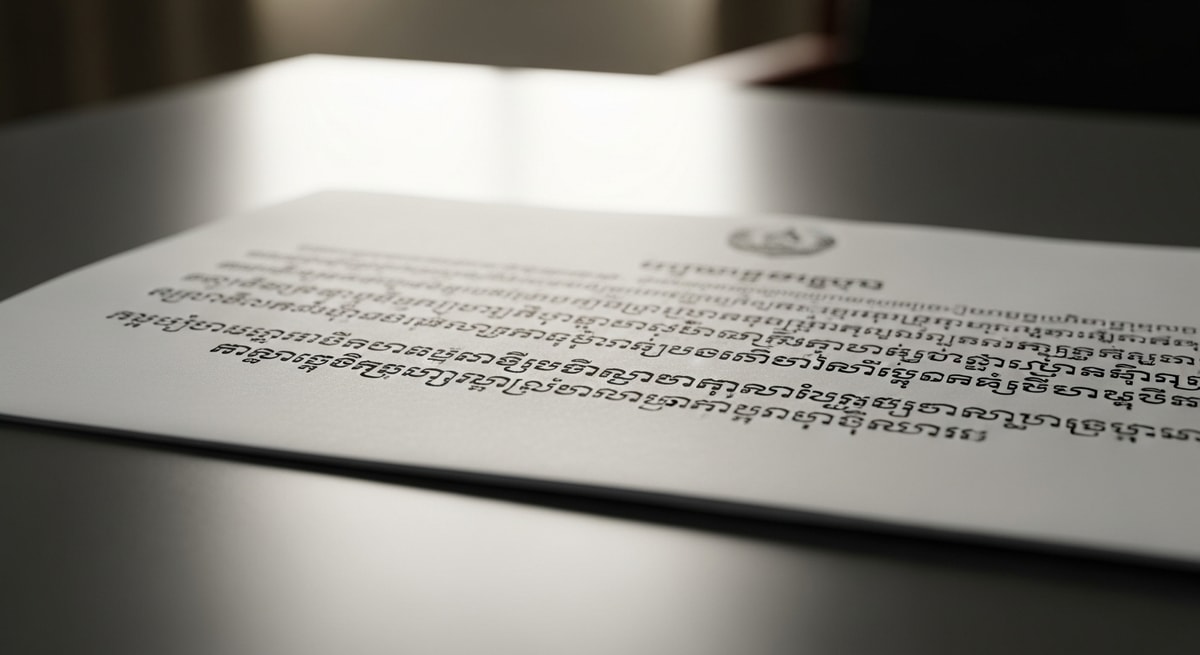
Khmer script uses 33 consonants, 23 dependent vowels, and no word spacing — requiring specialized translator expertise
Consular Legalization: Getting Cambodian Documents Accepted Abroad
Since Cambodia is not a member of the Hague Apostille Convention, Cambodian documents intended for use in foreign countries cannot receive a simple apostille stamp. Instead, they must undergo a full consular legalization process — a multi-step authentication chain that verifies the document's authenticity at each level.
This process begins with obtaining a certified translation of the original document, followed by authentication at the Department of Legal, Consular and Border Affairs of the Ministry of Foreign Affairs and International Cooperation (MFAIC) in Phnom Penh. After MFAIC authentication, the document must be further legalized by the embassy or consulate of the destination country in Cambodia. Each embassy has its own requirements, processing times, and fees. The complete legalization chain typically takes 7-15 business days, though some embassies may require longer processing periods during peak seasons.
For foreign nationals bringing documents into Cambodia, the reverse process applies: foreign documents must be authenticated by the issuing country's authorities, legalized by the Cambodian embassy or consulate in that country, and then translated into Khmer before Cambodian authorities will accept them. DoVisa manages the complete legalization chain in both directions, coordinating with the MFAIC and relevant embassies on your behalf.
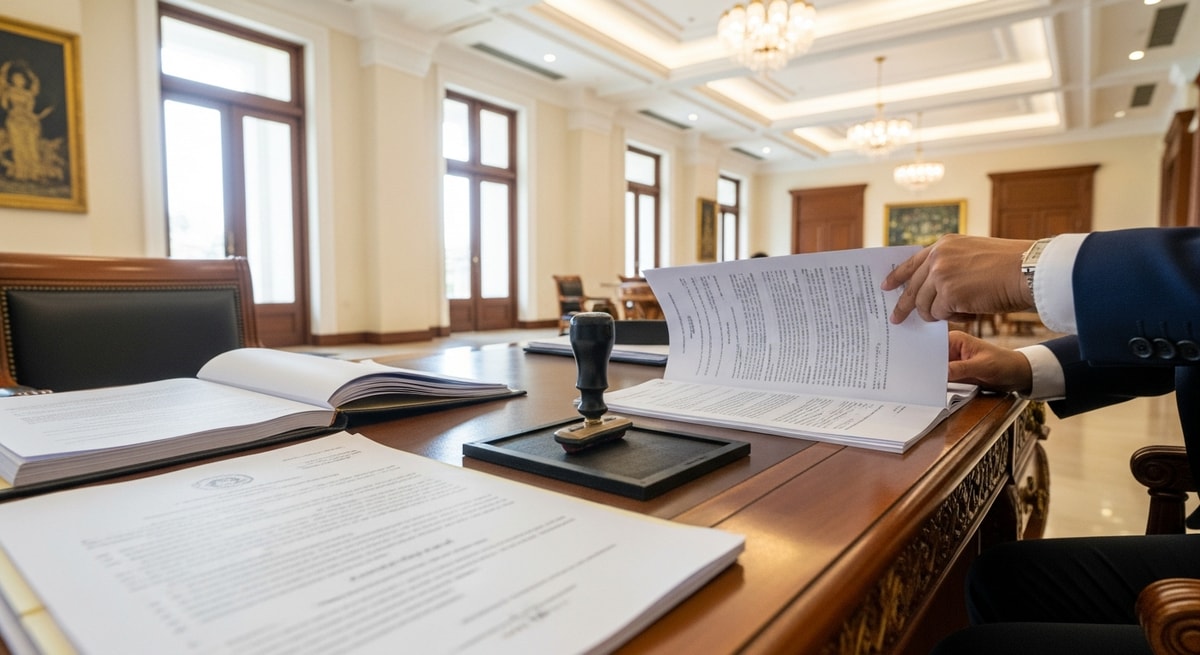
The MFAIC Department of Legal, Consular and Border Affairs handles document authentication for international use
Cambodia's Civil Registration System and Vital Records Translation
Cambodia's civil registration system is governed by Sub-Decree No. 103 on Civil Registration (29 December 2000) and the more recent Law on Civil Registration, Vital Statistics and Identification (LCRVSI) promulgated on 1 July 2023. Under this framework, commune/sangkat councils across Cambodia's 25 provinces are responsible for issuing and maintaining civil status documents including birth certificates (សំបុត្រកំណើត), marriage certificates (សំបុត្រអាពាហ៍ពិពាហ៍), and death certificates (សំបុត្រមរណភាព).
Cambodian civil documents follow a color-coded system: birth certificates are printed on green paper with a red seal and the vital records officer's signature, while death certificates use yellow paper with similar authentication markings. These formatting details are important during translation because the translator must accurately describe the document's physical characteristics in the certification statement, including seal colors, paper type, and any visible authentication features.
Historical Cambodian documents — particularly those from before the 1990s — may present additional translation challenges due to damage, fading, or the use of older administrative language. Documents from the Khmer Rouge period (1975-1979) are exceptionally rare, and many Cambodians born during that era lack original birth certificates. In such cases, supplementary documents such as family books (សៀវភៅគ្រួសារ), commune chief attestations, or court-ordered birth registration decrees may be used. Our translators have experience handling these alternative document types and can provide certified translations that include contextual notes explaining the document's origin and legal standing.
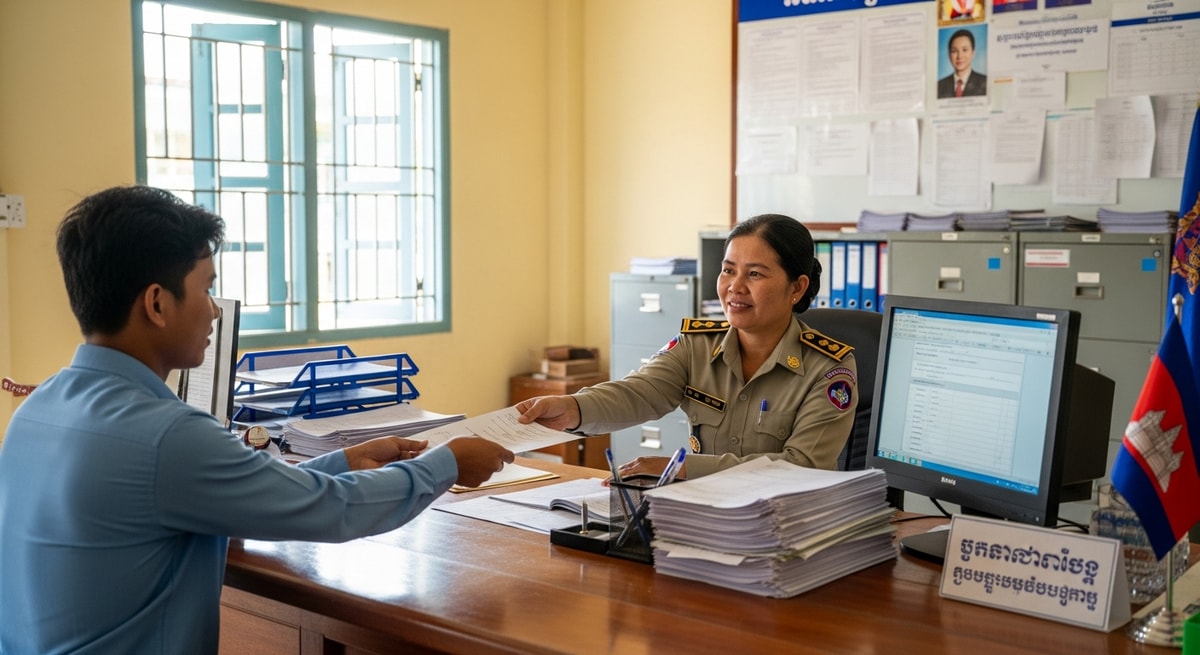
Commune/sangkat councils across Cambodia's 25 provinces issue civil status documents under Sub-Decree No. 103
"Needed my Cambodian birth certificate translated into English for my US green card application. DoVisa delivered in three days and USCIS accepted it without questions. The Khmer script was handled perfectly."
"Translated my Australian marriage certificate into Khmer for registration at the MFAIC in Phnom Penh. The formatting was professional and accepted immediately. Saved me the hassle of finding a local translator."
"Good quality translation of my Cambodian academic transcripts for my Canadian PR application. IRCC accepted everything. Standard delivery took the full 6 days, though the quality itself was excellent."
"Used DoVisa for translating Cambodian court adoption documents for our international adoption case. The legal terminology was handled expertly and the US Embassy in Phnom Penh accepted the translations."
"Our company needed 28 pages of Cambodian board meeting minutes translated from Khmer to English for foreign investors. The volume discount made it affordable and corporate terminology was accurate throughout."
"The translation of my husband's Cambodian family book was accurate but there was a small error in one date that we caught during review. They corrected it within a few hours and reissued the certified version."
"Excellent service translating my Cambodian police clearance certificate for my Australian skilled worker visa. The Department of Home Affairs accepted it without issues. Very helpful notes on document formatting."
"Had my French birth certificate translated into Khmer for marriage registration in Cambodia. Not many services offer this pair but DoVisa found a qualified translator who did excellent work."
"Translated my Cambodian death certificate and property documents for an inheritance case in the UK. The legal terminology was complex but the translator preserved every detail accurately."
"Needed my Cambodian marriage certificate translated for a spousal visa application to New Zealand. Immigration New Zealand accepted the certified translation immediately. Good dual-language format."
"Translated several Cambodian company registration documents for our joint venture with a Japanese firm. The business terminology was handled well and the partner's legal team approved everything."
"Needed my Cambodian birth certificate translated into English for my US green card application. DoVisa delivered in three days and USCIS accepted it without questions. The Khmer script was handled perfectly."
"Translated my Australian marriage certificate into Khmer for registration at the MFAIC in Phnom Penh. The formatting was professional and accepted immediately. Saved me the hassle of finding a local translator."
"Good quality translation of my Cambodian academic transcripts for my Canadian PR application. IRCC accepted everything. Standard delivery took the full 6 days, though the quality itself was excellent."
Cambodian Document Translation FAQs
What types of Cambodian documents can DoVisa translate?
DoVisa translates all categories of Cambodian official and personal documents including birth certificates (សំបុត្រកំណើត), marriage certificates (សំបុត្រអាពាហ៍ពិពាហ៍), death certificates (សំបុត្រមរណភាព), national ID cards (អត្តសញ្ញាណប័ណ្ណ), family books (សៀវភៅគ្រួសារ), academic transcripts and degree certificates, police clearance certificates, court orders and divorce decrees, company registration documents, medical records, and property title deeds. We also translate foreign documents into Khmer for use with Cambodian government agencies.
Are DoVisa's Cambodian translations certified?
Yes, every Cambodian translation includes a signed certification statement from the translator attesting to the accuracy and completeness of the translation. This declaration includes the translator's full name, qualifications, and a statement that the translation is a true rendering of the original document. Our certified translations are accepted by USCIS, IRCC, UK Visas and Immigration, the Australian Department of Home Affairs, Immigration New Zealand, and by foreign embassies and consulates in Phnom Penh.
How long does Cambodian document translation take?
Standard delivery is 4-6 business days for most document types. Single-page documents like birth certificates and ID cards typically complete in 4 business days. Multi-page documents such as academic transcripts and court orders may require the full 6 business days. Express service delivers within 2-3 business days, and rush delivery is available within 24 hours for select single-page documents. If you require MFAIC authentication and embassy legalization, add 7-15 additional business days.
What languages can Cambodian documents be translated into?
DoVisa offers Khmer translation into and from 100+ languages. Our most popular pairs include Khmer-English (for immigration and international business), Khmer-French (reflecting Cambodia's French colonial history), Khmer-Chinese (for business and trade), Khmer-Japanese (for employment and technical cooperation), Khmer-Korean (for labor migration programs), Khmer-Thai (for cross-border workers), and Khmer-Vietnamese (for bilateral relations). Less common pairs are available with slightly longer turnaround.
Will my Cambodian translation be accepted by immigration authorities?
Yes, our certified translations of Cambodian documents are specifically formatted to meet immigration requirements. For USCIS, our translations include the required certification statement with translator credentials. For IRCC (Canada), we provide the specific certified format required. Our translations also meet the requirements of UK Visas and Immigration, the Australian Department of Home Affairs, and Immigration New Zealand. Each translation includes a cover page identifying the original document type, language pair, and page count.
Do I need notarization for my Cambodian translated document?
Most international immigration agencies — including USCIS, IRCC, and UK Visas and Immigration — accept our standard certified translation without additional notarization. However, if your Cambodian document requires authentication through the Ministry of Foreign Affairs and International Cooperation (MFAIC), non-governmental documents must first be notarized by a Cambodian notary public before the MFAIC will authenticate them. DoVisa can advise on the specific requirements for your destination country and arrange notarization if needed.
Can Cambodian documents get an apostille?
No. Cambodia is not a member of the Hague Apostille Convention, so Cambodian documents cannot receive an apostille. Instead, documents intended for international use must undergo consular legalization: the document is authenticated by the Department of Legal, Consular and Border Affairs of the MFAIC in Phnom Penh, then legalized by the destination country's embassy or consulate in Cambodia. This process typically takes 7-15 business days. DoVisa manages the complete legalization chain on your behalf.
How much does Cambodian document translation cost?
Our Khmer translation pricing is based on a per-page rate with volume discounts that apply automatically for larger orders. Pricing varies based on language pair, document complexity, and processing speed selected. Legalization services through the MFAIC and embassy legalization are quoted separately based on your specific requirements. Upload your documents on our order page to receive a detailed instant quote before any work begins.
Can you translate handwritten Cambodian documents?
Yes, our Khmer translators have extensive experience with handwritten documents, which are common in older Cambodian civil records. Many birth certificates and family books from rural commune offices contain handwritten entries in Khmer script. The absence of word spacing in Khmer writing and the variety of individual handwriting styles make this particularly challenging, but our translators are trained to decipher handwritten Khmer characters accurately. For documents with compromised legibility, we note any unclear sections and provide our best professional interpretation.
What format will I receive my Cambodian translation in?
You will receive your certified translation as a high-resolution PDF delivered via email. The PDF includes the translated document, the translator's signed certification statement, and a copy of the original for reference. Hard copies with wet-ink signatures can be shipped to any address via tracked courier upon request. For multi-page documents, we provide both individual page translations and a compiled document with a professional cover page.
How do you handle Khmer name romanization in translations?
Khmer name romanization is one of the most critical aspects of certified translation, as no single universally enforced standard exists for converting Khmer script to Latin characters. French colonial conventions, modern English phonetic approaches, and individual preferences all produce different spellings for the same Khmer name. Our policy is to always match the romanization used on the individual's passport when available. We ask customers to provide a copy of their passport or specify their preferred English spelling. For names where no established romanization exists, we include the original Khmer script alongside the romanized version.
Can DoVisa help with the full legalization process for Cambodian documents?
Yes, DoVisa offers a complete legalization management service. Since Cambodia is not a Hague Convention member, the legalization process involves multiple steps: certified translation, optional notarization, authentication by the Department of Legal, Consular and Border Affairs of the MFAIC, and legalization by the destination country's embassy in Phnom Penh. We handle each step on your behalf, managing submissions, tracking progress, and collecting completed documents. The full process typically takes 7-15 business days depending on embassy processing times.
Get Your Cambodian Documents Translated Today
Professional certified translations accepted by Cambodian authorities and international agencies worldwide