
Certified Indonesian Document Translation
Professional translations of Indonesian documents accepted by USCIS, UK Home Office, IRCC Canada, Australian Home Affairs, and immigration authorities worldwide. Penerjemah Tersumpah-quality standards for international use.
TrustpilotSelect Languages
Drag & drop your documents here
or
PDF, JPEG, PNG, WebP — Max 10MB per file. Word documents: please save as PDF first.
Certified translators · Accepted by governments, courts & universities worldwide · View sample
Select a destination country to view pricing
How Indonesian Certified Translation Works
Submit Your Documents Securely
Upload clear scans or photographs of your Indonesian documents through our encrypted portal. We accept all standard formats including PDF, JPEG, and PNG. Our intake specialists review each upload for legibility and completeness, verifying that stamps, seals, and handwritten entries on Indonesian civil documents are fully readable before translation begins. If a rescan is needed, we contact you immediately.
Professional Translator Assignment
Your documents are assigned to a qualified translator with expertise in Indonesian (Bahasa Indonesia) and the specific document type. For legal, academic, and civil documents, we assign translators with demonstrated experience in Indonesian government terminology, civil registry formats, and the document conventions used by Dinas Kependudukan dan Pencatatan Sipil (Disdukcapil) offices and Kementerian Hukum dan HAM (Kemenkumham). Each translator's credentials are verified before every assignment.
Translation and Certification Review
The translator produces your certified translation, preserving all details from the original Indonesian document including official stamps, registration numbers, and notations. A second qualified linguist performs a thorough review of terminology, formatting, and accuracy. The completed translation includes a signed certification statement attesting to the accuracy and completeness of the translation, meeting the requirements of international immigration authorities.
Delivery with Full Certification
Receive your certified translation as a high-resolution PDF delivered to your email for immediate use with immigration applications and official submissions. Physical hard copies with original wet-ink signatures and certification stamps are shipped via tracked international courier to your address. For apostille services on the original Indonesian documents, DoVisa coordinates directly with the Kementerian Hukum dan HAM in Jakarta.
Indonesian Translation Service Specifications
Popular Language Pairs
We support all languages — 100+ language pairs available for Indonesian documents.
Common Documents
- Indonesian birth certificates (Akta Kelahiran)
- Family cards (Kartu Keluarga / KK)
- Identity cards (Kartu Tanda Penduduk / KTP)
- Marriage certificates (Akta Perkawinan / Buku Nikah)
- Divorce certificates (Akta Perceraian)
- Academic diplomas and transcripts (Ijazah / Transkrip Nilai)
- Police clearance certificates (Surat Keterangan Catatan Kepolisian / SKCK)
- Death certificates (Akta Kematian)
- Notarial deeds (Akta Notaris)
- Company registration documents (Akta Pendirian Perusahaan)
Turnaround Time
Certification Details
Indonesian Translation Requirements and Regulatory Framework
Embassy Acceptance
Notarization Process
Apostille Information
Legal Framework
Common Scenarios for Indonesian Document Translation
US Immigration and Green Card Applications
Indonesian nationals applying for US immigrant visas, K-1 fiance visas, or adjustment of status must submit certified English translations of their Akta Kelahiran (birth certificate), Akta Perkawinan or Buku Nikah (marriage certificate), Ijazah (academic diploma), SKCK (police clearance), and Kartu Keluarga (family card). USCIS requires that every foreign-language document be accompanied by a certified English translation with a translator's certification statement. DoVisa provides translations formatted specifically for USCIS submission, ensuring proper rendering of Indonesian civil registry terminology and government stamp descriptions.
UK Spouse and Family Visa Applications
Indonesian spouses and family members applying for UK settlement visas must provide certified translations of all supporting Indonesian documents for the UK Home Office and UKVI. Required documents typically include the Akta Perkawinan (marriage certificate), Akta Kelahiran for any dependent children, financial documents, and Kartu Tanda Penduduk (KTP) identity card. Our translations follow UKVI formatting guidelines and include the translator's qualifications, certification date, and contact information as required by Home Office guidance.
Australian Skilled and Partner Visa Applications
The Australian Department of Home Affairs requires certified translations of all Indonesian documents submitted with visa applications including subclass 189, 190, 491 (skilled visas) and subclass 820/801 (partner visas). Common Indonesian documents requiring translation include the Ijazah and Transkrip Nilai (academic credentials), SKCK (police clearance), Akta Kelahiran (birth certificate), and employment references. DoVisa's certified translations meet NAATI-equivalent certification standards accepted by the Department of Home Affairs.
Canadian Express Entry and Study Permits
Indonesian professionals applying through Canada's Express Entry system or Provincial Nominee Programs must submit certified English or French translations of their Ijazah (diploma), Transkrip Nilai (transcripts), SKCK (police clearance), and Akta Kelahiran (birth certificate) for WES or other designated credential evaluation organizations. IRCC requires that all non-English and non-French documents be accompanied by certified translations from a qualified translator. DoVisa delivers translations accepted by WES, IQAS, and all IRCC-designated evaluation bodies.
International Business and Corporate Filings
Foreign companies establishing operations in Indonesia or Indonesian companies expanding abroad require certified translations of Akta Pendirian Perusahaan (company establishment deeds), Surat Izin Usaha Perdagangan / SIUP (business permits), Nomor Pokok Wajib Pajak / NPWP (tax identification), and board resolutions. Translations are needed for foreign investment approvals through BKPM (Badan Koordinasi Penanaman Modal), international banking relationships, and corporate filings in destination countries. Our translators are experienced with Indonesian corporate and commercial law terminology.
Marriage Registration Abroad
Indonesian citizens marrying abroad must provide certified translations of their Akta Kelahiran (birth certificate), Kartu Tanda Penduduk (KTP), Surat Keterangan Belum Menikah (single-status certificate), and in some cases Kartu Keluarga (family card) and Surat Izin Orang Tua (parental consent letter). Marriage registration offices in countries such as Australia, Germany, the Netherlands, Japan, and South Korea each have specific document requirements. DoVisa provides translations formatted to meet each destination country's civil registry requirements.
Understanding Indonesian Official Documents
Indonesian official documents are issued by a network of government agencies at the national, provincial, and regency/city levels, each with distinct document formats and terminology. The Dinas Kependudukan dan Pencatatan Sipil (Disdukcapil), or Population and Civil Registration Office, issues the core civil documents that most translation requests involve: the Akta Kelahiran (birth certificate), Akta Perkawinan (marriage certificate for non-Muslim ceremonies), Akta Kematian (death certificate), and Akta Perceraian (divorce certificate). For Muslim marriages, which constitute the majority in Indonesia, the Kantor Urusan Agama (KUA, or Office of Religious Affairs) issues the Buku Nikah (marriage book), a distinctive green booklet that serves as the official marriage record.
The Kartu Keluarga (KK, or Family Card) is a uniquely Indonesian document issued by Disdukcapil that lists all members of a household, their relationships, and key personal data. This document has no direct equivalent in most Western countries, and accurate translation requires careful handling of the familial relationship terminology and the administrative codes used by Indonesian civil registration offices. Similarly, the Kartu Tanda Penduduk (KTP) identity card, now issued in electronic form as the e-KTP, contains personal identification data, a photograph, and a unique Nomor Induk Kependudukan (NIK) — the 16-digit national identification number that appears on virtually all Indonesian official documents.
Academic documents present their own translation challenges. Indonesian Ijazah (diplomas) and Transkrip Nilai (academic transcripts) follow formats established by the Kementerian Pendidikan dan Kebudayaan (Ministry of Education and Culture) and include grading scales, institutional accreditation information, and academic titles that must be accurately conveyed to foreign credential evaluation bodies. The Indonesian grading system uses a 0-4.0 scale at the university level, with specific letter grade equivalencies that differ from Western conventions. Our translators include explanatory notes on grading scales when required by the destination institution or evaluation agency.
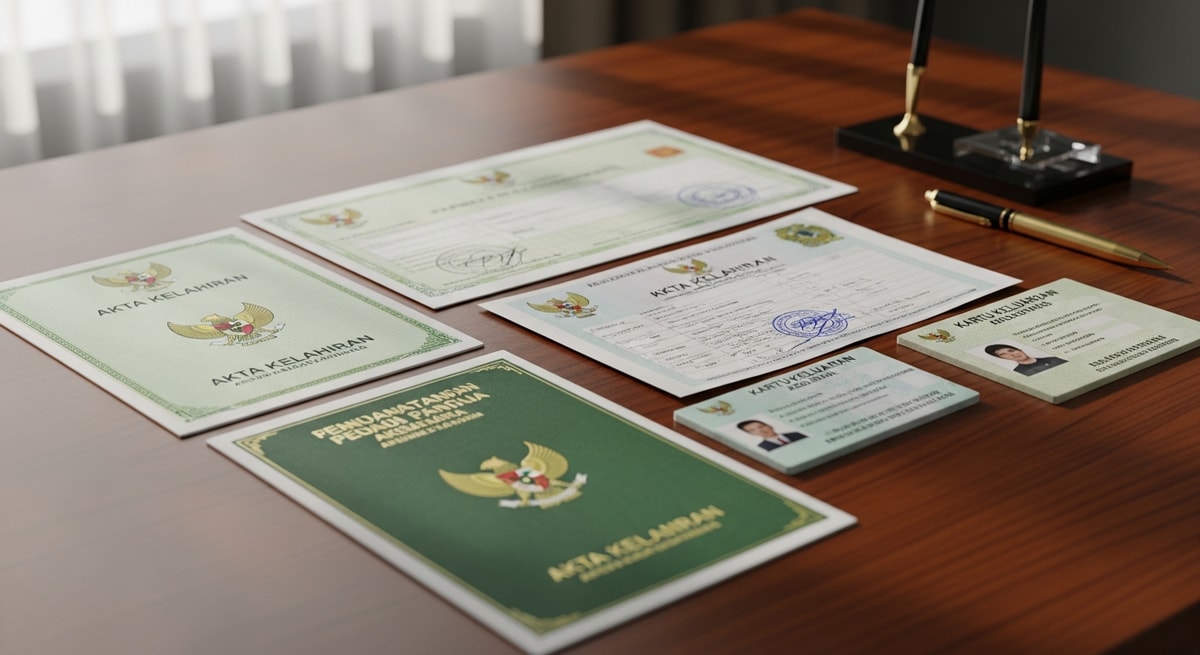
Indonesian civil documents such as Akta Kelahiran and Kartu Keluarga require specialized translation expertise
The Indonesian Penerjemah Tersumpah System
Indonesia operates a formal Penerjemah Tersumpah (sworn translator) system that governs official translation for domestic legal and administrative purposes. Regulated by Peraturan Menteri Hukum dan HAM Nomor 29 Tahun 2016 (Minister of Law and Human Rights Regulation No. 29 of 2016), as amended by Permenkumham No. 4 of 2019, this system requires that sworn translators pass a rigorous national certification examination conducted by the Badan Nasional Sertifikasi Profesi (BNSP) through the Lembaga Sertifikasi Profesi at Universitas Indonesia (LSP UI). Only Indonesian citizens are eligible to become sworn translators, and candidates must demonstrate advanced competence in both the source and target languages as well as knowledge of legal and administrative terminology.
After passing the BNSP examination, a sworn translator must take a formal oath (sumpah) before the Minister of Law and Human Rights or the head of a Kantor Wilayah (Regional Office) of Kemenkumham. This oath-taking ceremony must occur within 60 days of the appointment decision. Once sworn in, the translator registers their official stamp and signature with the authorities, and their name is entered into the Sistem Informasi Himpunan Penerjemah Indonesia (SIHaPeI), the official translator registry maintained by the Himpunan Penerjemah Indonesia (HPI). Translations produced by a Penerjemah Tersumpah carry legal equivalence to the original document under Indonesian law.
For international use, however, the requirements differ significantly. Immigration authorities in the United States, United Kingdom, Canada, and Australia do not require translations by Indonesian sworn translators specifically. Instead, they require certified translations meeting their own national standards: USCIS requires a certification statement from any competent translator, the UK Home Office requires a translator's declaration with contact details and qualifications, and IRCC Canada requires a certified translation by a competent translator. DoVisa provides translations that meet these international standards precisely, ensuring acceptance by the specific immigration authority reviewing your application. When documents also need to be used within Indonesia, we can coordinate with a registered Penerjemah Tersumpah for the domestic-use version.

Indonesia's Penerjemah Tersumpah system regulates sworn translators for domestic legal use
Apostille Services for Indonesian Documents
Indonesia became a party to the Hague Apostille Convention on October 5, 2021, with the Convention entering into force on June 4, 2022. This accession was a significant development for Indonesian document authentication, replacing the previous full legalization process that required sequential authentication by multiple government agencies. The designated competent authority for issuing apostilles in Indonesia is the Direktorat Jenderal Administrasi Hukum Umum (Directorate General of General Legal Administration) within the Kementerian Hukum dan Hak Asasi Manusia (Ministry of Law and Human Rights), commonly referred to as Kemenkumham or Ditjen AHU.
The apostille application process is conducted through the official online portal at apostille.ahu.go.id. Applicants must create an account, upload photographs or scans of the documents requiring apostille, and pay a fee of IDR 150,000 per document through a designated bank. After the online application passes review, the applicant presents the original documents and payment receipt at an authorized Kemenkumham service point, where the apostille is physically affixed to the document. Each Indonesian apostille includes a QR code and serial number that allows the receiving authority in the destination country to verify authenticity through the e-Register at apostille.ahu.go.id/verifikasi.
Documents eligible for apostille in Indonesia include public documents issued by government agencies, notarial deeds (Akta Notaris), civil registry certificates (Akta Kelahiran, Akta Perkawinan, Akta Kematian), academic certificates (Ijazah), and court documents. DoVisa coordinates the complete apostille process for Indonesian documents, including online application submission, fee payment, document presentation at the Kemenkumham service point in Jakarta, and international courier delivery of the apostilled original to your address. For documents destined for countries that are not members of the Apostille Convention, the traditional legalization process through the Kementerian Luar Negeri (Ministry of Foreign Affairs) and the destination country's embassy remains available, and DoVisa can manage this process as well.
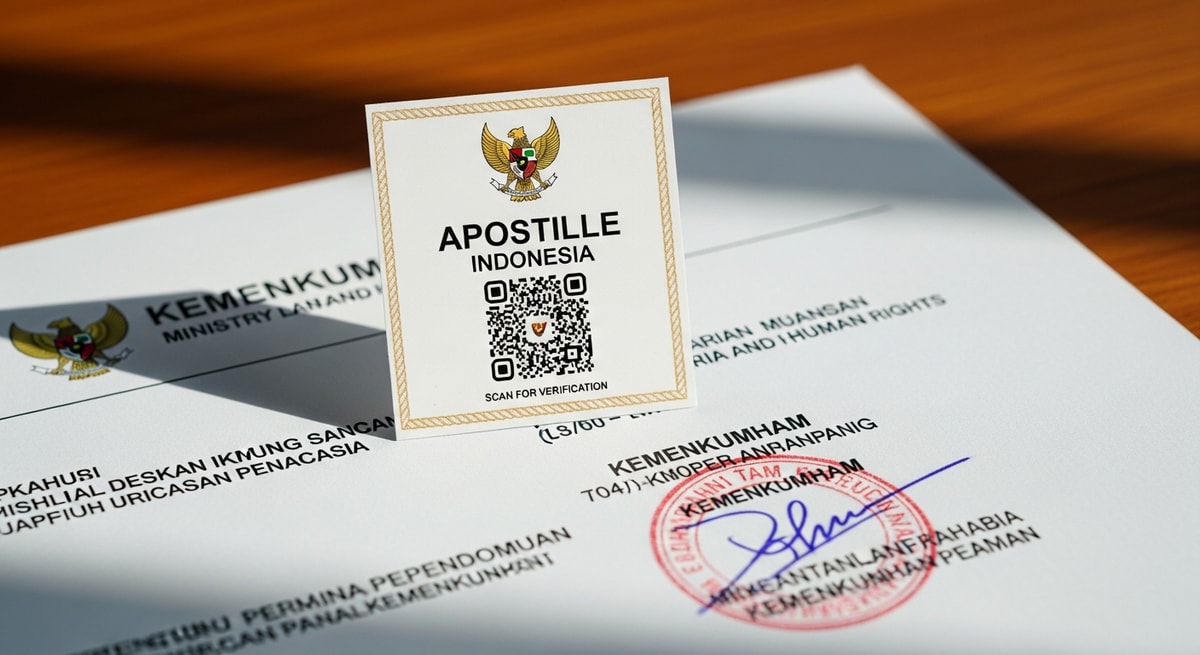
Indonesian apostilles issued by Kemenkumham are recognized in all Hague Convention member states
"Needed my Akta Kelahiran and Buku Nikah translated for a US immigrant visa application. The translator handled all the Indonesian civil registry terminology perfectly. USCIS approved our case without any RFE related to translations."
"DoVisa translated my wife's Indonesian birth certificate, marriage book, and police clearance for our UK spouse visa. The Home Office accepted everything on the first submission. Professional formatting and fast turnaround."
"Good translation of my Ijazah and Transkrip Nilai for WES credential evaluation in Canada. WES accepted the translations without any issues. Only giving 4 stars because I expected faster delivery on the express option."
"Had my Indonesian marriage certificate and wife's Akta Kelahiran translated for an Australian partner visa. The Department of Home Affairs accepted the translations immediately. Excellent attention to detail with the Indonesian document formats."
"Translated my SKCK, Ijazah, and employment references from Indonesian to English for Canadian Express Entry. IRCC processed everything without requesting corrections. Very satisfied with the quality and speed of service."
"Indonesian Kartu Keluarga translated to English for a family visa application. The translator correctly handled all the relationship terminology and household structure details. Good quality, slightly longer delivery than quoted."
"Our company needed Indonesian Akta Pendirian and SIUP translated to English for international banking purposes. The corporate terminology was handled expertly and the bank accepted everything on first submission. Highly recommended."
"Indonesian birth certificate translation was accurate but there was a minor spelling error in the address transliteration. They corrected it within a few hours after I pointed it out. The corrected version was accepted by USCIS."
"Needed six documents translated from Indonesian for my German student visa. Ijazah, transcripts, birth certificate, bank statements, SKCK, and health certificate. All accepted by the German embassy in Jakarta. Excellent service."
"Indonesian divorce certificate and Akta Kelahiran translated for a marriage registration in the Netherlands. The Dutch gemeente accepted the translations without any questions. Fast, professional, and fairly priced."
"DoVisa translated my Indonesian nursing diploma and transcripts to English for nursing board registration in Australia. AHPRA accepted the translations and my qualifications were assessed smoothly. Thank you for making this easier."
"Needed my Akta Kelahiran and Buku Nikah translated for a US immigrant visa application. The translator handled all the Indonesian civil registry terminology perfectly. USCIS approved our case without any RFE related to translations."
"DoVisa translated my wife's Indonesian birth certificate, marriage book, and police clearance for our UK spouse visa. The Home Office accepted everything on the first submission. Professional formatting and fast turnaround."
"Good translation of my Ijazah and Transkrip Nilai for WES credential evaluation in Canada. WES accepted the translations without any issues. Only giving 4 stars because I expected faster delivery on the express option."
Indonesian Document Translation FAQs
What is a Penerjemah Tersumpah and do I need one for my translation?
A Penerjemah Tersumpah is an Indonesian sworn translator who has passed the national BNSP certification exam, been appointed by the Kementerian Hukum dan HAM (Ministry of Law and Human Rights), and taken a formal oath. Their translations carry legal equivalence to original documents under Indonesian law. You need a Penerjemah Tersumpah if your translated document will be used within Indonesia for domestic legal or administrative purposes. However, for international use — such as immigration applications to the United States (USCIS), United Kingdom (Home Office), Canada (IRCC), or Australia (Home Affairs) — these countries require certified translations meeting their own national standards, not specifically an Indonesian sworn translation. DoVisa provides translations certified to meet the requirements of your specific destination country.
Are DoVisa translations accepted by USCIS for Indonesian documents?
Yes. USCIS requires that all foreign-language documents be accompanied by a certified English translation that includes the translator's certification statement declaring the translation is complete and accurate, along with the translator's name, signature, and date. Our translations of Indonesian documents — including Akta Kelahiran, Buku Nikah, Ijazah, SKCK, Kartu Keluarga, and all other Indonesian civil and legal documents — meet these USCIS requirements precisely. We have extensive experience with Indonesian-to-English translations for all USCIS visa categories, including family-based petitions (I-130), adjustment of status (I-485), K-1 fiance visas, and naturalization applications (N-400).
How much does certified Indonesian translation cost?
Our Indonesian certified translation pricing follows a transparent per-page structure with volume discounts that apply automatically for larger documents. Pricing varies based on document length, language pair, and the processing speed you select. Express and rush service options are available for time-sensitive immigration applications. Apostille processing through Kemenkumham is quoted separately. Upload your documents on our order page to receive an instant, detailed quote before work begins — no hidden fees.
What is the difference between an Akta Perkawinan and a Buku Nikah?
These are two different types of Indonesian marriage documents. The Akta Perkawinan (marriage certificate) is issued by the Dinas Kependudukan dan Pencatatan Sipil (Disdukcapil) for civil and non-Muslim religious marriages. The Buku Nikah (marriage book) is issued by the Kantor Urusan Agama (KUA, Office of Religious Affairs) for Muslim marriages and is a distinctive green booklet containing detailed information about the marriage ceremony, the couple, their witnesses, and the marriage guardian (wali). Since the majority of marriages in Indonesia are Muslim ceremonies, the Buku Nikah is the most commonly translated Indonesian marriage document. Both documents are recognized for immigration purposes, and DoVisa's translators are experienced with the specific formats and terminology of each.
Can Indonesia issue apostilles on documents for international use?
Yes. Indonesia became a party to the Hague Apostille Convention on October 5, 2021, with the Convention entering into force on June 4, 2022. The competent authority is the Direktorat Jenderal Administrasi Hukum Umum within Kemenkumham. Apostille applications are submitted through the online portal at apostille.ahu.go.id, with a fee of IDR 150,000 per document. Eligible documents include civil registry certificates (Akta Kelahiran, Akta Perkawinan, Akta Kematian), academic certificates (Ijazah), notarial deeds, and court documents. Each apostille includes a QR code for digital verification. DoVisa can coordinate the entire apostille process on your behalf, including submission and international delivery.
How long does Indonesian document translation take?
Standard delivery for Indonesian document translations is 3-5 business days. Express 48-hour service is available for documents up to 5 pages. Same-day rush service is available for single-page vital records such as Akta Kelahiran (birth certificate), Akta Perkawinan (marriage certificate), and Akta Kematian (death certificate) when orders are placed before 10:00 WIB. For apostille services, additional processing time of 5-10 business days is typical, depending on Kemenkumham's current workload. We provide tracking updates throughout the process so you always know the status of your order.
What is a Kartu Keluarga and why is it often required for translation?
The Kartu Keluarga (KK, or Family Card) is a uniquely Indonesian document issued by Disdukcapil that lists all members of a household, their personal details, family relationships, and Nomor Induk Kependudukan (NIK) identification numbers. It has no direct equivalent in most Western countries. Immigration authorities frequently request translations of the Kartu Keluarga because it provides a comprehensive overview of family relationships and household composition, which is particularly relevant for family-based visa applications, dependent visa claims, and proof of relationship for sponsorship cases. Our translators are experienced with the specific format and terminology of the KK, including accurate rendering of relationship designations and administrative codes.
Do I need original documents or are scans sufficient for translation?
For the translation process, clear digital scans or photographs are sufficient. Our translators work from the digital copies you upload through our secure portal. However, if you also need apostille services for your Indonesian documents, the original physical document must be presented at the Kemenkumham service point in Jakarta. For immigration applications, the receiving authority may require you to present the original document alongside the certified translation during your interview or appointment. We recommend keeping your originals safe and accessible. Our certified translations include a copy of the source document bound with the translation for reference.
Can DoVisa translate Indonesian academic credentials for WES evaluation?
Yes. We regularly translate Indonesian Ijazah (diplomas) and Transkrip Nilai (academic transcripts) for credential evaluation by WES (World Education Services), IQAS (International Qualifications Assessment Service), and other designated evaluation bodies in Canada and the United States. Our translators accurately render Indonesian academic terminology, including degree titles (Sarjana, Magister, Doktor), faculty names, accreditation details, and the Indonesian 0-4.0 grading scale with letter grade equivalencies. WES and other evaluation bodies consistently accept our translations without requiring amendments or additional documentation.
What is an SKCK and how is it translated?
The Surat Keterangan Catatan Kepolisian (SKCK), commonly referred to as a police clearance certificate, is issued by the Indonesian National Police (Polri) at the district police (Polres) or provincial police (Polda) level. It certifies that the holder has no criminal record or lists any recorded offenses. The SKCK contains the applicant's personal data, a photograph, fingerprint references, and the issuing officer's details. Immigration authorities worldwide require SKCK translations for visa applications. Our translators accurately render all fields, including police administrative terminology, rank designations, and the official clearance statement. For multi-country police clearance requirements, we can also translate SKCK documents from different Indonesian police jurisdictions.
Are digital PDF translations accepted by immigration authorities?
Most immigration authorities accept digital PDF submissions of certified translations, particularly for online application systems. USCIS accepts PDF uploads through their online filing system. The UK Home Office accepts scanned certified translations uploaded through the UKVI application portal. IRCC Canada accepts digital copies through their online portal. The Australian Department of Home Affairs accepts PDF uploads through ImmiAccount. DoVisa provides high-resolution certified PDF translations that are optimized for these digital submission systems. For authorities that require physical copies — such as during in-person interviews at embassies or immigration offices — we also ship original wet-ink certified hard copies via tracked international courier.
How do you handle Indonesian names with single names or no surname?
Many Indonesians, particularly those of Javanese origin, have single names without a surname (mononyms). This can create challenges when foreign forms require separate first-name and last-name fields. Our translators faithfully reproduce the name exactly as it appears on the original Indonesian document. When a document shows only a single name, we translate it as such and do not fabricate a surname or split the name arbitrarily. We can include a translator's note explaining that single names are common in Indonesian naming conventions, which helps immigration officers understand the discrepancy with their form fields. This approach aligns with USCIS, UK Home Office, and IRCC guidance on handling mononymous names from Indonesian documents.
Can DoVisa handle Buku Nikah translations with Arabic text?
Yes. The Indonesian Buku Nikah (marriage book for Muslim ceremonies) typically contains text in both Bahasa Indonesia and Arabic, including Quranic verses, the marriage contract (akad nikah) wording, and religious formulas. Our translators are experienced with this bilingual format and accurately translate both the Indonesian administrative content and the Arabic religious text. The Buku Nikah also includes specific Islamic marriage terminology such as mahar (dowry), wali (marriage guardian), and saksi (witnesses), which our translators render accurately in the target language while preserving the legal and religious significance of each term.
Get Your Indonesian Certified Translation Today
Professional certified translations of Indonesian documents accepted by USCIS, UK Home Office, IRCC Canada, Australian Home Affairs, and immigration authorities worldwide