
NAATI-Certified Australian Document Translation
Professional NAATI-credentialed translations accepted by the Department of Home Affairs, DFAT, Australian courts, universities, and all government agencies. Apostille service available through DFAT.
TrustpilotSelect Languages
Drag & drop your documents here
or
PDF, JPEG, PNG, WebP — Max 10MB per file. Word documents: please save as PDF first.
Certified translators · Accepted by governments, courts & universities worldwide · View sample
Select a destination country to view pricing
How Australian Certified Translation Works
Submit Your Documents Securely
Upload clear scans of your Australian or foreign-language documents through our encrypted portal. We accept PDF, JPEG, and PNG formats. Our intake specialists review each upload for legibility and completeness, flagging any issues before translation begins so nothing delays your application.
NAATI-Credentialed Translator Assignment
Your documents are matched with a NAATI-certified translator holding credentials under the current NAATI Certification System. Australia's Department of Home Affairs and DFAT require translations by NAATI-credentialed professionals. We verify each translator's active NAATI credential and practitioner ID before every assignment.
Translation & NAATI Certification
The translator produces your certified translation and affixes their official NAATI stamp — physical or digital — bearing their name, practitioner ID, language pair, and certification type. A second qualified linguist reviews terminology, formatting, and accuracy before final delivery.
Delivery with Full Certification
Receive your NAATI-certified translation as a high-resolution PDF for immediate use, with the original stamped hard copy shipped via Australia Post or international courier. For documents requiring apostille authentication through DFAT, we coordinate the complete submission process on your behalf.
Australian Translation Service Specifications
Popular Language Pairs
We support all languages — 100+ language pairs available for Australian documents.
Common Documents
- Australian birth certificates (state/territory registries)
- Marriage certificates (Registry of Births, Deaths and Marriages)
- Divorce orders (Federal Circuit and Family Court)
- Academic transcripts and diplomas (universities and TAFEs)
- Australian police check (AFP National Police Check)
- Driver licences (state/territory transport authorities)
- Citizenship certificates (Department of Home Affairs)
- Medicare and health records
- Business registration extracts (ASIC)
- Court orders and affidavits
Turnaround Time
Certification Details
Australian Translation Requirements & Regulatory Framework
Embassy Acceptance
Notarization Process
Apostille Information
Legal Framework
Common Scenarios for Australian Document Translation
Skilled Migration & Visa Applications
Australia's points-based skilled migration system requires NAATI-certified translations of foreign academic qualifications, employment references, and professional registration documents. The Department of Home Affairs reviews translations for General Skilled Migration (subclass 189/190/491), employer-sponsored visas (subclass 482/186), and student visas. Skills assessment bodies like Engineers Australia, VETASSESS, and ACS also require certified translations of overseas credentials.
Partner & Family Visa Applications
Partner visa (subclass 309/100 and 820/801) applicants must provide certified translations of relationship evidence, birth certificates, police clearances from every country of residence, and identity documents. The Department of Home Affairs assesses these translations during the decision-making process. Parent visas and child visas similarly require certified translations of supporting documentation in languages other than English.
University Admission & Credential Evaluation
Australian universities and credential evaluation services require NAATI-certified translations of foreign academic transcripts, diplomas, and secondary school certificates. Organizations such as the Australian Education International — National Office of Overseas Skills Recognition (AEI-NOOSR) assess overseas qualifications. Accurate translation of grading scales, credit systems, and academic terminology is essential for smooth evaluation outcomes.
Business & Corporate Document Translation
Foreign companies establishing operations in Australia must provide certified translations of corporate documents for registration with the Australian Securities and Investments Commission (ASIC). This includes certificates of incorporation, articles of association, shareholder registers, and director identification documents. The Australian Taxation Office (ATO) may also require translated financial records for tax compliance purposes.
Legal Proceedings & Court Documents
Cross-border litigation, family law matters, and international commercial disputes in Australian courts require certified translations of foreign-language evidence. The Federal Circuit and Family Court of Australia, state Supreme Courts, and tribunals accept NAATI-certified translations. Our legal translation team handles complex terminology from family law orders and commercial contracts to criminal records and statutory declarations.
Australia's NAATI Certification System Explained
Australia operates a unique national translation certification system through NAATI (National Accreditation Authority for Translators and Interpreters), established in 1977 and jointly owned by the Commonwealth, state, and territory governments. Unlike European countries that use court-appointed sworn translators, Australia centralizes translation credentialing through a single national body that sets competency standards, administers certification testing, and maintains a public directory of credentialed practitioners.
NAATI offers eight credential types for translators and interpreters. For translation, the key credentials are Certified Translator (the standard professional-level credential), Certified Advanced Translator (for complex, technical, and specialized material), and Recognised Practising Translator (for practitioners who demonstrate ongoing professional practice). Since 1 January 2018, NAATI transitioned from the former accreditation system to the current Certification System, and DFAT only accepts translations stamped under the new system.
Every NAATI-certified translation must display the translator's official NAATI stamp — either physical or digital — containing their full name, NAATI practitioner ID, language combination, and certification level. A copy of the source document, signed or stamped by the translator, must accompany the translation. NAATI also provides a public Online Directory at naati.com.au where anyone can verify a translator's current credential status, ensuring transparency and accountability. DoVisa maintains a network of NAATI-credentialed translators covering over 60 language pairs, with each translator's credential verified before every project.
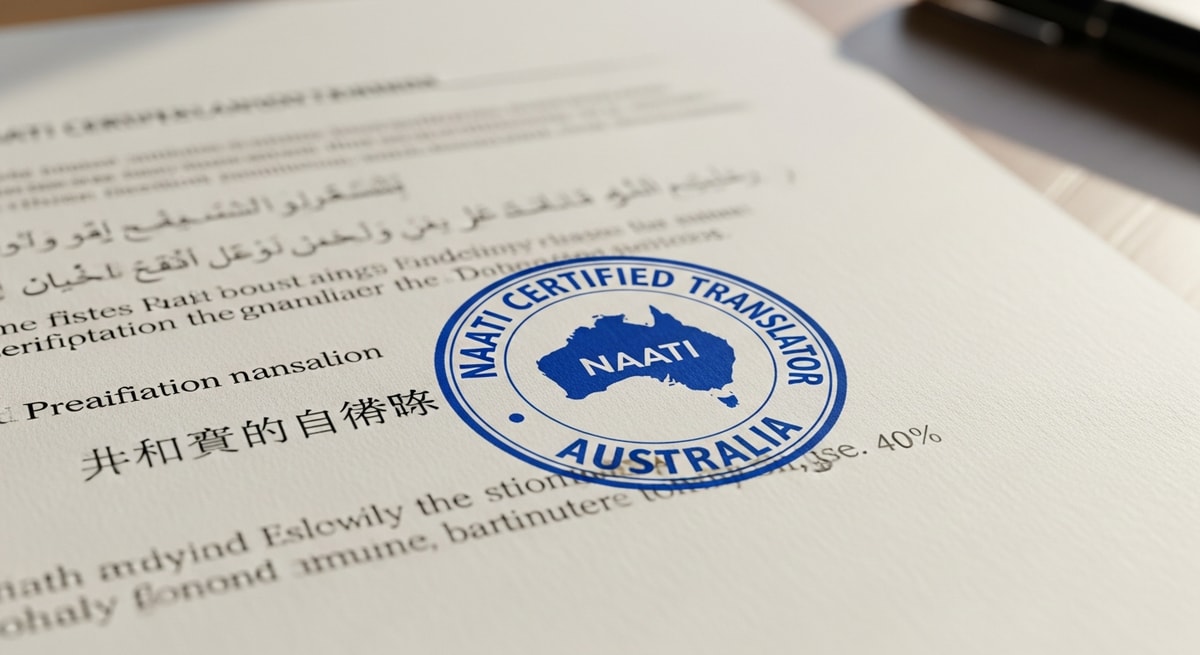
NAATI-certified translations carry official stamps recognized by all Australian government agencies
Apostille and Document Authentication for Australian Documents
Australia ratified the Hague Apostille Convention in 1994, with the Department of Foreign Affairs and Trade (DFAT) designated as the sole competent authority for issuing apostilles on Australian public documents. Unlike many countries that have multiple competent authorities, Australia centralizes all apostille issuance through DFAT, which operates through Australian Passport Offices located in each state and territory capital city — Sydney, Melbourne, Brisbane, Perth, Adelaide, Hobart, Darwin, and Canberra.
The apostille process for Australian documents involves presenting the original public document (or a NAATI-certified translation attached to it) at an Australian Passport Office. DFAT verifies the document's authenticity and the issuing authority's signature before affixing the apostille. Since 14 December 2015, DFAT has maintained the ORAO (Online Register of Apostilles Overseas) portal at orao.dfat.gov.au, where receiving authorities in other countries can verify the authenticity of Australian apostilles electronically.
For documents destined for countries that are not Apostille Convention members, DFAT provides a separate authentication service followed by legalization at the destination country's embassy or consulate in Australia. DoVisa manages both the apostille and the full legalization process, including identifying the correct pathway based on the destination country, preparing and submitting documents to DFAT or the relevant embassy, and delivering the authenticated documents to your address. Standard apostille processing through DFAT takes 5-10 business days; we also coordinate express processing when available.

DFAT is Australia's sole competent authority for apostille issuance across all states and territories
"Needed my Chinese university degree and transcripts translated for a skills assessment with Engineers Australia. The NAATI-certified translation was perfect — EA processed my assessment without any queries about the translation quality."
"DoVisa translated my Vietnamese birth certificate and police clearance for a partner visa application. The Department of Home Affairs accepted everything first time. Turnaround was 4 days as promised."
"Japanese academic transcripts translated to English for university admission in Melbourne. Good quality translation with correct NAATI stamp. Gave 4 stars because express wasn't available for Japanese at the time I needed it."
"Hindi marriage certificate and birth certificates for the whole family translated for our permanent residency application. The NAATI-certified translations were accepted by Home Affairs without any issues. Great communication throughout."
"Arabic documents translated for my skilled migration visa — university degree, employment references, and police clearance from Egypt. All five documents came back within the standard timeframe. VETASSESS accepted the translations immediately."
"Korean family register and birth certificate translated with NAATI certification. I also needed an apostille from DFAT for use in Canada, and DoVisa handled the entire process from translation to apostille delivery. Saved me so much time."
"French divorce decree translated to English for a family court matter in Sydney. The legal terminology was handled well and the Federal Circuit Court accepted it. Minor delay in shipping but otherwise a smooth experience."
"Tamil birth certificate translation for citizenship application. The translation was accurate but the initial version had my father's name romanized differently from my passport spelling. They corrected it within a few hours after I flagged it."
"Russian medical degree and registration documents translated for AHPRA assessment. The NAATI translator understood medical terminology perfectly. My qualifications were recognized without any requests for clarification on the translations."
"Vietnamese police clearance and birth certificate translated for my 190 state-nominated visa. Both translations were NAATI-certified and accepted by the Department of Home Affairs. Fast turnaround and professional service."
"German Arbeitszeugnis translated to English for a job application in Perth. The translator captured the coded reference language accurately. Helpful for my employer to understand the German grading conventions."
"Indonesian marriage certificate and spouse's birth certificate translated for a partner visa. DoVisa provided NAATI-certified translations that Home Affairs accepted without any RFE. The whole process took less than a week."
"Needed my Chinese university degree and transcripts translated for a skills assessment with Engineers Australia. The NAATI-certified translation was perfect — EA processed my assessment without any queries about the translation quality."
"DoVisa translated my Vietnamese birth certificate and police clearance for a partner visa application. The Department of Home Affairs accepted everything first time. Turnaround was 4 days as promised."
"Japanese academic transcripts translated to English for university admission in Melbourne. Good quality translation with correct NAATI stamp. Gave 4 stars because express wasn't available for Japanese at the time I needed it."
Australian Document Translation FAQs
What is NAATI and why does it matter for Australian translations?
NAATI (National Accreditation Authority for Translators and Interpreters) is Australia's national standards and credentialing body for translators and interpreters, established in 1977 and jointly owned by the Commonwealth, state, and territory governments. NAATI is the only organization authorized to issue translator credentials in Australia. Since 1 July 2018, the Department of Foreign Affairs and Trade (DFAT) only accepts translations completed by translators holding credentials under the current NAATI Certification System. The Department of Home Affairs, courts, universities, and professional registration bodies all require NAATI-certified translations for documents not in English.
What documents need to be translated for an Australian visa application?
For Australian visa applications, any supporting document not in English must be accompanied by a NAATI-certified translation. Common documents include birth certificates, marriage certificates, divorce decrees, police clearance certificates from every country where you have lived for 12 months or more, academic transcripts and diplomas, employment references, and professional registration certificates. The specific requirements depend on your visa subclass — skilled migration visas typically require translated qualifications and work experience documents, while partner visas require translated relationship evidence and identity documents.
How long does certified translation take for Australian documents?
Standard NAATI-certified translation is delivered within 4-6 business days for most document types and language pairs. Express processing is available for 2-3 business days, and rush delivery within 24 hours is offered for select single-page vital records such as birth, marriage, and death certificates. Turnaround times may vary for less common language pairs or highly technical documents. We provide a delivery estimate at the time of your order based on your specific documents and language combination.
Are DoVisa translations accepted by the Department of Home Affairs?
Yes. All our Australian translations are produced by translators holding current NAATI credentials under the post-2018 Certification System, which is the standard required by the Department of Home Affairs for all immigration and citizenship applications. Each translation bears the translator's official NAATI stamp with their practitioner ID, name, language pair, and certification level. Our translations are accepted for all visa subclasses including skilled migration, partner, parent, student, and temporary work visas.
Do I need a NAATI translator if my documents are being translated outside Australia?
If your documents are being translated outside Australia for an Australian immigration application, the translator does not need to be NAATI-certified. However, the translation must be endorsed with the translator's full name, address, telephone number, and details of their qualifications and experience in the language being translated. For documents submitted to DFAT for apostille or authentication, NAATI certification is required. We recommend using NAATI-certified translators whenever possible, as it provides the highest level of acceptance assurance with Australian authorities.
What is an apostille and do I need one for Australian documents?
An apostille is a certificate issued under the Hague Apostille Convention that authenticates the origin of a public document for use in another Convention member state. You need an apostille if your Australian document (or its certified translation) will be used in one of the 125+ countries that are members of the Convention. In Australia, the sole authority for issuing apostilles is the Department of Foreign Affairs and Trade (DFAT), operating through Australian Passport Offices. DoVisa handles the complete apostille application and submission process on your behalf.
How much does NAATI-certified translation cost?
Our Australian certified translation pricing follows a transparent per-page structure with volume discounts that apply automatically for larger documents. Pricing varies based on document length, language pair, and processing speed. Express and rush options are available for time-sensitive projects. Apostille processing through DFAT is quoted separately. Upload your documents on our order page to receive an instant, detailed quote — no hidden fees or surprises.
Can you translate documents for Australian citizenship applications?
Yes. Australian citizenship applications require NAATI-certified translations of identity documents, overseas birth certificates, change of name documents, and any other supporting evidence not in English. For citizenship by conferral, the Department of Home Affairs requires translations of documents verifying your identity, residency, and good character. We provide a citizenship translation package covering all standard document requirements at a bundled rate.
What is the difference between NAATI certification levels?
NAATI offers several credential types for translators. Certified Translator is the standard professional-level credential, qualifying the holder to translate general and moderately complex documents. Certified Advanced Translator handles highly complex, technical, and specialized material at the highest competency level. Recognised Practising Translator is a credential for experienced practitioners who demonstrate ongoing professional practice. For most government and immigration purposes, a Certified Translator credential is sufficient and fully accepted.
Can I verify my translator's NAATI credentials?
Yes. NAATI maintains a public Online Directory at naati.com.au where anyone can search for and verify a translator's current credential status, including their practitioner ID, language pairs, and credential type. Every DoVisa certified translation includes the translator's full name and NAATI practitioner ID, allowing you to independently verify their credentials. We also verify each translator's active credential status before every project assignment.
How do I get a DFAT apostille on my translated document?
To obtain a DFAT apostille, the NAATI-certified translation (along with the source document) must be submitted to an Australian Passport Office in a state or territory capital city. DFAT verifies the translator's NAATI credential and the document's authenticity before issuing the apostille. You must book an appointment before attending. DoVisa manages the entire process — we prepare the application, submit documents to the correct Passport Office, track processing, and deliver the apostilled translation to your address. Standard processing takes 5-10 business days.
Do you translate documents from Australian Aboriginal languages?
Yes, we can arrange translations involving Australian Aboriginal and Torres Strait Islander languages where NAATI-credentialed translators are available. NAATI credentials cover a range of indigenous languages, though availability varies. For languages where NAATI-credentialed translators are not available, we work with qualified linguists who endorse their translations with full credentials as required by Australian authorities. Please contact us with your specific language needs for a tailored quote.
What format will I receive my translated document in?
You will receive your NAATI-certified translation as a high-resolution PDF via email for immediate use, along with the original hard copy bearing the translator's wet-ink NAATI stamp and signature, shipped via tracked post. While many Australian agencies accept PDF copies for initial submissions and pre-checks, some may request the physical original during in-person appointments. We recommend keeping both the digital and physical copies accessible. International shipping is available via tracked courier.
Get Your Australian Documents Translated Today
NAATI-certified translations accepted by the Department of Home Affairs, DFAT, courts, and universities across Australia