
Certified Korean Document Translation
Professional Korean translations accepted by the Ministry of Foreign Affairs, Korea Immigration Service, Korean courts, and universities. Apostille and e-Apostille service through MOFA and MOJ competent authorities.
TrustpilotSelect Languages
Drag & drop your documents here
or
PDF, JPEG, PNG, WebP — Max 10MB per file. Word documents: please save as PDF first.
Certified translators · Accepted by governments, courts & universities worldwide · View sample
Select a destination country to view pricing
How Korean Certified Translation Works
Submit Your Documents Securely
Upload clear scans of your Korean or foreign-language documents through our encrypted portal. We accept all standard formats including PDF, JPEG, and PNG. For Korean documents containing Hangul (한글) and Hanja (漢字) characters, our intake team verifies that all text is legible, including official stamps (직인) and handwritten notations, before translation begins.
Professional Translator Assignment
Your documents are matched with a Korean language specialist experienced in the specific document type. For Korean government documents such as family relations certificates (가족관계증명서) and basic certificates (기본증명서), we assign translators with expertise in Korea's civil registration system. Each translator holds professional credentials and is verified for active status before every assignment.
Translation with Certification
The assigned translator produces your certified translation with a formal statement of accuracy, their professional credentials, signature, and date. A second qualified linguist reviews the translation for terminology accuracy, proper rendering of Korean names in standard romanization, and completeness. The certification statement confirms the translation faithfully represents the original Korean document.
Delivery with Full Documentation
Receive your certified translation as a high-resolution PDF for immediate use, with the original signed hard copy shipped via tracked international courier. For documents requiring apostille certification, DoVisa coordinates the complete process through the Ministry of Foreign Affairs or Ministry of Justice. Korea's e-Apostille system at apostille.go.kr enables electronic verification of issued apostilles.
Korean Translation Service Specifications
Popular Language Pairs
We support all languages — 100+ language pairs available for Korean documents.
Common Documents
- Basic certificates (기본증명서 / Gibon Jeungmyeongseo)
- Family relations certificates (가족관계증명서 / Gajok-gwangye Jeungmyeongseo)
- Marriage relations certificates (혼인관계증명서 / Honin-gwangye Jeungmyeongseo)
- Birth certificates (출생증명서 / Chulsaeng Jeungmyeongseo)
- Criminal record certificates (범죄경력회보서 / Beomjoe-gyeongnyeok Hoeboseo)
- Academic diplomas and transcripts (졸업증명서 / Joreop Jeungmyeongseo)
- Resident registration certificates (주민등록등본 / Jumin-deungnok Deungbon)
- Adoption relations certificates (입양관계증명서 / Ibyang-gwangye Jeungmyeongseo)
- Death certificates (사망증명서 / Samang Jeungmyeongseo)
- Driver's licenses (운전면허증 / Unjeon Myeonheojeung)
Turnaround Time
Certification Details
Korean Translation Requirements & Regulatory Framework
Embassy Acceptance
Notarization Process
Apostille Information
Legal Framework
Common Scenarios for Korean Document Translation
Immigration & Visa Applications
Foreign nationals applying for Korean visas — including E-7 (professional), F-2 (residence), F-5 (permanent residence), and F-6 (marriage) — must submit certified translations of foreign documents to the Korea Immigration Service (출입국·외국인정책본부). Required translations typically include birth certificates, criminal record checks, academic credentials, and employment contracts. DoVisa provides translations formatted for Korean immigration requirements, including proper Korean equivalents for foreign document terminology.
Marriage Registration in Korea
Foreign nationals marrying in Korea must submit certified translations of their birth certificate, single-status certificate (미혼증명서), and passport to the local gu-office (구청) or dong-office (동사무소). If the foreign spouse has been previously married, translated divorce decrees are also required. Each local office may have slightly different procedural preferences. Our translators are experienced with Korean civil registration terminology and formatting expectations across metropolitan and provincial offices.
Korean University Admissions
International students applying to Korean universities under the TOPIK-based or document-review admission tracks must provide certified translations of academic transcripts, diplomas, and recommendation letters. Universities including Seoul National University, KAIST, Yonsei, and Korea University each maintain specific translation format preferences. DoVisa's academic translators produce translations that meet Korean university admissions office expectations, including proper rendering of grading scales and degree nomenclature.
Korean Documents for Overseas Use
Korean nationals emigrating or conducting business abroad frequently need certified English translations of their family relations certificates (가족관계증명서), basic certificates (기본증명서), criminal record certificates (범죄경력회보서), and academic credentials. These translations are typically submitted to immigration authorities in countries like the United States, Canada, Australia, and the United Kingdom. DoVisa produces translations formatted for USCIS, IRCC, Home Affairs, and Home Office requirements, paired with apostille certification through MOFA.
Business & Corporate Document Translation
Companies establishing operations in Korea or Korean businesses expanding internationally require certified translations of articles of incorporation, shareholder agreements, board resolutions, commercial registry extracts, and financial statements. Korean corporate documents use specialized terminology that differs significantly from conversational Korean. Our commercial translators handle Hangul-only and mixed Hangul-Hanja corporate documents with equal proficiency, ensuring accurate translation of Korean Companies Act (상법) terminology.
Family Relations Certificate Translation for Inheritance
Cross-border inheritance cases involving Korean assets require translated family relations certificates, death certificates (사망증명서), and probate documents from the Korean family court system. Korea's individual-based family relations register (가족관계등록부), administered by the Supreme Court, issues five distinct certificate types that may all be required depending on the inheritance claim. DoVisa's legal translators understand the nuances of each certificate type and produce translations that foreign probate courts and estate attorneys can rely on.
Korea's Family Relations Registration System
South Korea operates a modern, fully digital civil registration system that replaced the former household-based hojuk (호적) register on 1 January 2008. The old hojuk system, centered on a male head of household (호주), was declared unconstitutional by Korea's Constitutional Court for violating individual dignity and gender equality. The replacement, established by the Act on Registration of Family Relations (가족관계의 등록 등에 관한 법률, enacted 17 May 2007), creates a separate entry for each individual rather than grouping everyone under a household head.
The new system, administered by the Supreme Court of Korea (대법원), issues five purpose-specific certificate types: the Basic Certificate (기본증명서) recording identity and birth details; the Family Relations Certificate (가족관계증명서) listing parents, spouse, and children; the Marriage Relations Certificate (혼인관계증명서) proving marital status; the Adoption Relations Certificate (입양관계증명서); and the Plenary Adoption Relations Certificate (친양자입양관계증명서). Each is available in General and Detailed versions, and certificates can be requested in both Korean and English through the online e-Family portal (efamily.scourt.go.kr).
These five certificate types are the most commonly translated Korean civil documents. DoVisa translators maintain specialized expertise in Korea's unique family registration terminology and the legal distinctions between each certificate type. Understanding these distinctions is critical — a receiving authority requesting proof of marital status needs the Marriage Relations Certificate, not the Family Relations Certificate, despite the similar names. Our project managers guide customers to the correct certificate type before translation begins, preventing costly delays.
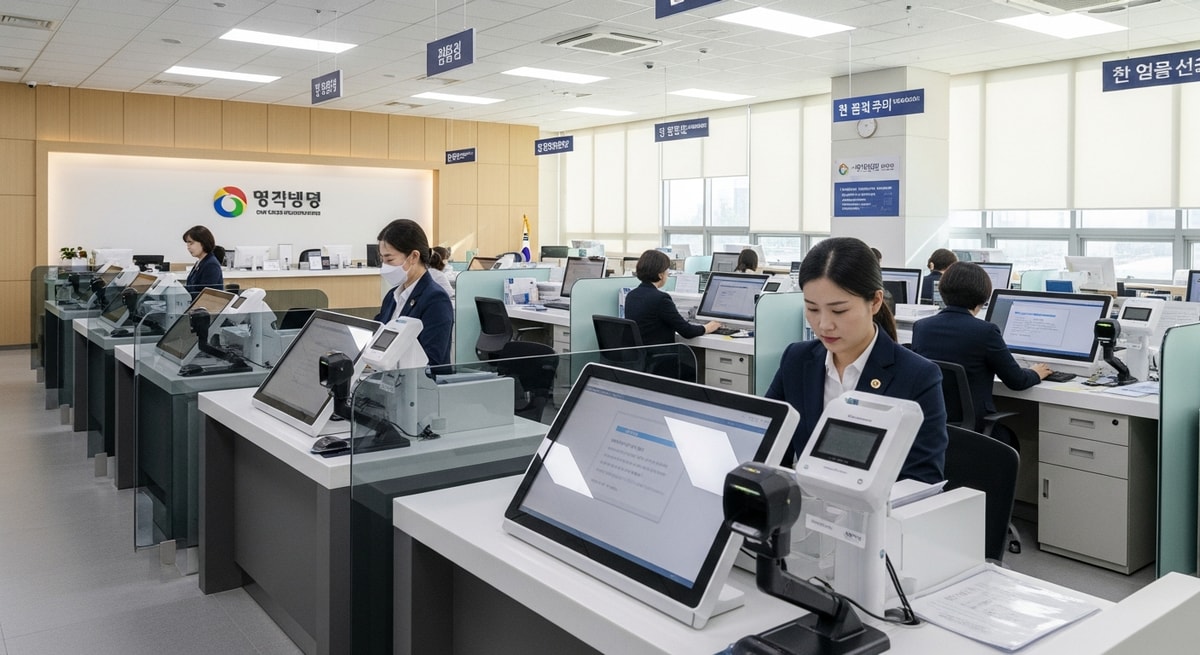
Korea's digital family relations registration system issues five distinct certificate types commonly required for translation
Apostille and e-Apostille Services in South Korea
South Korea joined the Hague Apostille Convention in 2007 and has since become one of the leading adopters of electronic apostille technology. Korea designates four competent authorities: the Ministry of Foreign Affairs (외교부) handles apostilles for most administrative documents; the Ministry of Justice (법무부) processes court records, notarial acts, and official certificates attached to private documents; the National Court Administration (법원행정처) covers court-related documents; and the Overseas Koreans Agency (재외동포청, launched June 2023) provides apostille services specifically for overseas Koreans.
Korea's e-Apostille system (apostille.go.kr) allows electronic application and issuance of apostilles, with verification available through the same portal. The apostille fee is 1,000 KRW per document — one of the lowest rates globally. The e-Apostille is transmitted electronically and can be verified by any receiving authority worldwide through the online portal, eliminating the need for physical apostille certificates in many cases. Processing typically takes 1-3 business days through the electronic system.
DoVisa manages the complete apostille process for Korean documents destined for international use. We identify the correct competent authority based on your document type, prepare the application through the appropriate channel, and coordinate either physical or electronic apostille issuance. For certified translations of Korean documents, the apostille is applied to the notarized translation package. Our experience with all four competent authorities ensures efficient processing regardless of your specific document type.
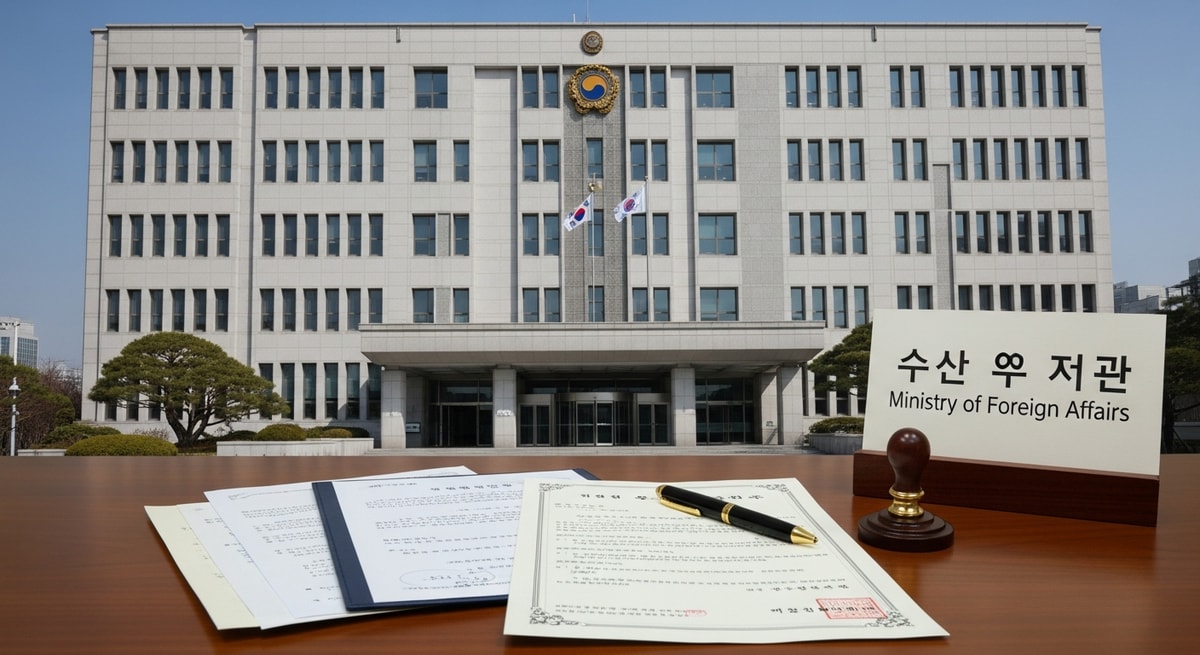
Korea's Ministry of Foreign Affairs and three other competent authorities issue apostilles with a fully electronic e-Apostille option
Korean Language Considerations for Document Translation
Korean uses the Hangul (한글) writing system, a featural alphabet invented in 1443 by King Sejong the Great. Modern Korean documents are primarily written in Hangul, though older documents and some legal texts include Hanja (漢字, Chinese characters). Korean names frequently have both Hangul and Hanja renderings, and legal documents may specify both. Accurate translation requires understanding both writing systems and the ability to correctly romanize Korean names according to the Revised Romanization of Korean system, the official standard since 2000.
Korean personal names present particular challenges in translation. The family name precedes the given name in Korean convention, and common surnames — Kim (김), Lee/Yi (이), Park (박), Choi (최), Jung/Jeong (정) — are shared by millions. Many Korean documents display the name in Hangul with the Hanja rendering in parentheses, providing disambiguation that must be preserved in translation. Korean honorifics and titles (님, 씨, 선생님) also require appropriate handling depending on the target language and document context.
Government documents issued through Korea's digital systems use standardized formatting, but older documents from the pre-2008 hojuk era may contain handwritten entries, mixed Hangul-Hanja text, and archival stamps. DoVisa's Korean translators are trained to handle both modern digitally issued certificates and legacy documents. We maintain particular expertise in the transition-period documents from 2007-2008, when the family registration system changed and document formats were in flux. This ensures accurate translation regardless of when your Korean document was originally issued.
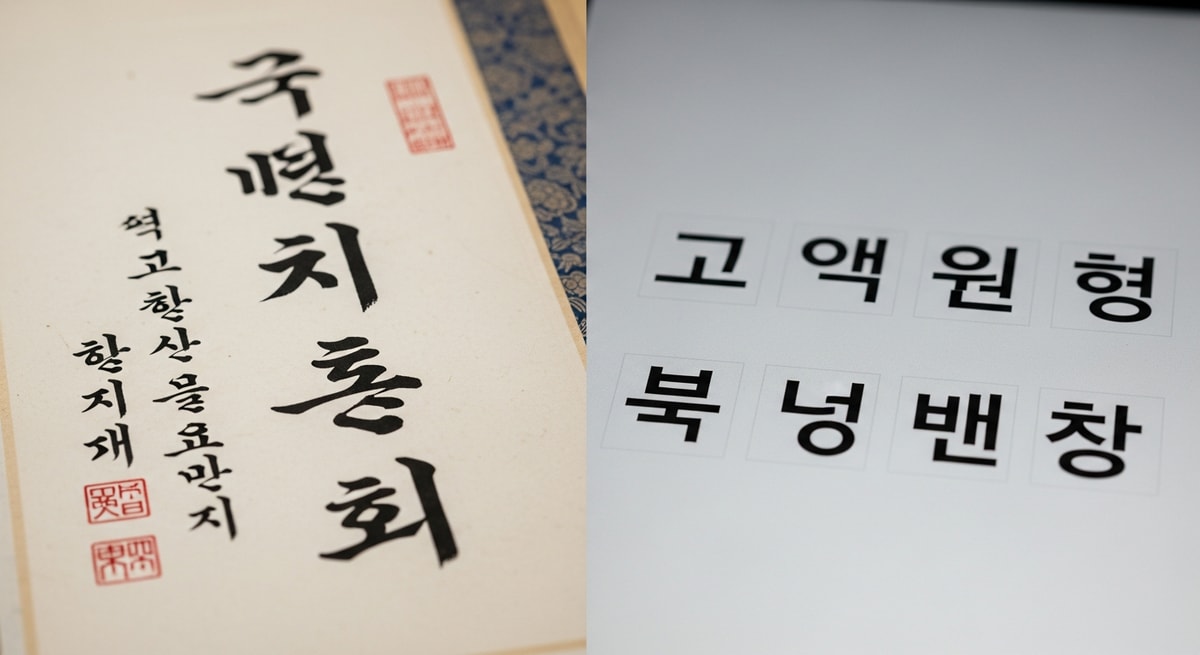
Korean documents may contain both Hangul and Hanja characters requiring specialized translation expertise
"Needed my Korean family relations certificate (가족관계증명서) and basic certificate (기본증명서) translated for a US green card application. DoVisa delivered both translations in 3 days with perfect formatting. USCIS processed my application without requesting any corrections."
"Translated my Korean university degree and transcripts from Seoul National University for a job application in London. The translator captured all the academic terminology correctly. My employer's HR department accepted everything immediately."
"Korean marriage certificate translation for Australian partner visa was accurate and accepted by the Department of Home Affairs. Only giving 4 stars because I had to wait the full 5 days for standard delivery. The quality itself was excellent."
"Korean-to-Japanese translation of a criminal record certificate (범죄경력회보서) for a work visa in Tokyo. The translator handled the legal terminology between Korean and Japanese perfectly. Immigration Bureau accepted it without questions."
"DoVisa translated my Korean birth certificate and family relations certificates with apostille from MOFA for my Canadian PR application. The e-Apostille verification through apostille.go.kr worked perfectly. IRCC accepted everything on first submission."
"Five Korean documents translated to English for my UK Skilled Worker visa — degree, transcripts, criminal record check, birth certificate, and employment reference. Good quality translations, all accepted by the Home Office. Took slightly longer than quoted but still within the delivery window."
"Our company needed Korean corporate documents translated for a joint venture with a Japanese firm. Articles of incorporation, board resolutions, and financial statements — all handled with precise commercial terminology. Both our Korean and Japanese legal teams approved the translations."
"Translation of my Korean resident registration certificate (주민등록등본) was accurate but there was an initial error in the romanization of my address. They fixed it within a few hours after I flagged it. The corrected version was accepted for my German Blue Card application."
"Korean divorce decree and custody agreement translated for a legal proceeding in California. The translator understood both Korean family court terminology and US legal requirements. My attorney was impressed with the accuracy and professional formatting."
"Needed my Korean nursing license and university diploma translated for CGFNS evaluation in the US. DoVisa assigned a translator experienced with Korean medical credential documents. CGFNS processed my evaluation without any follow-up questions about the translations."
"Korean adoption certificate (입양관계증명서) translated to English with apostille for an immigration case in Australia. Very sensitive document handled with care and professionalism. The Department of Home Affairs accepted the translation and apostille without issues."
"Translated a pre-2008 Korean hojuk (호적) document for an inheritance case. These old-format documents are tricky because they use mixed Hangul and Hanja. The translator handled it well and the probate court in New Zealand accepted the translation. Good service overall."
"Needed my Korean family relations certificate (가족관계증명서) and basic certificate (기본증명서) translated for a US green card application. DoVisa delivered both translations in 3 days with perfect formatting. USCIS processed my application without requesting any corrections."
"Translated my Korean university degree and transcripts from Seoul National University for a job application in London. The translator captured all the academic terminology correctly. My employer's HR department accepted everything immediately."
"Korean marriage certificate translation for Australian partner visa was accurate and accepted by the Department of Home Affairs. Only giving 4 stars because I had to wait the full 5 days for standard delivery. The quality itself was excellent."
Korean Document Translation FAQs
What is the difference between the five Korean family relations certificates?
Korea's family relations registration system issues five distinct certificate types, each serving a specific purpose. The Basic Certificate (기본증명서) records identity details including name, birth date, gender, and parents. The Family Relations Certificate (가족관계증명서) lists parents, spouse, and children. The Marriage Relations Certificate (혼인관계증명서) proves current and past marital status. The Adoption Relations Certificate (입양관계증명서) documents domestic and international adoptions. The Plenary Adoption Relations Certificate (친양자입양관계증명서) covers full adoptions with different legal status. Each certificate is available in General and Detailed versions. The receiving authority determines which certificates you need — a US immigration agency typically requires the Basic and Family Relations certificates, while a marriage registration abroad may require the Marriage Relations Certificate.
Does South Korea issue apostilles for translated documents?
Yes. South Korea has been a member of the Hague Apostille Convention since 14 July 2007. Korea designates four competent authorities: the Ministry of Foreign Affairs (외교부) for most administrative documents, the Ministry of Justice (법무부) for court records and notarial acts, the National Court Administration (법원행정처) for court-issued documents, and the Overseas Koreans Agency (재외동포청) for overseas Korean services. For translated documents, the translation is first notarized by a Korean notary public, then the apostille is applied to the notarized package. The apostille fee is 1,000 KRW per document. DoVisa handles the complete apostille process through the appropriate authority.
What is Korea's e-Apostille system?
South Korea operates a fully electronic apostille system at apostille.go.kr. The e-Apostille allows online application, electronic issuance, and remote verification of apostilles. Receiving authorities in any Apostille Convention member state can verify the authenticity of a Korean e-Apostille by entering the unique certificate number on the portal. The e-Apostille system is administered by the Overseas Koreans Agency and significantly speeds up the apostille process compared to physical-only issuance. Processing through the e-Apostille system typically takes 1-3 business days. DoVisa coordinates e-Apostille issuance for documents requiring electronic verification.
What is a Certified Public Translator (번역행정사) in Korea?
The Certified Public Translator (외국어번역행정사) is a licensed professional authorized by the Korean Ministry of the Interior and Safety (행정안전부) under the Licensed Administrative Agent Act (행정사법). These translators must pass a national qualifying examination and are authorized to issue official certificates of translation (번역증명서) under their own seal and license number. The system currently covers eight languages: English, Chinese, Japanese, French, German, Russian, Spanish, and Arabic. Their translations are recognized by Korean government ministries and public offices without additional notarization. DoVisa provides certified translations accepted by both Korean and international authorities.
How much does certified Korean translation cost?
DoVisa's Korean translation pricing follows a transparent per-page structure with volume discounts that apply automatically for larger projects. Pricing varies based on document length, language pair, and processing speed. Korean documents with mixed Hangul-Hanja text or pre-2008 hojuk format may require additional processing time. Express and rush service options are available for time-sensitive projects. Apostille processing through the appropriate competent authority is quoted separately. Upload your documents on our order page to receive an instant, detailed quote — no hidden fees.
Can I get Korean family relations certificates online?
Yes. Korean citizens can request family relations certificates through the e-Family portal (efamily.scourt.go.kr), administered by the Supreme Court of Korea. The portal allows electronic issuance of all five certificate types in both Korean and English. Overseas Koreans can access the system through the dedicated overseas portal (kfamily.scourt.go.kr) or visit their nearest Korean embassy or consulate. Certificates can also be obtained in person at any local gu-office (구청), dong-office (동사무소), or eup/myeon office. DoVisa can guide you on which certificates to obtain based on the receiving authority's requirements.
What documents do I need translated for Korean immigration?
The Korea Immigration Service (출입국·외국인정책본부) requires certified translations of all foreign-language documents submitted with visa applications. Common requirements by visa type include: E-7 (professional) — academic credentials, employment contract, professional licenses; F-2 (residence) — criminal record certificate, proof of income, academic credentials; F-5 (permanent residence) — criminal record, tax records, employment documentation; F-6 (marriage) — birth certificate, single-status certificate, criminal record. Requirements vary by nationality and individual circumstances. DoVisa provides translation packages tailored to specific Korean visa categories.
How are Korean names romanized in translations?
DoVisa follows the Revised Romanization of Korean, the official romanization system adopted by the Korean government in 2000. However, Korean personal names often have established romanized spellings that differ from the standard system — for example, the surname 이 is officially romanized as "I" but commonly written as "Lee" or "Yi" on Korean passports. Our translators check the individual's passport or existing official documents for their preferred romanization and use that consistently throughout the translation. When both Hangul and Hanja renderings appear on the source document, we preserve both in the translation to maintain disambiguation of the name.
What is the difference between notarized and certified Korean translations?
A certified translation includes a translator's formal statement of accuracy with their professional credentials and signature. This is sufficient for most immigration agencies, universities, and employers in English-speaking countries. A notarized translation (번역공증) adds an additional layer: the translator appears before a Korean notary public (공증인) who verifies the translator's identity, witnesses the signing of an accuracy affidavit, and applies their official seal. Notarized translations are required when the apostille process is involved, as the apostille is affixed to the notary's attestation. DoVisa advises on which level of authentication your receiving authority requires.
Can DoVisa translate old-format Korean hojuk (호적) documents?
Yes. Korea's civil registration system changed from the household-based hojuk (호적) system to the current individual-based family relations register on 1 January 2008. Pre-2008 hojuk documents often contain handwritten entries, mixed Hangul-Hanja text, and archival formatting that differs significantly from modern certificates. Our Korean translators are experienced with both the old hojuk format and the transitional documents from 2007-2008. We also handle historical Korean documents including Japanese colonial-era family registers (日本語戸籍) for heritage and genealogical purposes. Legacy document translations may require additional processing time.
Are Korean translations accepted for US immigration (USCIS)?
Yes. USCIS requires that all foreign-language documents be accompanied by certified English translations with a Certificate of Translation Accuracy. DoVisa's certified Korean-to-English translations meet USCIS requirements for all application types including family-based petitions (I-130), adjustment of status (I-485), naturalization (N-400), and employment-based immigration. Common Korean documents submitted to USCIS include the family relations certificate (가족관계증명서), basic certificate (기본증명서), criminal record certificate (범죄경력회보서), and marriage relations certificate (혼인관계증명서). Our translations include the USCIS-required certifier's statement with name, signature, address, and date.
How long does Korean apostille processing take?
Processing time depends on the competent authority and submission method. Through the e-Apostille system at apostille.go.kr, processing typically takes 1-3 business days. Physical apostille applications submitted to the Ministry of Foreign Affairs office in Seoul generally take 3-5 business days. The Ministry of Justice processes apostilles for court documents and notarial acts within a similar timeframe. The apostille fee is 1,000 KRW per document regardless of the issuing authority. DoVisa recommends the e-Apostille route when the receiving authority accepts electronic verification, as it is both faster and enables remote authentication.
Get Your Korean Certified Translation Today
Professional translations accepted by Korean government institutions, immigration authorities, and courts worldwide