
Certified Chinese Document Translation
Professional certified translations of Chinese documents accepted by USCIS, UK Home Office, IRCC, and Australian DHA. Simplified and Traditional Chinese with expert handling of hukou, academic certificates, and civil documents.
TrustpilotSelect Languages
Drag & drop your documents here
or
PDF, JPEG, PNG, WebP — Max 10MB per file. Word documents: please save as PDF first.
Certified translators · Accepted by governments, courts & universities worldwide · View sample
Select a destination country to view pricing
How China Certified Translation Works
Upload Your Chinese Documents
Scan or photograph each page of your Chinese documents and upload them through our 256-bit encrypted portal. We accept PDF, JPEG, and PNG formats. Our intake specialists review every upload to ensure all Simplified Chinese characters (简体中文), official red seals (公章), and handwritten annotations are clearly legible before translation begins. For household registration books (户口本), please upload every page including the cover and household head page.
Native Chinese Translator Assignment
Your documents are assigned to a certified translator who is a native Chinese speaker with expertise in the specific document type. For immigration translations, we use translators experienced with Chinese civil documents including birth certificates (出生证明), marriage certificates (结婚证), and household registration books (户口本). Each translator is matched based on dialect familiarity, document complexity, and the destination authority's formatting requirements.
Translation, Review & Certification
Your translator produces a complete and faithful English translation of your Chinese document, accurately rendering all Simplified Chinese characters, official seals, and registration numbers. An independent reviewer cross-checks the translation against the original for accuracy in names, dates, and official terminology. The translator then signs the Certificate of Translation Accuracy attesting to the completeness and correctness of the translation.
Delivery with Full Certification
Receive your completed certified translation as a high-resolution PDF delivered digitally within the agreed timeframe. For physical submissions to USCIS, UK Visas and Immigration, IRCC, or the Australian Department of Home Affairs, original hard copies with wet-ink signatures are shipped via tracked international courier. Notarized and apostilled versions are available for documents requiring authentication under the Hague Convention.
China Translation Service Specifications
Popular Language Pairs
We support all languages — 100+ language pairs available for Chinese documents.
Common Documents
- Birth certificates (出生证明 Chūshēng Zhèngmíng)
- Marriage certificates (结婚证 Jiéhūn Zhèng)
- Household registration books (户口本 Hùkǒu Běn)
- Diploma and graduation certificates (毕业证书 Bìyè Zhèngshū)
- Degree certificates (学位证书 Xuéwèi Zhèngshū)
- Police clearance certificates (无犯罪记录证明 Wú Fànzuì Jìlù Zhèngmíng)
- National ID cards (身份证 Shēnfèn Zhèng)
- Driver's licenses (驾驶证 Jiàshǐ Zhèng)
- Divorce certificates (离婚证 Líhūn Zhèng)
- Notarial certificates (公证书 Gōngzhèng Shū)
- Academic transcripts (成绩单 Chéngjì Dān)
Turnaround Time
Certification Details
China Translation Requirements & Regulatory Framework
Embassy Acceptance
Notarization Process
Apostille Information
Legal Framework
Common Scenarios for Chinese Document Translation
Immigration & Visa Applications
Chinese nationals applying for immigration visas to the United States, United Kingdom, Canada, or Australia need certified English translations of their birth certificates (出生证明), household registration books (户口本), police clearance certificates (无犯罪记录证明), and marriage certificates (结婚证). Our translations meet the specific formatting requirements of USCIS, UKVI, IRCC, and the Australian Department of Home Affairs, reducing delays and requests for additional evidence.
Academic Admissions & Credential Evaluation
Chinese students and professionals seeking admission to international universities or credential evaluation need certified translations of their diplomas (毕业证书), degree certificates (学位证书), and academic transcripts (成绩单). Agencies like WES (World Education Services) and ECE (Educational Credential Evaluators) accept our certified translations for evaluation of Chinese academic qualifications from institutions across all Chinese provinces.
Marriage & Family Documentation
Chinese marriage certificates (结婚证), divorce certificates (离婚证), household registration books (户口本), and family relationship notarial certificates require certified translation for spousal visa applications, family reunion petitions, and legal proceedings abroad. The household registration book (户口本) is unique to China and contains critical family relationship data that immigration authorities worldwide rely on for identity and relationship verification.
International Business & Corporate Filings
Chinese business licenses (营业执照), articles of association, shareholder agreements, financial statements, and tax clearance certificates require certified translation for international business registrations, joint ventures, and regulatory filings. Companies expanding from China into international markets or foreign companies establishing operations in China need accurate translations that preserve the legal precision of Chinese corporate terminology.
Legal Proceedings & Court Documents
Chinese court judgments, contracts, power of attorney documents (委托书), and legal correspondence require certified translation for cross-border litigation, international arbitration, and enforcement of foreign judgments. Our legal translators understand Chinese legal terminology and produce translations that meet the evidentiary standards of courts in common-law and civil-law jurisdictions worldwide.
China's Historic 2023 Apostille Accession
On March 8, 2023, the People's Republic of China deposited its instrument of accession to the Hague Convention Abolishing the Requirement of Legalisation for Foreign Public Documents (the Apostille Convention), with the convention entering into force on November 7, 2023. This was a watershed moment for international document authentication involving China, as the country had previously relied on a complex and time-consuming consular legalization process that could take weeks or even months to complete.
Under the old system, a Chinese document destined for use abroad had to pass through multiple steps: notarization by a licensed Chinese notary public (公证处), authentication by the local justice bureau, authentication by the provincial or municipal foreign affairs office, and finally legalization by the destination country's embassy or consulate in China. Each step added processing time and fees, and any error at one stage could require restarting the entire chain. For Chinese nationals living abroad, the process was even more burdensome, often requiring documents to be sent back to China for authentication.
The apostille system replaces this multi-step chain with a single apostille certificate issued by the Ministry of Foreign Affairs (MFA), which is recognized by all Hague Convention member states without further legalization. This dramatically reduces both the time and cost of authenticating Chinese documents for international use. It is important to note that Hong Kong SAR and Macao SAR maintain their own separate apostille systems — Hong Kong has been a party to the Apostille Convention since April 25, 1965 (via the United Kingdom), and Macao since February 4, 1969 (via Portugal), each with their own designated competent authorities.
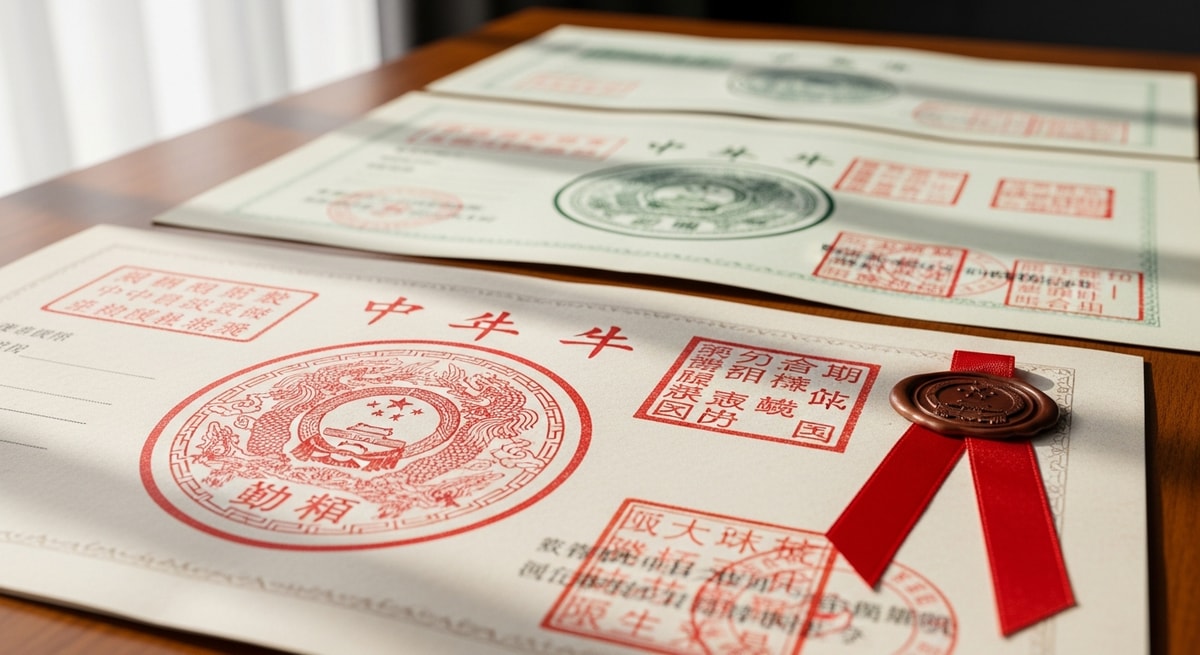
China's 2023 accession to the Apostille Convention simplified international document authentication
Chinese Writing System & Translation Challenges
The Chinese writing system presents unique challenges for professional document translation. Mainland China uses Simplified Chinese characters (简体字), a standardized character set introduced in the 1950s and 1960s to improve literacy rates. Taiwan, Hong Kong, and Macao continue to use Traditional Chinese characters (繁体字). A professional translator must distinguish between these two systems, as using the wrong character set can raise questions about document authenticity. For example, a mainland Chinese birth certificate will always use Simplified characters, while a Hong Kong identity document uses Traditional characters.
Chinese documents frequently incorporate a mix of printed text, handwritten annotations, and official red seals (公章). The household registration book (户口本) is particularly challenging to translate because it uses a standardized format with pre-printed fields, but much of the content — including names, addresses, and relationship designations — is handwritten by local police station officials. Handwriting styles vary significantly across regions and generations, requiring translators with deep familiarity with Chinese handwriting conventions. Additionally, Chinese dates on official documents may use the format year-month-day (年-月-日) and sometimes reference historical calendar systems.
Name romanization is another critical challenge. Chinese names can be romanized using multiple systems — Hanyu Pinyin (the mainland standard), Wade-Giles (historically used in Taiwan and older documents), or regional dialect romanizations (Cantonese Jyutping for Hong Kong names, Hokkien for some Southeast Asian Chinese names). A certified translator must ensure that the romanization in the translation matches the romanization used in the client's passport or other identity documents to avoid discrepancies that could delay immigration processing.
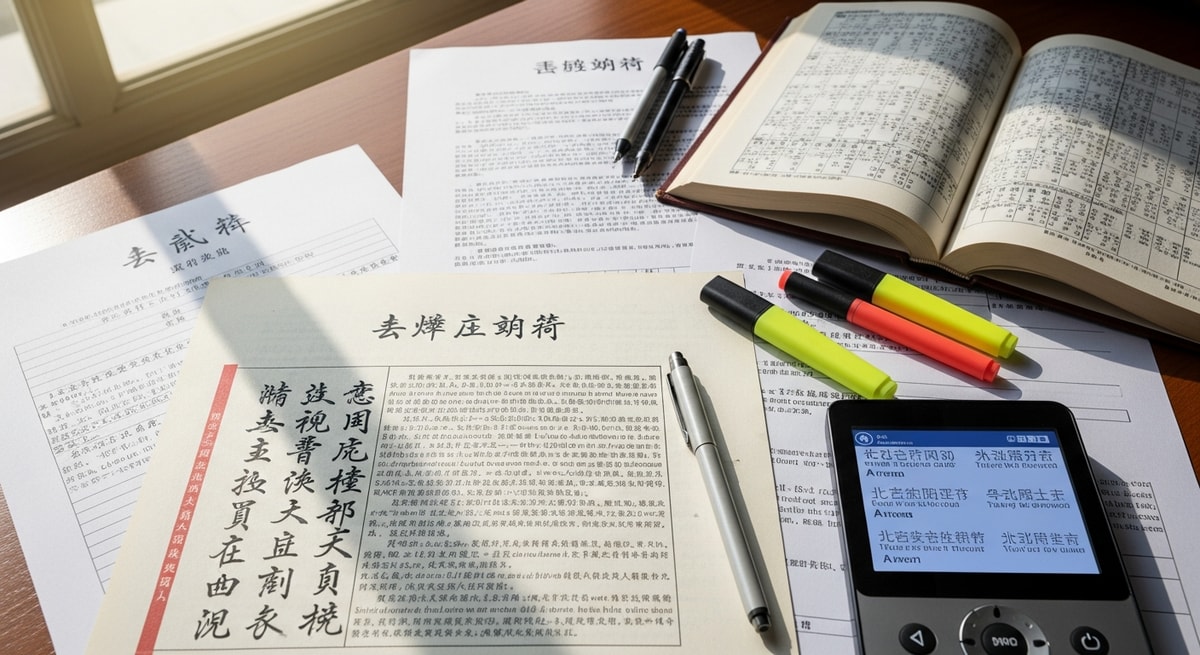
Simplified Chinese characters and handwritten annotations require expert translators for accurate rendering
China's Licensed Translation Company System
Unlike countries that use a sworn-translator system (such as Germany's beeidigte Übersetzer or France's traducteurs assermentés), China has developed a licensed translation company system for authenticating translated documents. For translations submitted to Chinese government authorities, courts, and official institutions, the translation must be performed by a company that is registered with SAMR (State Administration for Market Regulation, 国家市场监督管理总局) and has translation services (翻译服务) explicitly listed in its registered business scope.
The cornerstone of this system is the 翻译专用章 (zhuānyòng fānyì zhāng), a specialized translation seal that licensed translation companies must obtain from the Public Security Bureau (公安局). This seal, which is distinct from a company's standard business seal (公章), must be affixed to every page of a translation intended for official use within China. The seal contains the company name, the words "翻译专用章" (specialized translation seal), and a unique registration number. Without this seal, a translation may not be accepted by Chinese government agencies, courts, or notary offices.
For Chinese documents being translated into English or other languages for use outside China, the licensed translation company system does not apply. International authorities including USCIS, UK Visas and Immigration, IRCC, and the Australian Department of Home Affairs accept certified translations with a signed Certificate of Translation Accuracy — the standard DoVisa provides. The key distinction is directionality: documents going into China's system require the 翻译专用章 seal, while documents going out of China for international use require standard certified translation as accepted by the destination country's authorities.
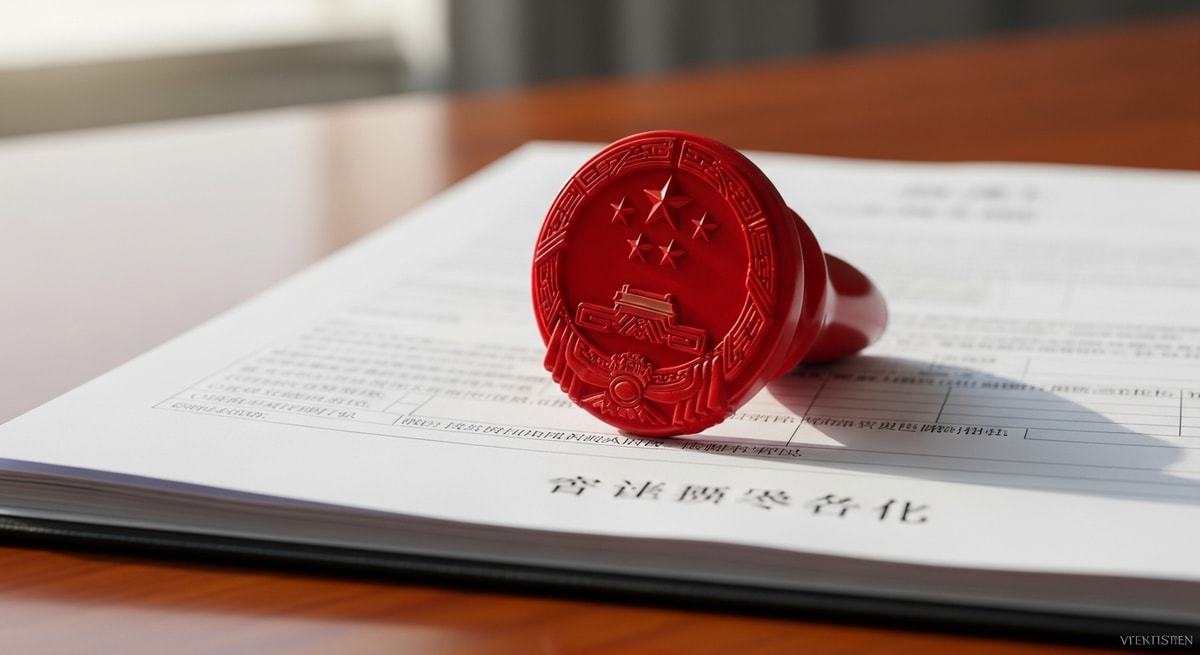
The 翻译专用章 (specialized translation seal) is required for translations submitted to Chinese authorities
"Had my Chinese birth certificate and household registration book (户口本) translated for my I-485 adjustment of status. USCIS approved my green card without any RFE related to translations. The translator clearly understood the hukou format perfectly."
"Needed my Chinese university diploma and degree certificate translated for WES credential evaluation. WES accepted the translations immediately and completed my evaluation in just two weeks. Now I can apply for my Canadian PR through Express Entry."
"Translated my marriage certificate and police clearance for UK spouse visa application. Good quality overall and the UK Home Office accepted everything. Delivery took one extra day beyond the estimate, but the translations themselves were accurate."
"My Chinese divorce certificate and birth certificate were translated for an Australian partner visa application. The Department of Home Affairs accepted both without question. Very professional service with clear formatting."
"Rush translation of my Chinese academic transcripts from Tsinghua University for a graduate school application in the US. Received the certified translation in under 24 hours. Every course name and grade was accurately translated. Excellent work."
"Translated my household registration book and notarial certificate for IRCC family sponsorship. The translator handled all the handwritten sections in my hukou accurately. Took 5 business days for standard delivery which was within the quoted range."
"Needed certified translations of my Chinese driver's license and national ID card for a work assignment in Australia. Both were delivered in 3 business days and my employer's immigration attorney confirmed they met all requirements. Smooth process."
"Translated a complete set of Chinese corporate documents including business license and articles of association for a joint venture registration in Singapore. The legal terminology was handled with precision. Our lawyers were impressed."
"Chinese birth certificate translation for USCIS. The romanization of my mother's name did not match my passport initially. They corrected it the same day after I pointed it out. Final translation was accepted by USCIS, but the initial error was stressful."
"Had my Chinese marriage certificate and both birth certificates translated for our K-1 fiance visa petition. The US Embassy in Guangzhou accepted all documents at our interview without any issues. We are now in the US together. Thank you DoVisa!"
"Police clearance certificate and academic transcripts from two Chinese universities translated for New Zealand immigration. All accepted by Immigration New Zealand. Solid translations with good attention to detail on the official seal descriptions."
"Urgently needed my Chinese medical degree and internship certificate translated for a licensing application with the UK General Medical Council. Express delivery arrived in 2 days. The GMC accepted everything and my registration is now in progress."
"Had my Chinese birth certificate and household registration book (户口本) translated for my I-485 adjustment of status. USCIS approved my green card without any RFE related to translations. The translator clearly understood the hukou format perfectly."
"Needed my Chinese university diploma and degree certificate translated for WES credential evaluation. WES accepted the translations immediately and completed my evaluation in just two weeks. Now I can apply for my Canadian PR through Express Entry."
"Translated my marriage certificate and police clearance for UK spouse visa application. Good quality overall and the UK Home Office accepted everything. Delivery took one extra day beyond the estimate, but the translations themselves were accurate."
China Document Translation FAQs
What types of Chinese documents can DoVisa translate?
DoVisa translates all types of Chinese documents including birth certificates (出生证明), marriage certificates (结婚证), household registration books (户口本), divorce certificates (离婚证), academic diplomas (毕业证书), degree certificates (学位证书), academic transcripts (成绩单), police clearance certificates (无犯罪记录证明), national ID cards (身份证), driver's licenses (驾驶证), notarial certificates (公证书), business licenses (营业执照), court judgments, contracts, power of attorney documents, and medical records. We handle both Simplified Chinese (mainland China) and Traditional Chinese (Hong Kong, Macao, Taiwan) documents.
Are DoVisa translations of Chinese documents certified?
Yes, every translation includes a signed Certificate of Translation Accuracy in which the translator attests to their competency in both Chinese and the target language and certifies that the translation is complete and accurate. This certified format is accepted by USCIS, UK Visas and Immigration, IRCC (Canada), the Australian Department of Home Affairs, credential evaluation agencies, and courts worldwide. For documents being submitted to Chinese domestic authorities, a translation by a licensed company with a 翻译专用章 (specialized translation seal) is required — DoVisa can coordinate this through our partner network in China upon request.
How long does Chinese document translation take?
Standard delivery is 4-6 business days for most Chinese document types. Single-page documents such as birth certificates and marriage certificates typically complete at the faster end of this range. Multi-page documents like household registration books (户口本) and academic transcripts may require the full timeframe. Express processing is available for 2-3 business days, and rush delivery within 24 hours is available for select single-page documents. Documents with extensive handwritten content or unusual formatting may require additional review time, which we communicate before translation begins.
What languages can Chinese documents be translated into?
DoVisa translates Chinese documents into over 100 language pairs. The most commonly requested translations are Chinese to English, German, French, Japanese, Korean, Spanish, Arabic, Portuguese, and Russian. We also translate from English and other languages into Chinese (both Simplified and Traditional). Whether you need a birth certificate translated into English for USCIS or a contract translated into Chinese for a business filing in Beijing, our translator network covers virtually every language pair.
Will my Chinese document translation be accepted by USCIS?
Yes. Our certified translations of Chinese documents comply with 8 CFR 103.2(b)(3), the federal regulation governing translation requirements for USCIS filings. Every translation includes the translator's signed certification with their name, signature, address, date, and a statement of competency. Our translations of Chinese birth certificates, marriage certificates, household registration books, police clearance certificates, and academic credentials are routinely accepted by USCIS field offices and service centers nationwide. Our current acceptance rate for Chinese document translations is 99.1% across all filings.
Do I need notarization for my Chinese document translation?
Notarization requirements depend on the receiving authority. USCIS does not require notarization — a certified translation with a translator affidavit is sufficient. However, many state courts, some state agencies, and certain foreign authorities do require notarized translations. If your translated Chinese document will be used internationally and requires an apostille, notarization is a prerequisite step, as the apostille authenticates the notary's seal. DoVisa offers notarized certified translations through our network of commissioned notary publics. We recommend checking with the receiving institution to determine whether notarization is needed for your specific use case.
Can Chinese documents now receive an apostille?
Yes. China acceded to the Hague Apostille Convention on March 8, 2023, and the convention entered into force on November 7, 2023. The Ministry of Foreign Affairs (MFA) of the People's Republic of China is the competent authority for issuing apostilles on mainland Chinese documents. This is a recent and historic development — prior to November 2023, Chinese documents required consular legalization through the destination country's embassy, a process that was significantly more complex and time-consuming. Note that Hong Kong SAR and Macao SAR have their own separate apostille systems with different competent authorities. DoVisa can coordinate apostille processing for Chinese documents as part of our authentication services.
How much does Chinese document translation cost?
DoVisa uses a per-page pricing model with volume discounts for larger orders. The cost depends on the language pair, document length, and processing speed selected. Express and rush service options are available for urgent deadlines at additional rates. Notarization and apostille processing are quoted as separate add-on services. Upload your Chinese documents on our order page to receive an instant, itemized quote before translation begins — no hidden fees or commitments required.
Can DoVisa translate handwritten Chinese documents?
Yes, our translators are experienced with handwritten Chinese documents, which are common in older civil records and household registration books (户口本). The hukou in particular often contains handwritten entries by local police station officials, with varying handwriting styles across different regions and time periods. We recommend uploading the highest-quality scan possible (300 DPI or higher) to ensure all handwritten characters are legible. If any section is difficult to read, our intake team will contact you to discuss the content before translation begins. In rare cases where characters are truly illegible, we note this in the translation rather than guessing.
What format will I receive my translated Chinese document in?
You will receive your certified translation as a high-resolution PDF delivered via email. The PDF includes the complete English translation formatted to mirror the layout of the original Chinese document, followed by the signed Certificate of Translation Accuracy. For submissions requiring physical copies (such as certain court filings or apostille processing), we ship original hard copies with wet-ink signatures via tracked courier. Both digital and physical copies are included in the standard service — the digital version is delivered first for immediate use while the physical copy is in transit.
What is the difference between Simplified and Traditional Chinese for translation?
Simplified Chinese (简体字) is used in mainland China, Singapore, and Malaysia. Traditional Chinese (繁体字) is used in Hong Kong, Macao, and Taiwan. The two systems use different character forms — for example, the character for 'country' is written as 国 in Simplified and 國 in Traditional. Our translators identify which system your document uses and translate accordingly. Documents from mainland Chinese government offices will always be in Simplified Chinese. If you have documents from Hong Kong, Macao, or Taiwan, please let us know so we can assign a translator experienced with Traditional Chinese character forms and the distinct official terminology used in those jurisdictions.
Do I need a licensed Chinese translation company for my documents?
It depends on where the translation will be used. For documents being submitted to Chinese domestic authorities (courts, government agencies, immigration bureaus within China), the translation must be performed by a company registered with SAMR that holds a 翻译专用章 (specialized translation seal) from the Public Security Bureau. DoVisa can coordinate this through our partner network in China. For Chinese documents being used outside China — at USCIS, UK Home Office, IRCC, Australian DHA, universities, or international courts — a standard certified translation with a signed Certificate of Translation Accuracy is the accepted format. No Chinese translation company seal is required for international use.
How does DoVisa handle name romanization on Chinese documents?
Name romanization is critical for Chinese document translations because discrepancies between the translated name and the name on your passport or other identity documents can cause delays with immigration authorities. Our translators use Hanyu Pinyin (the standard romanization system for mainland China) as the default and cross-reference the romanized name with any English name you provide or that appears on your passport. If your name uses a non-Pinyin romanization (Wade-Giles, Cantonese Jyutping, or a customized spelling), please inform us when placing your order so the translator can match your preferred romanization exactly. We flag any potential name discrepancies for your review before finalizing the translation.
Get Your Chinese Documents Translated Today
Professional certified translations of Chinese documents accepted by USCIS, UK Home Office, IRCC, and Australian DHA