Certified Japanese Document Translation
Professional Japanese-to-English and English-to-Japanese certified translations for immigration, legal, academic, and business purposes. Accepted by Japanese government ministries, ward offices, immigration bureaus, and international institutions.
TrustpilotSelect Languages
Drag & drop your documents here
or
PDF, JPEG, PNG, WebP — Max 10MB per file. Word documents: please save as PDF first.
Certified translators · Accepted by governments, courts & universities worldwide · View sample
Select a destination country to view pricing
How Japanese Certified Translation Works
Upload Your Japanese Documents
Scan or photograph your documents and upload them through our secure portal. We accept documents in Japanese (including handwritten kanji), English, and other languages requiring translation to or from Japanese. Our intake team includes Japanese-reading specialists who verify that every character in your uploaded documents is legible before translation begins.
Specialist Translator Assignment
Your documents are assigned to a native Japanese translator with expertise in your specific document type. Our Japanese translation team includes specialists in legal translation (hōyaku), medical translation (igaku honyaku), technical translation, and administrative document translation. Each translator holds a university degree in translation, linguistics, or the relevant subject field.
Translation, Review & Certification
The assigned translator produces a faithful certified translation, preserving the document's structure, seal impressions, and administrative formatting. A second native Japanese linguist performs a thorough quality review checking kanji accuracy, reading variants, name romanization, and date conversions between Japanese and Western calendar systems. The certification statement is then prepared and signed.
Certified Delivery with Authentication Options
Receive your completed translation as a digitally signed PDF. For Japanese authorities requiring physical submissions, hard copies with original signatures and company seal (kaisha-in) impressions are shipped via Japan Post or international courier. For documents requiring notarization or apostille, we coordinate with notaries public (kōshōnin) and the Ministry of Foreign Affairs (Gaimushō) or regional Legal Affairs Bureau.
Japanese Translation Service Specifications
Popular Language Pairs
We support all languages — 100+ language pairs available for Japanese documents.
Common Documents
- Family register (Koseki Tōhon / Koseki Shōhon)
- Residence certificate (Jūminhyō)
- Certificate of items recorded in Seal Registration (Inkan Shōmeisho)
- Japanese birth certificates (Shussei Todoke Jurishō)
- Marriage certificates (Kon'in Todoke Jurishō)
- Divorce certificates (Rikon Todoke Jurishō)
- Academic transcripts and diploma certificates
- Japanese driving licenses (Unten Menkyo)
- Company registration (Tōhon / Tōki Jikō Shōmeisho)
- Tax certificates (Kazei Shōmeisho / Nozei Shōmeisho)
- Japanese court orders and judgments
- Pension records (Nenkin Kiroku)
Turnaround Time
Certification Details
Japan Translation Requirements & Legal Framework
Embassy Acceptance
Notarization Process
Apostille Information
Legal Framework
When You Need Japanese Document Translation
Japanese Spouse Visa & Family Registration
Foreign nationals marrying a Japanese citizen or registering a marriage at a Japanese ward office (kuyakusho) must submit certified Japanese translations of their birth certificate, single-status affidavit, passport, and any prior divorce decrees. The ward office staff review these translations meticulously for consistency with the koseki (family register) entry requirements. DoVisa translations use the precise Japanese administrative terminology that kuyakusho clerks expect, minimizing back-and-forth requests for corrections.
Working in Japan: Visa & Professional Licensing
Applicants for Japanese work visas must submit translations of academic credentials, professional certificates, and employment contracts to the Immigration Services Agency. For regulated professions, additional translated documentation is required by licensing bodies such as the Japan Medical Association, the Japan Federation of Bar Associations, or the Institute of Chartered Accountants of Japan. Our translators use industry-specific Japanese terminology that facilitates visa processing and professional credential evaluation.
Japanese Koseki Translation for International Use
The koseki tōhon (complete family register) and koseki shōhon (partial family register extract) are Japan's primary civil status documents, containing birth, marriage, divorce, adoption, and death records for an entire family. These densely formatted documents require expert translation due to their unique vertical-column layout, specialized administrative kanji, and cross-referencing system. Our koseki translation specialists have collectively translated thousands of these registers and deliver translations that are immediately accepted by foreign immigration authorities.
Japanese Corporate Document Translation
Foreign companies establishing a presence in Japan through a branch office (shiten), subsidiary (kogaisha), or representative office (nihon daihyō jimusho) must file Japanese translations of their articles of incorporation, board resolutions, powers of attorney, and financial statements with the Legal Affairs Bureau. Japanese companies expanding internationally need English translations of their tōki jikō shōmeisho (corporate registry certificate), yakuin meibo (director lists), and teikan (articles of incorporation). Our corporate translators handle both directions with precise legal and business terminology.
Japanese Academic Credential Translation
Japanese graduates seeking employment or further education abroad need certified English translations of their sotsugyō shōmeisho (graduation certificate), seiseki shōmeisho (academic transcript), and gakui ki (degree certificate). Foreign students applying to Japanese universities need Japanese translations of their academic records for evaluation by the National Institution for Academic Degrees and Quality Enhancement of Higher Education (NIAD-QE). Our academic translators handle both directions and understand the specific grading systems used by Japanese institutions.
Japanese Real Estate & Property Transactions
Foreign buyers purchasing property in Japan need English translations of the tōki jikō shōmeisho (property registry certificate), jūyō jikō setsumeisho (important matters explanation), and baibai keiyakusho (sale and purchase agreement). Japanese property owners selling to foreign buyers or using Japanese property as evidence in foreign proceedings need translated property documents. Our real estate translators understand Japanese property law terminology including zoning categories, building restrictions, and the unique leasehold (shakuchiken) and freehold (shoyūken) distinctions in the Japanese system.
The Complexity of Japanese Script in Official Documents
Japanese is one of the most complex writing systems in the world for document translation purposes. Official Japanese documents employ three scripts simultaneously: kanji (Chinese-origin characters numbering in the thousands), hiragana (a phonetic syllabary used for grammatical elements and native Japanese words), and katakana (a phonetic syllabary used primarily for foreign loanwords and emphasis). A single Japanese government document may contain all three scripts interwoven within the same sentence, requiring the translator to correctly read and interpret each character in context.
Particular challenges arise from kanji with multiple readings. A single kanji character can have different pronunciations (on'yomi for Chinese-derived readings and kun'yomi for native Japanese readings) and meanings depending on context. In personal names, kanji readings become even more variable, as Japanese parents may assign non-standard readings to characters. The kanji combination for a name written as "one-two-three" could be read as multiple completely different names. This is why Japanese official documents often include furigana (small phonetic annotations above kanji) for names, and why our translators always request confirmation of name pronunciations when furigana is absent from the source document.
Japanese official documents also use specialized administrative kanji compounds (gyōsei yōgo) that differ significantly from everyday Japanese. Terms like todoke-de (notification/filing), jurisho (acceptance certificate), shōmeisho (certification), and shōmei (proof/attestation) have precise administrative meanings that must be translated with equivalent precision in English. Our Japanese document translators maintain specialized glossaries of over 4,500 administrative terms to ensure consistent and accurate translation of these formal documents.
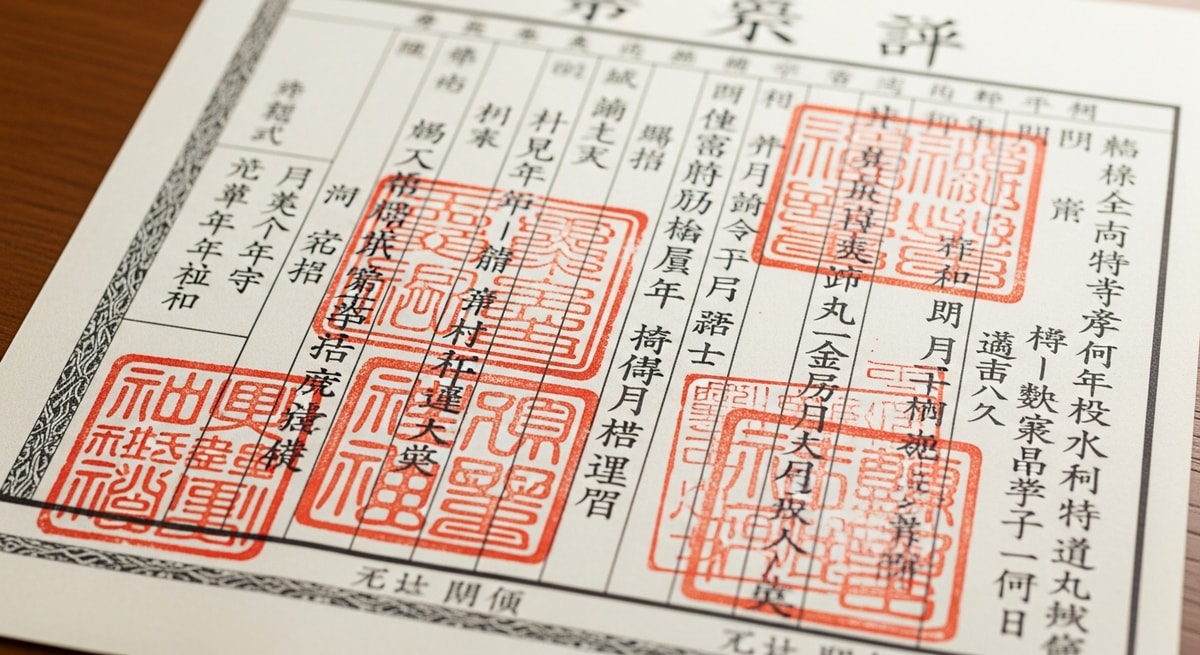
Japanese koseki documents use thousands of kanji characters in a specialized administrative format
The Japanese Koseki System: A Translation Guide
The koseki (family register) is the cornerstone of Japan's civil registration system, maintained by municipal governments under the Family Register Act (Koseki-hō). Unlike Western systems that issue individual birth, marriage, and death certificates, Japan records all civil status events for an entire family in a single register organized by household. The koseki tōhon is a complete copy of the family register showing all entries, while the koseki shōhon is a partial extract showing only specific individuals or events.
Translating a koseki presents unique challenges beyond script complexity. The document follows a standardized vertical-column format that organizes information in a specific hierarchical order: the honseki (registered domicile address, which may differ from the actual residential address), the household head (hittou-sha), and then entries for each family member including birth details, marriages, divorces, adoptions, and deaths. Cross-references to other family registers are common when family members have been transferred to or from other households. Our translators preserve this structural logic in the English translation while adding navigational aids that help foreign officials understand the document's organization.
The koseki also contains administrative annotations (fuki) and marginal notes (ranki) that record amendments, corrections, and the authority for each entry. These annotations are often in abbreviated administrative Japanese and reference specific articles of the Family Register Act. A marriage entry, for example, cites the specific article under which it was registered, and a divorce entry distinguishes between divorce by mutual consent (kyōgi rikon) and divorce by court judgment (saiban rikon). Our translators include all annotations in the translation and provide contextual notes where the administrative reference would be meaningless without explanation, ensuring that the translated koseki serves as a fully comprehensible document for foreign authorities.
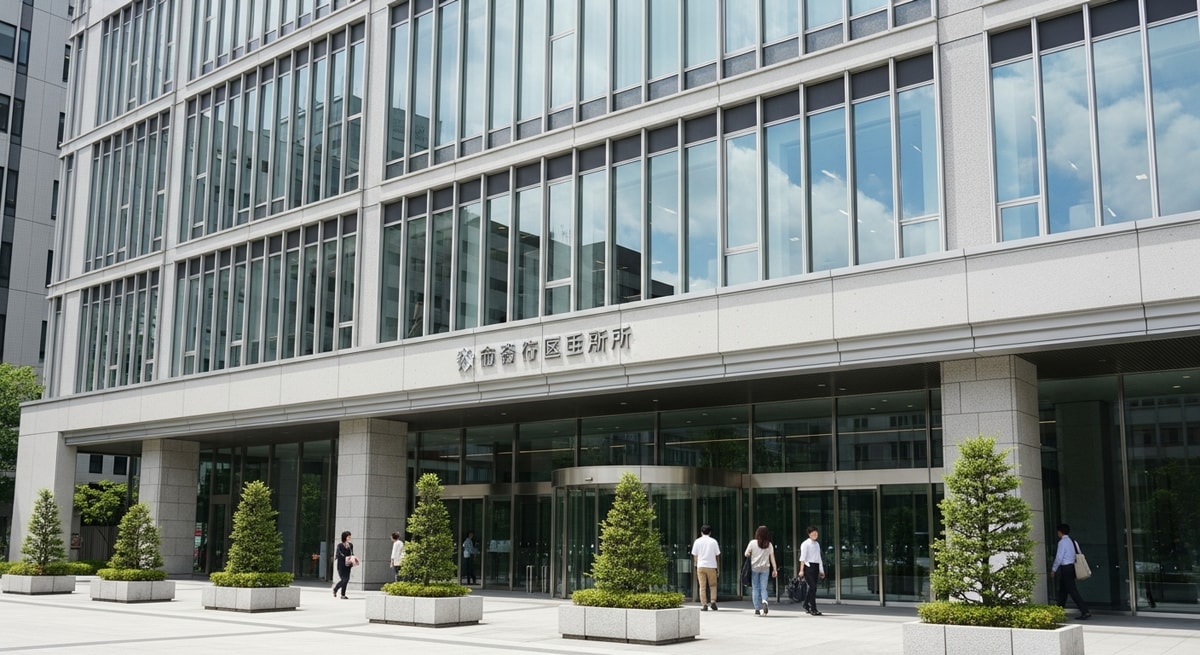
Japanese ward offices maintain the koseki family register system that is central to civil documentation
Apostille and Authentication for Japanese Documents
Japan's apostille and authentication system involves different paths depending on whether the document is a public document (issued by a government body) or a private document (such as a certified translation by a private translator). Public documents like koseki extracts, jūminhyō (residence certificates), and court judgments can receive an apostille directly from the Ministry of Foreign Affairs (Gaimushō) in Tokyo or from a regional Legal Affairs Bureau (Chihō Hōmukyoku) in prefectural capitals. The apostille is typically issued within 1-3 business days at the Tokyo MOFA office.
Private documents, including certified translations, require a multi-step authentication chain before an apostille can be issued. First, the translator signs the certification statement. Second, a notary public (kōshōnin) authenticates the translator's signature through a procedure called shoshi ninshō. Third, the director of the Legal Affairs Bureau in the jurisdiction where the notary is registered certifies the notary's signature and seal. Only after this three-step chain is complete can the Ministry of Foreign Affairs or Legal Affairs Bureau issue an apostille on the document. This process reflects the Japanese legal principle that private documents must be linked to the state authentication system through established intermediaries.
For documents destined for countries that are not members of the Apostille Convention (including China, which is a major destination for Japanese documents), a different authentication path applies. After notarial authentication and Legal Affairs Bureau certification, the document goes to the Ministry of Foreign Affairs for authentication (ninshon), followed by legalization at the destination country's embassy or consulate in Japan. DoVisa coordinates all authentication paths based on the specific requirements of your destination country and document type, managing each step from translation through final authentication and ensuring proper sequencing of the multi-step process.
Japan's Ministry of Foreign Affairs in Tokyo handles apostille issuance for international document authentication
"Had my entire koseki tōhon translated for my US green card application. The translator navigated all the family entries, cross-references, and administrative annotations perfectly. My immigration attorney said it was the clearest koseki translation he had ever seen. USCIS approved without any RFE."
"Needed my Japanese university degree and transcripts translated into English for a job application in Singapore. The translations accurately reflected my university's grading system and course descriptions. My employer's HR department processed my work visa documents immediately."
"Good translation of my American birth certificate into Japanese for marriage registration at the kuyakusho in Shinjuku. The ward office accepted it after one format question that DoVisa's support team resolved within an hour. Solid service."
"Our company needed the tōki jikō shōmeisho and teikan translated from Japanese to English for a UK subsidiary registration at Companies House. The corporate terminology was handled expertly. The UK solicitors commented on how clear and professionally formatted the translations were."
"DoVisa translated my divorce decree from Japanese family court for recognition in Australia. Complex legal document with custody provisions. The translator understood Japanese family law and expressed it in English legal terms perfectly. Exceptional work."
"Japanese driving license translation was accurate but initially had a minor error in the romanization of my middle name. I provided my passport for reference and they corrected it promptly. The revised version was accepted by the California DMV. Would have preferred getting it right the first time."
"Translated Japanese medical records from Keio University Hospital for a US malpractice case. 28 pages of technical medical Japanese. Every diagnosis and procedure was translated with precision. Our medical expert witness confirmed the accuracy."
"Needed my Brazilian birth certificate translated into Japanese for my spouse visa application at the Nagoya immigration bureau. Portuguese to Japanese is not a common pair but DoVisa found a qualified translator who delivered in 5 days. Immigration accepted it without questions. Very grateful."
"Had my Japanese pension records (nenkin kiroku) translated for a UK state pension claim involving overseas contributions. The financial terminology was correctly rendered and HMRC processed my claim. Took the full 6 days quoted but worth the wait for the quality."
"Full apostille chain for a Japanese koseki translation destined for Australia. DoVisa handled translation, kōshōnin authentication, Legal Affairs Bureau, and MOFA apostille. Complete package in 12 days. The Australian Department of Home Affairs accepted it immediately."
"My parents needed Japanese property documents translated for US estate planning. The translator handled complex real estate terminology including leasehold rights and building certificates. My attorney found the translations invaluable."
"Korean family register translated into Japanese for my husband's work visa renewal. Not the most common language pair but the translator knew both Korean and Japanese civil registration systems well. Quality was excellent; the immigration bureau processed the renewal smoothly."
"Had my entire koseki tōhon translated for my US green card application. The translator navigated all the family entries, cross-references, and administrative annotations perfectly. My immigration attorney said it was the clearest koseki translation he had ever seen. USCIS approved without any RFE."
"Needed my Japanese university degree and transcripts translated into English for a job application in Singapore. The translations accurately reflected my university's grading system and course descriptions. My employer's HR department processed my work visa documents immediately."
"Good translation of my American birth certificate into Japanese for marriage registration at the kuyakusho in Shinjuku. The ward office accepted it after one format question that DoVisa's support team resolved within an hour. Solid service."
Japanese Document Translation FAQs
What is a koseki and why is it important for translation?
The koseki (family register) is Japan's fundamental civil status document system, maintained by municipal governments under the Family Register Act (Koseki-hō). Unlike countries that issue separate birth, marriage, and death certificates, Japan records all civil status events for an entire family in a single register. The koseki tōhon is a complete copy of the register, while the koseki shōhon is a partial extract. A koseki serves simultaneously as a birth certificate, marriage certificate, proof of family relationships, and divorce record. Foreign immigration authorities, courts, and civil registries frequently require translated koseki documents for Japanese nationals applying abroad. Koseki translation requires specialized expertise due to the document's unique vertical-column format, administrative kanji, and cross-referencing system that connects entries across family members and households.
Does Japan require notarized translations?
Whether notarization is required depends on the receiving authority and the purpose of the translation. Japanese immigration bureaus accept certified translations without notarization for most visa applications. Japanese ward offices (kuyakusho) for civil registration purposes also generally accept certified translations from recognized translation services. However, documents entering the apostille authentication chain must be notarized by a Japanese notary public (kōshōnin) as a prerequisite for Legal Affairs Bureau certification and Ministry of Foreign Affairs apostille issuance. Japanese courts may require notarized translations depending on the judge's discretion and the nature of the proceedings. Foreign authorities receiving Japanese translations may have their own notarization requirements. DoVisa advises on the specific requirements for your situation and coordinates notarization through licensed Japanese kōshōnin when needed.
How are Japanese names romanized in translations?
Japanese name romanization in certified translations follows a careful protocol to prevent identity discrepancies. Our primary reference is the individual's passport, which uses the Hepburn romanization system as mandated by the Ministry of Foreign Affairs for Japanese passports. When a passport is available, we match the romanization exactly. When no passport reference exists, we follow the modified Hepburn system used by Japanese government agencies. Special attention is given to long vowels (ou/oo/o), the particles は (wa), を (wo), and へ (e), and the consonant ん (n/m before bilabial consonants). For kanji names without furigana (phonetic guides), we request the customer to confirm the reading, as the same kanji characters can be read multiple ways. The translator notes any romanization decisions in the certification clause for transparency.
How are Japanese dates converted in translated documents?
Japanese official documents use the Japanese era calendar (gengo) system rather than the Gregorian calendar. The current era is Reiwa (beginning May 1, 2019). Previous eras commonly found in documents include Heisei (1989-2019), Showa (1926-1989), and Taisho (1912-1926). Our translators provide both the original Japanese era date and the Gregorian equivalent in every translation. For example, Reiwa 7-nen 2-gatsu 11-nichi is rendered as February 11, Reiwa 7 (2025). This dual-date format is universally accepted by international authorities and eliminates confusion. All date conversions are double-checked during the quality review process, as era calculation errors are a common source of translation rejection at immigration offices.
How much does Japanese document translation cost?
DoVisa's Japanese translation pricing uses a per-page structure with volume discounts for larger documents. Japanese translation pricing reflects the complexity of the Japanese writing system and the specialized expertise required. Express and rush service options are available for time-sensitive projects. Kōshōnin (notary public) authentication and the full apostille chain (notarization + Legal Affairs Bureau + MOFA) are quoted separately based on your specific requirements. Upload your documents on our order page to receive an instant, detailed quote — all prices are confirmed before translation begins.
What is the apostille process for Japanese documents?
Japan's apostille process differs depending on whether the document is public or private. Public documents (koseki extracts, jūminhyō, court judgments) can receive an apostille directly from the Ministry of Foreign Affairs (MOFA) in Tokyo or from a regional Legal Affairs Bureau. Private documents such as certified translations require a multi-step chain: (1) translator's certified signature, (2) notarization by a kōshōnin (notary public), (3) certification by the Legal Affairs Bureau director, and (4) apostille from MOFA or the Legal Affairs Bureau. MOFA processes apostilles within 1-3 business days at the Tokyo office; regional bureaus may take 3-5 days. DoVisa manages the entire chain from translation through apostille delivery, handling submissions to each authority in sequence.
Can DoVisa translate handwritten Japanese documents?
Yes, and handwritten Japanese documents are among the most challenging translation tasks. Older koseki registers, pre-digital-era vital records, and certain court documents may be handwritten in cursive Japanese calligraphy (sōsho or gyōsho scripts) that differs significantly from printed characters. Some documents from the early Showa era or Taisho period may use historical kanji variants (kyujitai) that have since been simplified. Our senior translators include specialists with training in reading historical Japanese handwriting. If any characters are genuinely illegible, we mark them clearly as [illegible] in the translation and note this in the certification clause. We never guess at unclear characters, as an incorrect reading could change a name, date, or legal status entry with serious consequences.
What documents do I need translated for a Japanese spouse visa?
A Japanese spouse visa (haigūsha biza) application typically requires translations of: the foreign spouse's birth certificate translated into Japanese; marriage certificate if married outside Japan; passport biographical page; police clearance certificate from the country of residence; and in some cases, divorce decree from any prior marriage. The Japanese spouse must also provide their koseki tōhon showing the marriage entry, which may need English translation for the foreign spouse's records. Additional documents the immigration bureau may request include translated tax certificates, employment verification, and guarantor documents. DoVisa offers a spouse visa translation package covering all standard documents at a bundled rate, ensuring consistent terminology and formatting across the submission.
How long does Japanese document translation take?
Standard delivery is 4-6 business days for most Japanese document types. The longer standard timeframe compared to some languages reflects the inherent complexity of Japanese script translation and our thorough quality review process. Single-page vital records (koseki shōhon, jūminhyō) typically complete in 4 business days. Multi-page documents like complete koseki tōhon and academic transcripts may require 5-6 business days. Express 48-hour service is available for single-page documents. Same-day rush service is available for koseki extracts ordered before 9:00 AM JST. The full apostille chain (translation + notarization + Legal Affairs Bureau + MOFA) requires an additional 5-10 business days after translation completion. We recommend starting the translation process at least 4-6 weeks before any visa or immigration deadline.
What is the difference between a koseki tōhon and koseki shōhon?
The koseki tōhon (complete family register transcript) is a full copy of the family register that includes entries for every person recorded in that register, including the household head and all family members, with all historical entries (marriages, divorces, births, deaths, adoptions). The koseki shōhon (partial register extract) contains only the entries for one or more specific individuals named in the request. For most international purposes such as visa applications and marriage registrations abroad, the koseki shōhon is sufficient and is easier and less expensive to translate due to its shorter length. However, some immigration authorities (notably USCIS for certain petition types) may specifically request the koseki tōhon to verify complete family relationships. Our project managers can advise on which koseki type is most appropriate for your specific use case and receiving authority.
Do you translate Japanese technical and patent documents?
Yes, DoVisa provides technical Japanese translation for patent specifications (tokkyo meisaisho), utility model descriptions, design registrations, and prior art documents filed with the Japan Patent Office (JPO). Our technical translation team includes translators with engineering, scientific, and IT backgrounds who understand both Japanese technical writing conventions and international patent terminology. We also translate Japanese Industrial Standards (JIS) documentation, technical manuals, product specifications, and quality management system documents. Technical translations use our standard certification format suitable for patent office submissions, legal proceedings involving intellectual property disputes, and regulatory compliance filings in foreign jurisdictions.
What if the Japanese ward office rejects my translation?
DoVisa offers an acceptance guarantee for Japanese translations submitted to ward offices, immigration bureaus, courts, and other official institutions. If a Japanese authority rejects our translation due to a terminology, formatting, or certification issue, we revise and reissue the translation at no additional cost within 24 hours. Japanese ward offices occasionally have individual formatting preferences or may request specific supplementary information not standard across all municipalities. When this happens, our Japanese project team communicates directly with the ward office (in Japanese) to understand the exact requirement and adjusts the translation accordingly. Our current acceptance rate at Japanese government institutions is 99.1%. Rejections based on the content of the original document or issues with the original document itself are outside the scope of this guarantee.
Can I use a DoVisa translation for a Japanese court case?
Yes, DoVisa certified translations are regularly used in Japanese court proceedings including family court cases (divorce, custody, adoption), district court civil matters, and cases before the intellectual property high courts. The Code of Civil Procedure (Minji Soshō-hō) requires that foreign-language documents submitted as evidence be accompanied by Japanese translations. While the court does not mandate a specific translator credential, judges have discretion to assess translation quality and may reject inadequate translations. Our court-grade translations include the full certification statement, and we can arrange notarial authentication if the presiding judge requires it. For international arbitration proceedings in Japan administered under JCAA or ICC rules, our translations meet the evidentiary standards established in the respective arbitration rules.
How do you handle Japanese seals (hanko/inkan) in translations?
Japanese documents extensively use personal seals (hanko or inkan) and official stamps instead of or in addition to handwritten signatures. Our translations describe each seal impression by type and content: jitsu-in (registered personal seal), mitome-in (informal seal), kaisha-in (company seal), yakuin-in (officer's seal), and various government office stamps. Where the seal impression is legible, we transliterate the name or text within the seal. Where the impression is a design seal (such as certain corporate seals), we describe it as such. The location of each seal on the document is noted to correspond with the original's layout. We also note the presence of the inkan shōmeisho (seal registration certificate) if attached, and translate its contents confirming the seal's official registration with the municipal government.
Start Your Japanese Document Translation Today
Expert Japanese translators specializing in koseki registers, legal documents, and business filings with full apostille chain management