Certified New Zealand Document Translation
Professional certified translations accepted by Immigration New Zealand (INZ), the New Zealand Qualifications Authority (NZQA), courts, and government agencies across Aotearoa. E-apostille service available through the Department of Internal Affairs.
TrustpilotSelect Languages
Drag & drop your documents here
or
PDF, JPEG, PNG, WebP — Max 10MB per file. Word documents: please save as PDF first.
Certified translators · Accepted by governments, courts & universities worldwide · View sample
Select a destination country to view pricing
How New Zealand Certified Translation Works
Submit Your Documents Securely
Upload clear scans of your New Zealand or foreign-language documents through our encrypted portal. We accept PDF, JPEG, and PNG formats. Our intake specialists review each upload for legibility and completeness, flagging any issues before translation begins so nothing delays your application.
Qualified Translator Assignment
Your documents are matched with a professional translator holding recognised credentials — either full NZSTI (New Zealand Society of Translators and Interpreters) membership with certifying stamp authority, or NAATI certification, which New Zealand adopted for public-sector interpreters from 1 July 2024. Immigration New Zealand requires translations by professional translators or reputable translation services. We verify each translator's active credentials before every assignment.
Translation & Certification
The translator produces your certified translation and affixes their official stamp, signature, and certification statement confirming the translation is a true and accurate rendering of the original document. A second qualified linguist reviews terminology, formatting, and accuracy. For Te Reo Māori documents, translators licensed by Te Taura Whiri i te Reo Māori (the Māori Language Commission) handle the assignment.
Delivery with Full Certification
Receive your certified translation as a high-resolution PDF for immediate use, with the original stamped hard copy shipped to your address via tracked NZ Post or international courier. For documents requiring apostille authentication through the Department of Internal Affairs, we coordinate the complete submission process on your behalf, including e-apostille options.
New Zealand Translation Service Specifications
Popular Language Pairs
We support all languages — 100+ language pairs available for New Zealand documents.
Common Documents
- New Zealand birth certificates (Births, Deaths and Marriages)
- Marriage certificates (Tiwhikete Mārenatanga)
- Divorce orders (Family Court of New Zealand)
- Academic transcripts and diplomas (universities, wānanga, polytechnics)
- New Zealand police clearance (Ministry of Justice Criminal Record Check)
- Driver licences (Waka Kotahi NZ Transport Agency)
- Citizenship certificates (Department of Internal Affairs)
- Immigration documents (INZ visa grants and conditions)
- Business registration extracts (Companies Office, NZBN)
- Court orders and affidavits (District Court, High Court)
Turnaround Time
Certification Details
New Zealand Translation Requirements & Regulatory Framework
Embassy Acceptance
Notarization Process
Apostille Information
Legal Framework
Common Scenarios for New Zealand Document Translation
Skilled Migrant & Work Visa Applications
New Zealand's Skilled Migrant Category and Accredited Employer Work Visa (AEWV) pathways require certified English translations of foreign academic qualifications, professional registration certificates, and employment references. Immigration New Zealand reviews translations alongside International Qualification Assessments from NZQA. Green List occupations have specific qualification requirements that must be verified through translated documents. DoVisa provides translations formatted specifically for INZ applications, ensuring proper rendering of qualification equivalencies.
Partner & Family Visa Applications
Partnership-based visa applicants must provide certified translations of relationship evidence, birth certificates, police clearances from every country of residence, and identity documents. Immigration New Zealand assesses these translations when evaluating the genuineness of the partnership. Parent and dependent child visa categories similarly require certified translations of supporting documentation in languages other than English, including financial evidence and sponsorship documents.
NZQA International Qualification Assessment
The New Zealand Qualifications Authority requires certified English translations of all foreign academic documents submitted for International Qualification Assessment (IQA) or Overseas Study Assessment (OSA). This includes post-secondary education award certificates, academic transcripts, and mark sheets for each year of study. NZQA cannot process applications without English translations. Our academic translators understand New Zealand's NZQF (New Zealand Qualifications Framework) levels and use terminology that NZQA evaluators expect.
Business Registration & Companies Office Filings
Foreign companies establishing operations in New Zealand must provide certified translations of corporate documents for registration with the Companies Office and the New Zealand Business Number (NZBN) registry. This includes certificates of incorporation, constitutions, shareholder registers, and director identification documents. The Inland Revenue Department (Te Tari Taake) may also require translated financial records for tax compliance. Our corporate translators are familiar with New Zealand commercial law terminology and the Companies Act 1993.
Court Proceedings & Legal Documents
Cross-border litigation, family law matters under the Family Proceedings Act, and international commercial disputes in New Zealand courts require certified translations of foreign-language evidence. The District Court, High Court, and Family Court of New Zealand accept certified translations under the Evidence Act 2006. Our legal translation team handles complex terminology from protection orders and parenting agreements to commercial contracts and statutory declarations, ensuring New Zealand courts receive accurate translations that preserve the legal meaning of the original.
Te Reo Māori Document Translation
As an official language of Aotearoa New Zealand, Te Reo Māori appears in legal documents, iwi (tribal) records, land court orders from the Māori Land Court (Te Kooti Whenua Māori), and educational certificates from wānanga institutions. Our Te Reo Māori translators are licensed by Te Taura Whiri i te Reo Māori and listed on the National Register of Translators and Interpreters. They understand Māori language features including whakataukī (proverbs), kupu (terminology), and the specific conventions of legal and administrative Te Reo Māori.
New Zealand's Translation Certification Framework
New Zealand operates a professional translation system that combines the expertise of the New Zealand Society of Translators and Interpreters (NZSTI) with the recently adopted NAATI certification framework. Unlike European countries that use court-appointed sworn translators, New Zealand relies on professional credentials issued by recognised industry bodies to ensure translation quality and legal validity.
NZSTI, founded in 1985, is the national professional association for translators and interpreters in Aotearoa New Zealand. Only full members of NZSTI are entitled to a certifying stamp for written translations, and this stamp is issued only for the specific language direction in which the member is qualified. Full membership requires demonstrated competence through recognised qualifications, professional experience, or successful completion of NZSTI's assessment process. The certifying stamp provides official attestation that the translation is a true and accurate rendering of the original document.
In a significant development, the New Zealand Government introduced NAATI (National Accreditation Authority for Translators and Interpreters) certification standards for public-sector language practitioners from 1 July 2024, administered through the Ministry of Business, Innovation and Employment's Language Assistance Services Programme. This alignment with Australia's certification framework means that NAATI-certified translators and interpreters are now recognised across both countries, enhancing cross-Tasman professional mobility. For Te Reo Māori specifically, Te Taura Whiri i te Reo Māori (the Māori Language Commission) maintains its own licensing and certification system for Māori language translators and interpreters through its National Register. DoVisa's network includes translators holding all recognised credentials — NZSTI, NAATI, and Te Taura Whiri — covering over 60 language pairs.
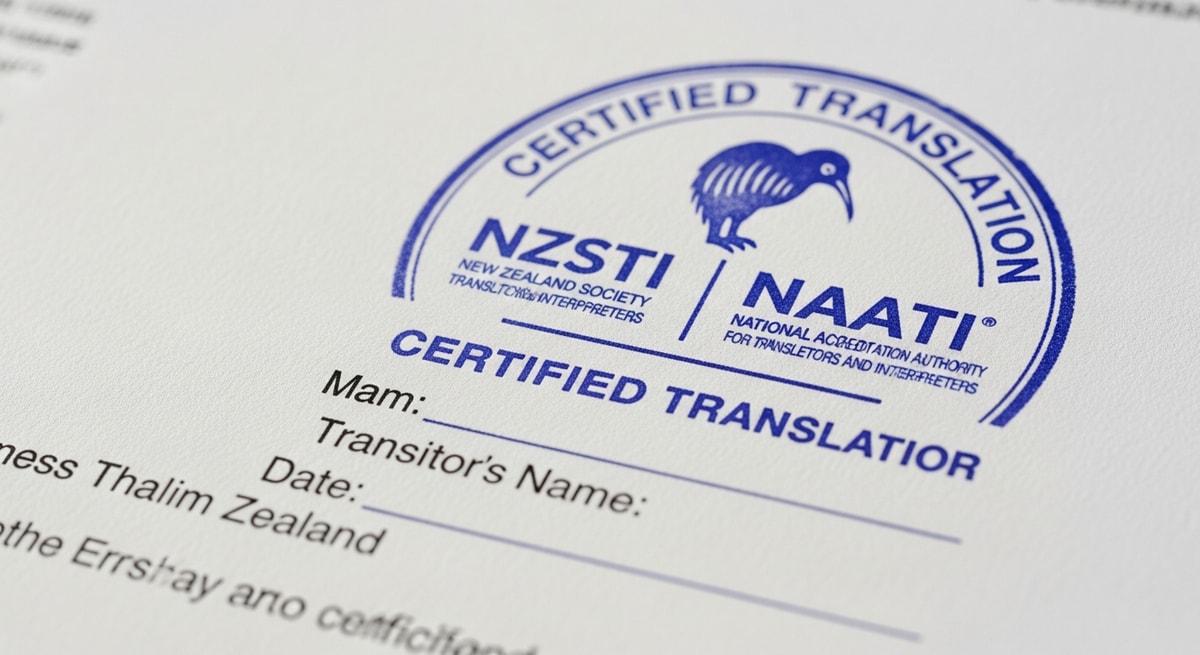
Certified translations carry official stamps from NZSTI members or NAATI-credentialed translators recognised across New Zealand
Apostille and E-Apostille for New Zealand Documents
New Zealand ratified the Hague Apostille Convention on 7 February 2001, with it entering into force on 22 November 2001. The Department of Internal Affairs (Te Tari Taiwhenua) Authentication Unit is the sole competent authority for issuing apostilles on New Zealand public documents. Apostilles authenticate documents for use in all 125+ Convention member states without further legalization.
New Zealand is a global leader in digital authentication, being one of only four countries worldwide that issues e-apostilles. An e-apostille is a secure PDF document emailed directly to the applicant, containing enhanced security features that make it more tamper-resistant than a traditional paper apostille. E-apostilles and paper apostilles are equally valid under the Convention, and recipients can verify the authenticity of any e-apostille through the DIA's online e-Register. This digital capability is particularly convenient for applicants who need authenticated documents quickly or who are located overseas.
For documents destined for countries that are not Apostille Convention members, a full authentication process is required. This involves the Department of Internal Affairs authenticating the document, followed by legalization at the destination country's embassy or high commission in New Zealand (or in Australia, which handles consular matters for several countries not represented in Wellington). DoVisa manages both apostille and full authentication processes, identifying the correct pathway based on the destination country, preparing and submitting the application to DIA, and delivering the authenticated documents to your address. Standard processing takes 15 working days; we can advise on any expedited options available.
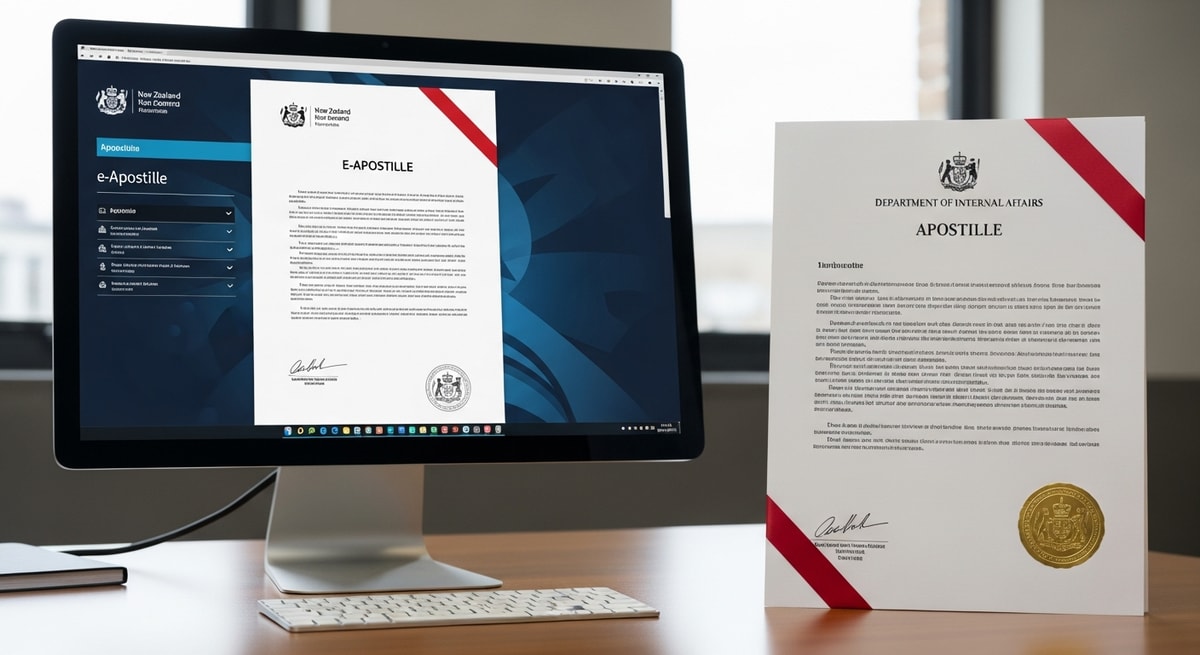
New Zealand is among only four countries worldwide offering e-apostilles alongside traditional paper apostilles
Te Reo Māori and Bilingual Document Requirements
Aotearoa New Zealand is unique among English-speaking countries in having Te Reo Māori as an official language under the Māori Language Act 2016 (Te Ture mō Te Reo Māori 2016). This means that government documents, court orders, and official correspondence may be issued in Te Reo Māori, English, or both languages. The Māori Land Court (Te Kooti Whenua Māori) frequently issues orders and titles in Te Reo Māori, and iwi (tribal) organisations produce governance documents, trust deeds, and historical records in Te Reo Māori.
Translating Te Reo Māori documents requires specialised knowledge beyond general linguistic competence. Our Te Reo Māori translators are licensed by Te Taura Whiri i te Reo Māori (the Māori Language Commission) and listed on their National Register of Translators and Interpreters. They understand the specific conventions of legal and administrative Te Reo Māori, including proper use of macrons (tohutō) — the diacritical marks that distinguish meaning in written Māori (for example, keke meaning cake versus kēkē meaning armpit). Correct use of macrons is essential for legal documents where precision of meaning is critical.
For international use, Te Reo Māori documents typically require translation into English and then certification and apostille for the destination country. DoVisa coordinates this multi-step process seamlessly — from Te Reo Māori to English translation by a licensed Te Taura Whiri translator, through certification, to apostille or authentication by the Department of Internal Affairs. We also handle the reverse process for documents being brought into New Zealand that need to be translated into Te Reo Māori for Māori Land Court proceedings or iwi governance purposes.
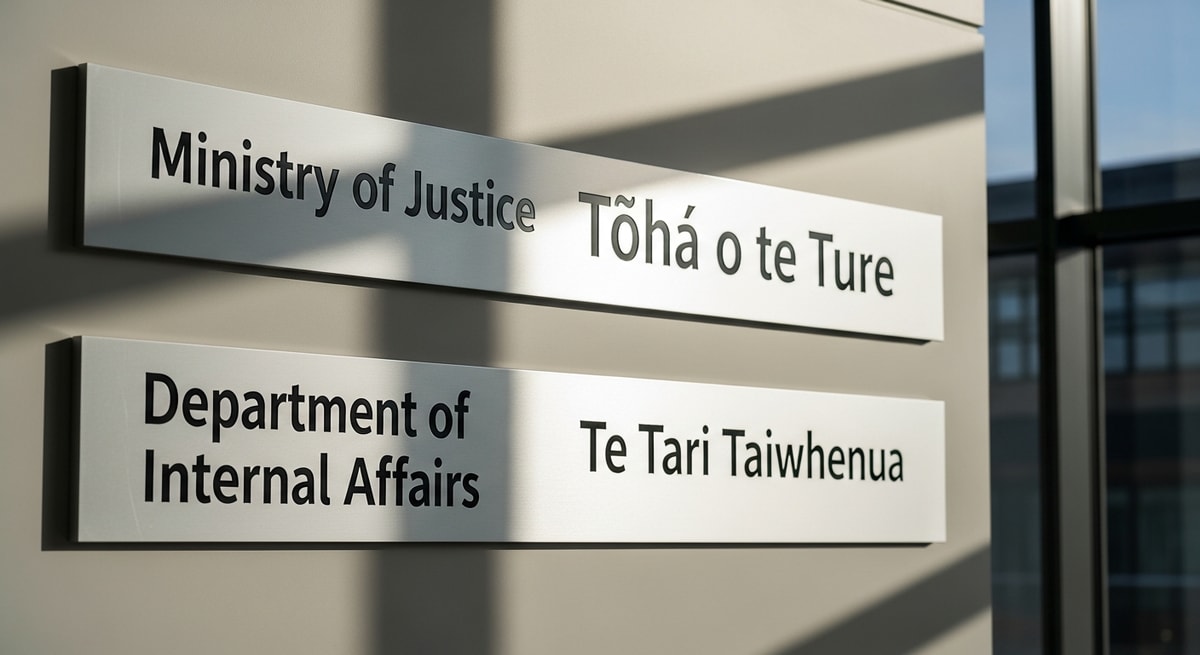
Te Reo Māori is an official language of New Zealand, requiring specialised translation expertise for legal and government documents
"Needed my Samoan birth certificate and police clearance translated for a Skilled Migrant Category visa application. Immigration New Zealand accepted both certified translations without any follow-up queries. The translator understood Pacific Island document formats perfectly."
"DoVisa translated my German university degree and academic transcripts for an NZQA International Qualification Assessment. The IQA was processed smoothly and my qualifications were recognised at NZQF Level 7. Excellent academic terminology throughout."
"Chinese marriage certificate and birth certificates translated for a partnership-based visa. INZ accepted everything on first submission. Gave 4 stars because express delivery was not available for Mandarin at the time I ordered."
"Hindi academic transcripts and employment references translated for an Accredited Employer Work Visa application. Five documents total, all delivered within the standard timeframe. INZ processed my visa without requesting any corrections to the translations."
"Korean family register translated with certification for a parent category visa application. Good quality and accepted by Immigration New Zealand. Minor delay with courier shipping but the translation itself was delivered on time digitally."
"Te Reo Māori land court documents translated to English for an overseas property transaction. The translator was licensed by Te Taura Whiri and handled the legal Māori terminology with real expertise. Very impressed with the attention to macrons and legal precision."
"French birth certificate translation for a NZ citizenship application. Accurate but had an initial date formatting issue. Corrected within hours after I flagged it, and the final version was accepted. Should not have happened though."
"Tongan police clearance and birth certificate translated for my residence visa. Both documents were accepted by INZ straight away. DoVisa also arranged the e-apostille through DIA for my NZ documents going back to Tonga. Very convenient one-stop service."
"Indian medical degree and registration documents translated for professional registration with the Medical Council of New Zealand. The NZSTI-certified translations were accepted and my qualifications were assessed without any queries about translation quality. Highly recommend."
"Chinese academic transcripts translated for Victoria University of Wellington admission. Good translation with proper NZQA-compatible formatting. The university processed my application without requesting re-translation. Solid service."
"Japanese marriage certificate and spouse's birth certificate translated for a partnership work visa. DoVisa provided certified translations that Immigration New Zealand accepted without any RFE. The whole process from upload to delivery took less than a week. Excellent."
"Arabic university degree and employment references translated for a Green List work visa application. All translations were certified and INZ accepted them immediately. The translator captured the academic terminology accurately and the NZQA assessment went through smoothly."
"Needed my Samoan birth certificate and police clearance translated for a Skilled Migrant Category visa application. Immigration New Zealand accepted both certified translations without any follow-up queries. The translator understood Pacific Island document formats perfectly."
"DoVisa translated my German university degree and academic transcripts for an NZQA International Qualification Assessment. The IQA was processed smoothly and my qualifications were recognised at NZQF Level 7. Excellent academic terminology throughout."
"Chinese marriage certificate and birth certificates translated for a partnership-based visa. INZ accepted everything on first submission. Gave 4 stars because express delivery was not available for Mandarin at the time I ordered."
New Zealand Document Translation FAQs
What qualifications do your New Zealand translators hold?
Our New Zealand translation network includes translators holding three types of recognised credentials. NZSTI full members carry an official certifying stamp issued by the New Zealand Society of Translators and Interpreters, valid only for their qualified language direction. NAATI-certified translators hold credentials under the NAATI framework adopted by New Zealand from 1 July 2024 for public-sector language services. For Te Reo Māori, our translators are licensed by Te Taura Whiri i te Reo Māori (the Māori Language Commission) and listed on the National Register of Translators and Interpreters. We verify each translator's active credentials before every project assignment.
Are certified translations required for all New Zealand visa applications?
Requirements vary by visa category. For resident visa applications, certified translations are required for all supporting documents not in English. For visitor visa applications, translations are still required for all non-English documents, but as of 26 May 2025, certification is no longer mandatory — though you must advise who translated the document and their qualifications. For all visa types, medical and police certificates must have certified English translations. The translator cannot be the applicant, a family member, or the immigration adviser assisting with the application. DoVisa recommends certified translations for all immigration documents to maximise acceptance certainty.
How much does certified translation cost for New Zealand documents?
Our New Zealand certified translation pricing follows a transparent per-page structure with volume discounts that apply automatically for larger documents. Pricing varies based on document length, language pair, and processing speed. Express and rush options are available for time-sensitive projects. Apostille and e-apostille processing through the Department of Internal Affairs is quoted separately. Upload your documents on our order page to receive an instant, detailed quote — no hidden fees.
What is an e-apostille and how does New Zealand issue them?
An e-apostille is a secure PDF document issued electronically by the Department of Internal Affairs Authentication Unit. New Zealand is one of only four countries worldwide that issues e-apostilles, making it a global leader in digital document authentication. The e-apostille has enhanced security features compared to a paper apostille, making it more tamper-resistant. It is emailed directly to the applicant and is equally valid as a paper apostille under the Hague Convention. Recipients can verify any e-apostille through the DIA's online e-Register. An apostille or e-apostille costs NZ$32, with additional copies at NZ$15 each. Standard processing takes 15 working days.
What documents need to be translated for an NZQA qualification assessment?
For an International Qualification Assessment (IQA) or Overseas Study Assessment (OSA), NZQA requires certified English translations of all post-secondary education documents not in English. This typically includes award certificates (degree, diploma, or certificate documents), academic transcripts or mark sheets for each year of post-secondary study, and any supplementary documents such as course descriptions or credit hour statements. NZQA cannot process your application without the English translations. Our translators format documents to meet NZQA's specific requirements, including proper rendering of grading scales and credit systems.
Can you translate Te Reo Māori documents?
Yes. We maintain a network of Te Reo Māori translators who are licensed by Te Taura Whiri i te Reo Māori (the Māori Language Commission) and listed on the National Register of Translators and Interpreters. Our Māori language translators handle documents from the Māori Land Court (Te Kooti Whenua Māori), iwi governance documents, wānanga academic records, and government correspondence in Te Reo Māori. They are proficient in legal and administrative Māori terminology and ensure correct use of tohutō (macrons), which are essential for preserving meaning in written Māori. We translate both from Te Reo Māori to English and from English to Te Reo Māori.
Are DoVisa translations accepted by Immigration New Zealand?
Yes. All our translations for New Zealand immigration purposes are produced by translators holding recognised professional credentials as required by INZ. Immigration New Zealand accepts translations completed by professional translators or reputable translation services. Our certified translations meet all INZ requirements for resident visas, work visas, student visas, partnership visas, and parent category visas. Each translation includes the translator's qualifications, contact details, and certification statement as specified in INZ's immigration instructions. Our acceptance rate across all INZ visa categories exceeds 99%.
What is the DIA Translation Service and how does DoVisa compare?
The Department of Internal Affairs (DIA) Translation Service is a government-operated translation service that assists with documents needed for immigration, citizenship, and other official purposes. DIA charges NZ$95 per document for selective translations of personal certificates (birth, marriage, death, divorce, name change, police certificates) with a 3-5 working day turnaround. DoVisa offers a broader service covering all document types in over 100 language pairs, with flexible processing speeds including express and rush options. We also coordinate apostille, e-apostille, and full authentication services, providing a complete document preparation solution that the DIA Translation Service alone does not cover.
Do I need original documents or are scans sufficient?
For the translation process itself, clear digital scans or photographs are sufficient. Our translators work from the digital copies you upload through our secure portal. However, Immigration New Zealand or other receiving authorities may require you to present the original document alongside the certified translation during your application or appointment. For apostille or e-apostille purposes, the DIA Authentication Unit requires the original document or a certified copy. We recommend keeping your originals safe and accessible, even though the translation process only requires digital copies.
Can I use a New Zealand certified translation in Australia?
New Zealand and Australia have closely aligned translation standards, particularly since New Zealand adopted the NAATI framework from 1 July 2024. Translations certified by NAATI-credentialed translators are generally accepted by Australian authorities including the Department of Home Affairs. NZSTI-certified translations may also be accepted by some Australian institutions, though NAATI certification provides the highest level of acceptance assurance across the Tasman. For documents destined for Australian immigration applications specifically, we recommend using a NAATI-certified translator. DoVisa can provide translations with the appropriate credentials for either country.
How long does the apostille process take for New Zealand documents?
The Department of Internal Affairs Authentication Unit processes apostille and e-apostille applications within 15 working days of receiving the complete submission. The cost is NZ$32 for the first apostille or e-apostille, and NZ$15 for each additional copy. E-apostilles are emailed directly to the applicant as secure PDFs, while paper apostilles are posted to the applicant's address. DoVisa handles the entire process including preparing the application, submitting documents to DIA, tracking processing, and forwarding the apostilled document to your address. We advise allowing sufficient lead time when planning applications that require apostilled documents.
What format will I receive my translated document in?
You will receive your certified translation as a high-resolution PDF via email for immediate use, along with the original hard copy bearing the translator's stamp and signature, shipped via tracked NZ Post domestically or international courier. While many New Zealand agencies accept PDF copies for initial submissions and online applications, some may request the physical original during in-person appointments. We recommend keeping both the digital and physical copies accessible. For e-apostille orders, the e-apostille itself is delivered as a secure PDF that can be submitted electronically to receiving authorities worldwide.
Get Your New Zealand Certified Translation Today
Professional certified translations accepted by Immigration New Zealand, NZQA, courts, and government agencies across Aotearoa