Certified Burmese Document Translation for Myanmar
Professional certified translations for Myanmar government documents, consular legalization, and international use. Burmese–English and 100+ language pairs with full legal certification.
TrustpilotSelect Languages
Drag & drop your documents here
or
PDF, JPEG, PNG, WebP — Max 10MB per file. Word documents: please save as PDF first.
Certified translators · Accepted by governments, courts & universities worldwide · View sample
Select a destination country to view pricing
How Myanmar Certified Translation Works
Submit Your Documents Securely
Upload clear scans of your Burmese or foreign-language documents through our encrypted portal. We accept PDF, JPEG, and PNG formats. Our intake specialists review each upload for legibility, checking for the distinctive rounded Burmese script and verifying whether your documents originate from Myanmar's federal authorities, state/regional governments, or ethnic minority administrative areas — as formatting and language conventions can vary significantly.
Professional Translator Assignment
Your documents are matched with a qualified translator experienced in Burmese administrative and legal terminology. Myanmar's unique abugida script — with 33 consonants, multiple vowel diacritics, and tonal markers — requires translators with deep expertise in the language. For documents involving ethnic minority languages such as Shan, Karen, or Kachin, we assign translators with the appropriate linguistic specialization.
Translation & Quality Review
The translator produces your certified translation with full attention to Myanmar's administrative conventions, Burmese naming formats, and official terminology. A second qualified linguist reviews terminology, script accuracy, and legal formatting. Each translation includes the translator's signature, certification statement, and relevant stamps required by the receiving authority.
Delivery with Full Certification
Receive your certified translation as a high-resolution PDF for immediate use, with the original stamped hard copy shipped via tracked courier. Since Myanmar is not a member of the Hague Apostille Convention, DoVisa can guide you through the consular legalization process — including authentication by the Myanmar Ministry of Foreign Affairs and legalization by the destination country's embassy — for documents intended for international use.
Myanmar Translation Service Specifications
Popular Language Pairs
We support all languages — 100+ language pairs available for Myanmar documents.
Common Documents
- Birth certificates (မွေးစာရင်း — Form-103)
- Marriage certificates (လက်ထပ်စာချုပ်)
- Death certificates (သေစာရင်း)
- Citizenship Scrutiny Card (နိုင်ငံသားစိစစ်ရေးကတ် — CSC)
- Household registration list (အိမ်ထောင်စုစာရင်း)
- Academic transcripts and degree certificates
- Passport (နိုင်ငံကူးလက်မှတ်)
- Police clearance certificates
- Powers of attorney
- Commercial registration documents
Turnaround Time
Certification Details
Myanmar Translation Requirements & Regulatory Framework
Embassy Acceptance
Notarization Process
Apostille Information
Legal Framework
Common Scenarios for Myanmar Document Translation
Immigration & Visa Applications
Myanmar nationals emigrating abroad need certified translations of birth certificates (Form-103), Citizenship Scrutiny Cards, household registration lists, and police clearances for visa applications with USCIS, UK Visas and Immigration, IRCC, and other immigration authorities. DoVisa provides certified translations with consular legalization guidance for seamless international acceptance.
Refugee & Asylum Documentation
Myanmar nationals seeking asylum or refugee status abroad require certified translations of identity documents, Citizenship Scrutiny Cards, household lists, and supporting evidence. Many documents are damaged or issued in non-standard formats due to ongoing conflict. Our translators are experienced in handling Myanmar documents in challenging conditions, including partial or deteriorated originals from conflict-affected areas.
Academic Credential Evaluation
Students and professionals seeking credential equivalency abroad must submit certified translations of Myanmar academic transcripts, diplomas, and degree certificates. The Department of Myanmar Examinations issues matriculation certificates with QR codes for digital verification. Our translators accurately render Burmese academic terminology and institutional names for international recognition.
Marriage & Family Documentation
Myanmar nationals marrying abroad or processing family reunification must provide certified translations of birth certificates, marriage certificates, and household registration lists. Myanmar's marriage requirements vary by religion — Buddhist marriages are established through cohabitation and common repute, while other faiths follow specific registration procedures. Our translators understand these distinctions.
Business & Investment
Foreign investors and companies operating in Myanmar need certified translations of commercial registration documents, permits, contracts, and corporate filings. The Myanmar Investment Commission and Directorate of Investment and Company Administration require translated documents for licensing and regulatory compliance in Myanmar's evolving business environment.
The Burmese Script: Translating Myanmar's Unique 'Bubble Script' Writing System
The Burmese writing system presents distinctive challenges for document translation. Known informally as the 'bubble script' for its characteristic rounded, circular letter forms, the Myanmar script is an abugida belonging to the Brahmic family of scripts. It features 33 basic consonants, each with an inherent vowel, plus additional diacritics for vowel modifications, tonal markers, and medial consonants that significantly alter pronunciation and meaning.
Burmese is a tonal, pitch-register, and syllable-timed language with a subject–object–verb (SOV) word order — fundamentally different from English's subject–verb–object structure. It is largely monosyllabic and analytic, relying on particles and word order rather than inflections to convey grammatical relationships. These linguistic characteristics mean that a competent Burmese translator must not simply convert words but restructure entire sentences for English-language clarity while preserving legal precision.
A significant historical challenge has been the Zawgyi encoding issue. Zawgyi was a non-standard font encoding widely used in Myanmar for over a decade, incompatible with Unicode and causing display issues and data corruption. Myanmar officially adopted Unicode as the national standard, but many older documents and digital records still use Zawgyi encoding. Our translators and technical team can work with both encoding systems, ensuring accurate translation regardless of how the original Burmese text was digitally stored or printed.
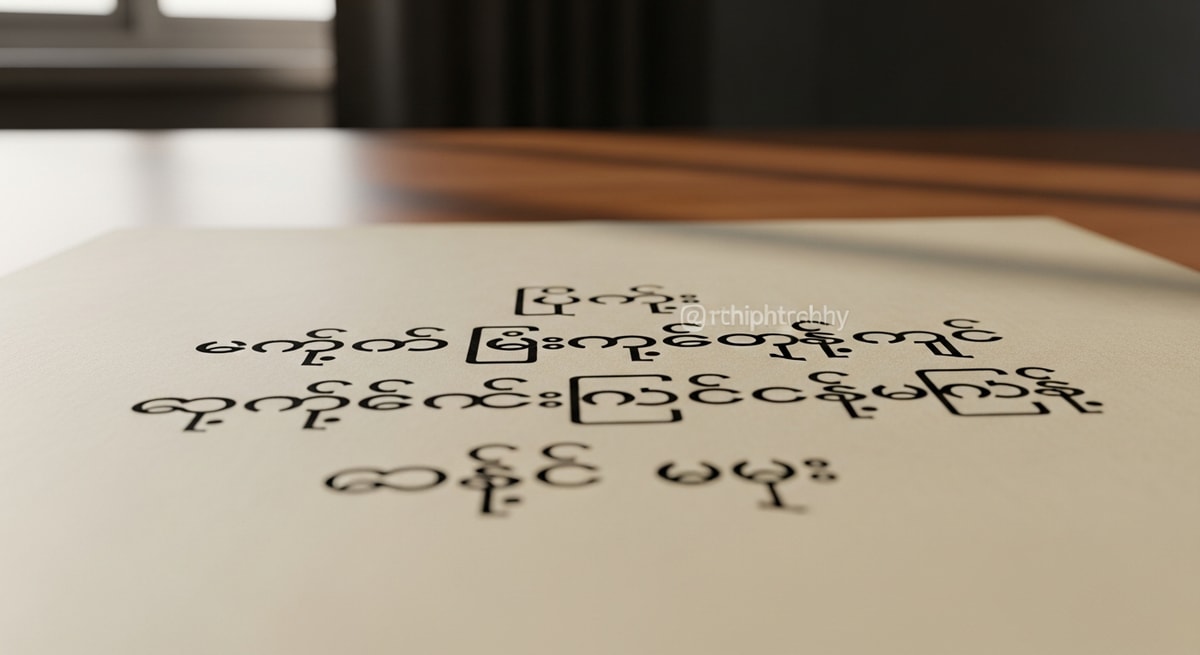
Myanmar's Burmese script features 33 consonants with rounded forms originally optimized for palm leaf inscription
Navigating Myanmar's Civil Registration and Identity Document System
Myanmar's civil registration system has its origins in the British colonial era, with birth and death registration beginning in 1907. Today, vital records are managed by the General Administration Department (GAD) under the Ministry of Home Affairs. Birth certificates are issued as Form-103 and contain the child's name in Burmese, date and place of birth, sex, and parents' names.
The most critical identity document in Myanmar is the Citizenship Scrutiny Card (နိုင်ငံသားစိစစ်ရေးကတ် — CSC), commonly referred to as the national registration card or NRC. This card is color-coded by citizenship category: pink for full citizens, blue for associate citizens, and green for naturalized citizens. The CSC number follows a specific format indicating the state/region, township, citizenship type, and sequential number. Translators must accurately render this coding system, as immigration authorities use it to verify citizenship status.
The Household Registration List (အိမ်ထောင်စုစာရင်း) is another essential document, serving as proof of residence and family composition. It lists all household members, their relationships, birth dates, and citizenship status. This document is frequently required for immigration applications, marriage registration, and property transactions. Decades of conflict have damaged civil records offices in many areas, making document replacement and verification challenging. DoVisa's translators are experienced in working with Myanmar documents in all conditions, including damaged or partially legible originals.
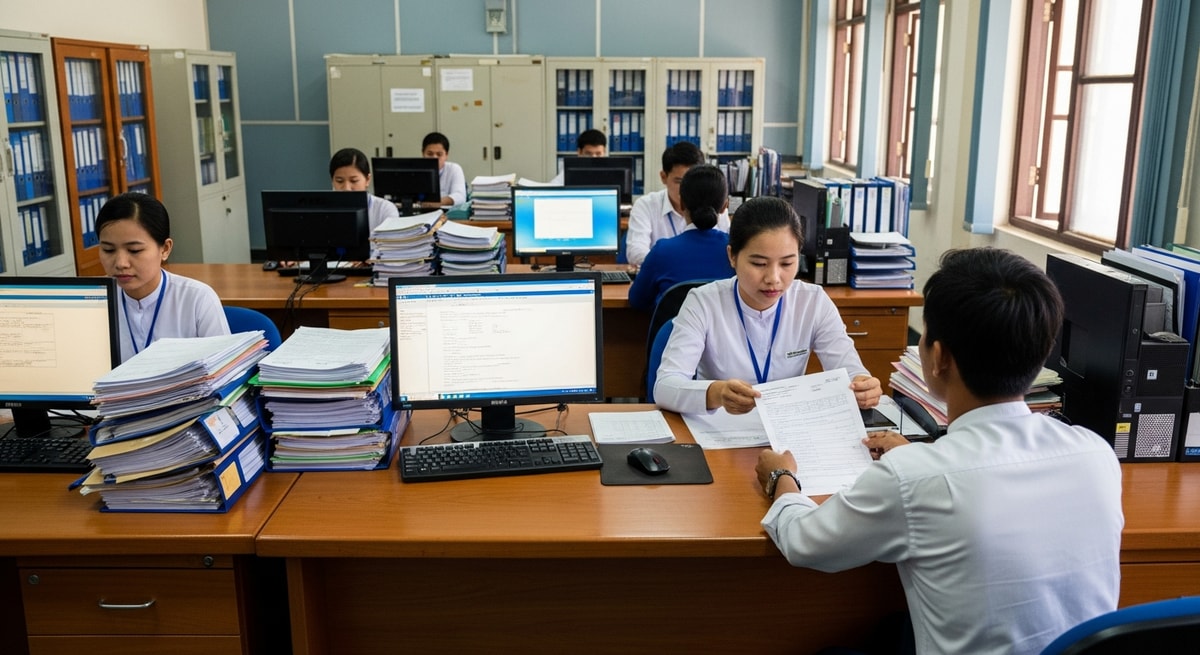
Myanmar's Citizenship Scrutiny Card (CSC) system uses color-coded cards to indicate citizenship categories
Consular Legalization: Getting Myanmar Documents Accepted Abroad
Since Myanmar is not a member of the Hague Apostille Convention, documents from Myanmar intended for international use require consular legalization rather than a simplified apostille. This multi-step authentication process ensures that the document's origin and the authority of its signatories are verified at each level before acceptance by a foreign government.
The standard legalization chain for Myanmar documents involves three steps: (1) authentication by the issuing authority — the Ministry of Education for academic documents, the Ministry of Health for medical records, or the General Administration Department for vital records; (2) authentication by the Ministry of Foreign Affairs (နိုင်ငံခြားရေးဝန်ကြီးဌာန) in Naypyidaw, which verifies the previous authentication; and (3) legalization by the destination country's embassy or consulate, typically in Yangon. This process takes 10-20 business days depending on the destination country.
Myanmar's ethnic diversity — with 135 officially recognized ethnic groups — adds complexity to document translation and legalization. Documents from ethnic minority areas may include text in Shan, Karen (S'gaw or Pwo), Kachin, Chin, Mon, or Rakhine, each using adapted forms of the Myanmar script with additional diacritics for sounds not found in standard Burmese. DoVisa's translators can handle documents from all of Myanmar's states and regions, ensuring accurate translation regardless of the ethnic language or script variant used.
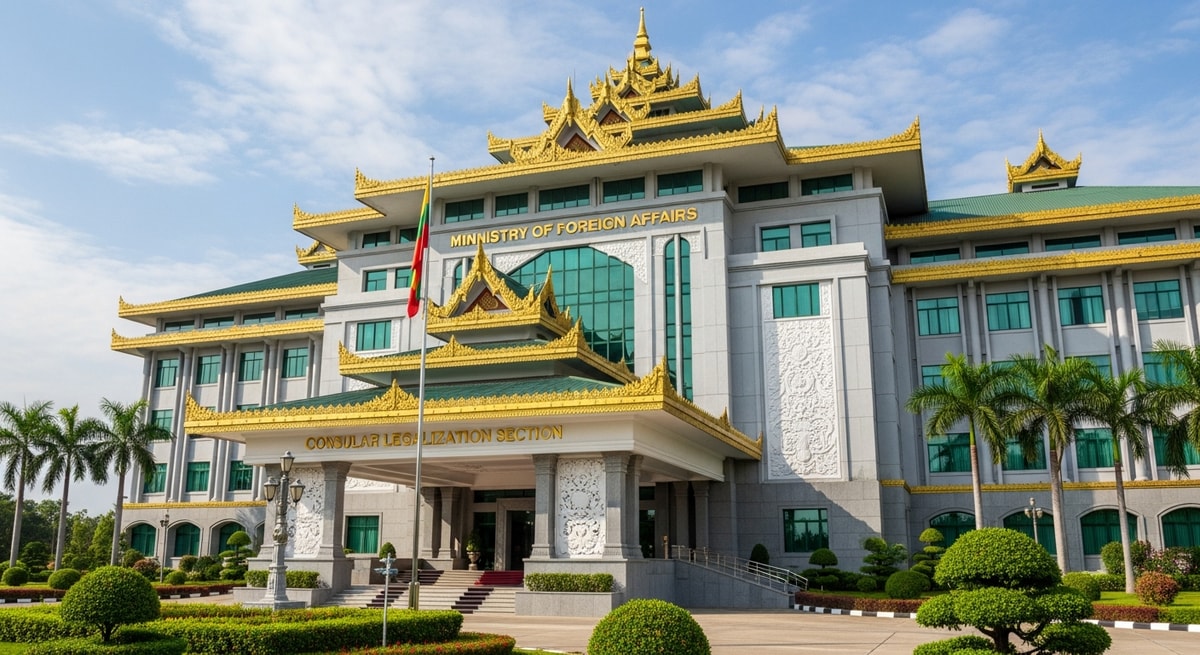
The Myanmar Ministry of Foreign Affairs in Naypyidaw authenticates documents for international use through consular legalization
"Needed my Myanmar birth certificate (Form-103) and Citizenship Scrutiny Card translated from Burmese to English for a USCIS asylum application. Both documents were accepted without any issues. Excellent handling of the Burmese script."
"Burmese to English translation of my university degree and academic transcripts for WES credential evaluation. The translator correctly rendered all Burmese academic terminology and WES processed my evaluation without corrections."
"Translated my Myanmar marriage certificate for a UK spouse visa. UKVI accepted the certified translation. The translator handled the Burmese naming conventions well. Delivery took one extra day but the quality was very good."
"DoVisa translated my Myanmar police clearance and household registration list for an Australian humanitarian visa. The Department of Home Affairs accepted everything on first submission. Very professional service."
"Burmese birth certificates for my two children translated for IRCC Canadian PR application. The translator accurately captured the Burmese naming format and CSC reference numbers. IRCC accepted without any RFE."
"Myanmar academic transcripts translated from Burmese to English for ECE credential evaluation. The grading conventions were accurately rendered. Good quality, though I wished the turnaround was slightly faster for the express option."
"Needed my damaged Myanmar birth certificate translated for a New Zealand immigration application. The translator carefully noted the illegible sections and the rest was translated perfectly. Immigration NZ accepted the certified translation."
"Myanmar commercial registration documents translated for a business investment application in Singapore. The translation was accurate and professionally formatted. Reliable service for corporate documents."
"Burmese to English translation of my Myanmar death certificate for a legal proceeding in the United States. The final version was accurate, but there was an initial confusion with the Zawgyi encoding that caused a name display error. It was resolved before final delivery."
"Household registration list and Citizenship Scrutiny Card translated from Burmese to English for a USCIS green card petition. The translator understood the color-coded CSC system and rendered all details accurately. USCIS approved our petition."
"Myanmar power of attorney translated for use in a legal matter in Japan. The translator handled the Burmese legal terminology professionally and the Japanese immigration office accepted the certified translation without question."
"Needed my Myanmar birth certificate (Form-103) and Citizenship Scrutiny Card translated from Burmese to English for a USCIS asylum application. Both documents were accepted without any issues. Excellent handling of the Burmese script."
"Burmese to English translation of my university degree and academic transcripts for WES credential evaluation. The translator correctly rendered all Burmese academic terminology and WES processed my evaluation without corrections."
"Translated my Myanmar marriage certificate for a UK spouse visa. UKVI accepted the certified translation. The translator handled the Burmese naming conventions well. Delivery took one extra day but the quality was very good."
Myanmar Document Translation FAQs
What types of Myanmar documents can be translated?
We translate all types of Myanmar documents including birth certificates (Form-103, မွေးစာရင်း), marriage certificates (လက်ထပ်စာချုပ်), death certificates (သေစာရင်း), Citizenship Scrutiny Cards (CSC, နိုင်ငံသားစိစစ်ရေးကတ်), household registration lists (အိမ်ထောင်စုစာရင်း), academic transcripts and degree certificates, passports, police clearances, powers of attorney, and commercial documents. We handle Burmese-to-English and 100+ other language pairs.
Are your Myanmar document translations certified?
Yes. Every translation includes a signed certification statement attesting to accuracy and completeness, with the translator's credentials and contact details. Our certified translations are accepted by USCIS, UK Visas and Immigration, IRCC (Canada), the Australian Department of Home Affairs, and credential evaluation agencies worldwide. For documents intended for Myanmar domestic courts and government agencies, translations must be produced by a licensed notary public under the Supreme Court of the Union.
How long does Myanmar document translation take?
Standard certified translation is delivered within 4-6 business days. Express processing is available for 2-3 business days, and rush delivery within 24 hours for select single-page documents. If consular legalization is needed for international use, additional time of 10-20 business days should be expected for the authentication chain through the Myanmar Ministry of Foreign Affairs and the destination country's embassy.
What languages do you translate Myanmar documents to and from?
While Burmese–English is the most common language pair for Myanmar documents, we provide direct translations between Burmese and Japanese, Korean, Chinese, Thai, German, French, Hindi, and many other languages. Burmese–Japanese and Burmese–Korean are increasingly common given growing migration from Myanmar to these countries. Direct translation avoids quality loss from translating through an intermediary language.
Will my translated Myanmar documents be accepted by immigration authorities?
Yes. Our certified translations of Myanmar documents are accepted by USCIS (United States), UK Visas and Immigration (UKVI), IRCC (Canada), the Australian Department of Home Affairs, and immigration authorities in Japan, South Korea, and other countries. Each translation includes the translator's signed certification statement confirming accuracy and completeness as required by these authorities.
Do I need notarization with my Myanmar document translation?
For documents submitted to Myanmar courts and government agencies, translations must be produced by a licensed notary public appointed under the Supreme Court of the Union. Myanmar has approximately 80 licensed notary publics nationwide. For international submissions to authorities like USCIS, UKVI, or IRCC, our standard certified translation is typically sufficient without additional notarization. DoVisa will advise on the specific requirements for your destination authority.
Can Myanmar documents get an apostille?
No. Myanmar is not a member of the Hague Apostille Convention. Myanmar documents intended for international use must undergo consular legalization — a multi-step process involving authentication by the issuing authority, the Myanmar Ministry of Foreign Affairs, and the destination country's embassy or consulate in Yangon. This process replaces the simplified apostille procedure available in Convention member states. DoVisa provides guidance through each step of the legalization chain.
How much does certified translation for Myanmar documents cost?
Our Myanmar document translation pricing follows a transparent per-page structure with volume discounts that apply automatically for larger projects. Pricing varies based on document type, language pair, and processing speed selected. Consular legalization fees are separate and depend on the destination country. Upload your documents on our order page to receive an instant, detailed quote with no hidden fees.
Can you translate handwritten Myanmar documents?
Yes. Many Myanmar documents — particularly older birth certificates, court records, and marriage certificates — contain handwritten entries in Burmese script. Our Burmese translators are experienced in reading both modern printed and handwritten Myanmar documents, including documents with faded stamps, marginal annotations, or damage from conflict. If a document's legibility is compromised, we will notify you before proceeding and suggest solutions.
What format will I receive my translated Myanmar document in?
You will receive your certified translation as a high-resolution PDF delivered via email, suitable for immediate digital submission to immigration authorities, credential evaluation agencies, and most government portals. If you need a physical hard copy with original stamps and signatures — for court submission or consular legalization — we ship via tracked international courier with delivery confirmation.
What is the Citizenship Scrutiny Card and why is it important for translation?
The Citizenship Scrutiny Card (CSC / နိုင်ငံသားစိစစ်ရေးကတ်) is Myanmar's primary national identity document. Cards are color-coded by citizenship category: pink for full citizens, blue for associate citizens, and green for naturalized citizens. The CSC number encodes the holder's state/region, township, citizenship type, and a sequential number. Our translators accurately render this coding system and citizenship classification, as immigration authorities use it to verify nationality and legal status.
Can you handle documents from Myanmar's ethnic minority regions?
Yes. Myanmar has 135 officially recognized ethnic groups, and documents from ethnic minority areas may include text in Shan, Karen (S'gaw or Pwo), Kachin, Chin, Mon, or Rakhine. These languages use adapted forms of the Myanmar script with additional diacritics. Our translation network includes linguists familiar with these script variants, ensuring accurate translation regardless of the region or ethnic language used in the original document.
Get Your Myanmar Documents Translated Today
Professional certified translations with consular legalization guidance — accepted by authorities worldwide