

Certified Portuguese Document Translation
Professional certified translations of Portuguese documents accepted by USCIS, UK Visas and Immigration, IRCC, and international authorities. Apostille coordination through the Procuradoria-Geral da Republica included.
TrustpilotSelect Languages
Drag & drop your documents here
or
PDF, JPEG, PNG, WebP — Max 10MB per file. Word documents: please save as PDF first.
Certified translators · Accepted by governments, courts & universities worldwide · View sample
Select a destination country to view pricing
How Portuguese Certified Translation Works
Submit Your Documents Securely
Upload clear scans of your Portuguese or foreign-language documents through our encrypted portal. We accept PDF, JPEG, and PNG formats. Our intake specialists review each upload for legibility and completeness, verifying that all pages of multi-page Portuguese documents such as certidoes (certificates) and academic transcripts are included before translation begins.
Translator Assignment
Your documents are matched with a professional translator specializing in Portuguese legal, civil, and administrative terminology. For documents requiring notarial certification under Portuguese law (traducao certificada), DoVisa can coordinate with our network of Portuguese notaries (notarios) and lawyers (advogados) authorized under Decreto-Lei no. 237/2001 to certify translations for official use.
Translation and Certification
The translator produces your certified translation with a signed certification statement attesting to the accuracy and completeness of the work. For international use, our certification includes the translator's signature, credentials, and a formal declaration. A second linguist performs quality review of all legal terminology, proper names, and formatting to ensure precision across Portuguese civil registry documents and official records.
Delivery with Full Certification
Receive your certified translation as a high-resolution PDF for immediate use, with the original hard copy shipped via tracked international courier. If you require an apostille from the Procuradoria-Geral da Republica for international recognition, DoVisa manages the complete apostille process. Standard delivery takes 4-6 business days, with express and rush options available for time-sensitive immigration and legal deadlines.
Portugal Translation Service Specifications
Popular Language Pairs
We support all languages — 100+ language pairs available for Portuguese documents.
Common Documents
- Birth certificates (certidao de nascimento)
- Marriage certificates (certidao de casamento)
- Death certificates (certidao de obito)
- Criminal record certificates (certificado do registo criminal)
- Academic diplomas and transcripts (diploma / certificado de habilitacoes)
- Divorce decrees (sentenca de divorcio)
- Power of attorney (procuracao)
- Commercial registry extracts (certidao do registo comercial)
- Property deeds (escritura de compra e venda)
- Social security records (declaracao da Seguranca Social)
Turnaround Time
Certification Details
Portugal Translation Requirements and Regulatory Framework
Embassy Acceptance
Notarization Process
Apostille Information
Legal Framework
Common Scenarios for Portuguese Document Translation
Immigration and Visa Applications
Portuguese nationals and residents applying for visas to the United States, United Kingdom, Canada, or Australia need certified translations of their certidao de nascimento (birth certificate), certificado do registo criminal (criminal record), academic diplomas, and employment records. USCIS, UK Visas and Immigration, and IRCC each have specific formatting requirements for certified translations. DoVisa provides translations formatted to meet each destination authority's standards, helping ensure smooth processing of immigration applications.
Marriage and Family Documentation
Individuals marrying abroad or registering a Portuguese marriage internationally need certified translations of their certidao de casamento (marriage certificate), certidao de nascimento (birth certificate), and single-status certificates (certificado de capacidade matrimonial). For family reunification cases involving Portuguese nationals, translated custody agreements, divorce decrees (sentenca de divorcio), and financial support declarations are commonly required by destination country immigration authorities.
Academic Credential Evaluation
Portuguese university graduates applying to international institutions or seeking credential evaluation through WES, ECE, or NACES member agencies need certified translations of their diplomas, academic transcripts (certificado de habilitacoes), and course descriptions. Portuguese academic documents often include specialized terminology from the Bologna Process framework. Our academic translators understand ECTS credit systems and Portuguese degree classifications such as licenciatura, mestrado, and doutoramento.
Business and Corporate Filings
Companies operating between Portugal and international markets require certified translations of commercial registry extracts (certidao do registo comercial), articles of association (pacto social), shareholder resolutions, and financial statements. Portuguese corporate documents filed with the Conservatoria do Registo Comercial use specific legal terminology from the Codigo das Sociedades Comerciais (Commercial Companies Code). Our corporate translators handle these specialized terms with precision for international legal and regulatory filings.
Property and Real Estate Transactions
Foreign buyers purchasing property in Portugal and Portuguese owners selling to international parties need certified translations of property deeds (escritura de compra e venda), land registry certificates (certidao do registo predial), and condominium regulations. Cross-border property transactions often require apostilled translations for recognition in the destination country's land registry system. DoVisa coordinates translation and apostille services together for efficient real estate transaction support.
Understanding Portugal's Certified Translation System
Portugal's approach to certified translations is distinctive among European countries. Unlike Germany or France, which maintain formal registers of court-appointed sworn translators, Portugal relies on a notarial certification model established under Decreto-Lei no. 237/2001 of 30 August. Under this framework, a certified translation (traducao certificada) requires a formal declaration drawn up by a notary (notario), lawyer (advogado), or solicitor (solicitador) that identifies the translator and records their oath or solemn affirmation that the translation is accurate and faithful to the original document.
The certification process involves binding three elements together: the declaration identifying the translator, the original document (or a certified copy), and the translated document. The notary or lawyer stamps and signs each page, creating an officially authenticated package. This bundle has legal force before Portuguese courts, the Instituto dos Registos e do Notariado (IRN), AIMA, and all Portuguese administrative bodies. The certifying professional does not need to verify the translation's quality — they attest to the translator's identity and the translator's sworn declaration of accuracy.
For international use outside Portugal, the certified translation itself often suffices at authorities in the United States, United Kingdom, Canada, and Australia without notarial certification. These countries accept a translator's certification statement as sufficient proof of accuracy. DoVisa provides this internationally recognized certification as standard with every translation. When Portuguese notarial certification is specifically required — for submission to Portuguese domestic authorities or for apostille purposes — DoVisa coordinates with authorized Portuguese professionals to complete the full Decreto-Lei no. 237/2001 certification process.

Portuguese certified translations require notarial authentication under Decreto-Lei no. 237/2001
Portugal's Civil Registry System and Vital Records
Portugal's civil registry system is administered by the Instituto dos Registos e do Notariado (IRN), which oversees all birth, marriage, death, and other civil status registrations throughout the country. Portuguese vital records are issued by local Conservatorias do Registo Civil (civil registry offices) and follow standardized formats established by the IRN. Key documents include the certidao de nascimento (birth certificate), certidao de casamento (marriage certificate), certidao de obito (death certificate), and records of perfilhacao (acknowledgment of paternity).
Portuguese civil registry certificates are available in three formats: narrativa (narrative summary), copia integral (full copy with all annotations and amendments), and modelo internacional (international model compliant with CIEC conventions that does not require translation for use in signatory countries). For immigration and legal purposes abroad, the copia integral is typically required as it contains the complete record including marginal annotations (averbamentos) that may record marriage, divorce, name changes, or nationality updates. Translators must carefully handle these averbamentos, which can contain complex legal language and references to other registry entries.
Since 2007, Portugal has progressively digitized its civil registry through the Civil Online platform, allowing citizens to request certificates electronically. Older Portuguese documents — particularly those predating digitization or originating from former overseas territories (Angola, Mozambique, Macau, East Timor, Guinea-Bissau) — may present unique translation challenges including handwritten entries, older orthographic conventions, and colonial-era administrative terminology. DoVisa's Portuguese specialists have experience with documents across all eras of Portuguese civil registration, ensuring accurate translation regardless of the document's age or origin.

The Instituto dos Registos e do Notariado oversees Portugal's civil registry and vital records system
Apostille and Authentication for Portuguese Documents
Portugal has been a Contracting Party to the Hague Apostille Convention since 1969, making it one of the earliest members. The competent authority for issuing apostilles is the Procuradoria-Geral da Republica (Attorney General's Office), which delegates this function to district offices in Lisbon, Porto, Coimbra, and Evora, as well as to representatives in the Autonomous Regions of Madeira and Acores. The apostille fee is EUR 10.20 per document, and processing is typically completed within 1-3 business days at the issuing office.
Portugal has also implemented an electronic apostille (Apostila Eletronica) system for documents bearing a qualified electronic signature (QES) or advanced electronic signature (AES). This digital apostille carries the same legal validity as the traditional paper apostille and is accepted by all Hague Convention member states. The e-Apostille system allows Portuguese citizens and institutions to authenticate documents entirely online, avoiding the need for in-person visits to the competent authority offices.
For certified translations destined for use in another Hague Convention member state, the apostille is affixed to the notarially certified translation package. The authentication chain works as follows: the translator produces the translation, a Portuguese notary or lawyer certifies it under Decreto-Lei no. 237/2001, and the Procuradoria-Geral da Republica then issues an apostille authenticating the notary's or lawyer's signature and seal. DoVisa manages this complete chain — from translation through notarial certification to apostille issuance — as an integrated service. For documents destined for countries that are not members of the Hague Convention, traditional consular legalization through the Ministerio dos Negocios Estrangeiros (MNE) and the destination country's embassy is required instead.
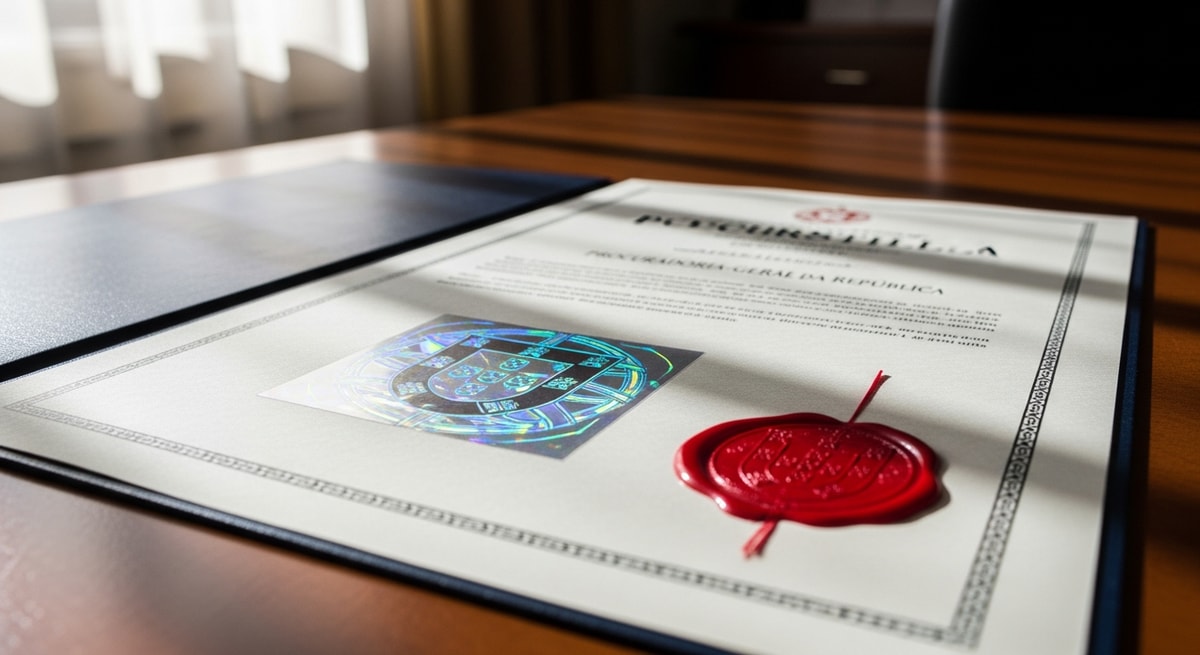
Portuguese apostilles are issued by the Procuradoria-Geral da Republica for international document recognition
"Needed my Portuguese certidao de nascimento translated to English for a US green card application. USCIS accepted the certified translation without any RFE. The translator handled all the averbamentos (marginal annotations) perfectly. Very professional service."
"DoVisa translated my Portuguese university diploma and transcripts from the Universidade de Lisboa for WES credential evaluation in Canada. The translator understood ECTS credits and Portuguese degree classifications. WES processed my evaluation without follow-up questions."
"Good translation of my Portuguese marriage certificate for a UK spouse visa application. The Home Office accepted everything on first submission. Would have preferred faster express delivery but the standard timeline was met as promised."
"Translated my certificado do registo criminal and certidao de nascimento from Portuguese to English for an Australian skilled worker visa. The Department of Home Affairs accepted both documents. Clean, accurate translations with quick turnaround."
"Corporate translation of Portuguese commercial registry extracts and articles of association for a subsidiary registration in the UK. Our solicitors at Companies House had no issues with the translated documents. Excellent handling of Portuguese corporate legal terminology."
"Portuguese divorce decree translated to English for IRCC family sponsorship application in Canada. The translation captured all the judicial language accurately. Four stars because I wished rush delivery was available for multi-page court documents."
"Had my Portuguese academic transcripts translated for a graduate school application in the US. The initial delivery had a minor error in the course title romanization which was corrected within a few hours. The revised version was accepted by the university without issues."
"Needed an apostilled translation of my Portuguese birth certificate for use in Japan. DoVisa coordinated the notarial certification and apostille through the Procuradoria-Geral da Republica seamlessly. The Japanese immigration bureau accepted everything. Impressive end-to-end service."
"Portuguese power of attorney translated to English for a property transaction in New Zealand. The lawyer in Auckland confirmed the certified translation met all requirements. Fast delivery and the translator clearly understood Portuguese legal document formatting."
"Translated Portuguese employment records and social security statements for a US immigration case. USCIS accepted everything. Good quality overall but I would have appreciated a status update during the translation process."
"My Portuguese certidao de casamento and both birth certificates were translated for an Australian partner visa. The Department of Home Affairs processed our application without requesting any corrections. Three documents delivered in four days. Excellent."
"Needed my Portuguese certidao de nascimento translated to English for a US green card application. USCIS accepted the certified translation without any RFE. The translator handled all the averbamentos (marginal annotations) perfectly. Very professional service."
"DoVisa translated my Portuguese university diploma and transcripts from the Universidade de Lisboa for WES credential evaluation in Canada. The translator understood ECTS credits and Portuguese degree classifications. WES processed my evaluation without follow-up questions."
"Good translation of my Portuguese marriage certificate for a UK spouse visa application. The Home Office accepted everything on first submission. Would have preferred faster express delivery but the standard timeline was met as promised."
Portugal Document Translation FAQs
What types of Portuguese documents can be translated?
We translate all types of Portuguese documents including certidao de nascimento (birth certificates), certidao de casamento (marriage certificates), certidao de obito (death certificates), certificado do registo criminal (criminal record certificates), academic diplomas and transcripts, divorce decrees, powers of attorney (procuracao), commercial registry extracts, property deeds, social security records, and all other civil, legal, and corporate documents issued in Portugal or by Portuguese consulates abroad.
Are the translations certified for official use?
Yes. Every DoVisa translation includes a signed certification statement attesting to the accuracy and completeness of the translation. This certification is accepted by international authorities including USCIS, UK Visas and Immigration, IRCC (Canada), and the Australian Department of Home Affairs. For submission to Portuguese domestic authorities such as the IRN, AIMA, or Portuguese courts, a notarially certified translation (traducao certificada em notario) under Decreto-Lei no. 237/2001 is required. DoVisa can coordinate this additional Portuguese notarial certification upon request.
Do I need a sworn translator for Portuguese documents?
It depends on where the translated document will be used. Portugal does not maintain a formal register of sworn translators like Germany or France. Instead, Portuguese law under Decreto-Lei no. 237/2001 requires that translations for domestic official use be certified by a notary, lawyer, or solicitor who draws up a declaration identifying the translator and recording their oath of accuracy. For use outside Portugal — such as immigration applications to the US, UK, Canada, or Australia — a standard certified translation with a translator's certification statement is sufficient and widely accepted. DoVisa provides the internationally recognized certification as standard and can arrange Portuguese notarial certification when specifically needed.
How long does Portuguese document translation take?
Standard certified translation of Portuguese documents is delivered within 4-6 business days. Express processing is available for 2-3 business days, and rush delivery within 24 hours is available for select document types such as single-page vital records. If you also need an apostille from the Procuradoria-Geral da Republica, allow an additional 1-3 business days for apostille processing. Turnaround times may vary for very large document sets or rare language combinations.
What languages do you translate Portuguese documents to and from?
We translate Portuguese documents to and from over 100 languages. Our most popular language pairs for Portuguese include English, French, Spanish, German, Italian, Dutch, Arabic, Chinese, Japanese, Russian, and Korean. We also handle translations between European Portuguese and Brazilian Portuguese when formal adaptation is needed for legal or administrative purposes. All language pairs include the same certified translation service with a signed certification statement.
Will the translation be accepted by immigration authorities?
Our certified translations of Portuguese documents are accepted by all major international immigration authorities including USCIS (United States), UK Visas and Immigration, IRCC (Canada), the Australian Department of Home Affairs, and Immigration New Zealand. Each of these authorities accepts certified translations with a translator's certification statement. Our current acceptance rate at international agencies is 98.7%. For Portuguese domestic immigration matters handled by AIMA, a notarially certified translation is required, which DoVisa can arrange.
Do I need notarization with my Portuguese translation?
For most international purposes — including immigration applications to the US, UK, Canada, and Australia — notarization is not required. A certified translation with a translator's certification statement is sufficient. However, if your translated document will be submitted to a Portuguese domestic authority (IRN, AIMA, Portuguese courts), notarial certification under Decreto-Lei no. 237/2001 is required. Additionally, if you need an apostille for international use in another Hague Convention member state, the translation must first be notarially certified before the apostille can be issued by the Procuradoria-Geral da Republica.
What is an apostille and do I need one for Portuguese documents?
An apostille is a standardized certificate that authenticates the origin of a public document for use in another country that is a member of the Hague Apostille Convention. Portugal has been a member since 1969, and apostilles are issued by the Procuradoria-Geral da Republica (Attorney General's Office) for a fee of EUR 10.20 per document. You need an apostille if your Portuguese document or certified translation will be used in another Convention member state and the receiving authority requires it. Portugal also offers an electronic apostille (Apostila Eletronica) for digitally signed documents. DoVisa can coordinate the complete apostille process for your translated documents.
How much does certified Portuguese translation cost?
Our Portuguese certified translation pricing follows a transparent per-page structure with volume discounts that apply automatically for larger documents. Pricing varies based on document length, language pair, and the processing speed you select. Express and rush service options are available for time-sensitive projects. Apostille processing through the Procuradoria-Geral da Republica is quoted separately. Upload your documents on our order page to receive an instant, detailed quote before work begins — no hidden fees or commitments.
Can you translate handwritten Portuguese documents?
Yes. We regularly translate handwritten Portuguese documents including older civil registry entries, personal correspondence, notarial records, and historical documents. Portuguese handwriting styles — particularly in documents from before digitization of the civil registry — can be challenging due to cursive conventions and older orthographic rules. Our translators experienced with Portuguese handwritten documents can decipher entries that automated tools cannot. For best results, provide the highest-quality scan possible. If any portion is illegible, we will note it in the translation and consult with you before finalizing.
What format will I receive the translation in?
You will receive your certified translation as a high-resolution PDF delivered via email, suitable for electronic submission to most authorities. The PDF includes the full translation, the translator's certification statement, and a copy of the source document. If you need a physical hard copy with original signatures — required by some authorities and for apostille processing — we ship via tracked international courier. For apostilled translations, you will receive both the digital PDF and the original apostilled hard copy package.
Can you translate documents from Portugal's former overseas territories?
Yes. We have experience translating documents originally issued in Portugal's former overseas territories including Angola, Mozambique, Guinea-Bissau, Cape Verde, Sao Tome and Principe, Macau, East Timor (Timor-Leste), and Goa. These documents may use older Portuguese orthographic conventions, colonial-era administrative terminology, or bilingual formatting. Some may include entries in local languages alongside Portuguese. Our translators are familiar with the administrative structures and document formats used across these territories during different historical periods, ensuring accurate translation of even complex historical records.
What is the difference between European Portuguese and Brazilian Portuguese for translation?
European Portuguese and Brazilian Portuguese differ in spelling, vocabulary, grammar, and official terminology. For legal and official documents, these differences matter: Portuguese and Brazilian institutions use different terms for the same legal concepts, and the 2009 Orthographic Agreement (Acordo Ortografico) introduced spelling changes that some institutions adopted and others did not. DoVisa uses translators who specialize in the appropriate variant. Documents issued in Portugal are translated by European Portuguese specialists, while documents issued in Brazil are handled by Brazilian Portuguese specialists, ensuring the correct terminology and conventions are used throughout.
Get Your Portuguese Documents Translated Today
Professional certified translations accepted by international authorities worldwide with apostille coordination available