Certified Trilingual Document Translation for Luxembourg
Professional certified translations for Luxembourg documents in Luxembourgish, French, and German. Apostille coordination, EU document handling, and 100+ language pairs with full legal certification.
TrustpilotSelect Languages
Drag & drop your documents here
or
PDF, JPEG, PNG, WebP — Max 10MB per file. Word documents: please save as PDF first.
Certified translators · Accepted by governments, courts & universities worldwide · View sample
Select a destination country to view pricing
How Luxembourg Certified Translation Works
Submit Your Documents Securely
Upload clear scans of your Luxembourg documents through our encrypted portal. We accept PDF, JPEG, and PNG formats. Our intake specialists review each upload for legibility and identify the document's language — Luxembourgish, French, or German — to ensure proper translator assignment. We confirm whether your documents require a traducteur assermenté (sworn translator) translation for Luxembourg domestic use or standard certified translation for international submissions.
Professional Translator Assignment
Your documents are matched with a qualified translator experienced in Luxembourg's trilingual administrative system. For documents intended for Luxembourg domestic authorities, we coordinate with traducteurs-interprètes assermentés sworn before the Superior Court of Justice (Cour supérieure de Justice) and registered with the Ministry of Justice. For Luxembourg documents going abroad, our certified translators provide translations accepted by USCIS, UKVI, IRCC, and authorities worldwide.
Translation & Quality Review
The translator produces your certified translation with full attention to Luxembourg's legal conventions, trilingual administrative terminology, and EU document formatting. A second qualified linguist reviews terminology, formatting, and accuracy. Each translation includes the translator's signature, certification statement, and relevant stamps required by the receiving authority.
Delivery with Full Certification
Receive your certified translation as a high-resolution PDF for immediate use, with the original stamped hard copy shipped via tracked courier. For documents requiring an apostille, DoVisa coordinates with the Luxembourg Parquet Général — the designated competent authority — for seamless international acceptance across all 129+ Convention member states. Within the EU, many documents may benefit from simplified circulation under EU Regulation 2016/1191.
Luxembourg Translation Service Specifications
Popular Language Pairs
We support all languages — 100+ language pairs available for Luxembourg documents.
Common Documents
- Birth certificates (acte de naissance / Geburtsurkunde)
- Marriage certificates (acte de mariage / Heiratsurkunde)
- Death certificates (acte de décès / Sterbeurkunde)
- Residence certificates (certificat de résidence)
- Academic diplomas and transcripts (diplôme / Diploma Supplement)
- Police clearance certificates (casier judiciaire / bulletin n°3)
- Luxembourg nationality certificates
- Corporate documents (registre de commerce et des sociétés)
- Powers of attorney (procuration / Vollmacht)
- Employment contracts and social security records
Turnaround Time
Certification Details
Luxembourg Translation Requirements & Regulatory Framework
Embassy Acceptance
Notarization Process
Apostille Information
Legal Framework
Common Scenarios for Luxembourg Document Translation
Immigration & Residency Applications
Foreign nationals relocating to Luxembourg — one of Europe's most international countries with nearly 48% foreign-born residents — need certified translations of birth certificates, marriage certificates, police clearances, and educational credentials for residency permit applications through the Direction de l'immigration. Documents not in French, German, or Luxembourgish must be accompanied by a sworn translation.
Academic Credential Recognition
Students and professionals seeking credential recognition in Luxembourg must submit translations of academic transcripts, diplomas, and Diploma Supplements to the Ministry of Higher Education and Research. Luxembourg's ENIC-NARIC office handles qualification recognition, with Benelux diplomas automatically recognized and non-Benelux qualifications requiring formal registration. Our translators accurately render academic terminology across Luxembourg's trilingual educational system.
EU & Cross-Border Employment
Luxembourg's workforce includes over 200,000 daily cross-border commuters from France, Belgium, and Germany, creating massive demand for multilingual document translation. Employment contracts, social security records, tax certificates, and professional qualifications frequently require translation between French, German, English, and Portuguese — reflecting Luxembourg's largest expatriate community.
Financial Services & Corporate Filings
As a leading global financial center, Luxembourg hosts the headquarters of major international funds, banks, and holding companies. Corporate translations include registre de commerce et des sociétés (RCS) extracts, fund prospectuses, board resolutions, and regulatory filings for the Commission de Surveillance du Secteur Financier (CSSF). Our translators handle financial and legal terminology across all three official languages.
Luxembourg Nationality Applications
Applicants for Luxembourg nationality must submit certified translations of birth certificates, marriage certificates, and proof of linguistic integration. The nationality law requires evidence of Luxembourgish language proficiency and at least five years of continuous residence. Our translations of supporting documents meet the standards required by the Ministère de la Justice for nationality applications.
Luxembourg's Trilingual System: Navigating Three Official Languages in Document Translation
Luxembourg's documentary landscape is shaped by one of Europe's most distinctive linguistic systems. Under the Law of 24 February 1984 on the Use of Languages, three languages share official status: Luxembourgish (Lëtzebuergesch) as the national language, French as the language of legislation, and German as a co-administrative language. This trilingual framework means that a single individual's official records may span multiple languages depending on the context of issuance.
In practice, French dominates Luxembourg's legal and administrative systems. Birth certificates (acte de naissance) and marriage certificates are issued by the état civil (civil registry) offices in French. Court judgments are primarily rendered in French, though German may be used in certain lower court proceedings. Academic transcripts from Luxembourg's school system reflect the trilingual education policy: primary school begins in Luxembourgish, transitions to German as the medium of instruction, and shifts to French for secondary school — meaning a student's educational records may contain all three languages.
For translators, this trilingual environment requires expertise in the specific legal and administrative conventions of each language as used in Luxembourg — which differ subtly from their usage in France, Germany, or Switzerland. A Luxembourg birth certificate uses French administrative terminology influenced by the Grand Duchy's own legal traditions, not identical to a French acte de naissance. DoVisa's translators understand these Luxembourg-specific conventions and ensure accurate translation regardless of which official language the original document uses.
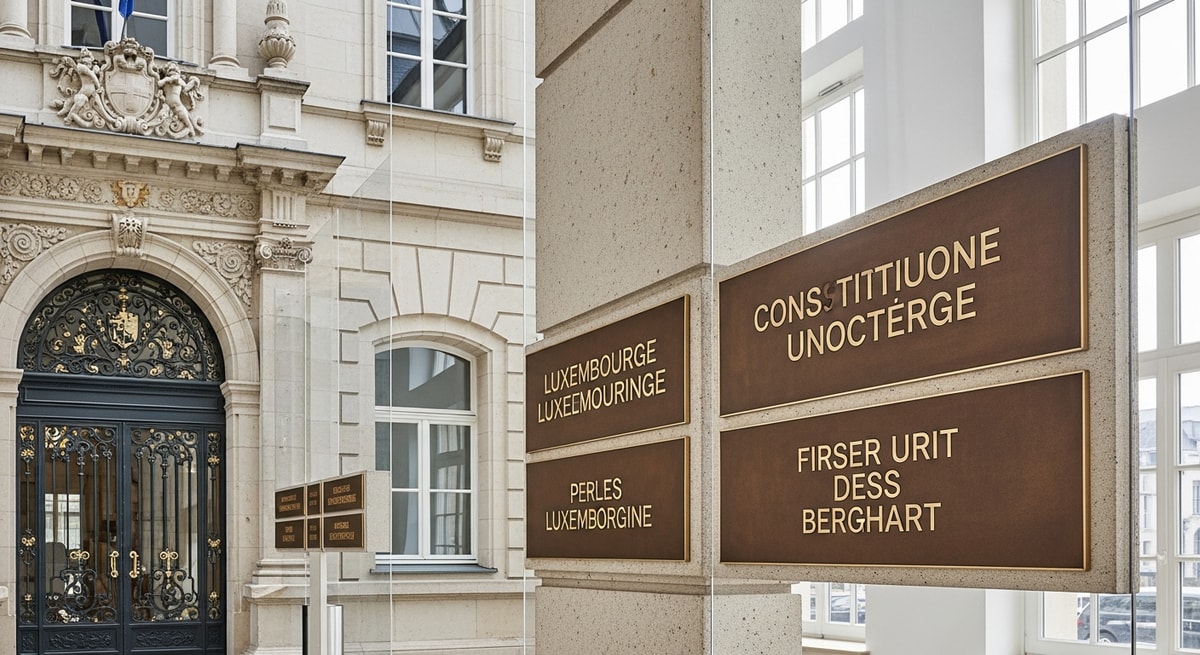
Luxembourg's Law of 24 February 1984 establishes Luxembourgish, French, and German as the three official languages
Luxembourg as an International Financial Center: Document Translation for the EU's Financial Hub
Luxembourg is the world's second-largest investment fund center after the United States, and its financial sector generates approximately 25% of the country's GDP. The Grand Duchy hosts over 3,500 registered funds, 127 banks, and the European headquarters of numerous international financial institutions. This concentration of global finance creates extraordinary demand for precise, legally compliant document translation across multiple languages.
Financial documents requiring translation include fund prospectuses, key investor information documents (KIIDs), regulatory filings for the Commission de Surveillance du Secteur Financier (CSSF), and corporate documents registered with the Registre de Commerce et des Sociétés (RCS). The CSSF requires all regulatory submissions in French or German, while many international fund documents originate in English. Translations must meet exacting standards for financial terminology, regulatory compliance references, and legal precision.
Luxembourg is also a founding member of the European Union and hosts major EU institutions including the Court of Justice of the European Union (CJEU), the European Court of Auditors, the European Investment Bank (EIB), and parts of the European Parliament. This institutional concentration means that Luxembourg-origin documents frequently require translation into all 24 official EU languages. DoVisa handles the full spectrum of Luxembourg financial and corporate translation needs, from single-page corporate extracts to multi-language fund documentation projects.

Luxembourg's Kirchberg district hosts major EU institutions and the headquarters of numerous international financial firms
"Luxembourg birth certificate translated from French to English for a USCIS immigration petition. The translator understood the Luxembourg état civil format perfectly and USCIS accepted it without questions."
"French to English translation of my Luxembourg university diploma and Diploma Supplement for WES credential evaluation. The trilingual academic terminology was handled expertly. WES processed my evaluation without corrections."
"Portuguese to French translation of my birth certificate for a Luxembourg residency permit application. The Direction de l'immigration accepted the sworn translation immediately. Very professional service for cross-border workers."
"German-language Luxembourg academic transcripts translated to English for credential evaluation in the United States. The translator accurately captured the German educational terminology used in Luxembourg secondary schools. Good quality."
"Needed my Luxembourg marriage certificate and birth certificate translated for an Australian partner visa. The Department of Home Affairs accepted both certified translations on first submission. Excellent attention to detail."
"Corporate documents translated from French to English — RCS extracts, board resolutions, and CSSF regulatory filings. The financial terminology was handled with precision. Essential service for Luxembourg's international business community."
"Luxembourg police clearance (casier judiciaire bulletin n°3) translated from French to English for a Canadian PR application through IRCC. The translation was accurate and IRCC accepted it. Reliable service."
"French to English translation of Luxembourg nationality certificate and supporting documents for a UK Skilled Worker visa. UKVI accepted the certified translations without any issues. Fast turnaround and professional quality."
"Luxembourg employment contract translated from French to Portuguese for a social security claim. The final translation was accurate, but there was a minor formatting inconsistency in the first draft that needed correction. Resolved quickly."
"Birth certificates for my two children translated from French to English for USCIS green card petitions. The translator correctly handled the Luxembourg naming conventions. USCIS approved our petitions without an RFE."
"Luxembourg fund prospectus translated from French to English for a cross-border distribution filing. The CSSF-specific regulatory terminology was rendered accurately. Good quality for a complex financial document."
"Luxembourgish and French documents translated to English for a New Zealand immigration application. The translator understood the trilingual document system and handled both languages perfectly. Immigration NZ accepted immediately."
"Luxembourg birth certificate translated from French to English for a USCIS immigration petition. The translator understood the Luxembourg état civil format perfectly and USCIS accepted it without questions."
"French to English translation of my Luxembourg university diploma and Diploma Supplement for WES credential evaluation. The trilingual academic terminology was handled expertly. WES processed my evaluation without corrections."
"Portuguese to French translation of my birth certificate for a Luxembourg residency permit application. The Direction de l'immigration accepted the sworn translation immediately. Very professional service for cross-border workers."
Luxembourg Document Translation FAQs
What types of Luxembourg documents can be translated?
We translate all types of Luxembourg documents including birth certificates (acte de naissance / Geburtsurkunde), marriage certificates (acte de mariage / Heiratsurkunde), death certificates, residence certificates (certificat de résidence), academic diplomas and Diploma Supplements, police clearances (casier judiciaire, bulletin n°3), Luxembourg nationality certificates, corporate documents (registre de commerce et des sociétés / RCS), powers of attorney, employment contracts, and financial regulatory filings. We handle translations from Luxembourgish, French, and German to English and 100+ other languages.
Are your Luxembourg document translations certified?
Yes. Every translation includes a signed certification statement attesting to accuracy and completeness, with the translator's credentials. Our certified translations are accepted by USCIS, UK Visas and Immigration, IRCC (Canada), the Australian Department of Home Affairs, and credential evaluation agencies worldwide. For submission to Luxembourg domestic authorities, a translation by a traducteur-interprète assermenté sworn before the Cour supérieure de Justice is required — DoVisa can coordinate this upon request.
How long does Luxembourg document translation take?
Standard certified translation is delivered within 4-6 business days. Express processing is available for 2-3 business days, and rush delivery within 24 hours for select single-page documents. If apostille processing through the Parquet Général is included, additional time of 3-7 business days should be expected.
What languages do you translate Luxembourg documents to and from?
Luxembourg documents may be in Luxembourgish, French, or German, and we translate from all three to English and 100+ other languages. French-to-English and German-to-English are the most common pairs. French-to-Portuguese is also frequently requested, reflecting Luxembourg's large Portuguese community. We provide direct translations between all major language pairs without intermediary translation.
Will my translated Luxembourg documents be accepted by immigration authorities?
Yes. Our certified translations of Luxembourg documents are accepted by USCIS (United States), UK Visas and Immigration (UKVI), IRCC (Canada), the Australian Department of Home Affairs, and immigration authorities worldwide. For additional authentication, we can coordinate an apostille through the Parquet Général — recognized in all 129+ Hague Convention member states. Within the EU, certain vital records may benefit from simplified circulation under EU Regulation 2016/1191.
Do I need a sworn translator (traducteur assermenté) for Luxembourg documents?
For documents submitted to Luxembourg domestic authorities — including courts, the Ministry of Justice, and état civil offices — translations must be produced by a traducteur-interprète assermenté sworn before a chamber of the Cour supérieure de Justice and registered with the Ministry of Justice. These sworn translators are listed on the Ministry's official website. For international submissions to authorities like USCIS, UKVI, or IRCC, our standard certified translation is accepted. DoVisa can coordinate with registered sworn translators when needed.
What is an apostille and can Luxembourg documents get one?
An apostille is a standardized international certificate that authenticates the origin of a public document. Luxembourg is a longstanding member of the Hague Apostille Convention. The designated competent authority is the Parquet Général (Attorney General's Office) at the Cité Judiciaire in Luxembourg City. Apostilled Luxembourg documents are accepted in all 129+ Convention member states without further embassy legalization. Additionally, within the EU, EU Regulation 2016/1191 may eliminate the need for apostille on certain vital records exchanged between member states. DoVisa coordinates the complete apostille process on your behalf.
How much does certified translation for Luxembourg documents cost?
Our Luxembourg document translation pricing follows a transparent per-page structure with volume discounts that apply automatically for larger projects. Pricing varies based on document type, source language (Luxembourgish, French, or German), and processing speed selected. Apostille processing fees are quoted separately. Upload your documents on our order page to receive an instant, detailed quote with no hidden fees.
Can you translate Luxembourgish documents?
Yes. Luxembourgish (Lëtzebuergesch) became the third officially recognized language of Luxembourg under the Law of 24 February 1984. While most official documents are in French, some administrative records, correspondence, and certificates may be in Luxembourgish — a West Germanic language related to Moselle Franconian dialects. Our translators are proficient in Luxembourgish and can translate to English, French, German, and other languages.
What format will I receive my translated Luxembourg document in?
You will receive your certified translation as a high-resolution PDF delivered via email, suitable for immediate digital submission to immigration authorities, credential evaluation agencies, and government portals. If you need a physical hard copy with original stamps and signatures — for court submission, apostille processing, or sworn translator certification — we ship via tracked international courier with delivery confirmation.
How does EU Regulation 2016/1191 affect Luxembourg document translation?
EU Regulation 2016/1191 simplifies the circulation of certain public documents between EU member states. For Luxembourg documents being used in another EU country, this regulation may reduce or eliminate the need for apostille on specific vital records (birth, death, marriage certificates, and others). The regulation also introduced optional multilingual standard forms that can accompany documents to avoid the need for translation in certain cases. DoVisa will advise on whether this regulation applies to your specific situation.
Can you handle Luxembourg financial and corporate document translation?
Yes. As a global financial center, Luxembourg generates significant demand for corporate and financial document translation. We translate RCS (Registre de Commerce et des Sociétés) extracts, fund prospectuses, CSSF regulatory filings, board resolutions, financial statements, and corporate bylaws. Our translators are experienced in Luxembourg's specific financial terminology, including references to the CSSF (Commission de Surveillance du Secteur Financier) and EU regulatory frameworks.
Get Your Luxembourg Documents Translated Today
Professional certified translations with apostille coordination — accepted by authorities worldwide