Certified Hebrew & Arabic Document Translation
Professional certified translations of Israeli documents including notarial certification under the Notary Law, 1976. Accepted by the Population and Immigration Authority, Israeli courts, and international authorities worldwide.
TrustpilotSelect Languages
Drag & drop your documents here
or
PDF, JPEG, PNG, WebP — Max 10MB per file. Word documents: please save as PDF first.
Certified translators · Accepted by governments, courts & universities worldwide · View sample
Select a destination country to view pricing
How Israeli Certified Translation Works
Submit Your Documents Securely
Upload clear scans of your Israeli or foreign-language documents through our encrypted portal. We accept PDF, JPEG, and PNG formats. Our intake specialists review each upload for legibility, paying particular attention to Hebrew and Arabic text clarity, dual-calendar date fields, and any handwritten annotations common on older Israeli civil registry documents. We contact you immediately if a rescan is needed.
Translator Assignment
Your documents are matched with a professional translator fluent in both the source and target languages. For documents requiring notarial certification (ishur notariyoni), we coordinate with a licensed Israeli notary — an attorney with at least ten years of practice appointed under the Notary Law, 1976 — who is fluent in both languages as required by Article 15 of the law and will personally verify the translation's accuracy.
Translation & Certification
The translator produces your certified translation, carefully handling right-to-left Hebrew and Arabic scripts, dual Hebrew-Gregorian calendar dates, and specialized Israeli legal terminology. For notarized translations, the Israeli notary reviews the translation, affixes their official stamp and signature, and binds the translation to the original document with red ribbon and serrated seal in accordance with Israeli notarial practice.
Delivery with Full Certification
Receive your certified translation as a high-resolution PDF for immediate use. If notarial certification was requested, the physical notarized document is shipped via tracked international courier. For documents requiring an apostille, DoVisa coordinates submission to the Israeli Ministry of Foreign Affairs or the Magistrates' Court Registrar, depending on the document type, and delivers the apostilled translation directly to your address.
Israel Translation Service Specifications
Popular Language Pairs
We support all languages — 100+ language pairs available for Israeli documents.
Common Documents
- Birth certificates (Teudat Leidah / תעודת לידה)
- Marriage certificates (Teudat Nisuin / תעודת נישואין)
- Divorce certificates (Teudat Gerushin / תעודת גירושין)
- Identity cards (Teudat Zehut / תעודת זהות)
- Academic diplomas and transcripts (Te'udot Akademiyot)
- Police clearance certificates (Tofes 16 / טופס 16)
- Military service records (Teudat Shichrur / תעודת שחרור)
- Population Registry extracts (Teudat Misrad HaPnim)
- Court judgments and legal documents
- Corporate registration documents (Rasham HaChevarot)
Turnaround Time
Certification Details
Israel Translation Requirements & Regulatory Framework
Embassy Acceptance
Notarization Process
Apostille Information
Legal Framework
Common Scenarios for Israeli Document Translation
Aliyah & Immigration Documentation
Immigrants making Aliyah to Israel or applying for Israeli visas must submit translated documents to the Population and Immigration Authority. Birth certificates, marriage certificates, police clearances, and academic credentials from the country of origin require certified translation into Hebrew. DoVisa provides translations formatted specifically for the Population and Immigration Authority's requirements, including proper Hebrew date rendering and terminology consistent with Israeli civil registry standards.
Israeli Documents for US Immigration (USCIS)
Israeli citizens and residents applying for US green cards, K-1 fiance visas, or naturalization must submit English translations of Israeli documents to USCIS. Common documents include the Teudat Leidah (birth certificate), Teudat Nisuin (marriage certificate), Teudat Shichrur (military discharge), and police clearance certificates. Our translators handle the dual Hebrew-Gregorian calendar dates and right-to-left script conversion that USCIS adjudicators expect to see in properly certified translations.
Marriage Registration & Family Law
Foreign nationals marrying in Israel or Israelis registering foreign marriages must submit translated documents to the relevant religious court (Beit Din for Jewish marriages, Sharia Court for Muslim marriages, or ecclesiastical court for Christian marriages). Israeli divorce certificates, custody agreements, and pre-nuptial agreements also frequently require translation for international legal proceedings. DoVisa handles the specialized terminology of Israel's religious court system across all recognized denominations.
Academic Credential Evaluation
Israeli academic transcripts, diplomas, and professional certifications require certified translation for international credential evaluation services such as WES, ECE, and NACES members. Israeli universities issue documents in Hebrew, and grading systems differ from international standards. Our academic translators accurately render Israeli degree titles, course names, and grade point equivalencies so that evaluation agencies can process your credentials without delays or requests for clarification.
Corporate & Business Documents
International business transactions involving Israeli companies frequently require translation of corporate registration documents from the Registrar of Companies (Rasham HaChevarot), board resolutions, shareholder agreements, and financial statements. Israeli high-tech companies expanding abroad, foreign investors entering the Israeli market, and cross-border mergers all generate significant translation needs. Our business translators are familiar with Israeli corporate law terminology and Companies Ordinance provisions.
Hebrew Script Complexities in Document Translation
Translating Israeli documents presents unique challenges rooted in the Hebrew writing system. Hebrew is written right-to-left (RTL), which requires careful handling of document layout, page orientation, and mixed-direction text when English names, numbers, or Latin-script terms appear within Hebrew documents. Israeli official documents frequently contain bidirectional text — Hebrew running right-to-left alongside embedded English words, registration numbers, and dates written left-to-right — creating complex formatting requirements that general-purpose translators often mishandle.
The Hebrew alphabet consists of 22 consonant letters, with vowels indicated by optional diacritical marks (nikud / נקוד) that appear below, above, or within letters. While modern Israeli documents typically use unvocalized Hebrew (without nikud), older civil registry records, religious documents from the Rabbinate, and legal texts may include full or partial vocalization. Translators must recognize vocalized forms to avoid misreading names and legal terms. Hebrew also contains letters that look similar but represent different sounds — for example, bet (ב) and vet (ב), or shin (שׁ) and sin (שׂ) — where the distinguishing dot may be barely visible on older or photocopied documents.
Name transliteration from Hebrew to English presents additional challenges because there is no single standardized romanization system in universal use. The same Hebrew name may be transliterated differently across various Israeli documents — for example, the name חיים might appear as Chaim, Haim, Hayim, or Chayim on different official records. DoVisa translators cross-reference the individual's passport or Teudat Zehut to ensure name transliteration consistency across all translated documents, preventing discrepancies that could cause problems with immigration authorities or credential evaluation services.
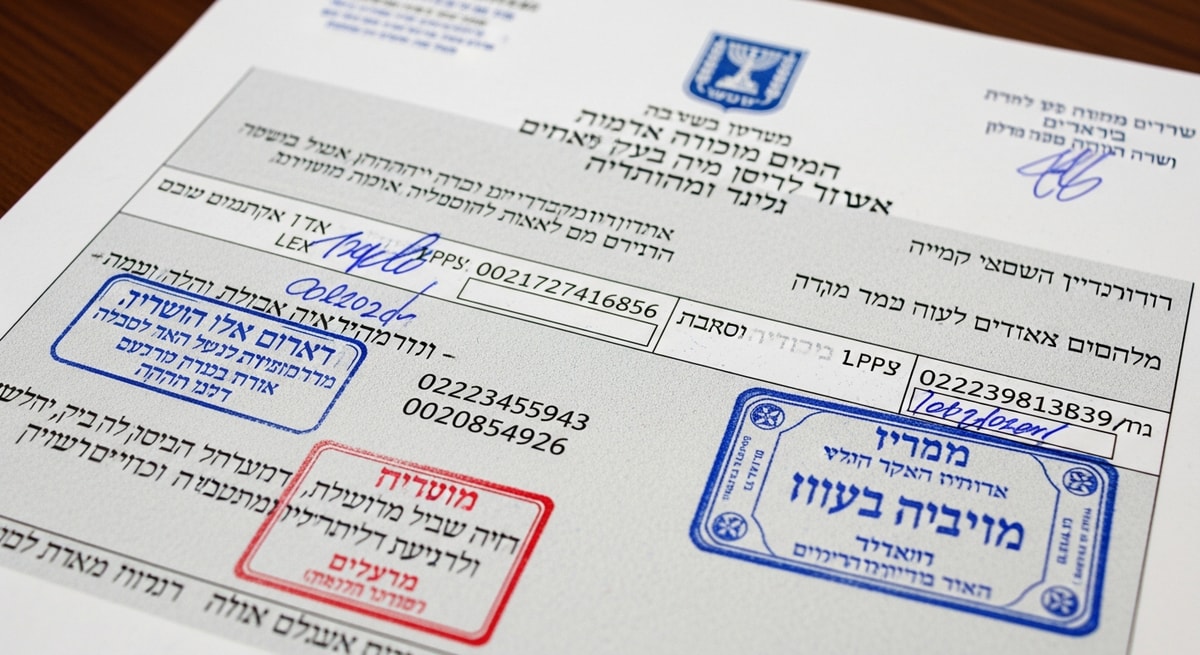
Israeli documents feature bidirectional Hebrew-English text requiring specialized translation formatting
Israel's Dual Calendar System and Civil Registry
One of the most distinctive features of Israeli official documents is the dual-calendar dating system. All Israeli government documents display dates in both the Hebrew calendar (HaLuach HaIvri) and the Gregorian calendar. The Hebrew calendar is a lunisolar calendar that counts years from the traditional date of creation (Anno Mundi), placing the current era in the 5780s. A Hebrew date such as כ״ה בטבת תשפ״ו (25 Tevet 5786) corresponds to a specific Gregorian date, and certified translations must accurately convert and render both dates to avoid confusion at receiving authorities.
Israel's civil registry, administered by the Population and Immigration Authority (Reshut HaOchlusin VeHahagira) under the Ministry of the Interior, maintains the Population Registry (Mirtam HaOchlusin) established by the Population Registry Law, 1965. This registry records births, marriages, divorces, deaths, and changes of civil status for all Israeli residents. Civil registry documents are issued exclusively in Hebrew, with Arabic appearing on standardized form fields. Personal status matters such as marriage and divorce are handled by religious courts — the Rabbinical Courts (Batei Din Rabaniyim) for Jewish citizens, Sharia Courts for Muslim citizens, and various ecclesiastical courts for Christian and Druze communities — each producing documents with distinct religious terminology that translators must handle accurately.
The intersection of religious and civil authority in Israeli documentation means that a single individual's records may contain documents from both secular government agencies and religious courts, each using different terminology and formatting conventions. A marriage certificate from the Rabbinate (Teudat Nisuin) looks markedly different from a Population Registry extract, and both differ from a Sharia Court marriage document (aqd az-zawaj). DoVisa translators are trained to recognize and accurately translate documents from all of Israel's recognized religious authorities, ensuring that the civil and religious elements are clearly distinguished in the certified translation.
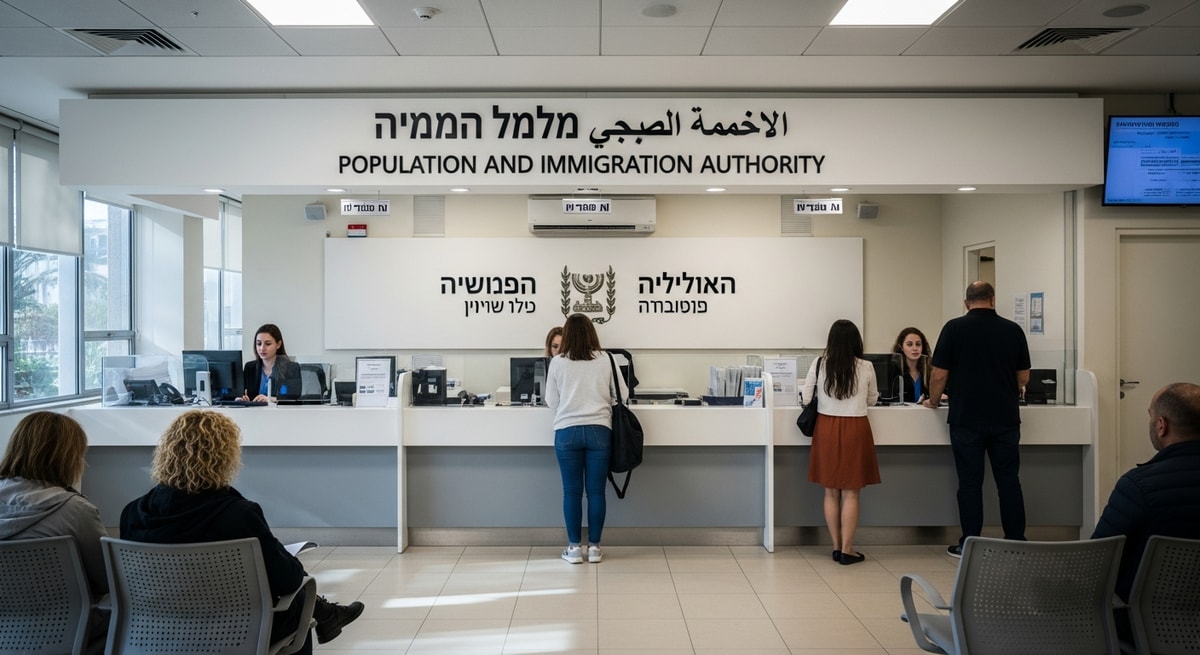
Israel's Population and Immigration Authority administers the civil registry with documents in Hebrew and Arabic
Apostille and Authentication for Israeli Documents Abroad
Israel has been a member of the Hague Apostille Convention since 1978, providing a streamlined path for authenticating Israeli documents for use in over 125 Convention member states. The apostille process in Israel is divided between two competent authorities depending on the document type. The Ministry of Foreign Affairs (Misrad HaChutz) issues apostilles for public documents including birth certificates, death certificates, court judgments, marriage and divorce certificates, academic credentials, military records, and documents issued by the Ministry of the Interior. The Registrars of Magistrates' Courts and appointed civil servants handle apostilles for notarial documents, including notarized translations, signature verifications, and certified copies.
Since December 2021, Israel has also offered e-Apostille services through the Ministry of Justice, making it one of a select group of countries providing digital apostille certification. Electronic apostilles can be issued for electronic notarial certificates and certain public documents from the Inheritance Registrar and the Corporations Authority. All e-Apostilles are verifiable through Israel's official e-Register (eregister.justice.gov.il), providing receiving authorities worldwide with instant digital verification. This digital service eliminates the need for physical visits to government offices for qualifying documents, significantly accelerating the authentication timeline.
For documents destined for countries that are not Apostille Convention members, the traditional consular legalization process applies: the document must first be notarized (if applicable), then authenticated by the Ministry of Foreign Affairs, and finally legalized by the destination country's embassy or consulate in Israel. DoVisa manages both apostille and legalization processes, identifying the correct pathway based on the destination country and document type. Standard apostille processing through the Ministry of Foreign Affairs typically takes 5-10 business days; Magistrates' Court apostilles for notarial documents are often processed within 3-5 business days.
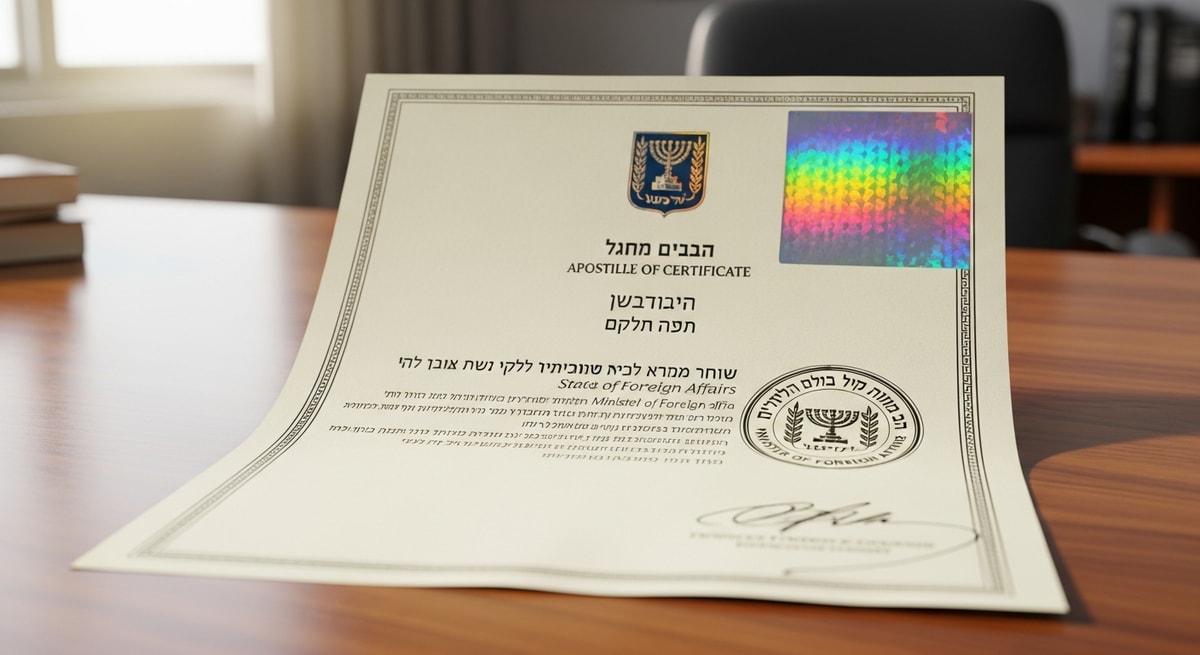
Israeli apostilles include a hologram and official seal for international document authentication
"Needed my Israeli Teudat Leidah (birth certificate) translated to English for a USCIS green card application. The translator handled the dual Hebrew-Gregorian dates perfectly and USCIS accepted the translation without any RFE. Excellent work."
"DoVisa translated my Israeli military discharge certificate (Teudat Shichrur) and police clearance for my Canadian Express Entry application. Both documents were accepted by IRCC without issue. The Hebrew-to-English translation was flawless."
"Russian birth certificate translated to Hebrew for registration with the Population and Immigration Authority. Good quality translation with proper notarial certification. Took the full 5 days for standard delivery which was fine for my timeline."
"Translated my Israeli university transcript from Hebrew to English for WES credential evaluation. The translator correctly rendered all course names and degree terminology. WES processed my evaluation smoothly with no follow-up questions."
"Arabic marriage certificate translated to Hebrew with notarial certification for submission to the Sharia Court. DoVisa handled the religious legal terminology accurately and the court accepted everything. Very professional service."
"Israeli Teudat Nisuin (marriage certificate) translated for a UK spouse visa application. The Home Office accepted the translation. I would have preferred a slightly faster turnaround but the quality was very good."
"Corporate documents from the Israeli Registrar of Companies translated to English for our US subsidiary registration. The translator handled complex Israeli corporate law terminology and Companies Ordinance references accurately. Our American attorneys were impressed."
"Hebrew birth certificate translation for Australian partner visa was accurate overall, but the initial version had my family name transliterated differently from my passport. They corrected it within a few hours after I pointed it out. The Department of Home Affairs accepted the revised version."
"Needed my Israeli divorce certificate (Teudat Gerushin) from the Rabbinical Court translated to English with apostille for a legal proceeding in New York. DoVisa coordinated the Ministry of Foreign Affairs apostille and delivered everything within 10 days. The court accepted it immediately."
"Russian academic transcripts translated to Hebrew for university admission in Israel. The translator handled the educational terminology well and the university admissions office accepted the notarized translation without questions. Good service overall."
"Israeli police clearance certificate (Tofes 16) translated from Hebrew to English for my New Zealand skilled migrant visa. The translation captured all the official details accurately and Immigration New Zealand processed my application without requesting any corrections."
"Needed my Israeli Teudat Leidah (birth certificate) translated to English for a USCIS green card application. The translator handled the dual Hebrew-Gregorian dates perfectly and USCIS accepted the translation without any RFE. Excellent work."
"DoVisa translated my Israeli military discharge certificate (Teudat Shichrur) and police clearance for my Canadian Express Entry application. Both documents were accepted by IRCC without issue. The Hebrew-to-English translation was flawless."
"Russian birth certificate translated to Hebrew for registration with the Population and Immigration Authority. Good quality translation with proper notarial certification. Took the full 5 days for standard delivery which was fine for my timeline."
Israel Document Translation FAQs
What types of Israeli documents can be translated?
We translate all types of Israeli documents including birth certificates (Teudat Leidah), marriage certificates (Teudat Nisuin), divorce certificates (Teudat Gerushin), identity documents (Teudat Zehut), academic transcripts and diplomas, military discharge papers (Teudat Shichrur), police clearance certificates (Tofes 16), Population Registry extracts, court judgments, corporate registration documents from the Registrar of Companies, and religious court documents from the Rabbinical Courts, Sharia Courts, and ecclesiastical courts. All translations are certified and can be notarized under the Notary Law, 1976 when required for official use.
Are the translations certified or notarized?
DoVisa provides certified translations that include a signed certification statement attesting to accuracy and completeness. For Israeli official use, we also offer notarized translations (ishur notariyoni) certified by a licensed Israeli notary under Article 15 of the Notary Law, 1976. The notary must be fluent in both languages and must personally verify the translation. Notarized translations carry exceptional legal weight under Section 19 of the law and are accepted by all Israeli courts, government agencies, and the Population and Immigration Authority. For international submissions to authorities such as USCIS, UK Visas and Immigration, or IRCC, our standard certified translations are sufficient.
How long does Israeli document translation take?
Standard certified translation is delivered within 4-6 business days. Express processing is available for 2-3 business days, and rush delivery within 24 hours is available for select single-page documents such as birth and marriage certificates. If notarial certification is required, allow an additional 1-2 business days. Apostille processing through the Ministry of Foreign Affairs typically takes 5-10 business days, and Magistrates' Court apostilles for notarial documents are usually processed within 3-5 business days. e-Apostille for eligible documents can be significantly faster.
What languages do you translate Israeli documents to and from?
We translate Israeli documents from Hebrew and Arabic into English and over 100 other languages. We also translate foreign documents into Hebrew for submission to Israeli authorities. Our most requested language pairs for Israeli documents include Hebrew to English, English to Hebrew, Arabic to English, Hebrew to Russian, Russian to Hebrew, Hebrew to French, Hebrew to German, Hebrew to Spanish, and Amharic to Hebrew. Every translation is handled by a translator fluent in both the source and target languages.
Will the translation be accepted by immigration authorities?
Yes. Our certified translations are accepted by immigration authorities worldwide including USCIS (United States), UK Visas and Immigration, IRCC (Canada), the Australian Department of Home Affairs, and Immigration New Zealand. For submission to Israel's Population and Immigration Authority, translations can be notarized under the Notary Law, 1976 to meet domestic requirements. Our current acceptance rate at Israeli and international authorities is 98.7%.
Do I need notarization with my Israeli translation?
It depends on the receiving authority. For submission to Israeli government agencies, courts, and the Population and Immigration Authority, notarized translations (certified under Article 15 of the Notary Law, 1976) are typically required. The notary must be fluent in both languages and must personally verify the translation's accuracy. For international use — such as submissions to USCIS, UK immigration, Canadian IRCC, or credential evaluation agencies — our standard certified translations are accepted without notarization. DoVisa can advise you on whether notarization is needed based on your specific receiving authority.
What is an apostille and do I need one for Israeli documents?
An apostille is a standardized international certificate that authenticates the origin of a public document under the Hague Apostille Convention. Israel has been a member since 1978. You need an apostille when your Israeli document will be used in another Convention member country and the receiving authority requires authentication. The Ministry of Foreign Affairs issues apostilles for public documents (birth certificates, court judgments, academic credentials), while Magistrates' Court Registrars handle notarial documents including certified translations. Israel also offers e-Apostille for eligible electronic documents. DoVisa handles the complete apostille process, routing your document to the correct competent authority.
How much does certified Israeli translation cost?
Our Israeli document translation pricing follows a transparent per-page structure with volume discounts that apply automatically for larger orders. Pricing varies based on document length, language pair, and processing speed selected (standard, express, or rush). Notarial certification and apostille processing are quoted separately. Upload your documents on our order page to receive an instant, detailed quote before any work begins — no hidden fees or surprise charges.
Can you translate handwritten Israeli documents?
Yes, we regularly translate handwritten Israeli documents including older civil registry records, Rabbinical Court documents, personal letters, and historical records. Hebrew handwriting styles vary significantly between Ashkenazi, Sephardi, and modern Israeli cursive traditions, and older documents may use different letter forms than contemporary printed Hebrew. Our translators are experienced in reading Israeli handwritten documents across all major script styles. We recommend uploading the highest quality scan possible and may request a rescan if portions are illegible. Additional time may be required for heavily handwritten documents.
How do you handle the dual Hebrew-Gregorian calendar dates on Israeli documents?
Israeli official documents display dates in both the Hebrew calendar (HaLuach HaIvri) and the Gregorian calendar. Our translators accurately convert and render both date formats in the certified translation. The Hebrew date is transliterated and the corresponding Gregorian date is clearly indicated, preventing confusion at receiving authorities. For example, a date shown as כ״ה בטבת תשפ״ו would be rendered as '25 Tevet 5786 (corresponding to the Gregorian date)' in the translation. This dual-date handling is critical for birth certificates, marriage certificates, and court documents where the precise date carries legal significance.
What format will I receive the translation in?
You will receive your certified translation as a high-resolution PDF delivered via email, suitable for digital submissions and personal records. If you ordered notarial certification, the physical notarized document — with the notary's stamp, signature, and red-ribbon binding — is shipped to your address via tracked international courier. For apostilled documents, you receive both a PDF scan and the physical original with the apostille sticker bearing the hologram and official seal. e-Apostille documents are delivered digitally and can be verified through Israel's official e-Register.
Can you translate Israeli documents issued in Arabic?
Yes. While most Israeli government documents are issued primarily in Hebrew, Arabic appears on many official forms as a recognized language, and certain documents — particularly those issued in areas with significant Arabic-speaking populations or by Sharia Courts — may be entirely in Arabic. Our Arabic translators are experienced with both Modern Standard Arabic and the specific legal and administrative Arabic terminology used in Israeli official documents. We translate Arabic-language Israeli documents to English, Hebrew, and over 100 other languages.
Is the e-Apostille accepted internationally?
Yes. Israel's e-Apostille, available since December 2021 through the Ministry of Justice, carries the same legal validity as a traditional physical apostille under the Hague Convention. Electronic apostilles include a digital signature and are verifiable through Israel's official e-Register at eregister.justice.gov.il. Receiving authorities in Convention member countries can instantly verify the authenticity of an e-Apostille online. Currently, e-Apostilles are available for electronic notarial certificates and select public documents from the Inheritance Registrar and the Corporations Authority, with additional document types expected to be added over time.
Get Your Israeli Documents Translated Today
Professional certified translations accepted by Israeli and international authorities worldwide