Certified Iranian Document Translation
Official Persian (Farsi) translations by judiciary-authorized certified translators, accepted by Iran's Ministry of Foreign Affairs, courts, civil registry offices, and embassies worldwide. Full consular legalization support for international use.
TrustpilotSelect Languages
Drag & drop your documents here
or
PDF, JPEG, PNG, WebP — Max 10MB per file. Word documents: please save as PDF first.
Certified translators · Accepted by governments, courts & universities worldwide · View sample
Select a destination country to view pricing
How Iranian Certified Translation Works
Submit Your Documents Securely
Upload clear scans of your Iranian or foreign-language documents through our encrypted portal. We accept all standard formats including PDF, JPEG, and PNG. Our intake specialists review each upload for legibility and completeness, verifying that all pages of multi-page documents such as the Shenasnameh (شناسنامه / identity booklet), marriage contract, or academic transcripts are included before translation begins.
Certified Translator Assignment
Your documents are matched with a judiciary-authorized certified translator (motarjem-e rasmi / مترجم رسمی) who has passed the official examination administered by the Judiciary of the Islamic Republic of Iran and holds an active certified translator's license. Iranian law requires that translations for official use be produced exclusively by translators who have completed the swearing-in ceremony and received authorization from the Judiciary. We verify each translator's active license before every assignment.
Translation and Quality Review
The certified translator produces your official translation and affixes their judiciary-issued seal, signature, and certification statement confirming accuracy and completeness. A second qualified linguist performs a thorough review of terminology, formatting, and legal accuracy. For documents requiring notarization, the translation is prepared for attestation at a Notary Public office (Daftar-e Asnad-e Rasmi / دفتر اسناد رسمی) and the Ministry of Foreign Affairs.
Delivery with Full Certification
Receive your certified translation as a high-resolution PDF for immediate use, with the original stamped and sealed hard copy shipped to your address via tracked international courier. For documents destined for international use, we coordinate the full consular legalization chain including Ministry of Foreign Affairs attestation and embassy authentication. Priority shipping within Iran and express international delivery options are available to all major Iranian diaspora destinations.
Iranian Translation Service Specifications
Popular Language Pairs
We support all languages — 100+ language pairs available for Iranian documents.
Common Documents
- Iranian identity booklet / birth certificate (Shenasnameh / شناسنامه)
- Marriage certificate (Aqd Nameh / عقدنامه)
- Divorce decree (Talaq Nameh / طلاقنامه)
- Academic diplomas and transcripts (Madrak-e Tahsili / مدرک تحصیلی)
- Police clearance certificate (Govahi-e Adami Sou-e Pishine / گواهی عدم سوء پیشینه)
- National identity card (Kart-e Melli / کارت ملی)
- Powers of attorney (Vekalatnameh / وکالتنامه)
- Death certificates (Govahi-e Fot / گواهی فوت)
- Military service completion card (Kart-e Payan-e Khedmat / کارت پایان خدمت)
- Commercial registration extracts (Sanad-e Sabt-e Sherkat / سند ثبت شرکت)
Turnaround Time
Certification Details
Iranian Translation Requirements and Regulatory Framework
Embassy Acceptance
Notarization Process
Apostille Information
Legal Framework
Common Scenarios for Iranian Document Translation
Immigration and Visa Applications Worldwide
Iranian nationals applying for immigration and visa programs in Canada, Australia, the United States, the United Kingdom, and European countries must submit certified translations of all Persian-language supporting documents. Common requirements include translation of the Shenasnameh (identity booklet), birth certificates, marriage contracts, police clearance certificates, academic transcripts, and financial documents. Each country's immigration authority has specific formatting and certification expectations. DoVisa provides translations formatted to the precise specifications of IRCC (Canada), the Department of Home Affairs (Australia), USCIS (United States), the UK Home Office, and European immigration offices, ensuring smooth processing without requests for additional documentation.
Academic Credential Evaluation and University Admission
Iranian students and professionals applying to universities and credential evaluation agencies abroad need certified translations of their academic records. These include high school diplomas (Diplom-e Dabirestan), university degrees (Madrak-e Daneshgahi), transcripts, and Ministry of Science attestation certificates. Credential evaluation agencies such as WES, NACES members, UK ENIC, and anabin require accurate translations that preserve Iranian academic terminology including grade designations and degree classifications. Our academic translators are experienced with the Iranian education system from pre-university levels through doctoral programs, and accurately convert Solar Hijri calendar dates to Gregorian equivalents.
Marriage Registration with Foreign Authorities
Iranians marrying abroad or foreign nationals registering an Iranian marriage internationally must submit certified translations of the Aqd Nameh (marriage contract), Shenasnameh pages showing marital status, and any prior divorce decrees. Foreign civil registration offices require translations that accurately convey the specific religious and legal terminology in Iranian marriage contracts, including the Mehrieh (مهریه / dower) clauses, witness details, and the registration office information. Our translators preserve the legal precision of these terms while providing clear equivalents understood by foreign civil authorities.
Employment and Professional Licensing Abroad
Iranian professionals seeking employment or professional licensure in other countries require certified translations of their academic degrees, professional certificates, employment references, and military service completion cards (Kart-e Payan-e Khedmat). Medical professionals applying to licensing bodies, engineers seeking accreditation, and lawyers pursuing recognition abroad all need translations that use the professional terminology expected by the receiving regulatory authority. DoVisa's specialized translators produce translations aligned with the requirements of professional licensing bodies across North America, Europe, Australia, and the Gulf states.
Family Reunification and Spousal Sponsorship
Spouses, children, and parents of Iranian nationals living abroad frequently require certified translations of birth certificates, marriage certificates, custody agreements, financial support declarations, and identity documents for family reunification visa applications. Immigration case officers review these translations closely during the approval process. Our translations meet the requirements of family sponsorship programs administered by IRCC (Canada), USCIS (United States), the UK Home Office, and European immigration authorities, reducing the risk of delays or refusals due to translation issues.
Iranian Court Document Translation for International Cases
Cross-border litigation, international divorce proceedings, and custody disputes require certified translations of Iranian court judgments, legal briefs, and official correspondence. Our legal translation team handles complex Iranian procedural law terminology across all court levels, from Courts of First Instance (Dadgah-e Bada'vi) through the Supreme Court (Divan-e Ali-ye Keshvar), ensuring that foreign courts and attorneys receive accurate translations preserving the legal precision of the original Persian judicial language.
The Iranian Certified Translator System Explained
Iran operates a structured and well-established translation certification system administered by the Judiciary of the Islamic Republic of Iran (Qovveh-ye Qaza'iyeh). The legislative foundation for official translation in Iran dates back to 1937, when the Iranian Parliament passed the first law governing the translation of official documents and court interpretation, making it one of the oldest formal translator licensing systems in the Middle East.
The Judiciary administers a rigorous certification examination (Azmun-e Motarjemi-ye Rasmi) to assess the professional qualifications of prospective certified translators. The examination process evaluates linguistic competence, knowledge of legal and administrative terminology, and familiarity with Iranian and international document formats. Candidates who pass the written examination and subsequent interview participate in a formal swearing-in ceremony (Marasem-e Tabdil) before receiving their certified translator's license (Parvane-ye Motarjemi-ye Rasmi). This license authorizes them to produce legally valid translations for official and legal purposes throughout Iran.
Once licensed, certified translators receive an official seal (Mohr-e Rasmi) bearing their name, license number, and language combination. Every certified translation must include a certification clause in which the translator attests under their official license that the translation is complete and accurate. This clause, combined with the translator's seal and handwritten signature, gives the translation its legal force. The Iranian Association of Certified Translators and Interpreters (IACTI), established on November 7, 1985, serves as the independent professional association overseeing ethical standards, professional development, and dispute resolution among certified translators. DoVisa maintains a network of judiciary-authorized translators covering all major Iranian cities and over 40 language combinations, ensuring we can provide properly certified translations regardless of the language pair or the Iranian authority that will receive the document.
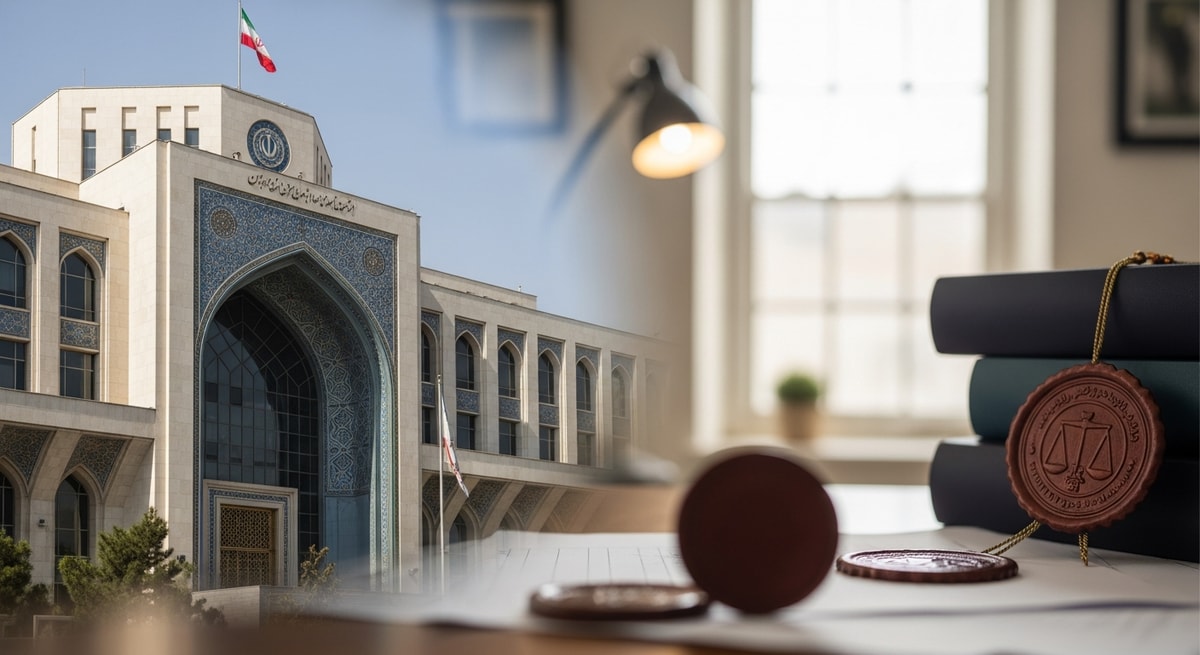
The Judiciary of the Islamic Republic of Iran administers the certification examination and licensing for official translators
Consular Legalization for Iranian Documents
Because Iran has not ratified the Hague Apostille Convention, documents originating from or destined for Iran must undergo the full consular legalization (Tasdig-e Qonsuli / تصدیق قنسولی) process rather than the simplified apostille procedure. This multi-step authentication chain verifies the document's authenticity through a series of official attestations by government authorities in both the originating and receiving countries.
For Iranian documents going abroad, the legalization chain typically follows these steps: first, the certified translation is produced by a judiciary-authorized translator with the official seal and certification. Next, the translation is notarized at a Notary Public office (Daftar-e Asnad-e Rasmi / دفتر اسناد رسمی). The notarized translation is then submitted to the Iranian Ministry of Foreign Affairs (Vezarat-e Omur-e Kharejeh / وزارت امور خارجه), which verifies the notary's attestation and affixes its own authentication stamp. Finally, the document is presented to the embassy or consulate of the destination country in Tehran for their legalization stamp, completing the authentication chain.
For foreign documents coming into Iran, the chain runs in reverse: the document is first notarized in the originating country, then authenticated by that country's ministry of foreign affairs, followed by legalization at the Iranian embassy or consulate in that country, and finally attested by Iran's Ministry of Foreign Affairs upon arrival. The complete process typically takes 7-12 business days depending on the specific embassies involved, though processing times vary by location and the current diplomatic relationship between Iran and the destination country. DoVisa manages the entire legalization chain in both directions, coordinating submissions, tracking progress, and delivering the fully legalized documents to your specified address.
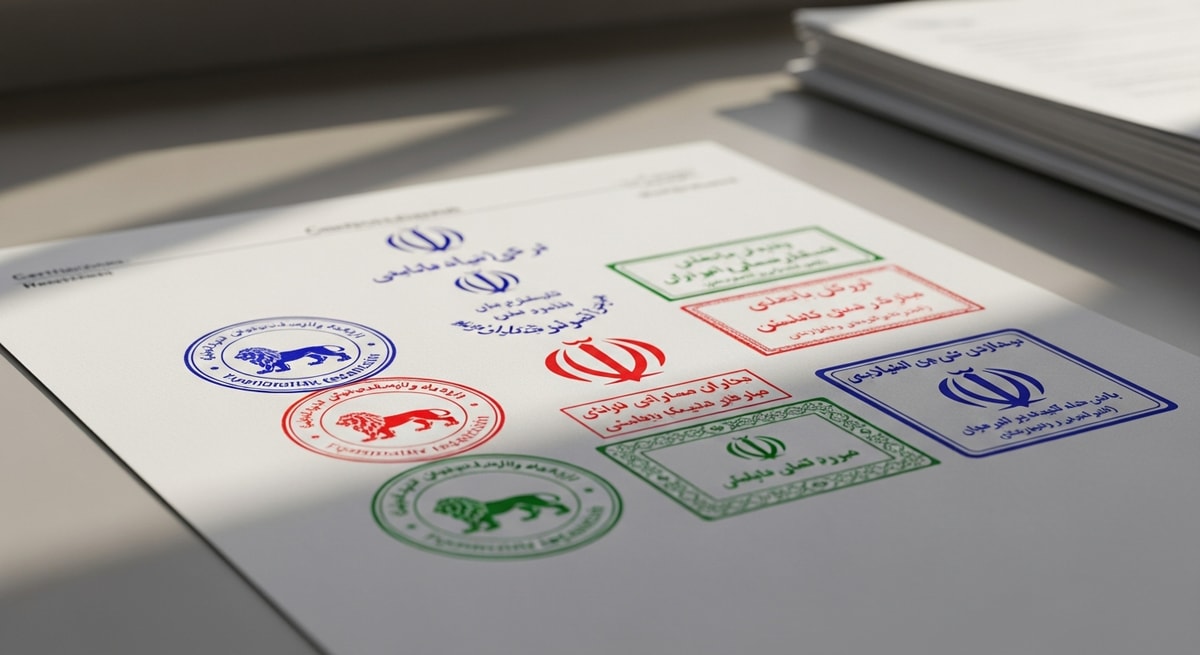
Iranian consular legalization authenticates documents through a multi-step chain for international recognition
Navigating Iranian Document Standards and the Solar Hijri Calendar
Iran's administrative system maintains specific documentation standards that require careful attention during translation. One of the most distinctive features of Iranian official documents is the use of the Solar Hijri calendar (Gahshomari-ye Hejri-ye Shamsi / گاهشماری هجری شمسی), also known as the Iranian calendar or Shamsi calendar. This calendar system, based on astronomical observations, begins its year at the spring equinox (Nowruz) and is the official calendar of Iran. All Iranian government documents — including the Shenasnameh, academic records, court documents, and commercial registrations — use Solar Hijri dates. Our translators accurately convert all dates to the Gregorian calendar in the translation while noting the original Shamsi date, ensuring foreign authorities can correctly interpret the timeline of events.
The National Organization for Civil Registration (Sazmaan-e Sabt-e Ahval-e Keshvar / سازمان ثبت احوال کشور) is responsible for maintaining population records and issuing vital documents. The Shenasnameh (شناسنامه / identity booklet) is the primary civil document issued to all Iranian citizens at birth, containing personal particulars, parents' information, place and date of birth, and spaces for recording marriage, divorce, and death. Modern Shenasnameh booklets include security features and standardized formatting, but older versions may use handwritten entries and older Persian calligraphic styles. The Kart-e Melli (کارت ملی / national identity card) is a separate photo ID card issued to citizens over the age of 15, containing a unique national identification number.
For academic documents, the Ministry of Science, Research, and Technology (Vezarat-e Olum, Tahghighat va Fanavari / وزارت علوم، تحقیقات و فناوری) oversees university-level education, while the Ministry of Education (Vezarat-e Amoozesh va Parvaresh / وزارت آموزش و پرورش) handles primary and secondary education. Academic transcripts typically include course names in Persian, grades using the 0-20 scale, and dates in the Solar Hijri calendar. DoVisa's academic translators are experienced with both modern and older Iranian academic document formats, ensuring accurate translation of all components including proper grade equivalencies and calendar conversions that credential evaluation agencies expect.
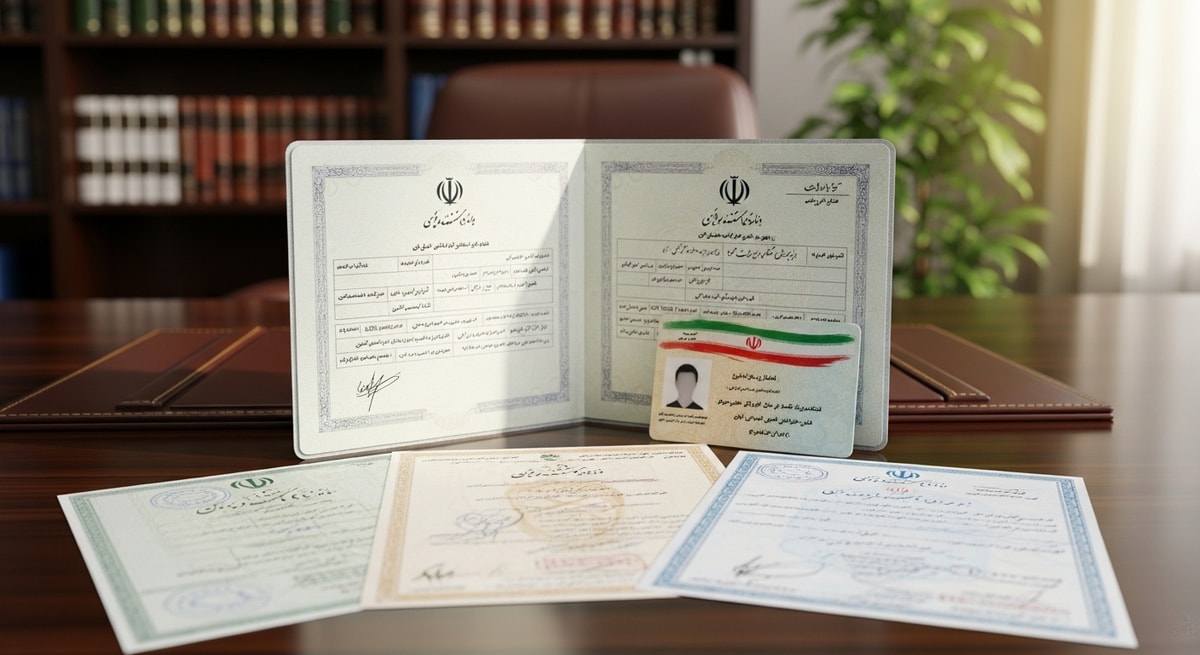
Iranian civil documents use the Solar Hijri calendar and Persian script, requiring specialized translation expertise
"Needed my Shenasnameh and birth certificate translated to English for a Canadian Express Entry application. DoVisa handled the Solar Hijri date conversions perfectly and IRCC processed my PR application without requesting any corrections. Excellent service."
"Translated my Iranian engineering degree and transcripts for credential evaluation through WES in Canada. The translator accurately rendered all Persian academic terminology and grade conversions. WES approved my ECA without follow-up questions."
"Good translation of my Iranian marriage certificate for a UK Spouse Visa application. The Home Office accepted everything. Only giving 4 stars because express service was not available for Persian to English at the time I ordered."
"DoVisa translated my Iranian police clearance certificate and university diploma from Persian to German for a Blue Card application. The Auslanderbehoerde in Munich accepted both translations without any issues. The legal terminology was handled very professionally."
"My parents' old handwritten Shenasnameh from the 1970s was translated beautifully. The translator handled the older Persian calligraphic script and converted all Shamsi dates accurately. Used it successfully for my Australian partner visa application."
"Persian to English translation of my Iranian divorce decree for use in a Canadian family court. The translator handled complex family law terminology accurately and the court accepted the translation. Communication was responsive throughout the process."
"Translated my Iranian medical degree and internship certificate for licensing in Sweden. The Swedish National Board of Health and Welfare accepted everything. DoVisa understood the Iranian grading system and all the medical terminology. Highly recommend."
"Translation of my Iranian birth certificate was accurate but the initial delivery had a minor transliteration error in my father's name. They corrected it within a few hours and the final document was accepted by USCIS, but the mistake should have been caught initially."
"Needed six documents translated from Persian to English for my family's immigration to Canada — Shenasnameh for each family member, marriage certificate, and police clearances. IRCC accepted all translations. Fast turnaround and very reasonable pricing for the volume."
"Our company needed Iranian commercial registration documents and a partnership agreement translated from Persian to English for an international joint venture. The corporate terminology was handled expertly and our foreign partners had no questions about the translations."
"Persian to Arabic translation of my academic transcripts for employment in the UAE. The Arabic translation was reviewed and cleared by my employer's HR department. DoVisa also coordinated the consular legalization through the Iranian Ministry of Foreign Affairs. Good service overall."
"Needed my Shenasnameh and birth certificate translated to English for a Canadian Express Entry application. DoVisa handled the Solar Hijri date conversions perfectly and IRCC processed my PR application without requesting any corrections. Excellent service."
"Translated my Iranian engineering degree and transcripts for credential evaluation through WES in Canada. The translator accurately rendered all Persian academic terminology and grade conversions. WES approved my ECA without follow-up questions."
"Good translation of my Iranian marriage certificate for a UK Spouse Visa application. The Home Office accepted everything. Only giving 4 stars because express service was not available for Persian to English at the time I ordered."
Iranian Document Translation FAQs
What is a certified translation and why is it required for Iranian documents?
A certified translation (Tarjome-ye Rasmi / ترجمه رسمی) of an Iranian document is a translation produced by a translator who has been officially licensed by the Judiciary of the Islamic Republic of Iran after passing the certification examination and completing the swearing-in ceremony. The translator affixes their judiciary-issued seal, handwritten signature, and a formal certification clause attesting that the translation is complete and accurate. This certification gives the translation legal standing before Iranian courts, government ministries, and institutions. Iranian authorities, including the Ministry of Foreign Affairs, the National Organization for Civil Registration, courts at all levels, and universities, only accept translations bearing the seal of a judiciary-authorized certified translator. For international use, foreign immigration authorities, courts, and institutions similarly require certified translations of Iranian documents.
Are all DoVisa Iranian translators authorized by the Judiciary?
Yes. Every translator in our Iranian network is a motarjem-e rasmi (certified translator) holding an active license issued by the Judiciary of the Islamic Republic of Iran. Our translators have passed the official certification examination, completed the required interview process, and participated in the swearing-in ceremony. Before each project assignment, we verify the translator's current license status. Our translators are also affiliated with the Iranian Association of Certified Translators and Interpreters (IACTI), which maintains professional standards and ethical guidelines. Our network covers all major Iranian cities including Tehran, Isfahan, Shiraz, Mashhad, and Tabriz, and provides coverage across more than 40 language pairs.
How much does certified Iranian translation cost?
Our Iranian certified translation pricing follows a transparent per-page structure with volume discounts that apply automatically for larger documents. Pricing varies based on document length, language pair, and the processing speed you select. Express and rush service options are available for time-sensitive projects. Consular legalization fees through the Iranian Ministry of Foreign Affairs and relevant embassies are quoted separately based on the destination country. Upload your documents on our order page to receive an instant, detailed quote before work begins — no hidden fees.
Why does Iran require consular legalization instead of an apostille?
Iran is not a member of the Hague Apostille Convention (formally the Convention Abolishing the Requirement of Legalisation for Foreign Public Documents). As a result, the simplified apostille process that allows documents to be authenticated with a single certificate between member states is not available for Iranian documents. Instead, Iran uses the traditional consular legalization (Tasdig-e Qonsuli) process, which involves a multi-step authentication chain through notaries, foreign affairs ministries, and embassies or consulates of both the originating and receiving countries. While this process takes longer than an apostille, it serves the same fundamental purpose of verifying document authenticity for cross-border use. DoVisa manages the complete legalization chain to minimize delays and ensure all steps are completed correctly.
How long does the consular legalization process take for Iranian documents?
The consular legalization timeline depends on the specific embassies and government offices involved. Within Iran, notarization at a Notary Public office typically takes 1-2 business days, and Ministry of Foreign Affairs attestation takes 2-4 business days. Embassy or consulate legalization by the destination country varies significantly: most embassies in Tehran process legalization requests within 5-10 business days, though some may take longer depending on the current diplomatic situation and processing volume. The complete chain from certified translation to fully legalized document typically takes 10-18 business days. DoVisa tracks each step and provides regular status updates throughout the process.
How do you handle Solar Hijri calendar dates in Iranian documents?
All Iranian official documents use the Solar Hijri calendar (Shamsi calendar), which begins its year at the spring equinox and has different month names and year numbering than the Gregorian calendar. For example, the year 1403 in the Solar Hijri calendar corresponds to March 2024 through March 2025 in the Gregorian calendar. Our translators accurately convert all Shamsi dates to Gregorian equivalents in the translation while including the original Solar Hijri date in parentheses for reference. This dual-date approach ensures that foreign authorities can correctly interpret the timeline while maintaining traceability to the original document. Date conversion accuracy is verified during our quality review process, as even a small conversion error can cause complications with immigration applications or legal proceedings.
What documents do I need translated for Canadian immigration from Iran?
Iranian applicants to Canadian immigration programs including Express Entry, Provincial Nominee Programs (PNP), and family sponsorship must provide certified English translations of all Persian-language documents. Common requirements include: Shenasnameh (identity booklet) pages showing personal details, parental information, and marital status; birth certificate pages; academic transcripts and degrees for Educational Credential Assessment (ECA) through WES or IQAS; police clearance certificates (Govahi-e Adami Sou-e Pishine); marriage certificate (Aqd Nameh) for spousal sponsorship; employment references; and military service completion card (Kart-e Payan-e Khedmat) where applicable. IRCC requires translations accompanied by the translator's certification statement. DoVisa ensures every translation meets IRCC requirements to avoid Requests for Additional Documents (RADs).
Can DoVisa translate old handwritten Iranian documents?
Yes. Many Iranian documents from before the computerization era — including older Shenasnameh booklets, handwritten marriage contracts, property deeds (Sanad-e Malekiyat), and pre-digital court documents — use older Persian calligraphic styles, traditional Nastaliq script, and archaic legal terminology that require specialized translation expertise. Our translators are experienced with historical Iranian document formats dating back several decades. All dates in the Solar Hijri calendar, including those from older documents, are accurately converted to Gregorian equivalents. For documents that are partially illegible due to age or damage, we provide a translator's note identifying any text that could not be fully deciphered, ensuring transparency with the receiving authority.
Do I need original documents or are scans sufficient for translation?
For the translation process itself, clear digital scans or photographs are sufficient. Our translators work from the digital copies you upload through our secure portal. However, for notarization, the Notary Public office may require sight of the original or a certified copy. For consular legalization, original documents must be submitted at certain steps in the authentication chain. We recommend keeping your original documents safe and accessible. For customers outside Iran, we can coordinate with local representatives to handle physical document submission for the legalization process. Our certified PDF translations are suitable for preliminary submissions and digital applications while the notarized hard copies are in transit.
Can I use a single translation for multiple countries?
In most cases, yes. A certified English translation of an Iranian document is generally accepted across English-speaking countries including Canada, the United States, the United Kingdom, Australia, and New Zealand, provided it meets the certification standards of each receiving authority. However, some countries require country-specific certification formats. For example, IRCC (Canada) requires the translator's signed declaration, while the UK Home Office requires a specific certification statement format. For non-English-speaking countries such as Germany, France, or the Gulf states, a translation into the target country's language is typically required. DoVisa can provide translations in multiple target languages from a single source document submission, and we advise on the specific certification format needed for each destination.
How do you handle Persian names and transliteration in translated documents?
Persian names and terms in translated documents require careful transliteration to ensure consistency across all official paperwork. When translating from Persian to English, our translators follow established transliteration conventions and cross-reference the spelling used in the individual's passport or other official English-language documents to maintain consistency. Persian contains characters and sounds that may be transliterated differently depending on convention — for example, the letter خ may appear as 'Kh' and غ as 'Gh'. For documents where name consistency is critical, such as immigration and civil status applications, we verify spellings against passport data you provide to prevent discrepancies that could cause delays at government offices.
What if a foreign authority rejects my Iranian document translation?
DoVisa offers an acceptance guarantee for all Iranian certified translations. If an immigration authority, court, embassy, university, or other official institution rejects our translation due to a formatting, terminology, or certification issue, we revise and reissue the translation at no additional cost within 24 hours. Rejections are extremely rare (under 1.2% of submissions) and typically involve institution-specific formatting preferences rather than translation errors. When a revision is needed, our translators promptly adjust the document to meet the particular authority's expectations. If a revision does not resolve the issue, we provide a full refund. This guarantee does not cover rejections based on the content of the original document itself or missing source documentation.
Can DoVisa translate Iranian documents into Arabic for Gulf state use?
Yes. We offer Persian-to-Arabic translation services specifically designed for Iranians relocating to or conducting business in Gulf states. The UAE, Qatar, Oman, Kuwait, and Bahrain each have specific requirements for document formatting and legalization. Our Arabic translators are familiar with the official terminology used by Gulf labour ministries, professional licensing authorities, and educational credential evaluation bodies. For Gulf state employment, we typically translate and authenticate degree certificates, police clearances, and employment contracts. The complete process includes Iranian Ministry of Foreign Affairs attestation followed by embassy legalization from the destination country.
Are digital PDF translations accepted by Iranian authorities?
Iranian authorities generally require the physical original of a certified translation bearing the translator's judiciary-issued seal and handwritten signature. Digital PDF copies are useful for preliminary submissions, pre-checks, and personal records, but most government offices will request the hard-copy original during your in-person appointment. This is particularly important for the notarization and legalization process, which requires physical documents at each stage. DoVisa includes free priority shipping within Iran for all certified translations. For international customers, we ship via tracked courier. Our certified PDFs include high-resolution scans of the sealed and signed translation for your digital records while the physical originals are in transit.
Get Your Iranian Certified Translation Today
Official Persian translations by judiciary-authorized certified translators, accepted by Iranian government institutions, courts, and foreign authorities worldwide, with full consular legalization support