Certified Arabic & Kurdish Document Translation for Iraq
Professional certified translations for Iraqi government submissions, consular legalization, court filings, and international use. Arabic–English, Kurdish–English, and 100+ language pairs with full legal certification.
TrustpilotSelect Languages
Drag & drop your documents here
or
PDF, JPEG, PNG, WebP — Max 10MB per file. Word documents: please save as PDF first.
Certified translators · Accepted by governments, courts & universities worldwide · View sample
Select a destination country to view pricing
How Iraq Certified Translation Works
Submit Your Documents Securely
Upload clear scans of your Arabic, Kurdish, or foreign-language documents through our encrypted portal. We accept PDF, JPEG, and PNG formats. Our intake specialists review each upload for legibility and confirm whether your documents originate from federal Iraqi authorities or from the Kurdistan Regional Government — as document formatting, language, and authentication requirements differ between the two jurisdictions.
Professional Translator Assignment
Your documents are matched with a qualified translator experienced in Iraqi Arabic legal and administrative terminology. For Kurdish-language documents from the Kurdistan Region, we assign translators fluent in Sorani Kurdish (the official written form in Iraqi Kurdistan) and familiar with Kurdish administrative conventions. Each translator is selected based on the specific document type — vital records, legal documents, academic transcripts, or commercial filings.
Translation & Quality Review
The translator produces your certified translation with full attention to Iraqi legal conventions, dual Arabic-Kurdish formatting where applicable, and official terminology from the relevant Iraqi ministry. A second qualified linguist reviews terminology, formatting, and legal accuracy. Each translation includes the translator's signature, certification statement, and relevant stamps required by the receiving authority.
Delivery with Full Certification
Receive your certified translation as a high-resolution PDF for immediate use, with the original stamped hard copy shipped via tracked courier. Since Iraq is not a member of the Hague Apostille Convention, DoVisa can guide you through the consular legalization process — including authentication by the Iraqi Ministry of Foreign Affairs and legalization by the destination country's embassy — for documents intended for international use.
Iraq Translation Service Specifications
Popular Language Pairs
We support all languages — 100+ language pairs available for Iraq documents.
Common Documents
- Birth certificates (شهادة ميلاد — Shahādat Mīlād)
- Marriage certificates (عقد زواج — ʿAqd Zawāj)
- Death certificates (شهادة وفاة — Shahādat Wafāh)
- Civil Status ID card (هوية الأحوال المدنية — Hawiyyat al-Aḥwāl al-Madaniyyah)
- Iraqi nationality certificate (شهادة الجنسية العراقية)
- Academic transcripts and degree certificates
- Police clearance certificates (شهادة عدم محكومية)
- Powers of attorney (وكالة — Wakālah)
- Commercial registration extracts
- Kurdistan Region bilingual documents (Arabic–Kurdish)
Turnaround Time
Certification Details
Iraq Translation Requirements & Regulatory Framework
Embassy Acceptance
Notarization Process
Apostille Information
Legal Framework
Common Scenarios for Iraq Document Translation
Immigration & Visa Applications
Iraqi nationals and residents emigrating abroad need certified translations of birth certificates (شهادة ميلاد), marriage certificates (عقد زواج), Civil Status ID cards, and police clearances for visa applications with USCIS, UK Visas and Immigration, IRCC, and other immigration authorities. DoVisa provides certified translations with consular legalization guidance for seamless international acceptance.
Refugee & Asylum Documentation
Iraqis seeking asylum or refugee status abroad require certified translations of identity documents, Civil Status ID cards, nationality certificates, and supporting evidence. Many Iraqi documents are damaged, handwritten, or issued in non-standard formats due to decades of conflict. Our translators are experienced in handling Iraqi documents in challenging conditions and can work with partial or deteriorated originals.
Academic Credential Evaluation
Students and professionals seeking credential equivalency abroad must submit certified translations of Iraqi academic transcripts, diplomas, and degree certificates to evaluation agencies such as WES, ECE, and NACES members. Iraqi universities issue documents in Arabic with specific grading conventions, and our translators accurately render academic terminology and institutional names for international recognition.
Marriage & Family Documentation
Foreign nationals marrying in Iraq or Iraqi nationals marrying abroad must provide certified translations of birth certificates, single-status certificates, and Civil Status ID cards. Iraqi marriage contracts (عقد زواج) contain specific religious and legal terminology that requires careful translation. Personal status courts in Iraq handle family matters under both civil and religious law frameworks.
Business & Corporate Setup
Foreign investors establishing businesses in Iraq — including in the Kurdistan Region's investment zones — need certified translations of articles of incorporation, board resolutions, financial statements, and commercial registration extracts. The National Investment Commission and Kurdistan Board of Investment require translated documents for licensing and regulatory compliance.
Arabic and Kurdish: Iraq's Bilingual Document Landscape
Iraq's documentary landscape is uniquely complex due to its constitutional bilingualism. Under Article 4 of the 2005 Iraqi Constitution, both Arabic and Kurdish are designated as official languages throughout the country. In practice, this creates two parallel administrative systems: federal Iraqi government documents are issued primarily in Arabic, while the Kurdistan Regional Government (KRG) in Erbil, Sulaymaniyah, and Duhok issues documents bilingually in Arabic and Sorani Kurdish (کوردی سۆرانی).
Sorani Kurdish uses a modified Arabic script with additional characters to represent sounds not found in Arabic, making it visually similar but linguistically distinct. Translators handling KRG-issued documents must be proficient in both Arabic and Sorani Kurdish, as a single document may contain headings in one language and body text in another. Birth certificates from the Kurdistan Region, for example, typically list the child's name in both Arabic and Kurdish scripts, with patronymic naming conventions that differ between the two communities.
A further complication arises from Iraq's recognized minority languages — Turkmen and Syriac (Assyrian Neo-Aramaic) — which have official status in areas where their speakers constitute a majority. Documents from cities like Kirkuk may include Turkmen text, while Syriac-language documents appear in the Nineveh Plains region. DoVisa's translators are trained to identify and accurately translate documents from all of Iraq's official and recognized language communities.
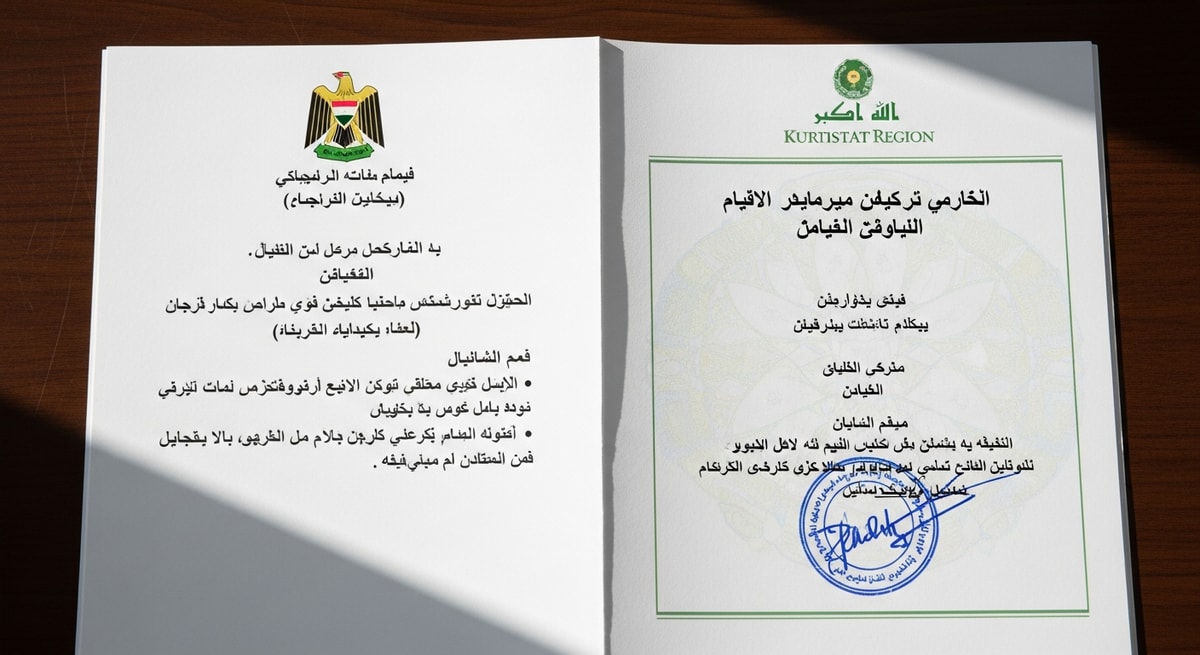
Iraq's constitutional bilingualism means documents may be issued in Arabic, Kurdish, or both languages simultaneously
Navigating Iraq's Civil Status System and Vital Records
Iraq's vital records are managed by the Directorate of Civil Affairs (مديرية الأحوال المدنية), operating under the Ministry of Interior. This directorate is responsible for issuing birth certificates (شهادة ميلاد), death certificates (شهادة وفاة), and the Civil Status ID card (هوية الأحوال المدنية) — the foundational identity document for all Iraqi citizens.
The Civil Status ID card is a particularly important document for translation. Unlike a simple birth certificate, it is a laminated card containing the holder's full name (including father's and grandfather's names following the patronymic naming convention), date and place of birth, religion, sect, nationality, and registration number. It is used extensively for immigration applications, marriage registration, inheritance proceedings, and government services. Translating this document requires careful attention to the multi-field format and accurate rendering of Arabic names using consistent romanization.
Decades of conflict have significantly impacted Iraq's civil records infrastructure. Many records were destroyed during the 2003 invasion, the ISIS occupation of Mosul (2014-2017), and earlier conflicts. As a result, replacement documents are frequently issued on non-standard forms, and older documents may contain handwritten entries, faded stamps, or damaged sections. DoVisa's translators are experienced in working with Iraqi documents in all conditions, including partially legible or damaged originals, and will note any illegible sections in the certified translation.
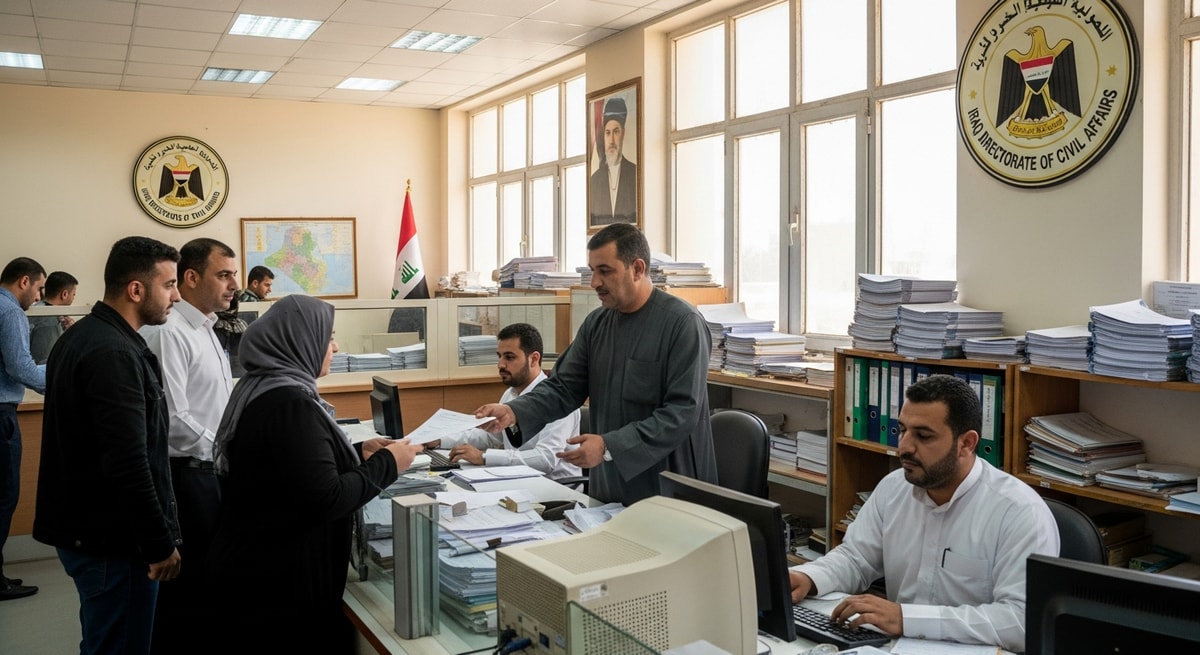
The Directorate of Civil Affairs manages all vital records including birth certificates, Civil Status ID cards, and nationality certificates
Consular Legalization: Getting Iraqi Documents Accepted Abroad
Since Iraq is not a member of the Hague Apostille Convention, Iraqi documents destined for international use require a multi-step consular legalization process rather than a simplified apostille. This chain of authentication ensures that the document's origin and the authority of its signatories are verified at each level before the document is recognized by a foreign government.
The standard legalization chain for Iraqi documents involves three steps: (1) authentication by the issuing authority — for example, the Ministry of Education for academic documents, the Ministry of Health for medical records, or the Directorate of Civil Affairs for vital records; (2) authentication by the Iraqi Ministry of Foreign Affairs (وزارة الخارجية العراقية) in Baghdad, which verifies the previous authentication and affixes its own seal; and (3) legalization by the destination country's embassy or consulate in Baghdad, which confirms the MOFA authentication and authorizes the document for use in that country.
For documents originating in the Kurdistan Region, an additional step may be required: authentication by the KRG's Ministry of Foreign Relations (وەزارەتی پەیوەندییەکانی دەرەوە) in Erbil before submission to the federal Ministry of Foreign Affairs. This extended chain typically takes 10-20 business days depending on the destination country and the complexity of the document. DoVisa prepares your documents with the correct certified translation format and provides step-by-step guidance through the legalization process, ensuring your translated documents meet the requirements of the receiving authority.
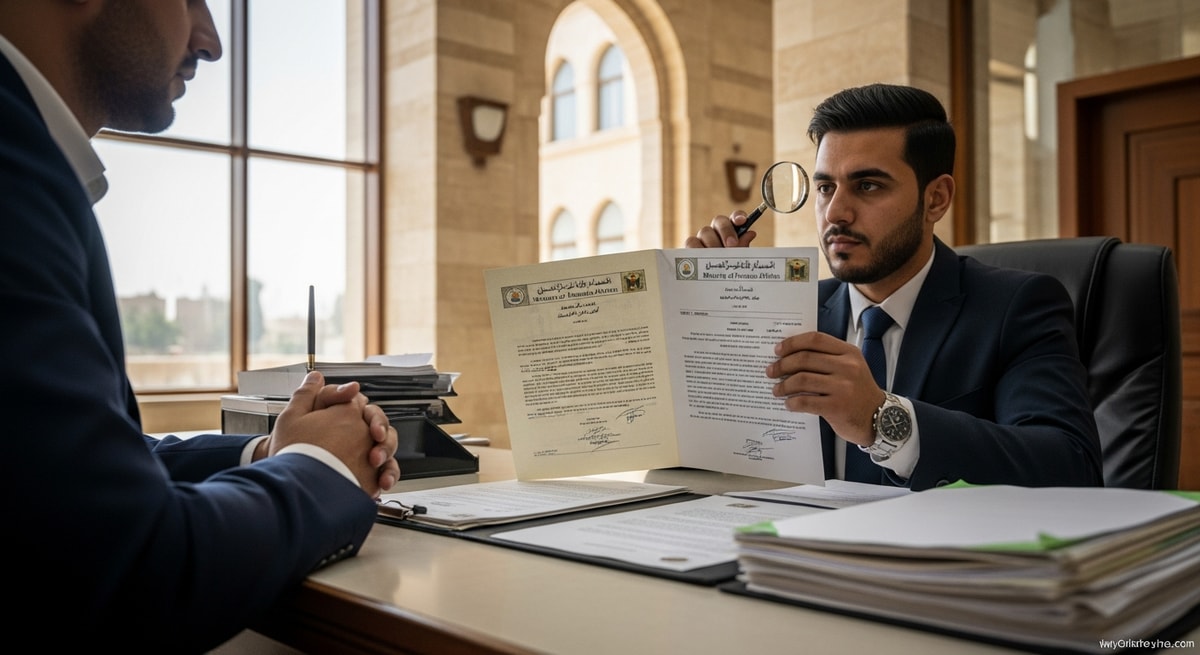
The Iraqi Ministry of Foreign Affairs authenticates documents as part of the multi-step consular legalization chain
"Needed my Iraqi birth certificate and Civil Status ID card translated from Arabic to English for a USCIS asylum application. Both documents were accepted without any issues — the translator handled the patronymic naming format perfectly."
"Arabic to English translation of my Iraqi university degree and transcripts for WES credential evaluation. The academic terminology was precise and WES processed my evaluation without requesting corrections."
"Kurdish to English translation of my birth certificate from the Kurdistan Region. The translator understood Sorani Kurdish and the bilingual Arabic-Kurdish format. IRCC accepted the translation for my Canadian PR application."
"Translated my Iraqi marriage certificate for a UK spouse visa application. UKVI accepted the certified translation. Delivery took one day longer than quoted, but the quality of the Arabic legal terminology was excellent."
"DoVisa translated my Iraqi police clearance and nationality certificate for an Australian skilled migration visa. The Department of Home Affairs accepted everything on first submission. Very professional handling of sensitive documents."
"Iraqi death certificate translated from Arabic to English for a legal proceeding in the United States. The document had some handwritten entries and faded stamps, but the translator handled it well and noted the condition clearly."
"Needed bilingual Arabic-Kurdish documents from Erbil translated for my New Zealand immigration application. The translator accurately captured both languages and Immigration New Zealand accepted the certified translation without question."
"Iraqi commercial registration extracts translated for a business investment application. The translation was accurate and professionally formatted. Good service, though I wish the express option was slightly faster for multi-page documents."
"Arabic to English translation of my Iraqi academic transcripts for ECE credential evaluation. The translator correctly rendered all course titles and grading conventions. ECE completed my evaluation promptly."
"Translated my Iraqi power of attorney for use in a legal matter in Germany. The final translation was accurate, but the first draft had an error in one of the Arabic names that needed correction before delivery."
"Iraqi birth certificates for two children translated for USCIS green card petitions. The translator accurately handled the Iraqi date format and name conventions. USCIS approved our petitions without any RFE."
"Needed my Iraqi birth certificate and Civil Status ID card translated from Arabic to English for a USCIS asylum application. Both documents were accepted without any issues — the translator handled the patronymic naming format perfectly."
"Arabic to English translation of my Iraqi university degree and transcripts for WES credential evaluation. The academic terminology was precise and WES processed my evaluation without requesting corrections."
"Kurdish to English translation of my birth certificate from the Kurdistan Region. The translator understood Sorani Kurdish and the bilingual Arabic-Kurdish format. IRCC accepted the translation for my Canadian PR application."
Iraq Document Translation FAQs
What types of Iraqi documents can be translated?
We translate all types of Iraqi documents including birth certificates (شهادة ميلاد), marriage certificates (عقد زواج), death certificates (شهادة وفاة), Civil Status ID cards (هوية الأحوال المدنية), nationality certificates (شهادة الجنسية العراقية), academic transcripts and degree certificates, police clearances (شهادة عدم محكومية), powers of attorney (وكالة), commercial registration extracts, and court judgments. We handle documents in Arabic, Kurdish (Sorani), and bilingual Arabic-Kurdish formats from both federal Iraq and the Kurdistan Region.
Are your Iraqi document translations certified?
Yes. Every translation includes a signed certification statement attesting to accuracy and completeness, with the translator's credentials and contact details. Our certified translations are accepted by USCIS, UK Visas and Immigration, IRCC (Canada), the Australian Department of Home Affairs, and credential evaluation agencies worldwide. For documents intended for submission to Iraqi domestic courts and government agencies, translations must be performed by a translator registered with the Iraqi Ministry of Justice.
How long does Iraqi document translation take?
Standard certified translation is delivered within 4-6 business days. Express processing is available for 2-3 business days, and rush delivery within 24 hours for select single-page documents. If consular legalization is needed for international use, additional time of 10-20 business days should be expected for the authentication chain through the Iraqi Ministry of Foreign Affairs and the destination country's embassy.
What languages do you translate Iraqi documents to and from?
While Arabic–English and Kurdish–English are the most common language pairs for Iraqi documents, we provide direct translations between Arabic and German, Swedish, Dutch, French, Turkish, Spanish, Danish, Norwegian, and many other languages. Kurdish (Sorani) to German and Swedish are particularly common given the large Iraqi Kurdish diaspora in Germany and Scandinavia. Direct translation avoids quality loss from translating through an intermediary language.
Will my translated Iraqi documents be accepted by immigration authorities?
Yes. Our certified translations of Iraqi documents are accepted by USCIS (United States), UK Visas and Immigration (UKVI), IRCC (Canada), the Australian Department of Home Affairs, and immigration authorities in New Zealand, Germany, Sweden, and other countries. Each translation includes the translator's signed certification statement confirming accuracy and completeness as required by these authorities.
Do I need notarization with my Iraqi document translation?
For documents submitted to Iraqi courts and government ministries, translations must be produced by a translator licensed through the Ministry of Justice and authenticated by a notary public. For international submissions to authorities like USCIS, UKVI, or IRCC, our standard certified translation is typically sufficient without additional notarization. DoVisa will advise on the specific requirements for your destination authority.
Can Iraqi documents get an apostille?
No. Iraq is not a member of the Hague Apostille Convention. Iraqi documents intended for international use must undergo consular legalization instead — a multi-step process involving authentication by the issuing authority, the Iraqi Ministry of Foreign Affairs, and the destination country's embassy or consulate in Baghdad. This process replaces the simplified apostille procedure available in Convention member states. DoVisa provides guidance through each step of the legalization chain.
How much does certified translation for Iraqi documents cost?
Our Iraqi document translation pricing follows a transparent per-page structure with volume discounts that apply automatically for larger projects. Pricing varies based on document type, language pair (Arabic or Kurdish), and processing speed selected. Consular legalization fees are separate and depend on the destination country. Upload your documents on our order page to receive an instant, detailed quote with no hidden fees.
Can you translate handwritten Iraqi documents?
Yes. Many Iraqi documents — particularly older birth certificates, court records, and marriage contracts — contain handwritten entries in Arabic that require specialized expertise. Our Arabic translators are experienced in reading both modern printed and handwritten Iraqi documents, including documents with faded stamps, marginal annotations, or damage from conflict. If a document's legibility is compromised, we will notify you before proceeding and suggest solutions such as higher-resolution scanning.
What format will I receive my translated Iraqi document in?
You will receive your certified translation as a high-resolution PDF delivered via email, suitable for immediate digital submission to immigration authorities, credential evaluation agencies, and most government portals. The PDF includes the translated document, the certification statement, and the translator's credentials. If you need a physical hard copy with original stamps and signatures — for example, for court submission or consular legalization — we ship via tracked international courier with delivery confirmation.
Can you translate Kurdish documents from the Kurdistan Region?
Yes. We translate documents issued by the Kurdistan Regional Government (KRG) in Sorani Kurdish (کوردی سۆرانی), which uses a modified Arabic script. Many KRG-issued documents are bilingual (Arabic and Kurdish), and our translators are proficient in both languages. We handle birth certificates, academic transcripts, identity documents, and all other official records from the Kurdistan Region's governorates of Erbil, Sulaymaniyah, Duhok, and Halabja.
What is the Iraqi Civil Status ID card and why does it need translation?
The Civil Status ID card (هوية الأحوال المدنية) is Iraq's foundational identity document issued by the Directorate of Civil Affairs under the Ministry of Interior. It contains the holder's full name (including patronymic chain), date and place of birth, religion, nationality, and registration number. It is frequently required for immigration applications, credential evaluations, and legal proceedings abroad. Our translators accurately render all fields, including the patronymic naming convention and registration details, in a format accepted by international authorities.
Do you handle documents damaged by conflict?
Yes. We understand that many Iraqi documents have been affected by decades of conflict — including documents damaged during the 2003 invasion, the ISIS occupation of Mosul and surrounding areas (2014-2017), and earlier wars. Our translators work with partially legible originals and clearly annotate any sections that are illegible or obscured. If a document is too damaged to translate accurately, we will advise you on obtaining a replacement from the relevant Iraqi authority before proceeding.
Get Your Iraqi Documents Translated Today
Professional certified translations with consular legalization guidance — accepted by authorities worldwide