

Certified Irish Document Translation
Professional certified translations accepted by Immigration Service Delivery (ISD), the Department of Foreign Affairs, Irish courts, universities, and all State bodies. Compliant with Irish legal and administrative standards.
TrustpilotSelect Languages
Drag & drop your documents here
or
PDF, JPEG, PNG, WebP — Max 10MB per file. Word documents: please save as PDF first.
Certified translators · Accepted by governments, courts & universities worldwide · View sample
Select a destination country to view pricing
How Irish Certified Translation Works
Submit Your Documents Securely
Upload clear scans of your documents through our encrypted portal. We accept all standard formats including PDF, JPEG, and PNG. Our intake specialists review each upload for legibility and completeness, contacting you immediately if a rescan is needed before translation begins. Whether your documents are in Irish (Gaeilge), Polish, Portuguese, French, or any other language, we handle them all.
Qualified Translator Assignment
Your documents are matched with a certified translator holding professional membership with the Association of Translators and Interpreters Ireland (ATII, formerly ITIA) or an equivalent internationally recognised body such as the Chartered Institute of Linguists (CIOL). Ireland does not operate a state-regulated sworn translator system, so professional association membership and demonstrated expertise serve as the standard of quality accepted by Irish authorities.
Translation with Certification Statement
The certified translator produces your translation and affixes their professional stamp, signature, and a certification statement confirming the translation is a true, accurate, and complete rendering of the original document. A second qualified linguist performs a thorough review of terminology, formatting, and accuracy. The certification statement includes the translator's credentials, membership number, and the date of certification.
Delivery with Full Certification
Receive your certified translation as a high-resolution PDF for immediate use, with the original signed and stamped hard copy shipped to your address via tracked An Post or international courier. Many Irish authorities accept digital certified copies for initial submissions, but hard copies with original signatures are recommended for in-person appointments at ISD offices and court proceedings.
Irish Translation Service Specifications
Popular Language Pairs
We support all languages — 100+ language pairs available for documents submitted to Irish authorities.
Common Documents
- Birth certificates (teastas breithe)
- Marriage certificates (teastas pósta)
- Death certificates (teastas báis)
- Divorce decrees and family law orders
- Academic diplomas and transcripts (teastas céime)
- Police clearance certificates
- Employment references and contracts
- Immigration and visa documents
- Medical reports and records
- Corporate and business registration documents
Turnaround Time
Certification Details
Irish Translation Requirements & Regulatory Framework
Embassy Acceptance
Notarization Process
Apostille Information
Legal Framework
Common Scenarios for Irish Document Translation
Immigration & Residence Permission Applications
Non-EEA nationals applying for Irish Residence Permissions (IRP) through Immigration Service Delivery (ISD) at Burgh Quay must submit certified English translations of all non-English supporting documents. This includes birth certificates, marriage certificates, police clearance certificates, educational qualifications, and employment contracts. ISD officers review these translations during the residence permission decision process. DoVisa provides translations formatted specifically for ISD requirements, ensuring all documents meet the standards outlined on irishimmigration.ie.
Marriage Registration with the HSE
Foreign nationals marrying in Ireland must provide certified English translations of their birth certificate (teastas breithe), passport, single-status declaration, and any prior divorce decrees to the HSE Civil Registration Service. The Registrar of Marriages requires that all foreign-language documents be accompanied by certified translations before a marriage notification can be processed. Our translators are experienced with the specific requirements of Irish civil registration offices across the country, ensuring every translation meets formatting and certification expectations.
University Admission & QQI Recognition
Irish universities, Technological Universities, and Quality and Qualifications Ireland (QQI/NARIC Ireland) require certified translations of foreign academic transcripts, diplomas, and secondary school certificates for admission and qualification recognition purposes. The National Framework of Qualifications (NFQ) comparability process requires clear, accurately translated academic records. Our academic translators understand Irish higher education terminology and produce translations that facilitate smooth evaluation outcomes at institutions such as Trinity College Dublin, University College Dublin, and University of Galway.
Company Registration & CRO Filings
Foreign entrepreneurs establishing companies in Ireland must provide certified English translations of their passport, proof of address, corporate documents from their home country, and directorship declarations. These translations are submitted to the Companies Registration Office (CRO/Oifig um Chlárú Cuideachtaí) and may also be required by Revenue Commissioners for tax registration. Our corporate translators are familiar with Irish company law terminology under the Companies Act 2014 and produce translations that meet the expectations of Irish regulatory bodies.
Family Reunification & Visa Applications
Spouses, children, and dependants of Irish residents applying for family reunification visas must present certified English translations of birth certificates, marriage certificates, custody agreements, and financial support declarations. ISD case officers review these translations during the visa and reunification application process. Ireland's Join Family visa category has specific documentation requirements, and our translations are formatted to meet ISD standards for all family reunification scenarios, including de facto partnerships and dependent relative applications.
Court & Legal Proceedings Translation
Cross-border litigation, international divorce proceedings, and child custody cases under EU Regulation Brussels IIa require certified translations of foreign court judgments, orders, and legal correspondence for submission to the Irish Courts Service. Our legal translation team handles documents for proceedings in the District Court, Circuit Court, High Court, and Supreme Court, ensuring that Irish judges and solicitors receive accurate translations that preserve the legal precision of the original documents in accordance with the Rules of the Superior Courts.
The Irish Certified Translation System Explained
Unlike countries such as Germany, France, or the Netherlands, Ireland does not have a state-regulated system of sworn or court-appointed translators. Instead, Ireland relies on a professional certification model where qualified translators attest to the accuracy and completeness of their work through a formal certification statement. The principal professional body is the Association of Translators and Interpreters Ireland (ATII), formerly known as the Irish Translators' and Interpreters' Association (ITIA), which was established in 1986 and is the only professional association in Ireland representing practising translators and interpreters.
ATII offers a specialised Certified Legal Translator designation. To qualify, a translator must hold Professional ATII membership (MATII), have at least five years of professional translation experience, and successfully pass two test translations including an official state document and a page of continuous legal text. ATII Certified Legal Translators may only certify translations in the specific language pairs for which they have been examined, and must work from original documents or certified copies rather than scanned images. Their certification statement includes their ATII membership number, the language pair, and a declaration that the translation is a true and accurate rendering of the original.
Irish authorities, including Immigration Service Delivery (ISD), the Courts Service, the HSE Civil Registration Service, and QQI, accept certified translations from ATII members, members of the Chartered Institute of Linguists (CIOL), and translators with equivalent professional credentials. DoVisa maintains a network of certified translators covering over 40 language combinations, with particular strength in the language pairs most commonly needed in Ireland including Polish, Portuguese, Romanian, French, Arabic, Chinese, and Hindi. We verify each translator's active professional membership and credentials before every assignment.

Irish courts and State bodies accept certified translations from qualified professional translators
Apostille and Legalisation for Irish Documents
Ireland acceded to the Hague Apostille Convention on 29 October 1996, and the Convention entered into force for Ireland on 9 March 1999. An apostille is a standardised certificate issued by a designated competent authority that authenticates the origin of a public document for use in another Convention member state. For Irish documents, the sole competent authority is the Consular Section of the Department of Foreign Affairs (An Roinn Gnóthaí Eachtracha), located at Knockmaun House, 42-47 Lower Mount Street, Dublin 2.
The apostille process for a certified translation involves several steps. First, the certified translator produces the translation with their professional stamp and certification statement. The translation must then be notarised by an Irish Notary Public, who verifies the translator's identity and signature. The notarised translation is then submitted to the Department of Foreign Affairs, which issues the apostille stamp after verifying the Notary Public's credentials. Each apostille stamp costs EUR 40. The Department offers a walk-in service in Dublin with a target turnaround of 30 minutes, and a postal service with processing times of 3-7 business days. A second office in Cork at South Mall also processes apostille requests.
Ireland does not currently offer an e-apostille or electronic apostille service. All apostilles are issued as physical stamps affixed directly to the document. However, the Department of Foreign Affairs maintains an online verification register at authentications.dfa.ie where the authenticity of an issued apostille can be confirmed electronically. For documents destined for countries that are not Apostille Convention members, a full legalisation process through the Department of Foreign Affairs and the destination country's embassy in Ireland is required instead. DoVisa manages the complete apostille and legalisation process from start to finish.
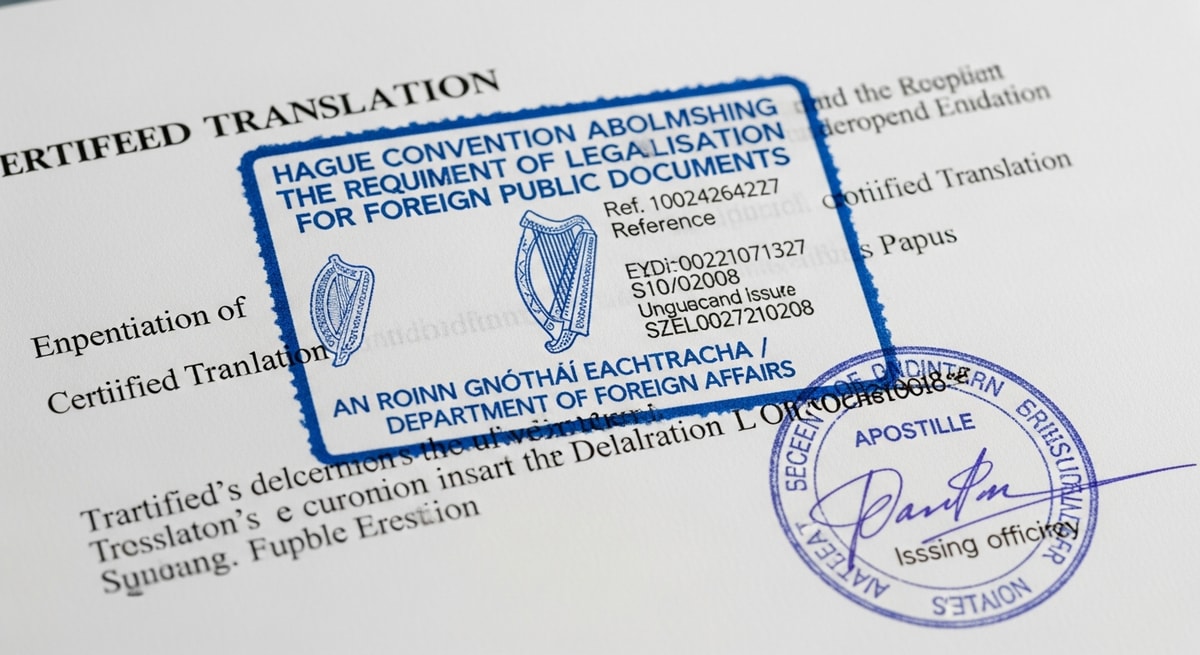
Irish apostilles issued by the Department of Foreign Affairs authenticate documents for use in 125+ countries
Navigating Irish Administrative Document Requirements
Ireland's administrative system involves several key government bodies, each with specific requirements for translated documents. Immigration Service Delivery (ISD), formerly known as INIS, is the primary agency processing visa and residence permission applications. Since January 2025, ISD at Burgh Quay, Dublin 2, handles all first-time in-person registrations for Irish Residence Permissions (IRP) nationwide, having taken over responsibilities from the Garda National Immigration Bureau. ISD requires certified English translations of all non-English supporting documents, and their official guidance at irishimmigration.ie specifies that translations must be stamped, signed, and dated by the translator with a certifying statement.
The HSE Civil Registration Service (Seirbhís um Chlárú Sibhialta an FSS) handles birth, marriage, and death registrations. Foreign nationals registering life events in Ireland must provide certified translations of foreign vital records. The General Register Office (GRO/Oifig an Ard-Chláraitheora) maintains Ireland's register of births, marriages, and deaths, and requires translated documents to follow a specific format that mirrors the layout of the original. Our translators maintain familiarity with GRO formatting expectations and produce translations that civil registrars accept without queries.
For professional qualification recognition, Quality and Qualifications Ireland (QQI) operates as NARIC Ireland and provides comparability statements for foreign qualifications against the National Framework of Qualifications (NFQ). Medical professionals apply to the Medical Council of Ireland, nurses to the Nursing and Midwifery Board of Ireland (NMBI/Bord Altranais agus Cnáimhseachais na hEireann), engineers to Engineers Ireland, and solicitors to the Law Society of Ireland. Each body has specific documentation and translation requirements. Our specialised translators produce translations using the professional terminology that Irish recognition bodies expect, improving the likelihood of a smooth evaluation and recognition process.

Irish State bodies including ISD and the HSE require certified translations meeting professional certification standards
"Needed my Polish birth certificate and marriage certificate translated for my IRP registration at Burgh Quay. DoVisa delivered both certified translations in 3 days. The ISD officer accepted everything without any questions. Highly recommended for Polish documents in Ireland."
"DoVisa translated my wife's Brazilian university transcripts and diploma for QQI recognition. The translations used exactly the right terminology and QQI issued a comparability statement within the standard processing time. Excellent academic translation quality."
"Good translation of my Indian marriage certificate and police clearance for a Stamp 4 dependent application. ISD accepted everything at Burgh Quay. Only 4 stars because the express option was not available for Hindi and I had to wait the standard 5 days."
"Translated five Polish documents for my Irish citizenship application — birth cert, marriage cert, police clearance, employment records, and qualifications. The Department of Justice processed my naturalisation without requesting corrections. Outstanding quality."
"French divorce decree translated for marriage registration with the HSE in Cork. The translator understood both French family law terminology and what the Irish Registrar needed. The civil registration office accepted the translation immediately. Very impressed."
"Used DoVisa for translating Nigerian academic certificates for a Masters application at UCD. Good translation that captured all the grading terminology correctly. Delivery was on time and UCD admissions processed my application without follow-up queries."
"Brazilian birth certificate and police clearance translated for my Stamp 1G visa extension. ISD accepted both without issues. DoVisa also arranged the apostille through the Department of Foreign Affairs. Upload to apostilled delivery took 10 days. Excellent."
"Translation of a Romanian driving licence and birth certificate was accurate but the initial delivery had my middle name formatted incorrectly. They corrected it within a few hours. The final version was perfect and accepted by ISD, but the error should not have occurred in the first place."
"Chinese degree and academic transcripts translated for Engineers Ireland professional recognition. The translations were impeccable — every technical term rendered precisely. Engineers Ireland processed my application without requesting any clarifications."
"Our company needed employment contracts and Polish corporate documents translated for a Revenue Commissioners audit. DoVisa delivered certified translations of eight documents in under a week. Revenue accepted everything without queries. Professional and reliable service."
"German birth certificate and military records translated for an Irish citizenship by descent application. The translator handled old-style documents perfectly, including Fraktur script. The Department of Foreign Affairs accepted the translations for my foreign births registration."
"Needed my Polish birth certificate and marriage certificate translated for my IRP registration at Burgh Quay. DoVisa delivered both certified translations in 3 days. The ISD officer accepted everything without any questions. Highly recommended for Polish documents in Ireland."
"DoVisa translated my wife's Brazilian university transcripts and diploma for QQI recognition. The translations used exactly the right terminology and QQI issued a comparability statement within the standard processing time. Excellent academic translation quality."
"Good translation of my Indian marriage certificate and police clearance for a Stamp 4 dependent application. ISD accepted everything at Burgh Quay. Only 4 stars because the express option was not available for Hindi and I had to wait the standard 5 days."
Irish Document Translation FAQs
What is a certified translation and why is it required in Ireland?
A certified translation in Ireland is a translation that has been stamped, signed, and dated by a qualified professional translator who includes a certification statement confirming that the translation is a true, accurate, and complete rendering of the original document. Irish authorities — including Immigration Service Delivery (ISD), the Courts Service, the HSE Civil Registration Service, Revenue Commissioners, and QQI — require certified translations of all non-English documents submitted for official purposes. Unlike countries such as Germany or France, Ireland does not have a state-regulated sworn translator system. Instead, certification is provided by professional translators who are members of recognised bodies such as the Association of Translators and Interpreters Ireland (ATII) or the Chartered Institute of Linguists (CIOL).
Do all DoVisa Irish translators hold professional accreditation?
Yes. Every translator in our Ireland network holds active professional membership with the Association of Translators and Interpreters Ireland (ATII), the Chartered Institute of Linguists (CIOL), or an equivalent internationally recognised professional body. Many of our translators hold the ATII Certified Legal Translator designation, which requires at least five years of professional experience, Professional ATII membership (MATII), and successful completion of specialist legal translation examinations. Before each project assignment, we verify the translator's current membership status and certification credentials. Our network covers over 40 language pairs, with particular strength in Polish, Portuguese, Romanian, French, Arabic, Chinese, and Hindi — the languages most frequently needed for Irish immigration and administrative purposes.
How much does certified translation cost for Irish documents?
Our certified translation pricing for Ireland follows a transparent per-page structure with volume discounts that apply automatically for larger documents. Pricing varies based on document length, language pair, and the processing speed you select. Express and rush service options are available for time-sensitive projects. Apostille processing through the Department of Foreign Affairs is quoted separately at EUR 40 per stamp. Hard-copy shipping within Ireland via An Post is included free of charge; international shipping is quoted based on destination. Upload your documents on our order page to receive an instant, detailed quote before work begins — no hidden fees.
Will my translation be accepted by Immigration Service Delivery (ISD)?
Yes. Our certified translations meet all requirements specified by Immigration Service Delivery (ISD) on their official website irishimmigration.ie. ISD requires that translations of non-English documents be certified, meaning they must be stamped and signed by the translator with a statement confirming the translation is a true and accurate rendering of the original. Our translations include the translator's full professional credentials, membership number, contact details, and the date of certification. We have extensive experience with ISD documentation requirements for all visa categories including Stamp 1, Stamp 1G, Stamp 4, Critical Skills Employment Permits, and family reunification applications.
What documents do I need translated for an Irish Residence Permission (IRP)?
The documents required for an Irish Residence Permission (IRP) registration depend on your visa category, but commonly include: your birth certificate (teastas breithe), marriage certificate (teastas pósta) if applicable, police clearance certificates from your country of origin and any country where you have resided for more than six months, academic qualifications and transcripts, employment contract or offer letter, and proof of address. All non-English documents must be accompanied by certified English translations. Some visa categories, such as the Critical Skills Employment Permit, also require translations of professional registration certificates and reference letters. DoVisa offers an IRP translation package covering all standard documents at a bundled rate.
How long does the apostille process take in Ireland?
The apostille processing time in Ireland depends on your submission method. The Department of Foreign Affairs operates a walk-in service at Knockmaun House, 42-47 Lower Mount Street, Dublin 2, with a target turnaround of 30 minutes from receipt of documents. Walk-in hours are Monday, Tuesday, Thursday, and Friday (no walk-in service on Wednesdays), from 09:30 to 12:30 and 14:30 to 16:00. For postal submissions, average processing time is 3-7 business days after receipt. A second office at South Mall, Cork, also processes apostille requests. Each apostille stamp costs EUR 40. DoVisa handles the entire apostille process including document preparation, submission, collection, and forwarding to your address via tracked delivery.
What is the difference between ATII certification and notarisation?
ATII certification is the translator's professional attestation that the translation is a true, accurate, and complete rendering of the original document. The ATII Certified Legal Translator stamps and signs the translation and includes their membership number and credentials. This level of certification is sufficient for most Irish administrative purposes including ISD applications, university admissions, and HSE civil registration. Notarisation is a separate step where an Irish Notary Public verifies the translator's identity and signature, and affixes their own notarial seal and signature. Notarisation is typically required when the translated document will be used internationally and needs an apostille, as the Department of Foreign Affairs apostilles the Notary Public's seal rather than the translator's certification directly. DoVisa can coordinate both certification and notarisation through our network of ATII translators and Notaries Public across Ireland.
Do I need original documents or are copies sufficient?
For the translation process itself, clear digital scans or photographs are sufficient. Our translators work from the digital copies you upload through our secure portal. However, ATII Certified Legal Translators are required by their professional code to work from original documents or certified copies rather than scanned images for the highest level of certification. If your documents require ATII Certified Legal Translator certification specifically, we may request to see the originals or certified copies. The receiving Irish authority may also require you to present the original document alongside the certified translation during your appointment. We recommend keeping your originals safe and accessible for in-person appointments at ISD, the HSE, or Irish courts.
Can DoVisa translate documents in Irish (Gaeilge)?
Yes. While English is the primary working language of Irish administration, Irish (Gaeilge) is the first official language under Article 8 of the Constitution of Ireland (Bunreacht na hEireann) and is used on many official documents. Birth certificates, marriage certificates, and death certificates issued by the General Register Office may be bilingual (English and Irish) or, in Gaeltacht areas, primarily in Irish. Our translators are experienced with Irish-language official documents and can translate from Irish to English or from English to Irish. We also handle documents that contain a mix of Irish and English text, which is common in Irish legal and governmental records. Common Irish-language document terms include teastas breithe (birth certificate), teastas pósta (marriage certificate), and teastas báis (death certificate).
What if an Irish authority rejects my translation?
DoVisa offers an acceptance guarantee for all certified translations submitted to Irish authorities. If ISD, the Courts Service, Revenue, QQI, the HSE, or any other Irish State body rejects our translation due to a formatting, terminology, or certification issue, we will revise and reissue the translation at no additional cost within 24 hours. In our experience, rejections are extremely rare (under 0.8% of submissions) and typically relate to individual office preferences rather than translation errors. When a revision is needed, our translators promptly adjust the document to meet the particular authority's expectations. If a revision does not resolve the issue, we provide a full refund. Please note that rejections based on the content of the original document or missing source documents are outside this guarantee's scope.
Can I get a translation for Irish citizenship by naturalisation?
Yes, the Irish naturalisation (Eadóirseacht) process requires a comprehensive set of translated documents. The standard naturalisation document package includes: birth certificate, marriage certificate (if applicable), divorce decree (if applicable), police clearance certificates from every country where you have resided, academic and professional certificates, current employment documentation, and proof of residence in Ireland. Applications are processed by the Citizenship Division of ISD under the Irish Nationality and Citizenship Act 1956 (as amended). Each document not in English must be accompanied by a certified translation. DoVisa offers a naturalisation translation package at a bundled rate, and our project managers can review your specific requirements to ensure all documents are properly translated before you submit your application.
Are digital PDF translations accepted by Irish authorities?
Many Irish authorities now accept digital certified translations for initial submissions and online applications. ISD's online portal accepts uploaded PDF translations for visa applications, and QQI accepts digital copies for qualification recognition requests. However, for in-person appointments at ISD Burgh Quay, court proceedings, and HSE civil registration, the original hard-copy certified translation with the translator's physical stamp and signature is typically required. This is why DoVisa includes free priority shipping within Ireland via An Post for all certified translations. For international customers, we ship via tracked courier. Our certified PDFs include high-resolution scans of the stamped and signed translation for your digital records, allowing you to use the digital version for initial submissions while the hard copy is in transit.
Get Your Irish Certified Translation Today
Professional certified translations accepted by ISD, the Department of Foreign Affairs, Irish courts, and all State bodies across Ireland