
Certified Greek Document Translation
Professional certified translations of Greek documents accepted by USCIS, UK Visas and Immigration, IRCC, and international authorities. Greek to English and 100+ language pairs with apostille coordination available.
TrustpilotSelect Languages
Drag & drop your documents here
or
PDF, JPEG, PNG, WebP — Max 10MB per file. Word documents: please save as PDF first.
Certified translators · Accepted by governments, courts & universities worldwide · View sample
Select a destination country to view pricing
How Greek Certified Translation Works
Submit Your Documents Securely
Upload clear scans of your Greek documents through our encrypted portal. We accept PDF, JPEG, and PNG files. Our intake specialists review each upload for legibility and completeness, paying particular attention to Greek-script documents, handwritten civil registry entries (ληξιαρχικές πράξεις), and older documents with polytonic orthography. If a rescan is needed, we contact you before work begins.
Professional Translator Assignment
Your documents are matched with a professional translator specializing in Greek legal and civil documents. For submissions to international authorities such as USCIS, IRCC, or the UK Home Office, our certified translators produce translations with a signed certification statement attesting to accuracy and completeness. For submissions requiring an official Greek translation (επίσημη μετάφραση), DoVisa can coordinate with certified translators registered in the Μητρώο Πιστοποιημένων Μεταφραστών upon request.
Translation & Quality Review
Your translator produces the certified translation, accurately rendering all Greek terminology, names, and legal references into the target language. A second qualified linguist reviews the translation for accuracy, proper transliteration of Greek names, and correct handling of the Greek alphabet. The certification statement confirms the translation is complete and faithful to the original document.
Delivery with Full Certification
Receive your certified translation as a high-resolution PDF for immediate use with immigration authorities, universities, and employers. The original certified hard copy is shipped via tracked international courier. If apostille certification is needed for use in Hague Convention member countries, DoVisa coordinates the complete apostille process through the appropriate competent authority, whether a Decentralized Administration or First Instance Court.
Greek Translation Service Specifications
Popular Language Pairs
We support all languages — 100+ language pairs available for Greek documents.
Common Documents
- Greek birth certificates (Ληξιαρχική Πράξη Γέννησης)
- Marriage certificates (Ληξιαρχική Πράξη Γάμου)
- Death certificates (Ληξιαρχική Πράξη Θανάτου)
- Family status certificates (Πιστοποιητικό Οικογενειακής Κατάστασης)
- Criminal record extracts (Αντίγραφο Ποινικού Μητρώου)
- Academic diplomas and transcripts (Πτυχίο / Αναλυτική Βαθμολογία)
- Divorce decrees (Απόφαση Διαζυγίου)
- Military service certificates (Πιστοποιητικό Στρατολογικής Κατάστασης)
- Powers of attorney (Πληρεξούσιο)
- Greek court judgments and legal documents
Turnaround Time
Certification Details
Greek Translation Requirements & Regulatory Framework
Embassy Acceptance
Notarization Process
Apostille Information
Legal Framework
Common Scenarios for Greek Document Translation
US Immigration & USCIS Applications
Greek nationals applying for US immigrant visas, adjustment of status, or naturalization need certified English translations of their Ληξιαρχική Πράξη Γέννησης (birth certificate), Ληξιαρχική Πράξη Γάμου (marriage certificate), Αντίγραφο Ποινικού Μητρώου (criminal record), and academic credentials. USCIS requires that all foreign-language documents be accompanied by certified English translations with a signed certification statement. DoVisa produces USCIS-compliant translations formatted to meet the specific requirements outlined in 8 CFR 103.2(b)(3).
UK & European Spouse or Family Visa
Greek citizens sponsoring family members or applying for spouse visas in the UK, Canada, or Australia require certified translations of marriage certificates, birth certificates, financial documents, and custody agreements. UK Visas and Immigration and IRCC accept DoVisa certified translations. Our translators accurately render Greek civil registry terminology and family law concepts into English, ensuring immigration case officers can readily assess the translated documents.
Academic Credential Evaluation
Greek university degrees (Πτυχίο), postgraduate diplomas (Μεταπτυχιακό Δίπλωμα), and academic transcripts (Αναλυτική Βαθμολογία) require certified translation for credential evaluation by organizations such as WES, ECE, and NACES members. Our academic translators understand the Greek grading system and university terminology, including the distinction between AEI (Ανώτατα Εκπαιδευτικά Ιδρύματα) and TEI (Τεχνολογικά Εκπαιδευτικά Ιδρύματα) institutions, ensuring accurate equivalency assessment.
International Business & Corporate Documents
Companies operating between Greece and international markets require certified translations of articles of incorporation, board resolutions, tax certificates, and commercial registry extracts (Πιστοποιητικό ΓΕΜΗ — General Electronic Commercial Registry). Our corporate translators handle Greek commercial law terminology and produce translations accepted by foreign corporate registries, banks, and regulatory bodies for cross-border transactions and subsidiary establishment.
Legal Proceedings & Court Documents
Cross-border litigation, international divorce proceedings, and enforcement of Greek court judgments abroad require certified translations of court decisions (δικαστικές αποφάσεις), legal briefs, contracts, and notarial deeds (συμβολαιογραφικές πράξεις). Our legal translators handle complex Greek procedural law terminology from Πρωτοδικείο (First Instance Court) through Άρειος Πάγος (Supreme Court) decisions, preserving the legal precision required by foreign courts and attorneys.
The Greek Alphabet and Script Challenges in Translation
The Greek alphabet is one of the oldest writing systems still in use, with 24 letters that include characters not found in any other modern European script. Translating Greek documents presents unique challenges beyond simple language conversion. The transliteration of Greek names into Latin characters is a frequent source of errors, as multiple romanization systems exist and Greek authorities have historically been inconsistent in how they render names on official documents. A single Greek name like Ευάγγελος might appear as Evangelos, Euangelos, or Evagelos depending on the document and era.
Older Greek documents, particularly those from before the 1982 language reform, may use polytonic orthography (πολυτονικό σύστημα) with additional diacritical marks including the rough breathing (δασεία), smooth breathing (ψιλή), circumflex accent (περισπωμένη), and iota subscript (υπογεγραμμένη). Civil registry records from the early and mid-20th century frequently use this system, and translators must be able to read and accurately interpret these older forms. Furthermore, some documents use the formal register Katharevousa (Καθαρεύουσα) rather than the modern Demotic Greek (Δημοτική) that became the official language in 1976, affecting vocabulary and grammatical structures throughout the text.
DoVisa translators specializing in Greek documents are trained to handle all script variations, including polytonic orthography, Katharevousa phrasing, and inconsistent name transliterations. We cross-reference name spellings against the individual's passport and other identity documents to ensure consistent romanization throughout the translation. For handwritten civil registry entries — common in Greek municipal archives — our translators have experience deciphering the distinctive cursive Greek handwriting styles used by registrars across different periods and regions of Greece.
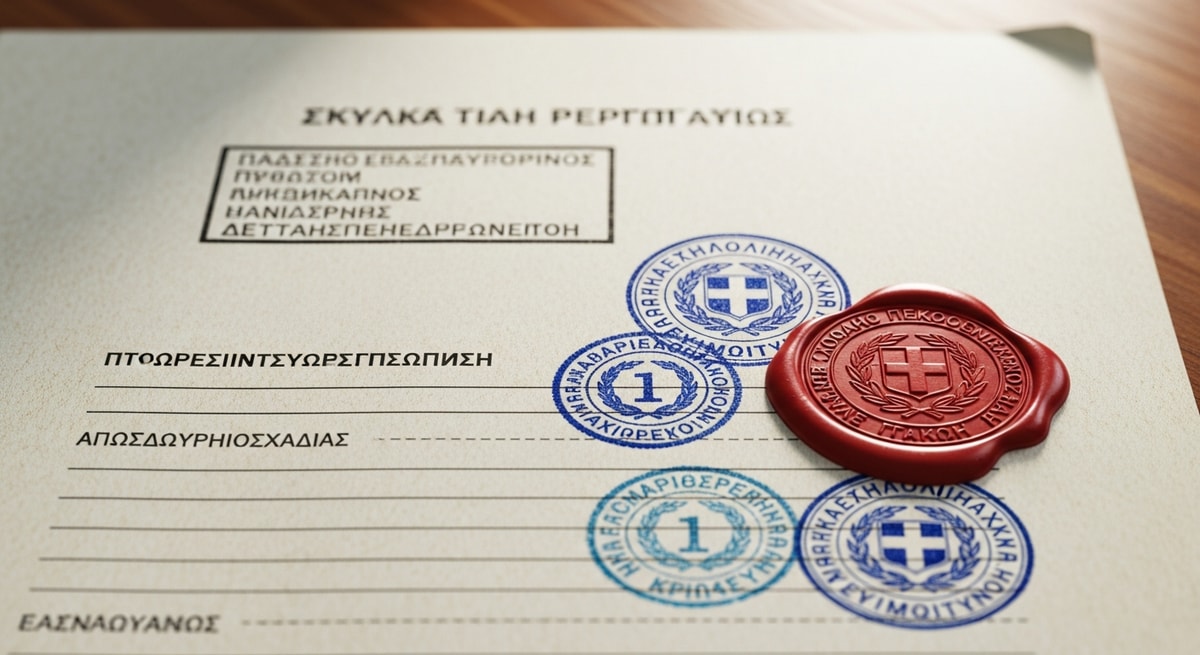
Greek documents require specialized knowledge of alphabet transliteration and historical script variations
Greece's Certified Translator System Under Law 4781/2021
Greece's system for official translations underwent a significant transformation in September 2021 when Law 4781/2021 abolished the longstanding Translation Service of the Ministry of Foreign Affairs (Μεταφραστική Υπηρεσία του Υπουργείου Εξωτερικών) and established the Certified Translators Registry (Μητρώο Πιστοποιημένων Μεταφραστών). The registry was compiled pursuant to Ministerial Decision no. P23MET-34908/19.07.2021, and registered translators now use a digital application at metafraseis.services.gov.gr to enter translation details and obtain a unique serial number for each official translation.
Under the current framework, three categories of professionals may produce official translations (επίσημες μεταφράσεις) accepted by Greek authorities: translators registered in the Μητρώο Πιστοποιημένων Μεταφραστών, lawyers authorized under Article 36 of Law 4194/2013, and graduates of the Ionian University's Department of Foreign Languages, Translation and Interpreting, whose right to produce official translations was established by Presidential Decree 169/2002 and confirmed by Council of State Judgment No. 2799/2013. Each official translation must bear the translator's signature and seal, and the original document must be physically attached to form a single integral unit.
It is important to understand the distinction between a certified translation as provided by DoVisa for international use and an official translation (επίσημη μετάφραση) required by Greek domestic authorities. DoVisa's certified translations — carrying a signed certification statement attesting to accuracy and completeness — are widely accepted by international immigration authorities, courts, universities, and credential evaluation bodies. However, for submission to Greek government agencies, courts, or municipal offices, an official translation by a registered certified translator is required. DoVisa can coordinate this requirement through our network of translators registered in the Ministry of Foreign Affairs' registry, ensuring your documents meet Greek domestic standards when needed.

The Ministry of Foreign Affairs maintains the Certified Translators Registry established by Law 4781/2021
Apostille and Authentication for Greek Documents
Greece signed the Hague Apostille Convention on 5 October 1961 and ratified it on 19 March 1985, with the convention entering into force on 18 May 1985. As one of the earliest signatories, Greece has a well-established apostille infrastructure. Unlike many countries that designate a single competent authority, Greece distributes apostille responsibilities across multiple institutions depending on the document type. The Decentralized Administrations (Αποκεντρωμένες Διοικήσεις) handle apostilles for civil and administrative documents, including vital records from municipal registry offices. The First Instance Courts (Πρωτοδικεία) apostille judicial documents issued within their jurisdiction. The Regions (Περιφέρειες) handle documents from regional self-government services.
A significant modernization occurred in July 2023 when Greece launched its e-Apostille system through the Ministry of Digital Governance. Documents issued electronically via the gov.gr portal can now receive a digital apostille, which includes a unique verification number and is presented in three languages: Greek, English, and French. The e-Apostille is recorded in an electronic register at e-apostille.gov.gr, allowing receiving authorities worldwide to verify its authenticity online. However, the e-Apostille is currently limited to documents self-issued through the gov.gr platform; documents obtained through KEP (Citizens' Service Centres) or issued in paper form still require a traditional physical apostille.
DoVisa manages the full apostille process for Greek documents, whether physical or electronic. We identify the correct competent authority based on the document type and issuing body, prepare the application, and handle submission and tracking. For clients who need both a certified translation and an apostille, we coordinate the process end to end, ensuring the apostille is obtained on the original Greek document before translation where required by the receiving authority, or on the certified translation where applicable. Standard apostille processing through Greek authorities takes 5-10 business days; expedited processing may be available depending on the specific competent authority.
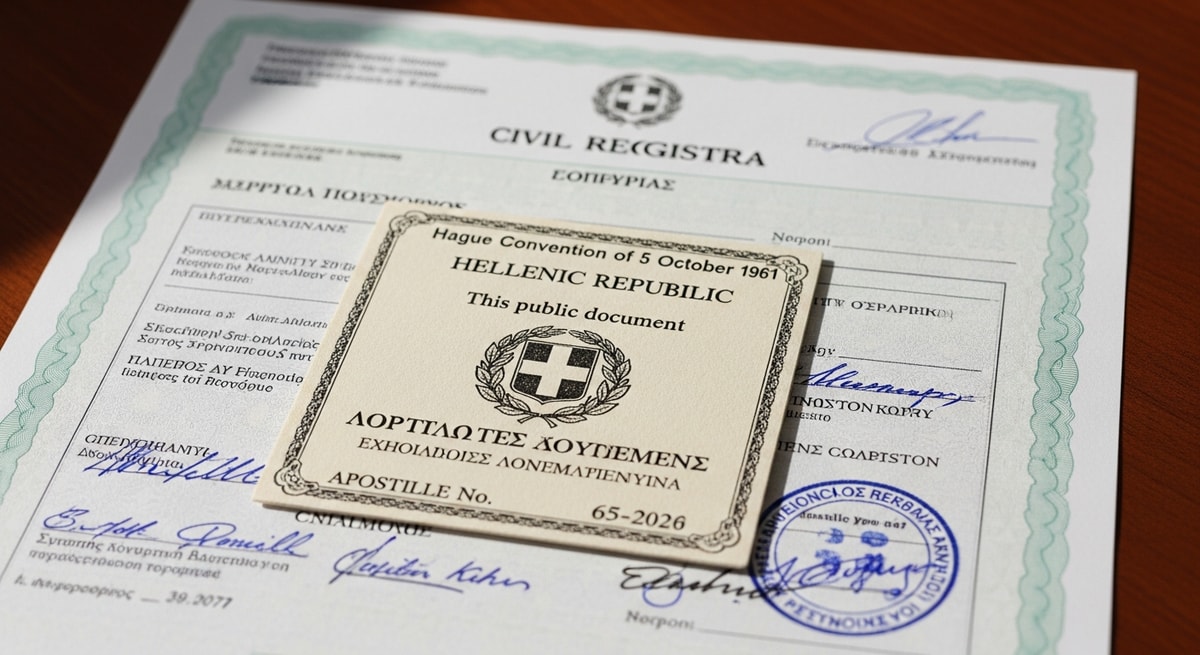
Greek apostilles authenticate public documents for recognition in 125+ Hague Convention member states
"Needed my Ληξιαρχική Πράξη Γέννησης and marriage certificate translated for a USCIS green card application. The translator handled the Greek script and name transliterations perfectly. USCIS accepted everything without an RFE. Very professional service."
"Greek university degree and transcripts translated for WES credential evaluation in Canada. The translator accurately rendered all the Greek academic terminology and grading scales. WES processed my evaluation without any follow-up questions."
"Good translation of my Greek Αντίγραφο Ποινικού Μητρώου (criminal record) for an Australian skilled visa. The Department of Home Affairs accepted it. Would have preferred slightly faster delivery but quality was solid."
"DoVisa translated my Greek divorce decree and birth certificate for a UK spouse visa application. The Home Office accepted both translations without issue. The translator understood the Greek legal terminology in the court judgment perfectly."
"Had three Greek documents translated to English for my Canadian Express Entry PR application: birth certificate, university degree, and police clearance. IRCC processed my application with no issues regarding the translations. Excellent quality and turnaround."
"Greek marriage certificate and family status certificate translated for a New Zealand partnership visa. Immigration New Zealand accepted both. The translations were accurate and well-formatted. Delivery took the full 5 days though."
"Our law firm needed Greek court judgments translated for enforcement proceedings in England. DoVisa's legal translator handled complex Greek procedural terminology from the Πρωτοδικείο decision with impressive accuracy. Our solicitors were very satisfied."
"Greek birth certificate translation for USCIS was accurate but had a minor name transliteration inconsistency between the certificate and my passport spelling. They corrected it within a few hours and the final version was accepted, but it should have been caught initially."
"Translated a Greek Πιστοποιητικό Οικογενειακής Κατάστασης (family status certificate) and my wife's birth certificate for our Australian partner visa. The Department of Home Affairs accepted everything. Appreciated the fast 3-day turnaround."
"Greek military service certificate and academic transcripts translated for a job application with an international company in London. The HR department accepted the translations immediately. Good quality work overall."
"Needed my Greek Πτυχίο and full transcript translated for a graduate school application in the US. The translator accurately captured all course titles and the grading scale conversion. My university processed the application without questions. Highly recommend."
"Needed my Ληξιαρχική Πράξη Γέννησης and marriage certificate translated for a USCIS green card application. The translator handled the Greek script and name transliterations perfectly. USCIS accepted everything without an RFE. Very professional service."
"Greek university degree and transcripts translated for WES credential evaluation in Canada. The translator accurately rendered all the Greek academic terminology and grading scales. WES processed my evaluation without any follow-up questions."
"Good translation of my Greek Αντίγραφο Ποινικού Μητρώου (criminal record) for an Australian skilled visa. The Department of Home Affairs accepted it. Would have preferred slightly faster delivery but quality was solid."
Greek Document Translation FAQs
What types of Greek documents can be translated?
We translate all types of Greek documents including birth certificates (Ληξιαρχική Πράξη Γέννησης), marriage certificates (Ληξιαρχική Πράξη Γάμου), divorce decrees (Απόφαση Διαζυγίου), death certificates (Ληξιαρχική Πράξη Θανάτου), family status certificates (Πιστοποιητικό Οικογενειακής Κατάστασης), criminal record extracts (Αντίγραφο Ποινικού Μητρώου), academic diplomas (Πτυχίο), transcripts (Αναλυτική Βαθμολογία), military service certificates, powers of attorney, court judgments, corporate documents, and notarial deeds. All translations are certified and accepted by international government agencies, courts, universities, and credential evaluation bodies.
Are the translations certified or sworn?
DoVisa provides certified translations with a signed certification statement attesting to the accuracy and completeness of the translation. These are accepted by international immigration authorities including USCIS, UK Visas and Immigration, IRCC (Canada), and the Australian Department of Home Affairs, as well as credential evaluation agencies such as WES and ECE. For submission to Greek domestic authorities, an official translation (επίσημη μετάφραση) by a translator registered in the Ministry of Foreign Affairs' Certified Translators Registry (Μητρώο Πιστοποιημένων Μεταφραστών) is required. DoVisa can coordinate official translations through our network of registered translators upon request.
Do I need a certified translator registered in Greece for my documents?
It depends on where you are submitting the documents. For submission to international authorities such as USCIS, UK Home Office, IRCC, or Australian immigration, DoVisa's certified translation with a signed certification statement is sufficient and widely accepted. For submission to Greek domestic authorities — including courts, KEP (Citizens' Service Centres), Decentralized Administrations, or municipal offices — an official translation by a professional registered in the Ministry of Foreign Affairs' Μητρώο Πιστοποιημένων Μεταφραστών (established under Law 4781/2021), a lawyer authorized under Article 36 of Law 4194/2013, or an Ionian University translation graduate (per Presidential Decree 169/2002) is legally required. DoVisa can arrange this through our network when needed.
How long does Greek document translation take?
Standard certified translation of Greek documents is delivered within 4-6 business days. Express processing is available for 2-3 business days, and rush delivery within 24 hours is offered for select single-page documents such as birth and marriage certificates. Complex documents like court judgments, multi-page academic transcripts, or corporate filings may require additional time depending on length and technical complexity. If apostille certification is also needed, allow an additional 5-10 business days for processing through the Greek competent authority.
What languages do you translate Greek documents to and from?
We translate Greek documents to and from 100+ languages. The most common language pairs include Greek to English, English to Greek, Greek to German, Greek to French, Greek to Italian, Greek to Spanish, Greek to Dutch, Greek to Arabic, Greek to Turkish, and Greek to Chinese. We also handle less common combinations involving Greek. Each translation is produced by a professional translator with expertise in both the source and target language as well as the relevant subject matter, whether legal, academic, medical, or corporate.
Will the translation be accepted by immigration authorities?
Yes. Our certified translations of Greek documents are accepted by major immigration authorities worldwide including USCIS (United States), UK Visas and Immigration, IRCC (Canada), the Australian Department of Home Affairs, Immigration New Zealand, and many others. Each translation includes a signed certification statement confirming accuracy and completeness, meeting the requirements set out in regulations such as 8 CFR 103.2(b)(3) for US immigration. Our current acceptance rate at international agencies is 98.7%.
Do I need notarization with my Greek translation?
Whether notarization is needed depends on the requirements of the receiving authority. Most international immigration authorities (USCIS, UK Home Office, IRCC, Australian immigration) accept our certified translation without additional notarization. Some authorities, particularly in certain Hague Convention member countries, may request a notarized translation accompanied by an apostille. In the Greek system, official translations by registered certified translators carry legal force through the translator's signature and seal without separate notarization. DoVisa can arrange notarization and apostille services when required by the destination authority.
What is an apostille and do I need one for Greek documents?
An apostille is a certificate issued under the Hague Convention of 1961 that authenticates the origin of a public document for use in another Convention member country. Greece ratified the Apostille Convention in 1985. You need an apostille if a foreign authority requires proof that your Greek document is genuine. The competent authorities in Greece include Decentralized Administrations (for civil documents), First Instance Courts (for judicial documents), Regions (for regional government documents), and the Ministry of Digital Governance (for gov.gr electronic documents via e-Apostille). Standard apostille processing takes 5-10 business days. DoVisa handles the complete apostille process, identifying the correct authority and managing submission through to delivery.
Does Greece offer e-Apostille for electronic documents?
Yes. Since July 2023, Greece offers e-Apostille for eligible documents issued electronically through the gov.gr portal. The e-Apostille is added to the document in three languages — Greek, English, and French — and carries a unique verification number that receiving authorities can check at e-apostille.gov.gr. However, the e-Apostille is currently limited to documents self-issued through the gov.gr platform. Documents obtained through KEP (Citizens' Service Centres) or issued in paper form still require a traditional physical apostille. DoVisa can advise whether your specific documents are eligible for e-Apostille or require the physical process.
How much does certified Greek translation cost?
Our Greek certified translation pricing follows a transparent per-page structure with volume discounts that apply automatically for larger documents. Pricing varies based on document length, language pair, and the processing speed you select (standard, express, or rush). Apostille processing through the relevant Greek competent authority is quoted separately. Upload your documents on our order page to receive an instant, detailed quote before work begins — no hidden fees or obligations.
Can you translate handwritten Greek documents?
Yes. Many Greek civil registry entries, particularly older records from municipal Ληξιαρχεία (registry offices), are handwritten in cursive Greek script. Some older documents may also use polytonic orthography (πολυτονικό σύστημα), which was the standard before the 1982 orthographic reform, or the formal Katharevousa register used in official documents before 1976. Our Greek-specialist translators are experienced in reading these historical handwriting styles, older orthographic conventions, and archaic vocabulary. We may request higher-resolution scans for particularly challenging handwritten documents to ensure accuracy.
What format will I receive the translation in?
You will receive your certified Greek translation as a high-resolution PDF delivered to your email, suitable for immediate electronic submission to immigration authorities, universities, and other institutions. The PDF includes the full translation with the translator's signed certification statement. The original hard-copy translation with wet-ink signature and certification is shipped via tracked international courier to your address. Many international authorities accept the digital PDF for initial filing, with the physical copy available for in-person appointments or mailing to government offices.
How do you handle Greek name transliteration?
Greek name transliteration is one of the most critical aspects of Greek document translation. Multiple romanization systems exist, and Greek authorities have historically been inconsistent in how names appear on documents. For example, the name Ευάγγελος might appear as Evangelos, Euangelos, or Evagelos. Our translators cross-reference name spellings against the individual's passport, identity card, or other official documents bearing a Latin-script rendering of the name. This ensures consistency between the translated document and the applicant's existing identity documents — a critical requirement for immigration applications where name discrepancies can cause delays or rejections.
Can Greek documents issued through gov.gr be translated?
Yes. We translate documents issued electronically through the gov.gr portal, including birth certificates, family status certificates, and other civil registry documents generated digitally. For these documents, Greece also offers e-Apostille (since July 2023), which adds a digital apostille in Greek, English, and French with a verifiable unique number. If your document was issued via gov.gr and needs both translation and apostille, we can coordinate the e-Apostille process before translation. Documents obtained through KEP (Citizens' Service Centres) following a gov.gr application are not eligible for e-Apostille and require the standard physical apostille process.
Get Your Greek Documents Translated Today
Professional certified translations of Greek documents accepted by USCIS, UK Home Office, IRCC, and international authorities worldwide