

Certified Spanish Document Translation for Argentina
Professional translations of Argentine documents compliant with Ley 20.305 standards. Accepted by USCIS, IRCC, UK Visas and Immigration, and international authorities worldwide. Apostille and e-Apostille coordination available.
TrustpilotSelect Languages
Drag & drop your documents here
or
PDF, JPEG, PNG, WebP — Max 10MB per file. Word documents: please save as PDF first.
Certified translators · Accepted by governments, courts & universities worldwide · View sample
Select a destination country to view pricing
How Argentine Certified Translation Works
Submit Your Documents Securely
Upload clear scans of your Argentine documents — partidas de nacimiento, certificados analíticos, títulos universitarios, or any other official records — through our encrypted portal. We accept PDF, JPEG, and PNG formats. Our intake specialists review each upload for legibility and completeness, ensuring every page and official seal is captured before the translation process begins.
Professional Translator Assignment
Your documents are matched with a professional translator specializing in Argentine legal and civil documents. Our translators are experienced with Argentine document formats, including the specific terminology used by the Registro Civil, Argentine courts, and universities. For clients requiring a traducción pública for submission to Argentine domestic authorities, DoVisa can coordinate this through our network of traductores públicos matriculados upon request.
Translation & Certification
The translator produces your certified translation with meticulous attention to Argentine legal terminology and document structure. Each translation includes a signed certification statement attesting to accuracy and completeness. A second qualified linguist reviews terminology, formatting, and fidelity to the original. For documents destined for international use, the certification meets the standards required by USCIS, IRCC, and credential evaluation agencies worldwide.
Delivery with Full Certification
Receive your certified translation as a high-resolution PDF for immediate use, with the original hard copy shipped to your address via tracked international courier. If you need an apostille or e-Apostille for your Argentine source documents, DoVisa coordinates the process through the Cancillería or the competent Colegio de Escribanos, delivering a fully authenticated document package ready for international submission.
Argentine Translation Service Specifications
Popular Language Pairs
We support all languages — 100+ language pairs available for Argentine documents.
Common Documents
- Argentine birth certificates (partida de nacimiento)
- Marriage certificates (partida de matrimonio / acta de matrimonio)
- Death certificates (partida de defunción)
- Academic transcripts (certificado analítico)
- University diplomas and degrees (título universitario)
- Police clearance certificates (certificado de antecedentes penales)
- Argentine National Identity Document (DNI)
- Divorce decrees (sentencia de divorcio)
- Power of attorney (poder notarial)
- Commercial registry extracts (extracto del Registro Público de Comercio)
Turnaround Time
Certification Details
Argentine Translation Requirements & Regulatory Framework
Embassy Acceptance
Notarization Process
Apostille Information
Legal Framework
Common Scenarios for Argentine Document Translation
U.S. Immigration & Visa Applications
Argentine nationals applying for U.S. visas, green cards, or naturalization through USCIS need certified English translations of their partida de nacimiento (birth certificate), partida de matrimonio (marriage certificate), certificado de antecedentes penales (police clearance), and academic credentials. DoVisa provides USCIS-compliant certified translations with the required translator certification statement, ensuring smooth processing without Requests for Evidence (RFEs) related to translation quality.
Marriage & Family Reunification Abroad
Argentine citizens marrying abroad or sponsoring family members for immigration need certified translations of vital records from the Registro Civil. Birth certificates, divorce decrees (sentencia de divorcio), and single-status certificates (certificado de soltería) must be translated and often apostilled for acceptance by foreign registries and immigration authorities in the U.S., Canada, UK, Australia, and EU member states.
Academic Credential Evaluation
Argentine university graduates seeking education or professional recognition abroad need certified translations of their título universitario (university degree), certificado analítico (academic transcript), and secondary school diploma (título de bachiller). Credential evaluation agencies such as WES, ECE, and NACES members require accurate English translations that preserve the structure and grading terminology of the Argentine academic system.
Corporate & Business Expansion
Companies operating in Argentina or expanding internationally require certified translations of corporate documents including estatutos sociales (articles of incorporation), actas de asamblea (shareholder meeting minutes), poderes notariales (powers of attorney), and financial statements. These translations support cross-border transactions, regulatory filings, and due diligence processes with foreign business partners and regulatory authorities.
Legal Proceedings & Court Documents
Cross-border litigation, international divorce proceedings, and child custody cases involving Argentina require certified translations of sentencias judiciales (court judgments), escrituras públicas (notarial deeds), and oficios judiciales (court orders). Our legal translation team handles complex Argentine procedural law terminology from Juzgados de Primera Instancia through Corte Suprema de Justicia de la Nación decisions with precision.
Understanding Argentina's Traductor Público System
Argentina operates one of Latin America's most structured sworn translator systems, established under Ley 20.305 enacted in 1973. Unlike many countries where any bilingual professional can produce a certified translation, Argentina restricts legally valid translations for domestic official use to traductores públicos — university-trained professionals who have completed a rigorous four-to-five-year Traductorado Público program at an accredited Argentine university. Major programs include those at the Universidad de Buenos Aires (UBA), Universidad del Museo Social Argentino (UMSA), and Instituto de Enseñanza Superior en Lenguas Vivas.
Upon graduation, the traductor público must register (matricularse) with the relevant Colegio de Traductores Públicos. In the City of Buenos Aires, this is the CTPCBA (Colegio de Traductores Públicos de la Ciudad de Buenos Aires), which maintains the professional registry, certifies signatures, and enforces the Código de Ética Profesional. Each Argentine province has its own Colegio with jurisdiction over translators practicing in that region. Only a traductor público matriculado may affix their professional seal and signature to a translation intended for submission to Argentine government agencies, courts, notaries, or public entities.
For international use — such as submitting Argentine documents to USCIS, IRCC, UK Visas and Immigration, or credential evaluation agencies — a DoVisa certified translation with a signed certification statement is accepted. This distinction is important: while Argentine domestic authorities require a traducción pública, international authorities accept certified translations meeting their own standards. DoVisa bridges both needs — providing certified translations for international use and coordinating with matriculated traductores públicos when a traducción pública is specifically required.
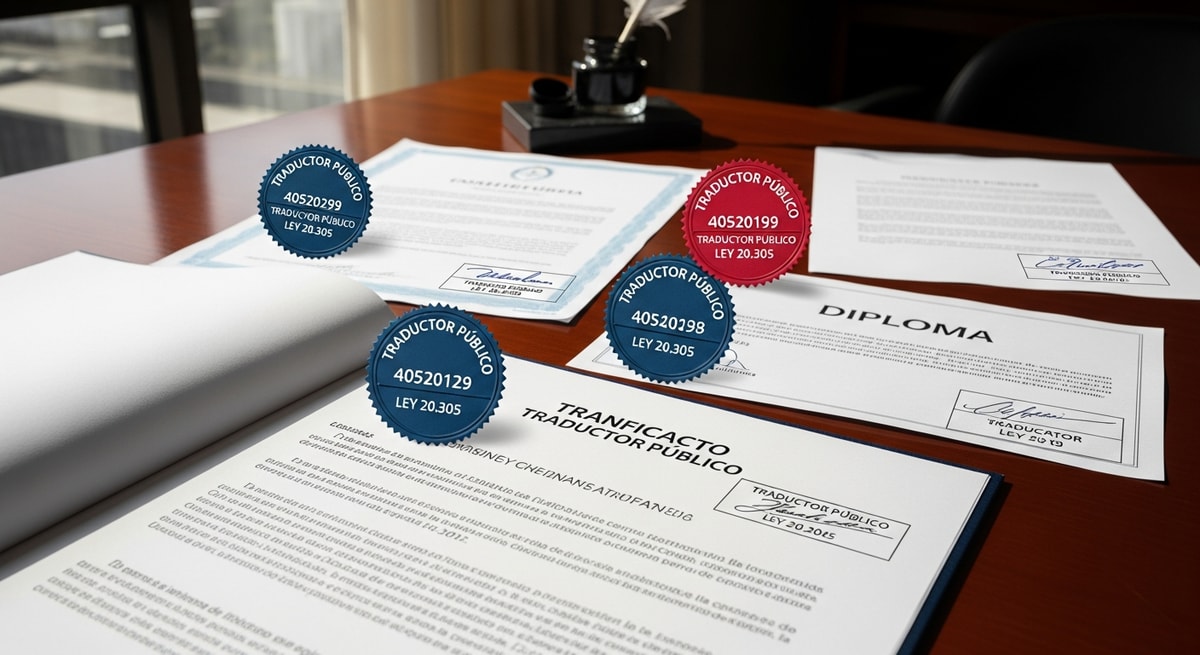
Argentina's traductor público system under Ley 20.305 ensures legally valid translations for domestic official use
Apostille and e-Apostille for Argentine Documents
Argentina has been a Contracting Party to the Hague Apostille Convention since February 18, 1988, enabling Argentine public documents to be authenticated for use in over 125 member countries through a streamlined apostille process. The competent authorities are the Ministerio de Relaciones Exteriores, Comercio Internacional y Culto (commonly known as the Cancillería) and, since 2003, the Colegios de Escribanos (notary public colleges) throughout the country, acting under delegation from the Cancillería through the Consejo Federal del Notariado Argentino (CFNA).
A significant modernization milestone came on April 15, 2019, when Argentina launched its electronic apostille (e-Apostille) system through the GDE (Gestión Documental Electrónica) platform. Argentina now issues digitally signed e-Apostilles that can be verified online through the Cancillería's verification portal. The e-Apostille carries the same legal validity as a traditional paper apostille and is accepted by all Hague Convention member states. Documents can be apostilled remotely through the TAD (Trámites a Distancia) online platform, eliminating the need for in-person visits to Buenos Aires.
DoVisa manages the complete apostille and e-Apostille process for Argentine documents. We coordinate submission through TAD or the appropriate Colegio de Escribanos, track processing, and deliver the apostilled or e-Apostilled document package to your address. For vital records from the Registro Civil, commercial documents, court orders, and academic certificates, we ensure each document follows the correct authentication chain before apostille issuance. Standard apostille processing takes 5-15 business days depending on the issuing authority and document type; express options are available for urgent cases.
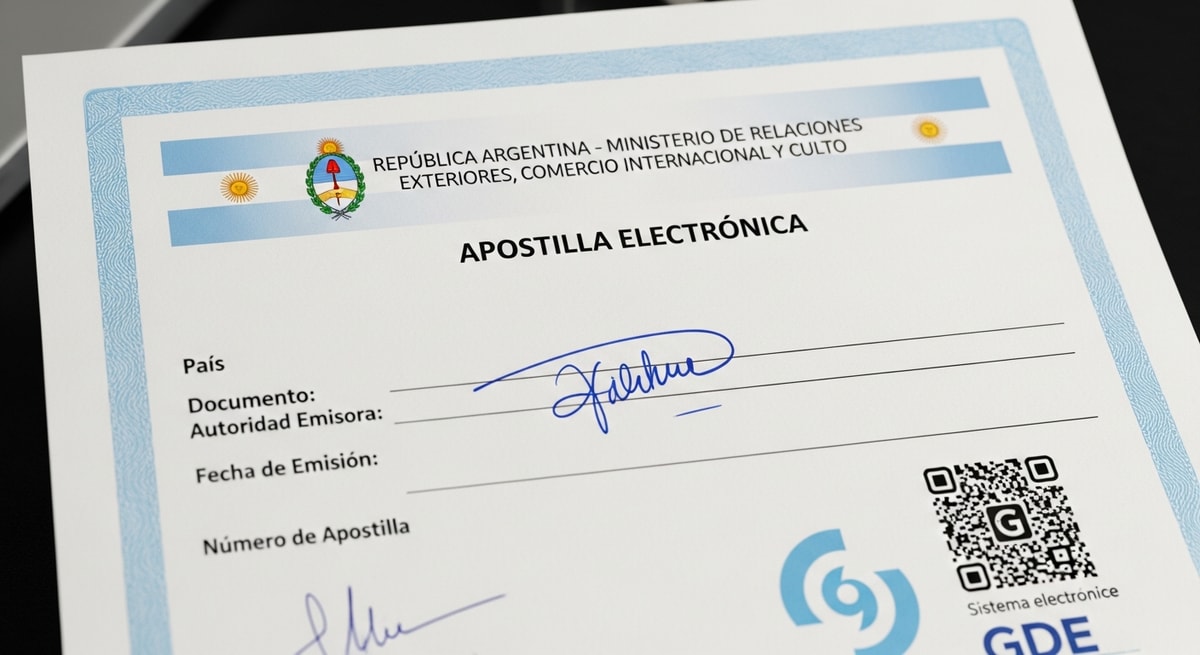
Since 2019, Argentina issues electronic apostilles (e-Apostille) with digital signatures verifiable online
Navigating Argentina's Civil Registry and Vital Records
Argentina's civil registration system is administered at the provincial level by each province's Registro Civil (Civil Registry), while the Registro Nacional de las Personas (RENAPER) oversees national identification and documentation including the DNI (Documento Nacional de Identidad) and passports. Vital records — birth certificates (partida de nacimiento), marriage certificates (partida de matrimonio), and death certificates (partida de defunción) — are issued by the provincial Registro Civil where the event was recorded.
Argentine vital records present specific translation challenges. Birth certificates often contain annotations (notas marginales) recording subsequent events such as marriage, divorce, name changes, or recognition of paternity. These marginal notes carry legal significance and must be translated in full. Marriage certificates may reference the régimen patrimonial (marital property regime) chosen by the spouses — either comunidad de ganancias (community property) or separación de bienes (separate property) — terminology that requires precise legal translation. Older documents from provincial registries may use handwritten entries with regional variations in formatting.
For international use, Argentine vital records typically require apostille authentication before submission to foreign authorities. The Registro Civil issues the original document, which must then be apostilled by the Cancillería or the competent Colegio de Escribanos. DoVisa assists clients in obtaining updated copies of Argentine vital records when originals are unavailable, coordinating with the relevant provincial Registro Civil. We also handle the full authentication chain — from obtaining the vital record through apostille issuance and certified translation — providing a complete, ready-to-submit document package for immigration applications, marriage registrations abroad, and credential evaluations.
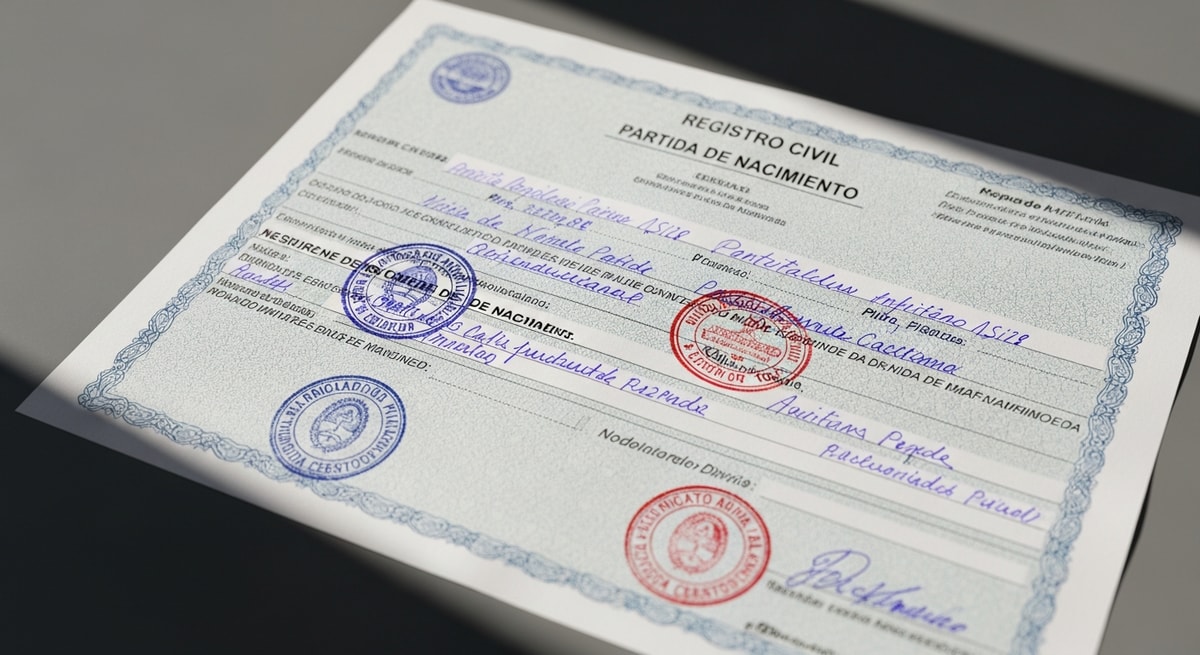
Argentine vital records from the Registro Civil require careful translation of marginal notes and legal terminology
"Needed my Argentine partida de nacimiento and certificado de antecedentes penales translated to English for my USCIS green card application. The translations were perfectly formatted and accepted without any RFE. Fast turnaround too — received the PDFs in 3 days."
"DoVisa translated my Argentine título universitario and certificado analítico for WES credential evaluation. They accurately captured all the Argentine academic terminology including the grading scale. WES processed my evaluation without requesting any clarifications."
"Good quality translation of my wife's Argentine marriage certificate and birth certificate for her UK spouse visa. The Home Office accepted everything. Would have preferred a slightly faster standard turnaround, but the quality was solid."
"Translated my Argentine police clearance and university diploma from Spanish to English for my Canadian Express Entry PR application. IRCC accepted the translations without any issues. The translator clearly understood Argentine document formats."
"Our company needed Argentine estatutos sociales and actas de asamblea translated to English for a cross-border acquisition. The legal terminology was handled with precision. Our New York attorneys were very impressed with the quality."
"Used DoVisa for translating my husband's Argentine birth certificate with marginal notes for an Australian partner visa. They translated all the notas marginales accurately, which I know is tricky. Good service overall."
"Excellent translation of my Argentine sentencia de divorcio for a family court proceeding in the United States. The translator preserved all the legal nuances from the original Spanish. The court accepted it without question."
"The translation of my Argentine certificado analítico was accurate but the initial delivery had my middle name spelled differently from my passport. DoVisa corrected it within a few hours and the revised version was perfect for my ECE evaluation. Minor issue but should have been caught initially."
"DoVisa translated three Argentine birth certificates and a marriage certificate for our family's New Zealand residence visa. All documents were accepted by Immigration New Zealand. They also coordinated the apostille through the Cancillería, which saved us a lot of hassle."
"Needed my Argentine nursing degree translated to English for credentialing in the United States. The translator understood Argentine healthcare terminology well. CGFNS accepted the translation for their evaluation program. Reliable service."
"Translated my Argentine poder notarial and escritura pública from Spanish to English for a property transaction in the UK. Complex legal documents with notarial language that the translator handled expertly. The solicitor in London confirmed the translations were impeccable."
"Needed my Argentine partida de nacimiento and certificado de antecedentes penales translated to English for my USCIS green card application. The translations were perfectly formatted and accepted without any RFE. Fast turnaround too — received the PDFs in 3 days."
"DoVisa translated my Argentine título universitario and certificado analítico for WES credential evaluation. They accurately captured all the Argentine academic terminology including the grading scale. WES processed my evaluation without requesting any clarifications."
"Good quality translation of my wife's Argentine marriage certificate and birth certificate for her UK spouse visa. The Home Office accepted everything. Would have preferred a slightly faster standard turnaround, but the quality was solid."
Argentine Document Translation FAQs
What types of Argentine documents can be translated?
We translate all types of Argentine documents including birth certificates (partida de nacimiento), marriage certificates (partida de matrimonio), death certificates (partida de defunción), academic transcripts (certificado analítico), university diplomas (título universitario), police clearance certificates (certificado de antecedentes penales), court documents (sentencias judiciales), notarial deeds (escrituras públicas), corporate documents (estatutos sociales, actas de asamblea), and Argentine identity documents (DNI). All translations include a signed certification statement attesting to accuracy and completeness.
Are your translations of Argentine documents certified?
Yes. Every translation includes a signed certification statement from the translator attesting to the accuracy and completeness of the translation. Our certified translations are accepted by international authorities including USCIS, IRCC, UK Visas and Immigration, and the Australian Department of Home Affairs, as well as credential evaluation agencies such as WES and ECE. For submission to Argentine domestic authorities (Registro Civil, courts, Dirección Nacional de Migraciones), a traducción pública by a traductor público matriculado is required — DoVisa can coordinate this through our professional network upon request.
Do I need a sworn translator (traductor público) for my Argentine documents?
It depends on where you are submitting the documents. For Argentine domestic authorities — including the Registro Civil, Argentine courts, the Dirección Nacional de Migraciones, and notaries — Ley 20.305 requires a traducción pública produced by a traductor público matriculado registered with the relevant Colegio de Traductores Públicos. For international submission — to USCIS, IRCC, UK Visas and Immigration, Australian Home Affairs, or credential evaluation agencies — a certified translation with a translator's certification statement is accepted. DoVisa provides certified translations for international use and can coordinate with matriculated traductores públicos when a traducción pública is specifically needed for Argentine domestic proceedings.
How long does Argentine document translation take?
Standard certified translation is delivered within 4-6 business days. Express processing is available for 2-3 business days, and rush delivery within 24 hours is available for select document types such as single-page vital records from the Registro Civil. Turnaround times begin after we receive clear, legible scans of your documents. If apostille processing is required, additional time is needed — standard apostille processing through the Cancillería or Colegio de Escribanos takes 5-15 business days.
What languages do you translate Argentine documents to and from?
We translate Argentine documents from Spanish to English and over 100 other language pairs. Common combinations include Spanish to Portuguese, French, German, Italian, Chinese, Japanese, Korean, Arabic, Russian, and Dutch. We also translate into Spanish for foreign documents intended for use in Argentina. Each language pair is handled by translators with specific expertise in Argentine legal and administrative terminology, ensuring accurate rendering of terms unique to the Argentine system.
Will my translated Argentine documents be accepted by USCIS?
Yes. Our certified translations of Argentine documents meet USCIS requirements under 8 CFR 103.2(b)(3), which requires that any foreign-language document be accompanied by a full English translation certified by the translator as complete and accurate. Every DoVisa translation includes the required certification statement with the translator's signature, printed name, date, and attestation of competence. Our current acceptance rate for USCIS submissions is 98.7%, with the rare rejections typically related to source document issues rather than translation quality.
Do I need notarization with my Argentine document translation?
Notarization requirements depend on the receiving authority. USCIS does not require notarization — a certified translation with the translator's certification statement is sufficient. Some U.S. state agencies, certain international embassies, and some credential evaluation bodies may request notarized translations. For documents intended for use in Hague Convention member countries, an apostille on the Argentine source document may be required in addition to the certified translation. DoVisa can arrange notarization and apostille services as needed for your specific submission requirements.
What is an apostille and do I need one for my Argentine documents?
An apostille is a standardized certificate issued under the Hague Apostille Convention that authenticates the origin of a public document for international use. Argentina has been a Convention member since February 18, 1988, and apostilles are issued by the Cancillería (Ministerio de Relaciones Exteriores, Comercio Internacional y Culto) and by the Colegios de Escribanos across the country. Since April 15, 2019, Argentina also offers e-Apostilles with digital signatures. You typically need an apostille when submitting Argentine documents to authorities in another Hague Convention member country. DoVisa handles the complete apostille process, including e-Apostille coordination.
How much does certified translation of Argentine documents cost?
Our Argentine document translation pricing follows a transparent per-page structure with volume discounts that apply automatically for larger documents. Pricing varies based on document length, language pair, and processing speed selected. Express and rush options are available for time-sensitive projects. Apostille and e-Apostille coordination are quoted separately based on the authentication requirements. Upload your documents on our order page to receive an instant, detailed quote before any work begins — no hidden fees or unexpected charges.
Can you translate handwritten Argentine documents?
Yes. Many older Argentine documents from provincial Registro Civil offices, historical court records, and notarial archives contain handwritten entries that require specialized expertise to decipher and translate accurately. Our translators are experienced with Argentine handwriting styles, including the distinctive cursive conventions used in civil registry entries, marginal annotations (notas marginales), and notarial protocols. For handwritten documents, we recommend uploading the highest-quality scan possible. If any portion is illegible, our team will flag the specific sections and discuss interpretation options with you before proceeding.
What format will I receive my translated Argentine documents in?
You will receive your certified translation as a high-resolution PDF delivered via email for immediate use, along with the original hard copy shipped to your address via tracked international courier. The PDF includes the full translation with the translator's signed certification statement. For apostilled documents, the apostille certificate or e-Apostille is attached to or embedded within the document package. Digital copies are stored securely in your DoVisa account for future access. We use 256-bit AES encryption and ISO 27001 certified infrastructure to protect your documents throughout the process.
Can you translate Argentine documents with marginal notes (notas marginales)?
Yes. Argentine vital records frequently contain notas marginales — annotations added to the original registry entry recording subsequent events such as marriage, divorce, name changes, recognition of paternity, or judicial orders. These marginal notes carry legal significance and must be translated in full for the translation to be considered complete. Our translators are trained to identify and translate all marginal annotations, preserving the chronological record of amendments to the original entry. We ensure receiving authorities understand the relationship between the original entry and each subsequent annotation.
How do I get an e-Apostille for my Argentine documents?
Since April 15, 2019, Argentina offers electronic apostilles through the GDE (Gestión Documental Electrónica) system. The e-Apostille is a digitally signed PDF document with the same legal validity as a traditional paper apostille. Applications can be submitted remotely through the TAD (Trámites a Distancia) platform at tramitesadistancia.gob.ar. DoVisa manages the complete e-Apostille application process on your behalf, from uploading your documents to the TAD platform through to delivery of the digitally authenticated document package. E-Apostilles can be verified online through the Cancillería's verification portal. Processing typically takes 5-15 business days.
Get Your Argentine Documents Translated Today
Professional certified translations accepted by USCIS, IRCC, UK Visas and Immigration, and international authorities worldwide