Certified Arabic and French Document Translation
Professional translations of Moroccan documents — actes d'etat civil, diplomas, and legal records. Accepted by USCIS, IRCC, UK Visas and Immigration, and credential evaluation agencies worldwide. Apostille coordination available.
TrustpilotSelect Languages
Drag & drop your documents here
or
PDF, JPEG, PNG, WebP — Max 10MB per file. Word documents: please save as PDF first.
Certified translators · Accepted by governments, courts & universities worldwide · View sample
Select a destination country to view pricing
How Moroccan Certified Translation Works
Submit Your Documents Securely
Upload clear scans of your Moroccan documents through our encrypted portal. We accept PDF, JPEG, and PNG formats. Our intake specialists review each upload for legibility, verifying that Arabic text, French annotations, and any Tifinagh script are fully readable. If your document is a bilingual acte d'etat civil (civil status record) with both Arabic and French columns, we ensure both language sections are captured clearly before translation begins.
Professional Translator Assignment
Your documents are matched with a certified translator specializing in Moroccan Arabic and French legal documents. Morocco's administrative system produces bilingual Arabic-French records, and our translators understand the specific terminology used by Moroccan civil registries (bureaux d'etat civil), courts (tribunaux de premiere instance), and government ministries. For Amazigh-language documents, we assign translators with specific Tamazight expertise.
Translation and Certification
The translator produces your certified translation and affixes their signature and certification statement attesting to accuracy and completeness. For Moroccan documents containing both Arabic and French text, the translator addresses both language components in the certified English output. A second linguist reviews all terminology, proper names, dates, and formatting to ensure the translation meets the standards required by international immigration authorities and credential evaluation agencies.
Delivery with Full Certification
Receive your certified translation as a high-resolution PDF for immediate use with online applications, plus the original signed hard copy shipped via tracked international courier. For documents requiring an apostille, DoVisa coordinates with the competent Moroccan authority — either the judicial authorities connected to the Ministry of Justice or the local authorities under the Ministry of the Interior — to obtain the apostille before shipping the complete authenticated package to your address.
Morocco Translation Service Specifications
Popular Language Pairs
We support all languages — 100+ language pairs available for Moroccan documents.
Common Documents
- Birth certificates (شهادة الميلاد / Acte de naissance)
- Marriage certificates (عقد الزواج / Acte de mariage)
- Divorce decrees (حكم الطلاق / Jugement de divorce)
- Family booklet (دفتر الحالة المدنية / Livret de famille)
- Academic diplomas and transcripts (شهادة جامعية / Diplome universitaire)
- Police clearance certificates (شهادة السوابق العدلية / Casier judiciaire)
- Death certificates (شهادة الوفاة / Acte de deces)
- National identity card (بطاقة التعريف الوطنية / Carte nationale d'identite)
- Commercial register extracts (السجل التجاري / Registre du commerce)
- Property deeds (عقد الملكية / Titre foncier)
Turnaround Time
Certification Details
Morocco Translation Requirements and Regulatory Framework
Embassy Acceptance
Notarization Process
Apostille Information
Legal Framework
Common Scenarios for Moroccan Document Translation
Immigration and Visa Applications
Moroccan nationals applying for visas to the United States, Canada, United Kingdom, or Schengen countries need certified translations of their birth certificates (شهادة الميلاد), police clearance certificates (شهادة السوابق العدلية), and academic credentials. USCIS, IRCC, and UK Visas and Immigration all require certified English translations of Moroccan Arabic and French documents. DoVisa provides translations formatted to meet each immigration authority's specific requirements, including proper handling of the bilingual Arabic-French format common in Moroccan civil records.
Marriage and Family Reunification
International marriages involving Moroccan nationals require certified translations of the Acte de mariage, Livret de famille (family booklet), birth certificates, and divorce decrees from prior marriages. Family reunification applications at foreign embassies in Rabat or Casablanca require extensive translated documentation. Our translators understand the specific family law terminology used in Moroccan civil status records, including Moroccan personal status law (Moudawana) references that appear in family court documents.
Academic Credential Evaluation
Moroccan students and professionals seeking admission to foreign universities or professional license recognition need certified translations of their diplomas, transcripts, and academic certificates. Moroccan academic records from institutions such as universities, grandes ecoles, and professional training institutes are typically issued in French or bilingual Arabic-French. Credential evaluation agencies including WES, ECE, and NACES members require certified English translations of all Moroccan academic documents.
Business and Commercial Documents
Moroccan companies engaged in international trade and foreign investors establishing businesses in Morocco need certified translations of commercial register extracts (السجل التجاري / Registre du commerce), articles of incorporation, financial statements, and contracts. Morocco's position as a gateway to African markets means frequent demand for translations between Arabic, French, English, and Spanish for cross-border business transactions and regulatory filings.
Legal Proceedings and Court Documents
Cross-border litigation, international divorce cases, and child custody disputes involving Moroccan courts require certified translations of court judgments (احكام قضائية), notarial deeds, and legal correspondence. Moroccan court documents are issued in Arabic, and our legal translation team handles the specialized judicial terminology used by the tribunaux de premiere instance, cours d'appel, and Cour de cassation with precision and accuracy.
Morocco's Bilingual Arabic-French Document System
Morocco's administrative system operates in a unique bilingual framework that reflects the country's historical and linguistic heritage. Since independence in 1956, Arabic has been the official language of the state, and the 2011 Constitution further elevated Amazigh (Tamazight) to co-official status alongside Arabic. French, while not constitutionally official, remains deeply embedded in government administration, higher education, business, and diplomatic affairs — a legacy of the French protectorate period (1912-1956).
This bilingualism has practical implications for document translation. Most Moroccan civil status documents (actes d'etat civil) are issued in a bilingual Arabic-French format, with Arabic text on one side and French on the other. Birth certificates (شهادة الميلاد / Acte de naissance), marriage certificates (عقد الزواج / Acte de mariage), and death certificates (شهادة الوفاة / Acte de deces) all follow this dual-language structure. Academic documents from Moroccan universities may be issued entirely in French, entirely in Arabic, or in a bilingual format depending on the institution and the field of study. Court documents and judicial records are issued exclusively in Arabic, as mandated by the Code of Civil Procedure.
Translating bilingual Moroccan documents requires a translator who can accurately render both the Arabic and French components into the target language, cross-referencing the two versions to ensure consistency. Discrepancies between the Arabic and French sections of the same document — which occasionally occur due to transliteration differences in proper names or administrative shorthand — must be identified and noted in the translation. DoVisa's Moroccan document specialists are trained to handle this bilingual complexity, producing certified translations that accurately represent both language components of the original record.
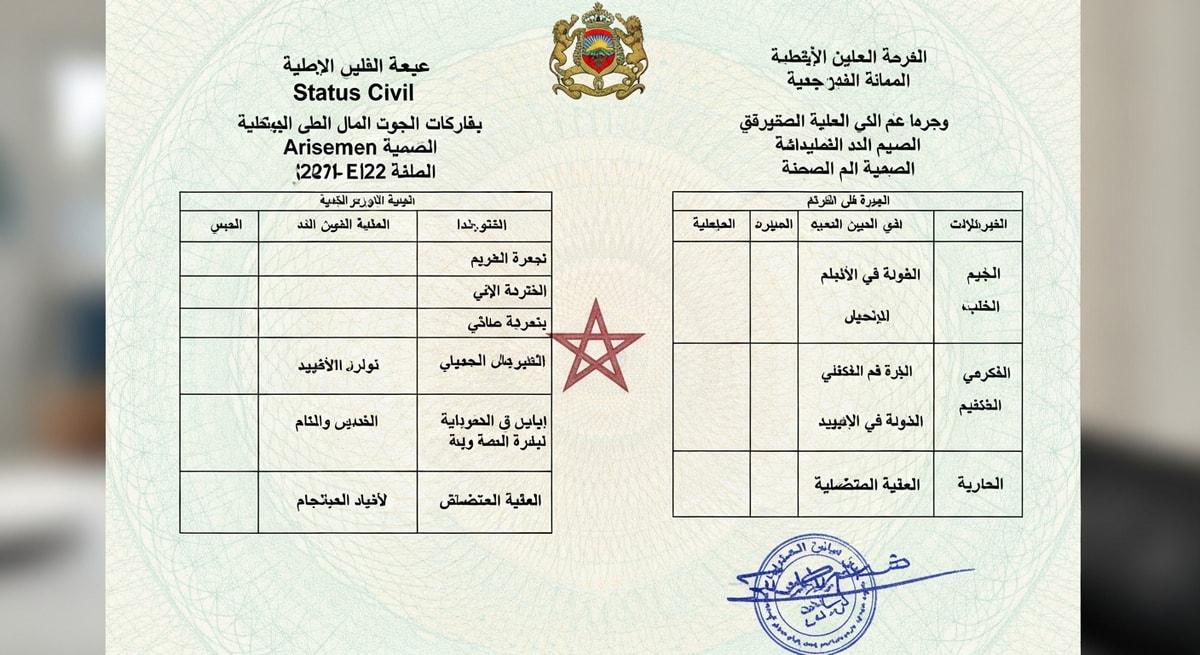
Moroccan civil status records are issued in bilingual Arabic-French format requiring specialized translation expertise
The Moroccan Sworn Translator System and International Alternatives
Morocco operates a formal sworn translator system in which traducteurs agrees pres les tribunaux (translators accredited to the courts) are the only professionals authorized to produce legally valid translations for Moroccan domestic use. Becoming a sworn translator in Morocco requires Moroccan nationality, a university degree in translation or a related field, successful completion of a rigorous professional examination, and an oath taken before a court. Once accredited, sworn translators receive authorization from the Ministry of Justice and are registered with the courts where they practice. Their translations carry an official stamp and signature that gives the document legal force within Morocco's judicial and administrative systems.
For international use, however, the requirements differ. Immigration authorities in the United States (USCIS), Canada (IRCC), the United Kingdom, Australia, and New Zealand accept certified translations produced by qualified professional translators — a sworn translator accredited to Moroccan courts is not required. DoVisa's certified translation service meets the standards demanded by these international authorities: each translation includes a signed certification statement attesting to the translator's qualifications and the accuracy and completeness of the translation.
When Moroccan domestic use is required — for example, submitting a foreign document to a Moroccan tribunal or bureau d'etat civil — DoVisa can coordinate a sworn translation through our partner network of traducteurs agrees based in Casablanca, Rabat, Marrakech, and other major Moroccan cities. This dual-track approach ensures that whether your Moroccan documents are headed abroad or foreign documents are coming into Morocco, the translation meets the correct legal standard for its destination.
Moroccan sworn translators are accredited through the court system under the Ministry of Justice
Apostille Authentication for Moroccan Documents
Morocco acceded to the Hague Apostille Convention on 27 November 2015, with the Convention entering into force on 14 August 2016. This relatively recent accession replaced the lengthier consular legalization process that was previously required for authenticating Moroccan documents for international use. An apostille issued by the competent Moroccan authority certifies the authenticity of a public document's signature, the capacity in which the signer acted, and the identity of any seal or stamp on the document.
Morocco designates two categories of competent authorities for issuing apostilles under Article 6 of the Convention. For documents emanating from judicial officials — including public prosecutors, court clerks, bailiffs, and notaries — the competent authority is the public prosecutor (procureur du Roi) at the relevant court of first instance, or the Procureur General du Roi at the Court of Cassation for higher-court documents. For administrative documents and private documents that have been legalized by administrative authorities, the walis and governors of prefectures and provinces under the Ministry of the Interior are the designated competent authorities.
The apostille process in Morocco typically takes 7-15 business days depending on the document type and the issuing authority's workload. DoVisa manages the entire process: we identify whether your document falls under judicial or administrative jurisdiction, submit the apostille application to the correct competent authority, track processing, and ship the apostilled document to your international address. For certified translations that need apostille authentication, the translation must first be produced by a Moroccan sworn translator (traducteur agree) before the apostille can be affixed. The official Moroccan apostille portal at apostille.ma provides verification services for apostilles issued in Morocco.
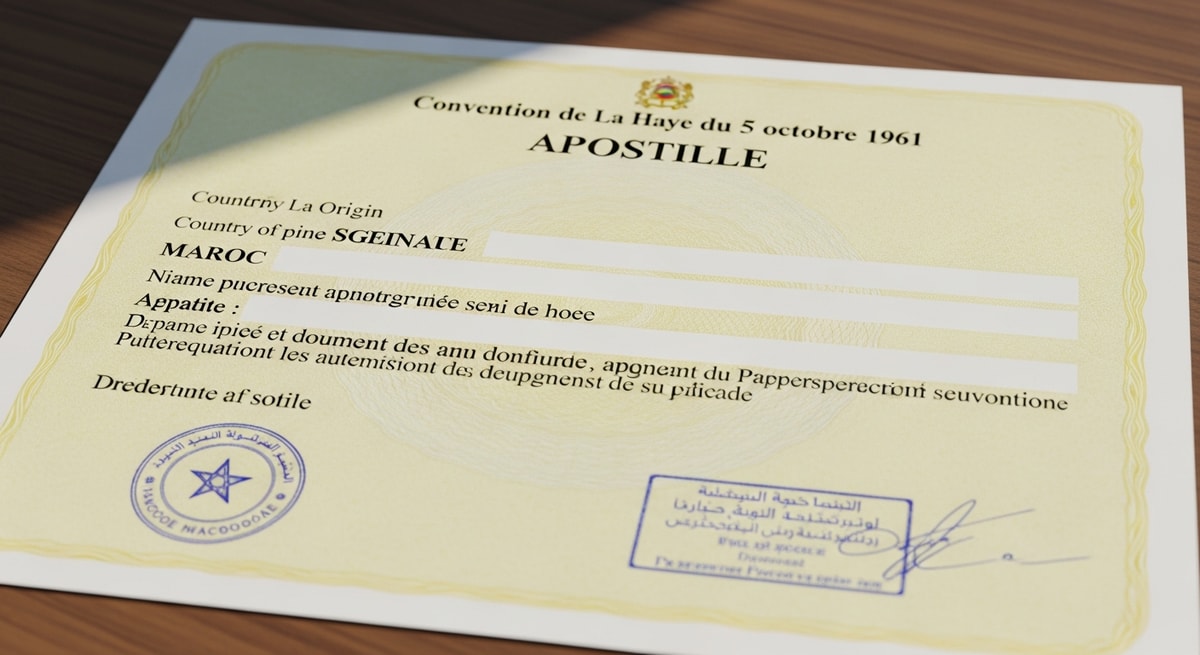
Morocco's apostille system has been operational since August 2016 under the Hague Convention framework
"Needed my Moroccan birth certificate (Acte de naissance) translated from Arabic and French to English for my USCIS green card application. The translator handled the bilingual format perfectly. USCIS accepted it without any RFE. Very professional service."
"DoVisa translated my Moroccan university diploma and transcripts from French to English for WES credential evaluation. The academic terminology was spot-on and WES processed my evaluation in standard time. No follow-up questions needed."
"Good translation of my Moroccan marriage certificate and family booklet for a UK spouse visa. The Home Office accepted everything. Would have liked faster delivery but standard turnaround of 5 days was within the quoted timeframe."
"Translated my Casier judiciaire (police clearance) and birth certificate from Arabic to English for Canadian Express Entry. IRCC processed my PR application without requesting corrections. The Arabic legal terminology was translated accurately."
"Moroccan divorce decree translated for an Australian partner visa application. The translator understood the Moudawana family law terminology perfectly. Department of Home Affairs accepted the translation on first submission."
"Had my Moroccan commercial register extract and articles of incorporation translated to English for a business partnership in the UK. Solid translation of the legal and commercial terms. Delivery was on time."
"DoVisa translated three Moroccan birth certificates and a Livret de famille from bilingual Arabic-French to English for our family's New Zealand skilled migrant visa. Immigration New Zealand accepted all documents without issues."
"Translation of my Moroccan academic transcripts was accurate but there was a minor spelling error on a professor's name. They corrected it within a few hours after I flagged it. The corrected version was accepted by ECE for credential evaluation."
"Needed a certified translation of my Moroccan death certificate and inheritance documents for a US probate case. The translator handled the Arabic legal terminology with great precision. Our attorney was impressed with the quality."
"Moroccan Acte de naissance translated to English for USCIS. The bilingual Arabic-French document was handled well and USCIS accepted it. Pricing was reasonable for the quality provided."
"Translated my Moroccan nursing diploma from French to English for credential evaluation with CGFNS in the United States. The medical and academic terminology was rendered perfectly. Very satisfied with the turnaround time and accuracy."
"Needed my Moroccan birth certificate (Acte de naissance) translated from Arabic and French to English for my USCIS green card application. The translator handled the bilingual format perfectly. USCIS accepted it without any RFE. Very professional service."
"DoVisa translated my Moroccan university diploma and transcripts from French to English for WES credential evaluation. The academic terminology was spot-on and WES processed my evaluation in standard time. No follow-up questions needed."
"Good translation of my Moroccan marriage certificate and family booklet for a UK spouse visa. The Home Office accepted everything. Would have liked faster delivery but standard turnaround of 5 days was within the quoted timeframe."
Morocco Document Translation FAQs
What types of Moroccan documents can be translated?
We translate all types of Moroccan documents including birth certificates (شهادة الميلاد / Acte de naissance), marriage certificates (عقد الزواج / Acte de mariage), divorce decrees, family booklets (Livret de famille), academic diplomas and transcripts, police clearance certificates (Casier judiciaire), death certificates, national identity cards, commercial register extracts, property deeds, court judgments, notarial deeds, and medical records. We handle documents issued in Arabic, French, bilingual Arabic-French format, and Amazigh (Tamazight).
Are the translations certified or sworn?
DoVisa provides certified translations that include a signed certification statement attesting to the accuracy and completeness of the translation. These certified translations are accepted by international immigration authorities including USCIS, UK Visas and Immigration, IRCC (Canada), the Australian Department of Home Affairs, and credential evaluation agencies worldwide. For submission to Moroccan domestic authorities — such as tribunaux, bureaux d'etat civil, or government ministries — a sworn translation (traduction assermentee) by a traducteur agree pres les tribunaux (translator accredited to the courts) is legally required. DoVisa can coordinate sworn translations through our network of court-accredited translators in Morocco upon request.
Do I need a sworn translator for Moroccan documents?
It depends on the destination of your translated document. For submission to international authorities such as USCIS, IRCC, UK Visas and Immigration, or the Australian Department of Home Affairs, a certified translation by a qualified professional translator is sufficient — a Moroccan sworn translator is not required. For submission to Moroccan domestic authorities including courts, government ministries, and civil registry offices, Moroccan law requires a sworn translation produced by a traducteur agree pres les tribunaux. DoVisa's standard service covers the international certified translation. If you need a Moroccan sworn translation, we can arrange this through our partner network at an additional cost.
How long does certified translation of Moroccan documents take?
Standard certified translation of Moroccan documents is delivered within 4-6 business days. Express processing is available for 2-3 business days, and rush delivery within 24 hours is offered for select single-page document types such as birth and marriage certificates. Bilingual Arabic-French documents may require slightly longer processing due to the need to translate and cross-reference both language components. If apostille authentication is also needed, add approximately 7-15 business days for the Moroccan competent authority to process the apostille application.
What languages do you translate Moroccan documents to and from?
We translate Moroccan documents from Arabic, French, and Amazigh (Tamazight) into English and over 100 other target languages. The most common translation pairs for Moroccan documents are Arabic to English, French to English, and Arabic to French. We also provide translations into Spanish, German, Italian, Dutch, Portuguese, and many other languages. For documents destined for Morocco, we translate from English and other languages into Arabic or French as required by Moroccan authorities.
Will the translation be accepted by immigration authorities?
Yes. Our certified translations of Moroccan documents are accepted by all major international immigration authorities including USCIS (United States), IRCC (Canada), UK Visas and Immigration, the Australian Department of Home Affairs, Immigration New Zealand, and Schengen visa processing offices. Each translation includes a signed certification statement that meets the specific formatting and attestation requirements of these agencies. Our current acceptance rate at international immigration agencies is 98.5%.
Do I need notarization with my Moroccan translation?
Most international immigration authorities accept certified translations without additional notarization. USCIS, IRCC, and UK Visas and Immigration all accept certified translations with a translator's certification statement. However, some authorities and private institutions may request notarization as an additional layer of authentication. For Moroccan domestic use, the sworn translator's official stamp and signature serve a similar function to notarization. If notarization is specifically required for your use case, DoVisa can arrange notarization of the certified translation through our network of notaries.
What is an apostille and do I need one for Moroccan documents?
An apostille is a standardized certificate under the Hague Apostille Convention that authenticates the origin of a public document for international use. Morocco has been a member of the Apostille Convention since 14 August 2016. You need an apostille if the receiving country requires authentication of your Moroccan document and is also a Convention member state. The apostille replaces the older, lengthier consular legalization process. DoVisa coordinates the apostille application with the correct Moroccan competent authority — either the judicial authorities under the Ministry of Justice or the walis and governors under the Ministry of the Interior — depending on your document type. Standard apostille processing takes 7-15 business days.
How much does certified translation of Moroccan documents cost?
Our Moroccan document translation pricing follows a transparent per-page structure with volume discounts that apply automatically for larger document sets. Pricing varies based on document length, language pair, and the processing speed you select (standard, express, or rush). Bilingual Arabic-French documents are priced based on the total translated output. Apostille coordination through the Moroccan competent authority is quoted separately. Upload your documents on our order page to receive an instant, detailed quote before work begins — no hidden fees.
Can you translate handwritten Moroccan documents?
Yes, we translate handwritten Moroccan documents including older civil status records, personal correspondence, and historical legal documents. Handwritten Arabic script can present legibility challenges, particularly in older documents that use traditional Maghrebi Arabic calligraphic styles. Our translators are experienced with Moroccan handwriting conventions and can work with documents that may be partially faded or difficult to read. For best results, upload the highest-quality scan possible. If any portions are illegible, the translator will note this in the certification statement rather than guessing at the content.
What format will I receive the translation in?
You receive your certified translation in two formats: a high-resolution PDF delivered via email for immediate use with online applications and digital submissions, plus the original signed hard copy shipped via tracked international courier. The PDF includes a scan of the translator's signed certification statement. Most immigration authorities accept the digital PDF for initial application submission, with the physical copy required for in-person interviews or final processing. For apostilled documents, only the physical original with the attached apostille certificate is legally valid.
How do you handle the bilingual format of Moroccan documents?
Most Moroccan civil status documents are issued in a bilingual Arabic-French format with parallel text in both languages. Our translators process both the Arabic and French components, cross-referencing the two versions to ensure consistency and identify any discrepancies in proper name transliterations or date formats. The certified English translation reflects the complete content of the original document from both language sections. Any differences between the Arabic and French text — such as variations in how a name is spelled between the Arabic and Latin scripts — are noted in the translation to provide full transparency for the receiving authority.
Can you translate Moroccan documents written in Amazigh (Tamazight)?
Yes. Since the 2011 Moroccan Constitution established Amazigh as a co-official language alongside Arabic, some official documents are now issued in Tamazight, occasionally using the Tifinagh script. We have translators with specific expertise in Amazigh language variants including Tashelhit, Tamazight, and Tarifit. While Tifinagh-script documents are still relatively uncommon in official Moroccan administration, their use is expanding under Organic Law No. 26-16. Upload your Amazigh-language document and we will assign a translator with the appropriate linguistic expertise.
Get Your Moroccan Documents Translated Today
Professional certified translations of Arabic and French documents accepted by international immigration authorities worldwide