Certified Faroese & Danish Document Translation
Professional certified translations of Faroe Islands documents in Faroese and Danish. The Faroe Islands is a self-governing archipelago within the Kingdom of Denmark. Accepted by USCIS, UK Visas and Immigration, IRCC, and authorities worldwide.
TrustpilotSelect Languages
Drag & drop your documents here
or
PDF, JPEG, PNG, WebP — Max 10MB per file. Word documents: please save as PDF first.
Certified translators · Accepted by governments, courts & universities worldwide · View sample
Select a destination country to view pricing
How Faroe Islands Certified Translation Works
Submit Your Documents Securely
Upload clear scans of your Faroe Islands documents through our encrypted portal. We accept PDF, JPEG, and PNG formats. Faroese civil documents may be issued in Faroese (the official language of the Faroe Islands since 1948) or Danish, through the Skrásetingarstovan (Faroese Civil Registration Office). Our intake specialists verify legibility before translation work begins.
Translator Assignment
Your documents are matched with a certified translator experienced in Faroese and Danish legal and administrative terminology. Faroese is a North Germanic language closely related to Icelandic and Old Norse, with distinct grammar and vocabulary from Danish. Our translators understand both Faroese civil registry conventions administered by Skrásetingarstovan and Danish-language official documents, as well as the Kingdom of Denmark's legal framework governing the Faroe Islands.
Translation & Certification
The translator produces your certified translation and affixes their official signature, certification statement, and stamp confirming the translation is a complete and accurate rendering of the original Faroese or Danish document. A second linguist reviews terminology and accuracy before final certification is applied, ensuring the translation meets the requirements of receiving authorities worldwide.
Delivery with Full Certification
Receive your certified translation as a high-resolution PDF for immediate use, with the original hard copy shipped via tracked international courier. For documents requiring an apostille, DoVisa coordinates the full process through the Danish apostille system — the Hague Convention was extended to the Faroe Islands through Denmark's membership, with the Danish Udenrigsministeriet (Ministry of Foreign Affairs) serving as the competent authority.
Faroe Islands Translation Service Specifications
Popular Language Pairs
We support all languages — 100+ language pairs available for Faroe Islands documents.
Common Documents
- Birth certificates (føðingarskírteini / fødselsattest)
- Marriage certificates (hjúskaparskírteini / vielsesattest)
- Death certificates (deyðarfrásøgn / dødsattest)
- Divorce decrees (skilunarskjal)
- Police clearance certificates (Løgregluskírteini)
- Academic diplomas and transcripts
- Residence certificates (búsetuskírteini)
- Population register extracts (fólkaskráin)
- Business registration documents
- Court documents and legal decisions
Turnaround Time
Certification Details
Faroe Islands Translation Requirements & Regulatory Framework
Embassy Acceptance
Notarization Process
Apostille Information
Legal Framework
Common Scenarios for Faroe Islands Document Translation
Immigration & Visa Applications
Faroe Islands residents applying for visas or immigration abroad must submit certified translations of Faroese-language or Danish-language civil documents. Birth certificates (føðingarskírteini), marriage certificates (hjúskaparskírteini), and population register extracts from Skrásetingarstovan require certified translation for submission to USCIS, UK Visas and Immigration, IRCC, and other international immigration authorities.
Marriage & Family Documentation
Faroese nationals marrying internationally or requiring family documentation for cross-border purposes need certified translations of civil records from Skrásetingarstovan. Our translators accurately render both Faroese and Danish civil registry terminology, including the unique conventions of this self-governing North Atlantic archipelago, for acceptance by foreign authorities and family courts.
Academic Credential Recognition
Academic documents from Faroese educational institutions, issued in Faroese or Danish, require certified translation for university admission and credential evaluation abroad. Our academic translators are experienced with both Faroese and Danish academic terminology, as well as the Faroese education system structure, enabling accurate translations accepted by WES, ENIC-NARIC, and university admissions offices worldwide.
Business & Maritime Industry Documents
The Faroe Islands' economy is heavily centered on fishing and maritime industries. Business registration documents, vessel certificates from Skrásetingarstovan, fishing permits, and corporate documents require certified translation for international trade, banking, and regulatory compliance. Our translators handle Faroese and Danish commercial and maritime terminology with precision.
Legal Proceedings & Inheritance
Cross-border legal matters, inheritance cases, and property transactions involving Faroe Islands documents require certified translations for foreign courts and legal authorities. Our legal translators handle Faroese and Danish legal terminology from Faroese courts (Rætturin), producing translations accepted by international legal proceedings and estate administration processes.
The Faroese Language and Civil Registration System
The Faroe Islands (Føroyar in Faroese, Færøerne in Danish) is a self-governing archipelago of 18 inhabited islands in the North Atlantic, located between Norway and Iceland. With a population of approximately 55,000, the Faroe Islands has its own language, government, and parliament (the Løgting), though defense and foreign affairs remain with the Kingdom of Denmark.
Faroese (føroyskt) was granted official status in 1948 and is a North Germanic language derived from Old Norse, most closely related to Icelandic. It uses a distinctive alphabet including the letters ð (eth) and the ligature ø, along with accented vowels. Modern Faroese developed from spoken dialects and was standardized in the 20th century by linguist Venceslaus Ulricus Hammershaimb. This linguistic distinctiveness means that translating Faroese documents requires specialized expertise — translators must understand both historical Danish-influence in older documents and modern standard Faroese conventions.
Civil registration in the Faroe Islands is managed by Skrásetingarstovan (the Civil Registration Office), which issues vital records including føðingarskírteini (birth certificates), hjúskaparskírteini (marriage certificates), and deyðarfrásøgn (death certificates) in Faroese. The fólkaskráin (national register) maintains population records. DoVisa's translators are experienced with Faroese script, diacritical marks, and the specific institutional references that appear on documents issued by Skrásetingarstovan.
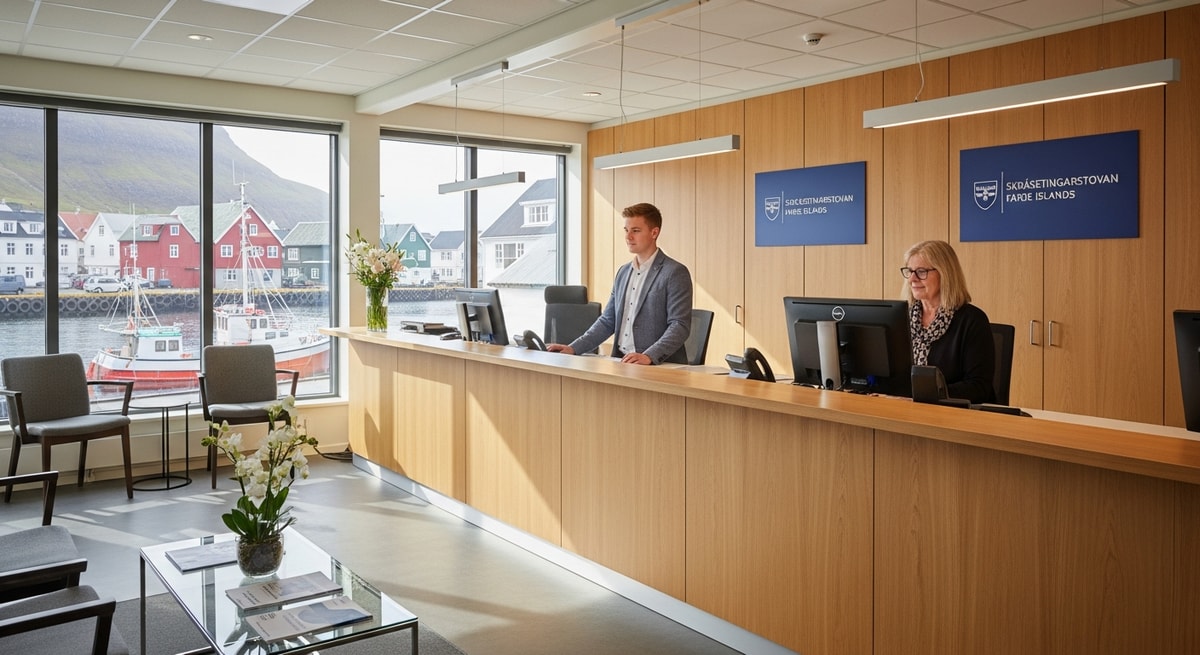
Skrásetingarstovan manages civil registration and issues vital records for the Faroe Islands
Apostille Authentication for Faroe Islands Documents
Faroe Islands public documents can be apostilled under Denmark's membership in the Hague Apostille Convention. Denmark ratified the Convention on 29 December 2006 but initially excluded the Faroe Islands. Denmark withdrew that exclusion on 14 October 2021, and the Convention entered into force for the Faroe Islands on 13 December 2021, meaning documents originating from the Faroe Islands can now be authenticated via the Danish apostille system for use in all Hague Convention member states worldwide.
The apostille process for Faroe Islands documents follows the Danish pathway. The competent authority responsible for issuing apostilles is the Danish Ministry of Foreign Affairs (Udenrigsministeriet). Documents issued in the Faroe Islands are first authenticated through appropriate channels confirming the issuing authority's signature, then the apostille is affixed by the Udenrigsministeriet. The apostille certificate follows the standard Hague Convention format (Annex 1) and is recognized in all 120+ Convention member states.
For countries that are not Hague Convention members, Faroe Islands documents undergo consular legalization through the Danish Ministry of Foreign Affairs and the destination country's embassy in Copenhagen. DoVisa manages the complete apostille and legalization process for Faroe Islands documents, coordinating with the relevant Danish authorities and delivering the fully authenticated document. Standard apostille processing takes 7-15 business days. This timeline is consistent whether the document requires apostille for immigration, academic, legal, or commercial purposes.

The Danish Udenrigsministeriet issues apostilles for Faroe Islands documents under the Hague Convention
"Had my Faroese birth certificate and marriage certificate translated for a USCIS green card application. Both were accepted without any Request for Evidence. The translator handled the Faroese terminology accurately."
"Needed my føðingarskírteini and academic transcripts from the Faroe Islands translated for WES credential evaluation in Canada. Everything was accepted on the first submission. Excellent quality and fast turnaround."
"Good translation of my Faroese civil documents for a UK spouse visa. The Home Office accepted everything without issues. The translator clearly understood the difference between Faroese and Danish document formats."
"DoVisa translated my Faroese divorce decree and birth certificate for an Australian skilled visa application. The Department of Home Affairs accepted everything on first submission. Very professional service."
"Our company needed Faroese fishing vessel certificates and business registration documents translated for a UK regulatory submission. The maritime terminology was handled expertly and the regulatory authority accepted all documents."
"Translation of my Faroese population register extract was accurate but arrived one day after the estimated delivery. DoVisa apologized and explained the delay. IRCC accepted the translation without any issues."
"My Faroese birth certificate was translated with apostille coordination for submission to the UAE. DoVisa handled the Danish Udenrigsministeriet process smoothly. The whole process took about two weeks and the document was accepted."
"Faroese academic diploma translated for a university application in the Netherlands. The translation preserved all technical details and the admissions office processed it without requesting anything further. Fair pricing."
"Submitted three Faroe Islands documents for an IRCC family sponsorship application. All translations were accepted and the application moved forward without delays. Highly recommend DoVisa for Faroese documents."
"Had my Faroese marriage certificate and police clearance translated for a New Zealand work visa. Immigration New Zealand accepted both documents on the first submission. Fast delivery and excellent quality."
"Faroese court documents translated for a probate case in the United States. Our US attorney confirmed the legal terminology was precise and the court accepted the translations without any requests for clarification."
"Had my Faroese birth certificate and marriage certificate translated for a USCIS green card application. Both were accepted without any Request for Evidence. The translator handled the Faroese terminology accurately."
"Needed my føðingarskírteini and academic transcripts from the Faroe Islands translated for WES credential evaluation in Canada. Everything was accepted on the first submission. Excellent quality and fast turnaround."
"Good translation of my Faroese civil documents for a UK spouse visa. The Home Office accepted everything without issues. The translator clearly understood the difference between Faroese and Danish document formats."
Faroe Islands Document Translation FAQs
What types of Faroe Islands documents can be translated?
Are your translations accepted by USCIS and international immigration authorities?
Is Faroese a dialect of Danish or a separate language?
How long does Faroe Islands document translation take?
What languages can Faroe Islands documents be translated into?
Is an apostille available for Faroe Islands documents?
Do I need notarization with my Faroe Islands translation?
Are Faroe Islands documents treated as Danish documents internationally?
How much does certified translation of Faroe Islands documents cost?
Can you translate handwritten Faroe Islands documents?
What format will I receive my translation in?
Does the Faroe Islands use the same personal identification number system as Denmark?
Get Your Faroe Islands Documents Translated Today
Professional certified Faroese and Danish translations accepted by USCIS, IRCC, and international authorities worldwide