Certified Colombian Document Translation
Traducciones certificadas of Colombian documents accepted by USCIS, UK Home Office, IRCC Canada, and Australian DHA. For use within Colombia, DoVisa coordinates with licensed traductores oficiales upon request.
TrustpilotSelect Languages
Drag & drop your documents here
or
PDF, JPEG, PNG, WebP — Max 10MB per file. Word documents: please save as PDF first.
Certified translators · Accepted by governments, courts & universities worldwide · View sample
Select a destination country to view pricing
How Colombian Certified Translation Works
Submit Your Documents Securely
Upload clear scans or photographs of your Colombian or foreign-language documents through our encrypted portal. We accept all standard formats including PDF, JPEG, and PNG. Our intake specialists review each upload for legibility and completeness, verifying that key details such as the Registraduria seal, notarial stamps, and apostille markings are visible before translation begins.
Professional Translator Assignment
Your documents are matched with a qualified translator who specializes in Colombian legal and civil documents. For translations intended for use abroad (immigration, academic evaluation, legal proceedings), our certified translators produce translations accepted by USCIS, IRCC, UK NARIC, and other international bodies. If your translation requires a traductor oficial for domestic Colombian use, DoVisa coordinates assignment through our network of officially licensed translators holding a Certificado de Idoneidad.
Translation and Quality Review
Your translator produces the certified translation with careful attention to Colombian legal terminology, proper rendering of names with tildes and accents, and accurate conversion of Colombian civil status terminology into the target language. A second qualified linguist performs a thorough review of terminology, formatting, and legal accuracy. Every translation includes a signed certification statement attesting to completeness and fidelity to the source document.
Delivery with Full Certification
Receive your certified translation as a high-resolution PDF for immediate use with immigration applications and online submissions. Hard copies with original signatures and stamps are shipped via tracked international courier to your address in Colombia or worldwide. For documents requiring apostille authentication through the Cancilleria (Ministry of Foreign Affairs), DoVisa can coordinate the complete apostille process, including Colombia's fully online e-Apostille system.
Colombian Translation Service Specifications
Popular Language Pairs
We support all languages — 100+ language pairs available for Colombian documents.
Common Documents
- Colombian birth certificates (Registro Civil de Nacimiento)
- Marriage certificates (Registro Civil de Matrimonio)
- Divorce decrees (Sentencia de Divorcio)
- Academic diplomas and transcripts (Diploma / Acta de Grado / Certificado de Notas)
- Colombian police clearance (Certificado de Antecedentes Judiciales)
- National identity card (Cedula de Ciudadania)
- Colombian passport (Pasaporte colombiano)
- Notarial deeds and powers of attorney (Escritura Publica / Poder Notarial)
- Death certificates (Registro Civil de Defuncion)
- Military service card (Libreta Militar)
Turnaround Time
Certification Details
Colombian Translation Requirements and Regulatory Framework
Embassy Acceptance
Notarization Process
Apostille Information
Legal Framework
Common Scenarios for Colombian Document Translation
US Immigration and USCIS Applications
Colombian nationals applying for US visas, green cards, adjustment of status, or naturalization must submit certified English translations of their Registro Civil de Nacimiento, Registro Civil de Matrimonio, academic credentials, Certificado de Antecedentes Judiciales (police clearance), and Cedula de Ciudadania. USCIS requires that translations include a signed certification statement from a competent translator. DoVisa provides translations formatted specifically for USCIS requirements, including proper I-130, I-485, and N-400 supporting documentation. Our translations consistently pass USCIS review without Requests for Evidence (RFEs) related to translation quality.
Canadian Express Entry and Family Sponsorship
Colombians applying through Canada's Express Entry system, Provincial Nominee Programs, or family sponsorship streams must provide certified English or French translations of their Colombian birth certificates, marriage certificates, police clearances, academic transcripts, and employment references. IRCC requires that translations be produced by a certified translator and include a sworn declaration. DoVisa's translations meet IRCC's strict formatting and certification requirements, facilitating smooth processing of permanent residence applications for Colombian applicants.
Academic Credential Evaluation
Colombian graduates seeking credential evaluation through WES (World Education Services), ECE (Educational Credential Evaluators), or NACES member organizations need certified English translations of their Diploma, Acta de Grado (degree certificate), Certificado de Notas (transcript), and sometimes their tarjeta profesional (professional license card). Our academic translators understand the Colombian higher education system including the distinction between profesional, tecnologo, and tecnico qualifications, as well as the grading scales used by Colombian universities, ensuring accurate translations that credential evaluators readily accept.
Marriage Registration Abroad
Colombians marrying abroad or registering a Colombian marriage in a foreign country need certified translations of their Registro Civil de Nacimiento, Registro Civil de Matrimonio, and sometimes a certificado de solteria (single-status certificate). Requirements vary by destination: UK registrars require translations for marriage licence applications, Australian registry offices need certified translations for marriage validity recognition, and European civil registry offices have specific formatting expectations. DoVisa provides translations tailored to each destination country's civil registry requirements.
Business and Corporate Document Translation
Colombian companies expanding internationally or foreign businesses operating in Colombia require translations of corporate documents including the Certificado de Existencia y Representacion Legal (certificate of incorporation from the Camara de Comercio), Escrituras Publicas (notarial deeds), shareholder agreements, and financial statements. Our corporate translators are experienced with Colombian commercial law terminology from the Codigo de Comercio and produce translations suitable for foreign corporate registries, banking institutions, and regulatory authorities.
Family Reunification and Dependent Visas
Colombians sponsoring family members for reunification in the United States, United Kingdom, Canada, Australia, or Europe need certified translations of birth certificates establishing family relationships, marriage certificates, custody agreements (acuerdos de custodia), adoption decrees (sentencias de adopcion), and financial support declarations. Each immigration authority has specific document and formatting requirements. DoVisa's family reunification translation packages cover all standard documents required by the destination country's immigration authority, with proper rendering of Colombian family law terminology.
Colombia's Traductor Oficial System Explained
Colombia operates a regulated official translation system rooted in Decreto 382 of 1951, which created the legal figure of the traductor e interprete oficial. Unlike many countries where any qualified translator can produce certified translations, Colombia restricts officially recognized translations for domestic legal use to professionals holding a Certificado de Idoneidad (Certificate of Suitability) issued by one of only three authorized entities: the Universidad Nacional de Colombia, the Universidad de Antioquia, or the Ministerio de Justicia y del Derecho.
The Universidad Nacional de Colombia has been the primary certifying body since 1997, administering rigorous examinations twice per year that test candidates' linguistic competence, legal terminology knowledge, and translation accuracy. Since 2007, the Universidad de Antioquia has also been authorized to conduct examinations, though exclusively for English and French language pairs. Candidates who pass receive the Certificado de Idoneidad, which authorizes them to produce official translations that carry legal validity before all Colombian authorities, courts, and government institutions.
An official Colombian translation bears the traductor oficial's handwritten signature, personal stamp displaying their Certificado de Idoneidad number, and a declaration attesting to the translation's completeness and accuracy. Since December 1, 2020, official translations prepared in Colombia for domestic use no longer require separate apostille or legalization, because the traductor oficial's signature carries independent legal validity within national territory. This important distinction means that for domestic Colombian proceedings, translations must come from a licensed traductor oficial. However, for Colombian documents being translated for use abroad, international immigration authorities such as USCIS, IRCC, UKVI, and the Australian DHA apply their own certification standards and do not require the Colombian traductor oficial credential. DoVisa provides both pathways: internationally certified translations for foreign immigration authorities, and coordination with traductores oficiales for documents requiring domestic Colombian legal validity.
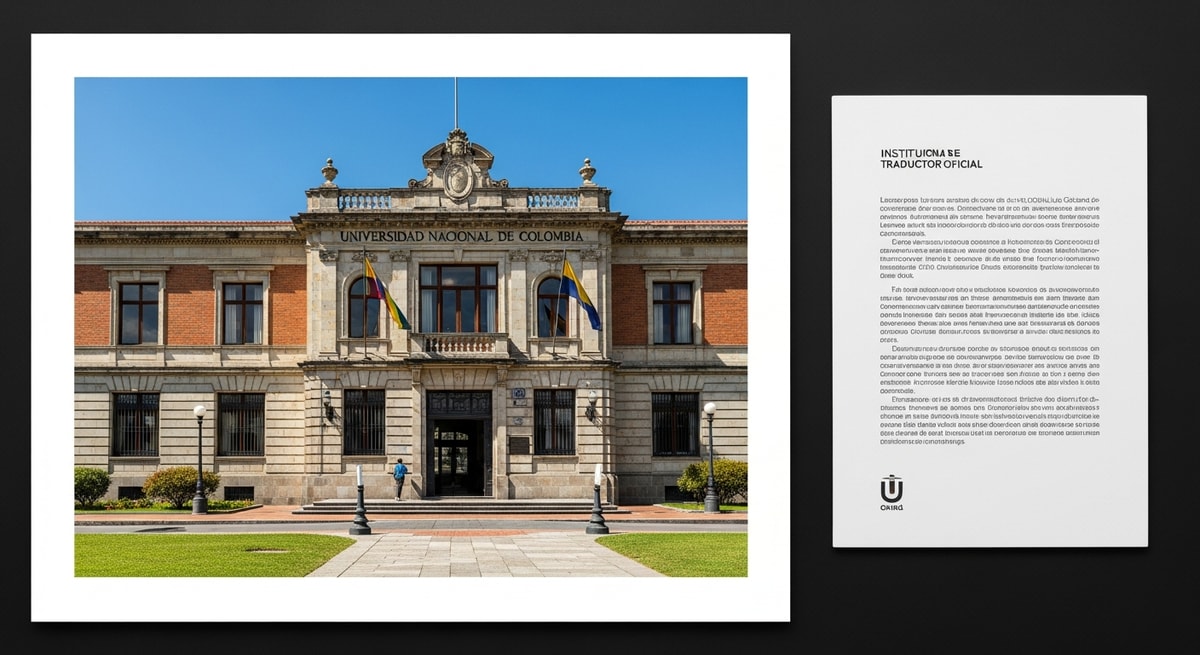
The Universidad Nacional de Colombia administers official translator examinations and issues the Certificado de Idoneidad
Apostille and e-Apostille for Colombian Documents
Colombia acceded to the Hague Apostille Convention in 2001, designating the Ministerio de Relaciones Exteriores (Cancilleria) as the sole competent authority for issuing apostilles. Colombia has emerged as a leader in apostille modernization, having implemented a fully electronic e-Apostille system that allows the entire process to be completed online from anywhere in the world. The Cancilleria's digital platform at tramites.cancilleria.gov.co operates 24 hours a day, 7 days a week, including holidays.
The apostille process for Colombian documents involves submitting a request through the online portal, uploading the document to be authenticated, and paying the applicable fee electronically. The Cancilleria verifies the document's origin and the issuing authority's signature before generating the apostille. Processing typically completes within 24 hours of successful verification. Each electronic apostille includes a QR code that allows receiving authorities anywhere in the world to instantly verify its authenticity through the Cancilleria's verification portal. Both electronic and traditional paper apostilles issued by Colombia are equally valid and authentic under the Hague Convention.
Colombian documents commonly requiring apostille for international use include the Registro Civil de Nacimiento (birth certificate), Registro Civil de Matrimonio (marriage certificate), academic diplomas and transcripts, Certificados de Antecedentes Judiciales (police clearances), notarial documents (Escrituras Publicas), and court decisions. For documents destined for countries that are not members of the Apostille Convention, a full consular legalization process through the Cancilleria and the destination country's embassy in Colombia is required instead. DoVisa manages the complete apostille or legalization process, handling the online submission, verification tracking, and delivery of the authenticated document to your address in Colombia or internationally.
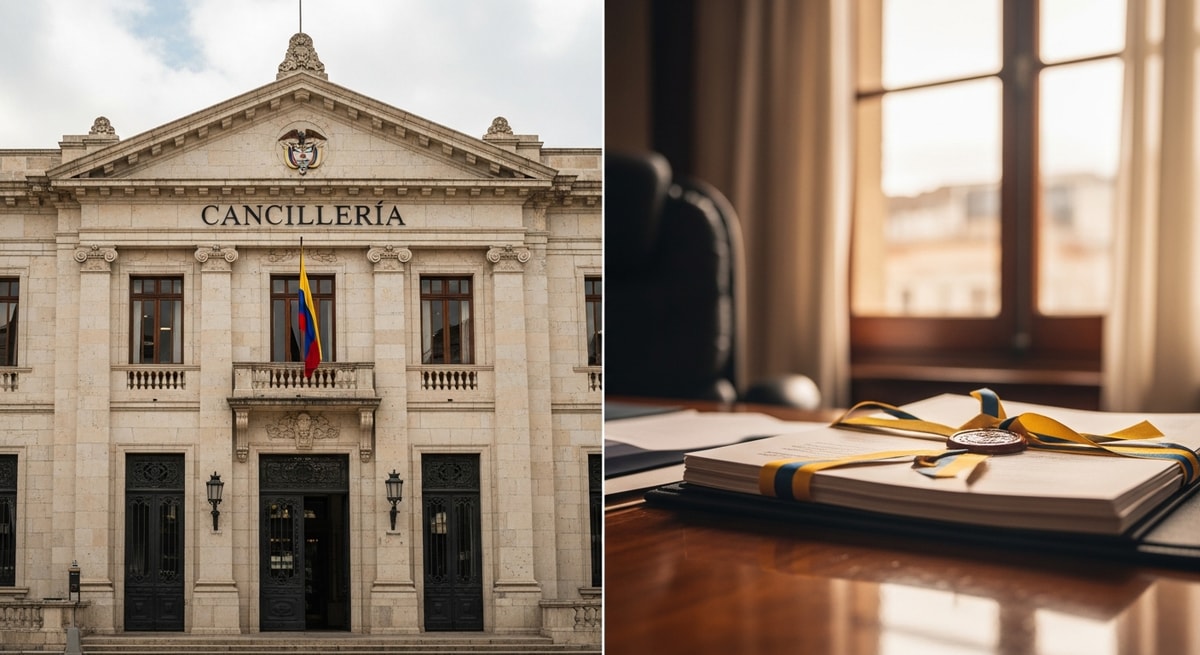
The Cancilleria (Ministry of Foreign Affairs) is Colombia's sole competent authority for apostille issuance
Navigating Colombian Civil and Identity Documents
Colombia's civil documentation system is administered by the Registraduria Nacional del Estado Civil, the government agency responsible for maintaining civil registry records throughout the country. Understanding the Colombian document ecosystem is essential for accurate translation, as document names, formats, and legal significance differ from those in other Spanish-speaking countries.
The Registro Civil de Nacimiento is Colombia's foundational identity document, issued at birth and required for virtually all legal proceedings. It contains the individual's full name, date and place of birth, parents' names, and a unique NUIP (Numero Unico de Identificacion Personal). The Cedula de Ciudadania is the national identity card issued to all Colombian citizens upon reaching 18 years of age and serves as the primary identification document for civil, political, administrative, and judicial acts as established by Ley 39 of 1961. For minors between 7 and 17, the Tarjeta de Identidad serves as the identity document.
The Registro Civil de Matrimonio documents marriages performed in Colombia, whether civil or religious (Catholic marriages registered with civil authorities carry the same legal weight). Colombian Escrituras Publicas (notarial deeds) are produced by notarias publicas and cover a wide range of legal acts including property transfers, powers of attorney, corporate formations, and prenuptial agreements. The Certificado de Antecedentes Judiciales is the police clearance certificate issued by the Policia Nacional, frequently required for immigration applications abroad. The Libreta Militar (military service card) documents completion of mandatory military service and is often required for male Colombian citizens applying for certain government services or traveling abroad. Our translators maintain thorough familiarity with all Colombian document types, their legal significance, and the precise terminology that immigration authorities and credential evaluators expect to see in the target language.
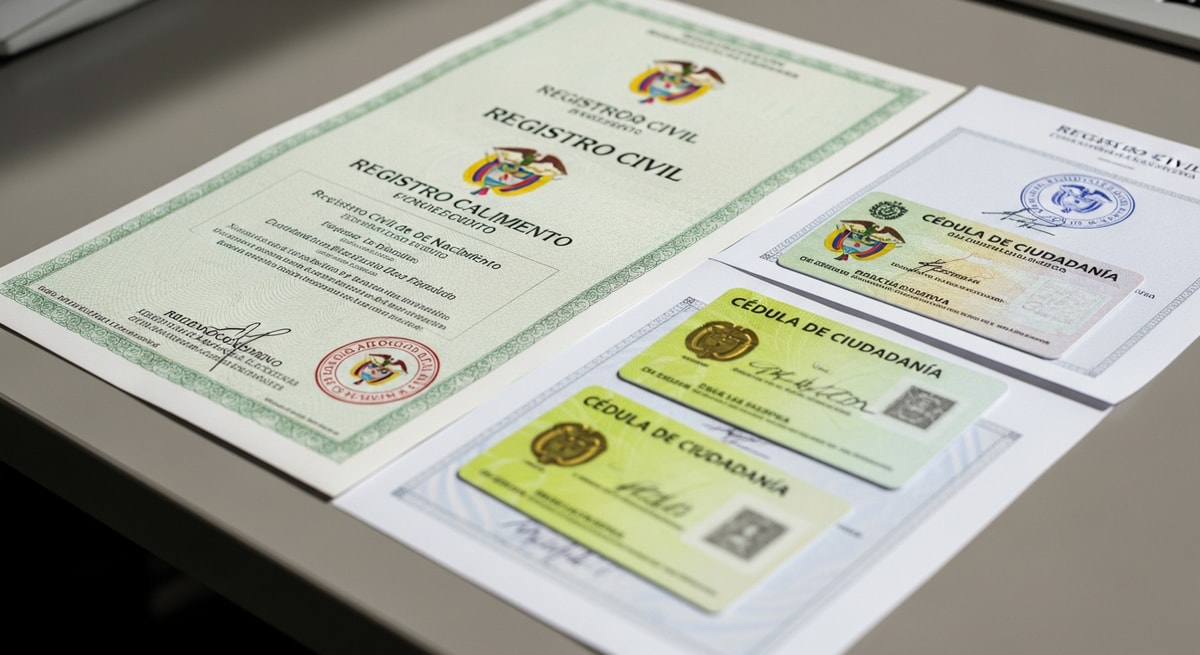
Colombian civil documents issued by the Registraduria Nacional del Estado Civil require specialized translation expertise
"Needed my Colombian Registro Civil de Nacimiento and Registro Civil de Matrimonio translated for a USCIS I-130 petition. Both translations were accepted without any RFE. The translator captured all the Registraduria formatting perfectly."
"DoVisa translated my Colombian university diploma and Certificado de Notas for WES credential evaluation. WES processed my evaluation in standard time with no requests for corrections. The academic terminology was rendered perfectly in English."
"Good translation of my Colombian birth certificate and police clearance for a Canadian Express Entry application. IRCC processed everything without issues. Giving 4 stars because the standard delivery took the full 5 days, but quality was excellent."
"Translated my Colombian Antecedentes Judiciales, birth certificate, and marriage certificate for an Australian partner visa. The Department of Home Affairs accepted all three translations on first submission. Quick turnaround and fair pricing."
"Used DoVisa for translating my Colombian Acta de Grado and transcripts for a graduate school application in the UK. The translations were accurate and UK NARIC accepted them for credential evaluation. Delivery was on time."
"Our company needed the Certificado de Existencia y Representacion Legal from the Camara de Comercio translated to English for a business partnership in the United States. The translation was impeccable and our US attorneys accepted it immediately."
"DoVisa handled the translation of my complete USCIS naturalization package — birth certificate, marriage certificate, police clearance, and diploma. All documents were delivered in 4 days and USCIS accepted everything without a single RFE. Highly recommend."
"Colombian birth certificate translation was accurate but the initial version had my second surname slightly misspelled. They corrected it within a few hours after I pointed it out. The corrected version was accepted by IRCC for my application."
"Needed my Colombian divorce decree and custody agreement translated for a UK family visa application. The translators handled the complex legal terminology professionally. UK Visas and Immigration accepted everything without questions."
"Translated my Colombian Libreta Militar and Cedula de Ciudadania for a New Zealand work visa. Immigration New Zealand processed the application smoothly. Good quality translation with proper handling of all the Colombian document formatting."
"DoVisa translated my Colombian nursing credentials for registration with the Australian Health Practitioner Regulation Agency. The AHPRA evaluation proceeded without any translation-related issues. Professional service overall."
"Moved from Medellin to Toronto and needed my Colombian police clearance and academic transcripts translated for my permanent residence application. IRCC accepted the translations without any issues. The whole process was smooth and pricing was transparent."
"Needed my Colombian Registro Civil de Nacimiento and Registro Civil de Matrimonio translated for a USCIS I-130 petition. Both translations were accepted without any RFE. The translator captured all the Registraduria formatting perfectly."
"DoVisa translated my Colombian university diploma and Certificado de Notas for WES credential evaluation. WES processed my evaluation in standard time with no requests for corrections. The academic terminology was rendered perfectly in English."
"Good translation of my Colombian birth certificate and police clearance for a Canadian Express Entry application. IRCC processed everything without issues. Giving 4 stars because the standard delivery took the full 5 days, but quality was excellent."
Colombian Document Translation FAQs
What is a traductor oficial and do I need one?
A traductor oficial is a licensed official translator in Colombia who holds a Certificado de Idoneidad (Certificate of Suitability) issued by the Universidad Nacional de Colombia, the Universidad de Antioquia, or the Ministerio de Justicia y del Derecho. Colombian law (Decreto 382 of 1951, as modified by Ley 962 of 2005) requires that translations for domestic legal use within Colombia — such as submissions to Colombian courts, the Registraduria Nacional, notarias, or Migracion Colombia — be produced by a traductor oficial. However, if you are translating Colombian documents for use abroad (for example, for USCIS, IRCC, UK Home Office, or Australian DHA), these foreign authorities do not require Colombian traductor oficial credentials. They accept certified translations from qualified translators meeting their own standards. DoVisa provides both options: internationally certified translations for foreign use, and traductor oficial coordination for domestic Colombian requirements.
Are DoVisa translations accepted by USCIS for Colombian documents?
Yes. Our certified translations of Colombian documents are fully compliant with USCIS requirements as specified in 8 CFR 103.2(b)(3). Every translation includes a signed certification statement in which the translator attests to their competence in both Spanish and English and to the translation's completeness and accuracy. We have extensive experience translating Colombian Registros Civiles, Cedulas de Ciudadania, Certificados de Antecedentes Judiciales, academic credentials, and other documents for I-130, I-485, I-140, N-400, and other USCIS forms. Our translations consistently pass USCIS adjudication without Requests for Evidence related to translation quality.
How much does certified Colombian translation cost?
Our Colombian certified translation pricing follows a transparent per-page structure with volume discounts that apply automatically for larger document sets. Pricing varies based on document length, language pair, and the processing speed you select. Express and rush service options are available for time-sensitive immigration deadlines. Apostille processing through the Cancilleria is quoted separately. Upload your documents on our order page to receive an instant, detailed quote before work begins — no hidden fees or surprise charges.
Can DoVisa handle the apostille process for Colombian documents?
Yes. Colombia's apostille process is managed entirely online through the Cancilleria (Ministerio de Relaciones Exteriores) portal. Colombia has implemented a fully electronic e-Apostille system available 24/7 from anywhere in the world. Processing typically completes within 24 hours of verification. Each apostille includes a QR code for instant authenticity verification. DoVisa handles the complete apostille application process including online submission, fee payment, verification tracking, and delivery of the apostilled document. For countries that are not Apostille Convention members, we coordinate full consular legalization through the Cancilleria and the destination country's embassy.
What documents do I need translated for a US green card application?
Colombian applicants for US permanent residence typically need certified translations of: Registro Civil de Nacimiento (birth certificate), Registro Civil de Matrimonio (marriage certificate, if applicable), Sentencia de Divorcio (divorce decree, if applicable), Certificado de Antecedentes Judiciales (police clearance), Cedula de Ciudadania (national ID), and academic diplomas and transcripts if employment-based. Some petitions also require translated military service records (Libreta Militar) and financial documents. DoVisa offers immigration translation packages at bundled rates covering all standard documents needed for I-130, I-485, and related USCIS filings.
How do you handle Colombian names with multiple surnames?
Colombian naming conventions follow the Spanish two-surname system, where a person carries their father's first surname followed by their mother's first surname (for example, Garcia Lopez). Our translators preserve the complete legal name exactly as it appears on the source document, including all given names and both surnames. We do not abbreviate, reorder, or omit any part of the name. Special characters including tildes and accented vowels are preserved in the translation. When the receiving authority's forms have limited name fields, we include a translator's note explaining the Colombian naming convention to prevent confusion during processing.
What is the turnaround time for Colombian document translation?
Standard delivery for Colombian document translation is 3-5 business days from receipt of legible source documents. Express 48-hour service is available for documents up to 5 pages. Same-day rush service is available for single-page vital records (birth, marriage, death certificates) with orders placed before 10:00 Colombian time (UTC-5). Turnaround for larger projects (academic transcripts with multiple pages, corporate document packages) is quoted individually based on volume. Apostille processing through the Cancilleria adds approximately 1-2 business days to the total timeline.
Are digital PDF translations accepted by immigration authorities?
Yes, most international immigration authorities accept digital PDF copies of certified translations for initial submission. USCIS accepts electronic submissions through its online filing system. IRCC accepts digital copies for Express Entry and other online applications. The UK Home Office accepts scanned translations for online visa applications. The Australian DHA accepts digital copies through ImmiAccount. DoVisa delivers high-resolution certified PDFs for immediate use with online applications. Physical hard copies with original signatures are also available and shipped via tracked international courier for authorities that require wet-ink originals during in-person interviews or biometrics appointments.
Can I get my Colombian academic credentials translated for WES evaluation?
Yes. We have extensive experience translating Colombian academic documents for WES (World Education Services), ECE (Educational Credential Evaluators), and other NACES member organizations. Colombian academic documents we commonly translate include the Diploma, Acta de Grado (degree certificate), Certificado de Notas (transcript), and the Tarjeta Profesional (professional license card). Our academic translators understand the Colombian higher education system, including the distinction between titulos profesionales, tecnologicos, and tecnicos, the SNIES (Sistema Nacional de Informacion de la Educacion Superior) institutional codes, and Colombian grading scales. Translations are formatted to meet WES and ECE evaluation requirements.
Do I need to apostille my Colombian documents before translation?
The sequencing depends on the receiving authority's requirements. For most international immigration applications, the translation is done first, and the apostille (if required) is applied to the original document separately. Some authorities require the apostille to be on the original Colombian document before it is translated, while others accept the translation and apostille as separate documents. USCIS does not require apostilles on source documents. IRCC generally does not require apostilles. Some European countries require apostilled originals. DoVisa's project managers advise you on the correct sequence for your specific destination country and application type, ensuring your documents meet all requirements.
What if the immigration authority rejects my translation?
DoVisa offers an acceptance guarantee for all certified translations submitted to recognized immigration authorities. If USCIS, IRCC, UK Visas and Immigration, the Australian DHA, New Zealand Immigration, or any other major immigration authority rejects our translation due to a formatting, terminology, or certification issue, we will revise and reissue the translation at no additional cost within 24 hours. In our experience, rejections are extremely rare (under 0.9% of submissions) and typically relate to individual case officer preferences rather than translation errors. If a revision does not resolve the issue, we provide a full refund. Please note that rejections based on the content of the original document or missing source documents are outside this guarantee's scope.
How do you translate Colombian Registros Civiles issued by the Registraduria?
Colombian Registros Civiles issued by the Registraduria Nacional del Estado Civil follow a standardized format that includes the NUIP (Numero Unico de Identificacion Personal), serial number, issuing office, and detailed civil status information. Our translators are thoroughly familiar with the Registraduria's document format, including the various versions issued over the decades (older handwritten formats through modern digitized certificates). We accurately translate all fields including marginal notes (notas marginales), annotations, and official stamps. The NUIP, serial numbers, and other alphanumeric identifiers are preserved exactly as they appear in the original. When Registros Civiles include legal annotations such as marriage registrations, adoptions, or name changes, we translate these with proper legal terminology in the target language.
Can DoVisa translate Colombian court documents and legal judgments?
Yes. Our legal translation team handles Colombian court documents including sentencias (judgments), autos (judicial orders), demandas (legal complaints), and correspondence from Colombian courts at all levels — from Juzgados Municipales through the Corte Suprema de Justicia. We translate complex Colombian procedural law terminology from the Codigo General del Proceso and substantive law from the Codigo Civil. For international legal proceedings, divorce recognition cases, and child custody matters under international conventions, our translations preserve the legal precision of the original Colombian judicial language while rendering it accurately in the target language for foreign courts and attorneys.
What languages can Colombian documents be translated into?
DoVisa supports 100+ language pairs for Colombian document translation. The most commonly requested target languages for Colombian documents are English (for US, UK, Canada, Australia, and New Zealand immigration), French (for Canadian Quebec immigration and French-speaking countries), Portuguese (for Brazil), German (for German immigration and credential recognition), and Italian (for Italian ancestry and immigration applications). We also provide translations into Arabic, Chinese, Japanese, Korean, Dutch, and dozens of other languages. All language pairs receive the same certification, quality review, and acceptance guarantee regardless of the target language.
Get Your Colombian Certified Translation Today
Traducciones certificadas of Colombian documents accepted by USCIS, IRCC, UK Home Office, and immigration authorities worldwide