Certified Turkmen Document Translation for Turkmenistan
Professional certified translations of Turkmen and Russian-language documents from Turkmenistan. Turkmen–English and 100+ language pairs with Ministry of Foreign Affairs legalization coordination.
TrustpilotSelect Languages
Drag & drop your documents here
or
PDF, JPEG, PNG, WebP — Max 10MB per file. Word documents: please save as PDF first.
Certified translators · Accepted by governments, courts & universities worldwide · View sample
Select a destination country to view pricing
How Turkmenistan Certified Translation Works
Submit Your Documents Securely
Upload clear scans of your Turkmen or Russian-language documents through our encrypted portal. We accept PDF, JPEG, and PNG formats. Turkmenistan officially uses the <strong>New Turkmen Alphabet</strong> (Täze Türkmen Elipbiýi) — a Latin-script alphabet adopted in 1993 and finalized in 2000 — though older documents may use Cyrillic Turkmen script. Russian remains widely used in official contexts. Our intake specialists identify the script and language of each document and confirm the authentication pathway required.
Expert Turkmen or Russian Translator Assignment
Your documents are matched with a qualified translator specializing in Turkmen legal and administrative terminology or Russian official language, depending on the document's language. Our translators understand the specific vocabulary of Turkmenistani civil documents — including terms such as dogluş şahadatnamasy (birth certificate) and nikah şahadatnamasy (marriage certificate) — and are familiar with the administrative framework of Türkmenistanyň Daşary işler ministrligi (Ministry of Foreign Affairs).
Translation & Quality Review
The translator produces your certified translation with careful attention to Turkmen naming conventions, regional administrative references (welaýat provinces), and the official document formats issued under Turkmenistan's civil registration system. A second linguist reviews the translation for accuracy and completeness. Documents issued before 2000 may use Cyrillic Turkmen, which requires specialist knowledge distinct from modern Latin-script Turkmen — our translators are qualified in both forms.
Delivery with Full Certification
Receive your certified translation as a high-resolution PDF for immediate use, with the original stamped hard copy shipped via tracked courier. For documents requiring authentication by the Turkmenistanyň Adalat ministrligi (Ministry of Justice) and the Türkmenistanyň Daşary işler ministrligi (Ministry of Foreign Affairs) for use abroad, DoVisa coordinates the complete consular legalization chain including the destination country's embassy in Ashgabat.
Turkmenistan Translation Service Specifications
Popular Language Pairs
We support all languages — 100+ language pairs available for Turkmenistan documents.
Common Documents
- Birth certificates (dogluş şahadatnamasy)
- Marriage certificates (nikah şahadatnamasy)
- Death certificates (ölüm şahadatnamasy)
- National passports and identity documents
- Household registration certificates
- Academic transcripts and degree diplomas
- Police clearance certificates
- Court orders and divorce decrees
- Employment records and professional certificates
- Company registration documents
- Medical records and hospital documentation
- Power of attorney documents
Turnaround Time
Certification Details
Turkmenistan Translation Requirements & Regulatory Framework
Embassy Acceptance
Notarization Process
Apostille Information
Legal Framework
Common Scenarios for Turkmenistan Document Translation
Immigration & Visa Applications
Turkmenistani nationals emigrating abroad need certified translations of birth certificates (dogluş şahadatnamasy), marriage certificates (nikah şahadatnamasy), police clearances, and household registration certificates for visa applications with USCIS, IRCC, UK Visas and Immigration, and the Australian Department of Home Affairs. DoVisa provides certified translations with Ministry of Foreign Affairs authentication coordination.
Academic Credential Evaluation
Turkmenistani students and professionals applying to foreign universities or seeking credential equivalency need certified translations of academic transcripts, degree diplomas, and professional qualifications. Organizations such as WES, ECE, and NACES member agencies accept our certified translations for credential evaluation of documents from Turkmenistani universities and secondary schools.
Marriage & Family Documentation
Foreign nationals marrying in Turkmenistan must provide certified translations of birth certificates, single-status certificates, and passport pages for civil registry proceedings. Turkmenistani marriage certificates being used abroad for spouse visa applications require certified translation plus Ministry of Foreign Affairs authentication and embassy legalization in Ashgabat.
Energy & Business Contracts
Turkmenistan's energy sector — one of the world's largest natural gas exporters — generates significant demand for certified translations of commercial contracts, joint venture agreements, and regulatory documents. International energy companies operating in Turkmenistan regularly require Turkmen-to-English and Russian-to-English translations of licensing documents, technical reports, and corporate filings.
Legal Proceedings
Court orders, property documents, divorce decrees, and other legal documents from Turkmenistani courts require certified translation for use in foreign legal proceedings or inheritance matters. Our translators are experienced in Turkmenistani legal terminology and civil court document formats in both Turkmen and Russian.
Government & Diplomatic Documentation
Government agencies, diplomatic missions, and international organizations working with Turkmenistan require certified translations of official correspondence, legislative texts, and regulatory documents. Our translators handle formal Turkmen and Russian administrative language to the standard required for diplomatic and governmental use.
The Turkmen Language and Its Alphabet Transition
Turkmen (türkmen dili) is a Turkic language spoken by approximately 10 million people, primarily in Turkmenistan. It is closely related to Turkish and other Oghuz Turkic languages, sharing significant vocabulary and grammatical structure. Like Turkish, Turkmen uses vowel harmony — a systematic feature where the vowels within a word agree in terms of frontness and roundedness.
Turkmenistan's official writing system has undergone a significant transition in recent decades. During the Soviet era, Turkmen was written in Cyrillic script. Following independence in 1991, the government introduced a Latin-script alphabet in 1993, which was revised and finalized as the New Turkmen Alphabet (Täze Türkmen Elipbiýi) in 2000. This alphabet uses 30 letters, including several characters with diacritics and special forms such as ä, ö, ü, ň, ş, ž, ý — essential to accurate transliteration of Turkmen sounds.
This script transition means that Turkmenistani documents issued before approximately 2000 are written in Cyrillic Turkmen, while documents issued after 2000 use the Latin New Turkmen Alphabet. Additionally, Russian remains widely used in official and administrative contexts, and many official documents — particularly those issued during or shortly after the Soviet era — are in Russian. Our translators are qualified in Latin-script Turkmen, Cyrillic Turkmen, and Russian, enabling us to handle the full range of Turkmenistani document types accurately.
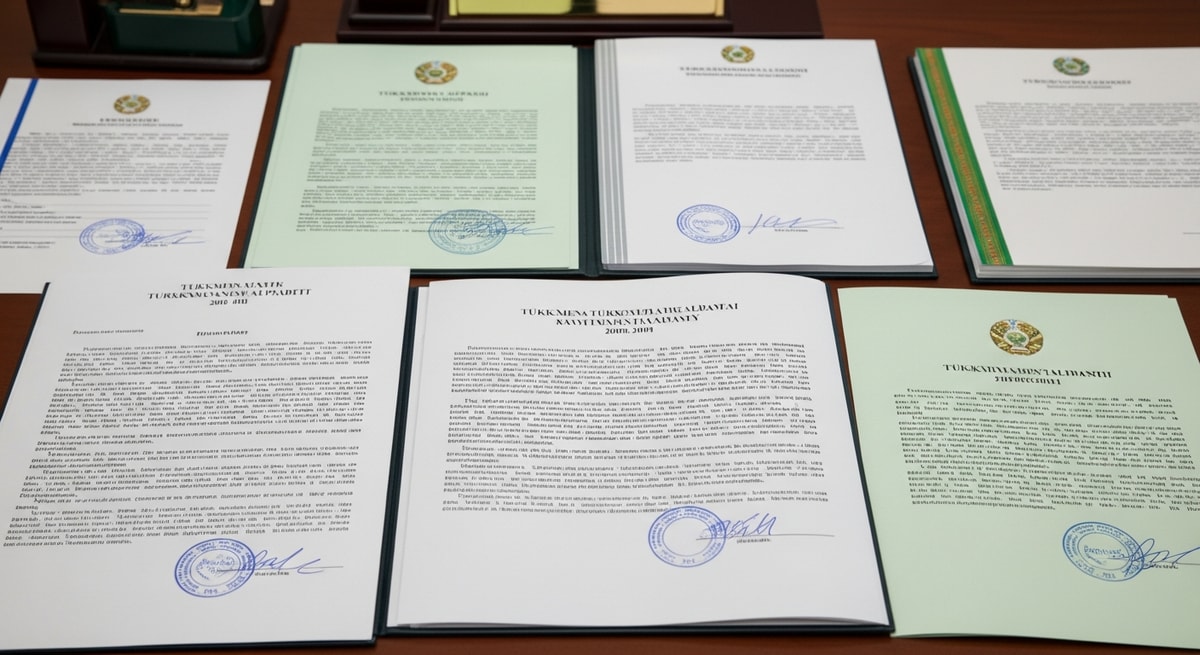
The New Turkmen Alphabet (Täze Türkmen Elipbiýi) replaced Cyrillic script in 2000 for all official Turkmenistani documents
Consular Legalization: Getting Turkmenistani Documents Accepted Abroad
Since Turkmenistan is not a member of the Hague Apostille Convention, Turkmenistani documents intended for use in foreign countries cannot receive a simple apostille stamp. Instead, they must undergo a full consular legalization process — a multi-step authentication chain that verifies the document's authenticity at each governmental level.
The standard legalization chain for Turkmenistani documents proceeds as follows: the document first receives a certified translation, then undergoes authentication by the Turkmenistanyň Adalat ministrligi (Ministry of Justice), followed by authentication by the Türkmenistanyň Daşary işler ministrligi (Ministry of Foreign Affairs) in Ashgabat. The fully authenticated package is then submitted to the embassy or consulate of the destination country in Ashgabat for final legalization. The complete process typically takes 15-30 business days, though individual embassy processing times vary.
Turkmenistan's relative geographic isolation and the limited number of foreign embassies based in Ashgabat mean that some destination countries handle Turkmenistani documents through their nearest regional embassy rather than a resident Ashgabat mission. DoVisa tracks current embassy presence in Ashgabat and advises on the most practical legalization pathway for your specific destination country. We manage the complete legalization chain from initial authentication through to delivery of the fully legalized document set.
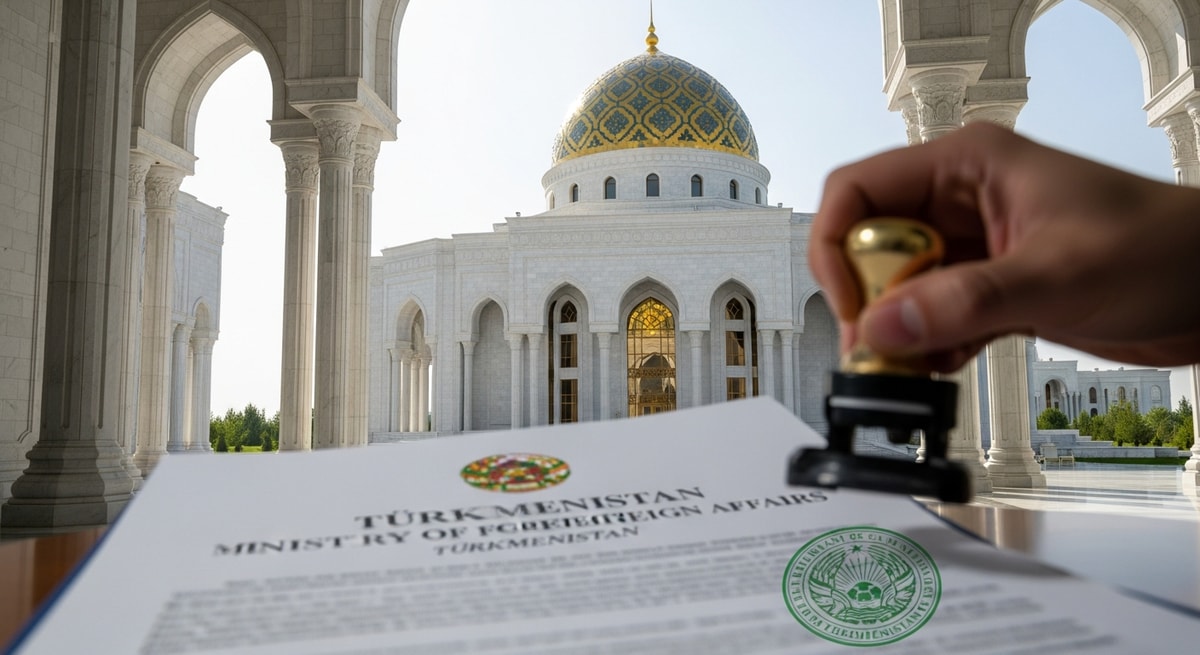
The Türkmenistanyň Daşary işler ministrligi (Ministry of Foreign Affairs) authenticates documents for international recognition
Turkmenistan's Civil Registration System and Document Types
Turkmenistan's civil registration system inherited its structural framework from the Soviet-era ZAGS system (Zapis Aktov Grazhdanskogo Sostoyaniya — Civil Acts Registration). Civil registry offices at the district level issue vital records including birth certificates (dogluş şahadatnamasy), marriage certificates (nikah şahadatnamasy), and death certificates (ölüm şahadatnamasy). The system is administered by the Turkmenistanyň Adalat ministrligi (Ministry of Justice).
Birth certificates issued in Turkmenistan include the child's full name in Turkmen, date and place of birth, the parents' names and nationalities, and a registry number. Documents issued during the Soviet era may use patronymic naming conventions (father's name as a middle name suffix), which are still widely used in Turkmenistan today. Patronymics typically end in -ow/-ow (male) or -owa/-owa (female) in Turkmen Latin script, or -ов/-ова in Russian/Cyrillic documents. Understanding these naming conventions is critical for accurate translation and consistent name identification across multiple documents.
Older documents — particularly from the Soviet period — are often in Russian rather than Turkmen, and may use Cyrillic Turkmen for names and place names. The transition to Latin-script Turkmen in official documents after 2000 means that translators working with Turkmenistani documents must be qualified in all three forms: Latin Turkmen, Cyrillic Turkmen, and Russian. DoVisa's specialist Turkmen translators cover all document eras and both scripts.
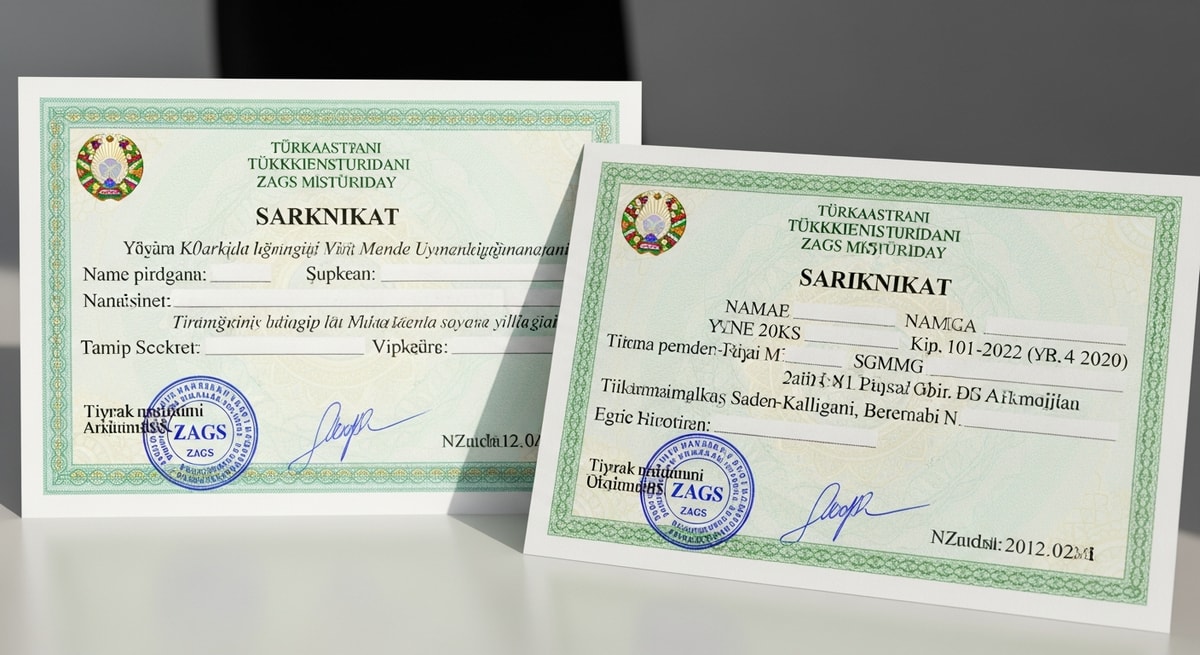
Turkmenistani civil registry offices issue dogluş şahadatnamasy (birth certificates) and nikah şahadatnamasy (marriage certificates)
"Had my Turkmenistani birth certificate (dogluş şahadatnamasy) translated into English for my USCIS green card application. USCIS accepted it without any requests for revision. The Latin Turkmen script was handled accurately."
"Translated my Turkmenistani marriage certificate into English for a spousal visa to Australia. The Department of Home Affairs accepted the certified translation immediately. Professional service and good communication throughout."
"Good quality translation of my Turkmenistani academic transcripts from a university in Ashgabat for a WES credential evaluation. WES accepted everything. Took the full 6 days for standard delivery but the quality was excellent."
"DoVisa translated my old Soviet-era Turkmenistani birth certificate which was in Cyrillic Turkmen script. The translator clearly had expertise in both Cyrillic and Latin Turkmen. IRCC accepted it for my Canadian PR application."
"Our energy company needed technical contracts translated from Russian into English for a Turkmenistani joint venture project. The legal and technical terminology was accurately rendered throughout the 30-page document set."
"Translated my Turkmenistani police clearance into English for a UK skilled worker visa. UK Visas and Immigration accepted it without question. The certification statement met all requirements."
"Had my Turkmenistani university diploma and transcripts translated into German for a graduate school application in Germany. The German admissions office accepted the certified translations. Fast turnaround on express service."
"The translation of my Turkmenistani marriage certificate was accurate but I received it at the end of the 6-day window. Customer support kept me informed and the document was accepted by Immigration New Zealand as required."
"Translated several pages of Turkmenistani company registration documents for our international expansion. The corporate terminology in both Turkmen and Russian sections was handled accurately and our legal team approved everything."
"Needed Turkmenistani property documents translated from Russian into English for an international inheritance matter. Good quality work from a translator clearly experienced with Turkmenistani legal document formats."
"DoVisa translated my divorce decree and custody documents from Turkmenistani courts for a family visa application. The legal terminology was precise and the Australian High Commission accepted the certified translations."
"Had my Turkmenistani birth certificate (dogluş şahadatnamasy) translated into English for my USCIS green card application. USCIS accepted it without any requests for revision. The Latin Turkmen script was handled accurately."
"Translated my Turkmenistani marriage certificate into English for a spousal visa to Australia. The Department of Home Affairs accepted the certified translation immediately. Professional service and good communication throughout."
"Good quality translation of my Turkmenistani academic transcripts from a university in Ashgabat for a WES credential evaluation. WES accepted everything. Took the full 6 days for standard delivery but the quality was excellent."
Turkmenistan Document Translation FAQs
What types of Turkmenistani documents can DoVisa translate?
DoVisa translates all categories of Turkmenistani official and personal documents including birth certificates (dogluş şahadatnamasy), marriage certificates (nikah şahadatnamasy), death certificates (ölüm şahadatnamasy), national passports and identity documents, household registration certificates, academic transcripts and degree diplomas, police clearance certificates, court orders and divorce decrees, company registration documents, energy and commercial contracts, medical records, and power of attorney documents. Documents in both Turkmen (Latin or Cyrillic script) and Russian are translated.
Are DoVisa's Turkmenistani translations certified?
Yes, every translation includes a signed certification statement from the translator attesting to the accuracy and completeness of the translation. This declaration includes the translator's full name, qualifications, and a statement that the translation is a true rendering of the original. Our certified translations are accepted by USCIS, IRCC, UK Visas and Immigration, the Australian Department of Home Affairs, Immigration New Zealand, and credential evaluation agencies such as WES and ECE worldwide.
How long does Turkmenistani document translation take?
Standard delivery is 4-6 business days for most document types. Single-page documents such as birth certificates typically complete in 4 business days, while multi-page documents may require the full 6 business days. Express service delivers within 2-3 business days, and rush delivery is available within 24 hours for select single-page documents. If you require Ministry of Justice and Ministry of Foreign Affairs authentication plus embassy legalization in Ashgabat, add approximately 15-30 additional business days.
What languages can Turkmenistani documents be translated into?
DoVisa offers Turkmen and Russian translation into and from 100+ languages. Most common pairs include Turkmen–English and Russian–English (for immigration and international business), Turkmen–Turkish (reflecting close linguistic and diplomatic ties), Turkmen–German and Turkmen–French (for European immigration), Turkmen–Chinese (for energy sector trade), and Turkmen–Arabic (for regional trade). Less common pairs are available with slightly longer turnaround.
Will my Turkmenistani translation be accepted by immigration authorities?
Yes, our certified translations of Turkmenistani documents are formatted to meet international immigration requirements. For USCIS, we include the required certification statement with full translator credentials. For IRCC (Canada), we use the specific certified format required. Our translations also meet requirements of UK Visas and Immigration, the Australian Department of Home Affairs, and Immigration New Zealand. Each translation includes a cover page identifying the original document type, language pair, and page count.
Do I need notarization with my Turkmenistani translation?
Most international immigration agencies accept our standard certified translation without additional notarization. For documents that must undergo the consular legalization process through Turkmenistan's Ministry of Justice and Ministry of Foreign Affairs, the document may require notarization by a Turkmenistani state notary as part of the authentication chain before the ministries will process it. DoVisa advises on the specific requirements for your destination country and coordinates the full legalization process if needed.
Can Turkmenistani documents get an apostille?
No. Turkmenistan is not a member of the Hague Apostille Convention, so Turkmenistani documents cannot receive an apostille. Instead, documents intended for international use must undergo consular legalization: authentication by the Turkmenistanyň Adalat ministrligi (Ministry of Justice), then authentication by the Türkmenistanyň Daşary işler ministrligi (Ministry of Foreign Affairs), then legalization by the destination country's embassy in Ashgabat. This process typically takes 15-30 business days. DoVisa manages the entire chain on your behalf.
How much does Turkmenistani document translation cost?
Our Turkmen and Russian translation pricing is based on a per-page rate with volume discounts that apply automatically for larger orders. Pricing varies by language pair, document complexity, and selected processing speed. Legalization services through the Ministry of Foreign Affairs and embassy legalization are quoted separately. Upload your documents on our order page to receive a detailed instant quote before any work begins.
Can you translate handwritten Turkmenistani documents?
Yes, our translators are experienced with handwritten Turkmenistani documents. Older records from district ZAGS offices may contain handwritten entries in Russian, Cyrillic Turkmen, or early Latin-script Turkmen. We can handle all three script forms. For documents with compromised legibility, we note any unclear sections and provide our best professional interpretation. Submitting the clearest available copy ensures the most accurate result.
What format will I receive my Turkmenistani translation in?
You will receive your certified translation as a high-resolution PDF delivered via email. The PDF includes the translated document, the translator's signed certification statement, and a copy of the original for reference. Hard copies with wet-ink signatures can be shipped to any address via tracked courier upon request. For multi-page documents, we provide a compiled document with a professional cover page listing document types, language pairs, and page counts.
Can you translate documents in both Cyrillic and Latin Turkmen script?
Yes. Turkmenistan's official script changed from Cyrillic to the New Turkmen Alphabet (Latin script) between 1993 and 2000. Documents issued before approximately 2000 are typically in Cyrillic Turkmen or Russian, while documents issued after 2000 use Latin-script Turkmen. Our specialist Turkmen translators are qualified in all three forms — Latin Turkmen, Cyrillic Turkmen, and Russian — enabling us to handle the full range of document ages and types accurately.
How do you handle Turkmenistani patronymic names in translations?
Turkmenistani naming conventions follow a patronymic system in which a person's middle name is derived from the father's first name. In Turkmen, male patronymics typically end in -ow or -muhammedow style suffixes, while female patronymics end in -owa. In Russian-language documents, the same names appear with Cyrillic patronymic endings (-ов/-ова). Our translators carefully match the name spelling across all submitted documents and align it with the romanization used on the individual's passport to prevent identity discrepancies.
Can DoVisa help with the full legalization process for Turkmenistani documents?
Yes, DoVisa offers a complete legalization management service. Since Turkmenistan is not a Hague Convention member, documents for international use require: certified translation, authentication by the Turkmenistanyň Adalat ministrligi (Ministry of Justice), authentication by the Türkmenistanyň Daşary işler ministrligi (Ministry of Foreign Affairs), and legalization by the destination country's embassy in Ashgabat. We handle each step, managing submissions, tracking progress, and collecting completed documents. The full process typically takes 15-30 business days.
Get Your Turkmenistani Documents Translated Today
Professional certified translations accepted by international authorities and Turkmenistani government agencies