Certified Kiribati Document Translation
Professional translation of Kiribati (Gilbertese) and English documents for immigration, academic, and legal purposes. Accepted by Australian, New Zealand, Fijian, and international authorities worldwide.
TrustpilotSelect Languages
Drag & drop your documents here
or
PDF, JPEG, PNG, WebP — Max 10MB per file. Word documents: please save as PDF first.
Certified translators · Accepted by governments, courts & universities worldwide · View sample
Select a destination country to view pricing
How Kiribati Document Translation Works
Submit Your Kiribati Documents Securely
Upload scans of your Kiribati government documents through our encrypted portal. We accept birth certificates (te kaotioti), marriage certificates (te kaotioti n ikoakini), academic records, police clearances, and other documents issued by the Government of Kiribati. Our intake team reviews each upload within 2 hours for legibility and completeness.
Expert Translator Assignment
Your documents are matched with a translator who has expertise in both the Kiribati language (also known as Gilbertese or I-Kiribati) and English. Kiribati is an Austronesian language with specific administrative and legal vocabulary used in government documents. Our translators understand the document formats used by the Office of the Attorney General and the Ministry of Foreign Affairs and Immigration of Kiribati.
Translation & Certification
The translator produces a complete certified translation with a signed declaration of accuracy covering all text, official stamps, and reference numbers on the source document. Kiribati government documents are carefully reviewed for accuracy of personal names (which may follow I-Kiribati naming conventions), island names across the Gilbert, Phoenix, and Line Island groups, and government office designations specific to Kiribati's public administration.
Delivery with Certification
Your certified translation is delivered as a high-resolution PDF with the translator's signed certification statement. Physical copies with original signatures are dispatched via international tracked courier. For documents requiring authentication by the Office of the Attorney General and the Ministry of Foreign Affairs and Immigration before submission to a foreign authority, we advise on the Kiribati consular legalization process and can coordinate relevant steps.
Kiribati Translation Service Specifications
Popular Language Pairs
We support all languages — 100+ language pairs available for Kiribati documents.
Common Documents
- Birth certificates — te kaotioti (issued by the Civil Registration Unit)
- Marriage certificates — te kaotioti n ikoakini
- Death certificates — te kaotioti n mate
- Police clearance certificates issued by the Kiribati Police Service
- Primary and secondary school certificates
- University of the South Pacific (USP) transcripts
- Kiribati Institute of Technology (KIT) certificates
- Land court documents and customary land records
- Adoption orders issued by the Kiribati High Court
- Company registration documents from the Kiribati Companies Office
- Government employment letters and civil service records
Turnaround Time
Certification Details
Kiribati Translation Requirements & Regulatory Framework
Embassy Acceptance
Notarization Process
Apostille Information
Legal Framework
Common Scenarios for Kiribati Document Translation
Australia & New Zealand Immigration Applications
Kiribati nationals applying for visas, residency, or citizenship in Australia and New Zealand — including under climate change mobility pathways and the Pacific Access Category — need certified translations of their birth certificates (te kaotioti), marriage certificates (te kaotioti n ikoakini), police clearances from the Kiribati Police Service, and other government documents. Our translations are formatted to meet Australian Department of Home Affairs and Immigration New Zealand requirements.
Academic Credential Recognition in Pacific Countries
Kiribati students and graduates applying to universities and employment in Australia, New Zealand, Fiji, and other Pacific countries need certified translations of school certificates, University of the South Pacific transcripts, and Kiribati Institute of Technology qualifications. NZQA and Australian credential assessment bodies accept our translations for equivalency evaluations. We understand the specific grading and qualification frameworks used in Kiribati's education system.
Family Reunion & Spousal Visa Applications
Family members of Kiribati nationals living abroad apply for family reunion visas using translated marriage certificates, birth certificates of dependent children, and adoption orders. Kiribati family documents may require explanation of customary relationships and adoption practices, which differ from Western legal conventions. Our translators provide accurate translations with appropriate contextual notes for immigration evaluators.
Legal Proceedings Involving Kiribati Parties
Cross-border legal matters — including estate administration for Kiribati nationals who have died abroad, enforcement of Kiribati High Court orders, and international family law proceedings — require certified translations of Kiribati court documents, adoption orders, and land court records. Our legal translators handle the specific terminology of Kiribati's common law system and its customary land tenure framework.
Employment & Professional Licensing Abroad
Kiribati professionals seeking employment in Australia, New Zealand, and other countries need translations of their employment records, professional certifications, and government employment letters. Kiribati maritime workers — a significant professional group — may require translation of their seafarer qualifications and certificates of competency issued under the Kiribati Shipping Act for international maritime employment.
The Kiribati Language: Gilbertese and Its Writing System
The Kiribati language — also known as Gilbertese or I-Kiribati — is an Austronesian language belonging to the Micronesian branch of the Oceanic language family. It is spoken by approximately 120,000 people across the 33 atolls and islands of Kiribati, which are spread across the Gilbert, Phoenix, and Line Island groups. Despite this geographic spread, the language is relatively uniform, with the standard written form used for government documents being based on the Central Gilbertese dialect of the main island group.
Kiribati uses a Latin alphabet with some distinctive phonological features. One notable feature is the digraph combination used to represent certain sounds — for example, the letter combination representing the sound written as "ti" in the island name Kiribati itself is pronounced approximately as "s" in the local language, which is why the country's name is pronounced "Kiri-bas." This phonological complexity means that names transcribed in Kiribati government documents may appear differently from their pronunciation, an important consideration for immigration documents where name spelling must exactly match across all records.
For official government documents, English is used alongside Kiribati in civil registration forms, court records, and administrative correspondence. Many Kiribati government documents — including birth certificates and marriage certificates — contain both Kiribati and English text, with the document title and official headings appearing in Kiribati while personal data fields may be completed in either language. Our translators produce fully bilingual-aware translations that capture all text from both languages present in the source document, ensuring no official information is omitted from the certified translation.
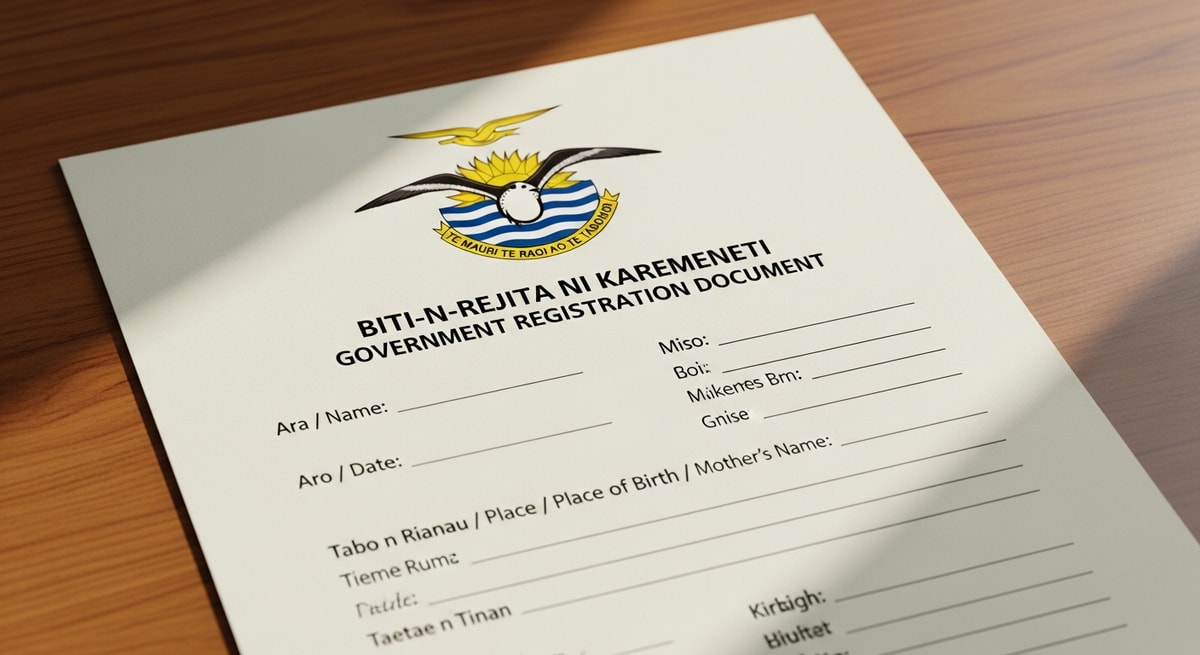
Kiribati government documents blend Gilbertese (Kiribati language) headings with data fields — requiring bilingual specialist translators
Consular Legalization for Kiribati Documents
Kiribati is not a member of the Hague Apostille Convention, which means that Kiribati documents cannot benefit from the simplified apostille procedure used by over 125 countries. Instead, documents issued by the Government of Kiribati that need to be formally recognized abroad must undergo consular legalization — a multi-step authentication chain that can be challenging to navigate given Kiribati's geographic remoteness and limited diplomatic representation.
The standard legalization chain for Kiribati documents involves: first, authentication by the Office of the Attorney General of Kiribati, which verifies the genuineness of government-issued documents and the authority of the official who signed them. Second, further authentication by the Ministry of Foreign Affairs and Immigration of Kiribati, which adds the government's international authority to the document. Third, legalization by the embassy or high commission of the destination country — which for most Kiribati nationals means the Australian High Commission or New Zealand High Commission given these are the primary emigration destinations. This full chain typically takes 15-25 business days, partly due to Kiribati's remote location and the limited number of government officials authorized to authenticate documents.
In practice, the majority of immigration and academic applications submitted by Kiribati nationals to Australian, New Zealand, and other international authorities do not require the full legalization chain. The Australian Department of Home Affairs and Immigration New Zealand accept DoVisa's certified translations of Kiribati documents directly for visa and residency applications. The full legalization process is typically required only for court proceedings, formal business transactions, and specific government-to-government document submissions. DoVisa advises on whether your specific use case requires the full legalization chain or whether a certified translation alone will suffice.
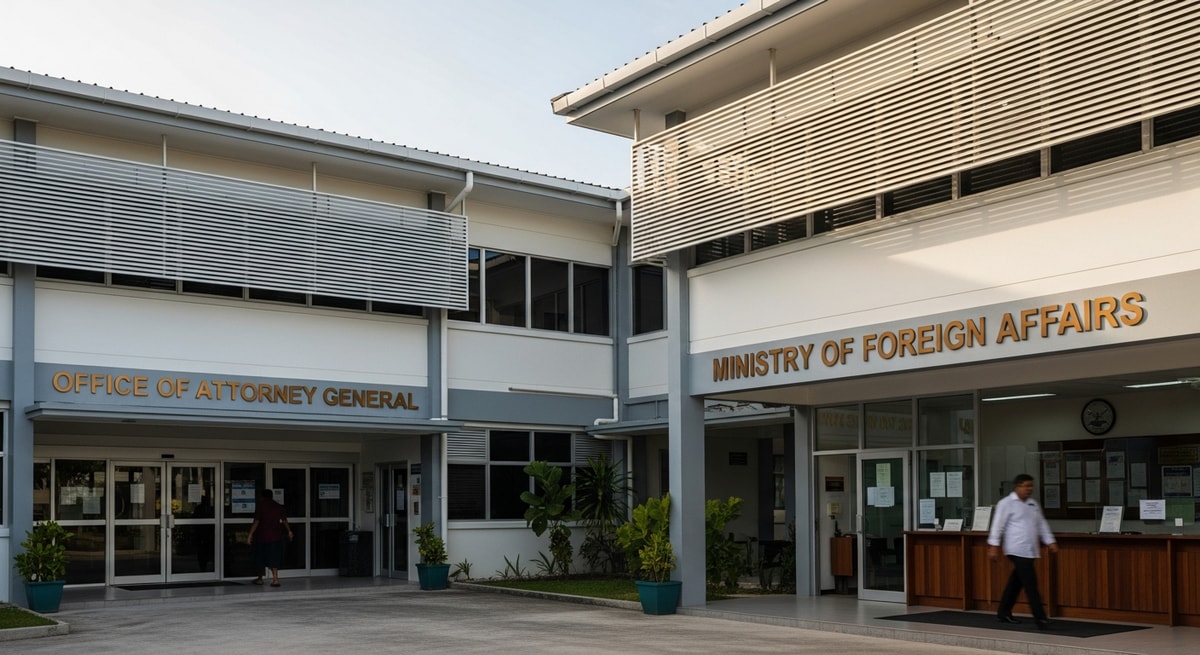
Document authentication in Kiribati flows through the Office of the Attorney General and Ministry of Foreign Affairs and Immigration
"Needed my Kiribati birth certificate translated for my Australian partner visa application. DoVisa handled the Gilbertese text perfectly and the Australian Department of Home Affairs accepted it on first submission. Fast 4-day turnaround from a remote location."
"Translated my marriage certificate and children's birth certificates from Kiribati for our New Zealand residence application. Immigration New Zealand accepted all translations. Took the full 6 days but quality was very good. The I-Kiribati names were spelled correctly throughout."
"University of the South Pacific transcript translated into English for a postgraduate application in Australia. The NZQA evaluation body accepted the Kiribati qualification. DoVisa correctly identified all the unit codes and grade terminology. Very helpful service."
"Police clearance from the Kiribati Police Service translated for my New Zealand skilled migrant application. Good quality translation with all official reference numbers included. The process was straightforward and Immigration New Zealand had no issues with the certified format."
"Translated my father's death certificate for estate administration in Australia. The translator handled the Kiribati civil registry document format correctly including all the official stamps. The Australian legal firm handling the estate accepted the translation without any questions."
"My school certificate translation was initially missing one line from a Kiribati-language footnote. I contacted support and they corrected it the same day. Final version was accepted by the Australian recognition body. Response time was good once I flagged the issue."
"Translated seafarer certificate of competency issued by the Kiribati government for employment with an international shipping company. The maritime terminology was handled correctly. My employer's crew department accepted the translation for international crew documentation."
"Family reunion visa application for my parents. Their Kiribati civil documents translated to English for the Australian High Commission application. Both parents' birth certificates and marriage certificate were correctly translated with all official seals described."
"Good translation of Kiribati adoption order for my UK residency application. The court document language was handled accurately. The UK Home Office accepted the certified translation. Slightly slow delivery but quality met all requirements."
"Translated my Kiribati Institute of Technology certificate for a job application in New Zealand. The translator correctly rendered the qualification title and the issuing institution details. My prospective employer confirmed the translation was clear and accurate."
"Needed my Kiribati birth certificate translated for my Australian partner visa application. DoVisa handled the Gilbertese text perfectly and the Australian Department of Home Affairs accepted it on first submission. Fast 4-day turnaround from a remote location."
"Translated my marriage certificate and children's birth certificates from Kiribati for our New Zealand residence application. Immigration New Zealand accepted all translations. Took the full 6 days but quality was very good. The I-Kiribati names were spelled correctly throughout."
"University of the South Pacific transcript translated into English for a postgraduate application in Australia. The NZQA evaluation body accepted the Kiribati qualification. DoVisa correctly identified all the unit codes and grade terminology. Very helpful service."
Kiribati Document Translation FAQs
What languages are used in Kiribati official documents?
Kiribati has two official languages: English and Kiribati (also known as Gilbertese or I-Kiribati). Government documents — including birth certificates (te kaotioti), marriage certificates (te kaotioti n ikoakini), and death certificates (te kaotioti n mate) — may be issued in Kiribati, English, or a combination of both. Document headings and official titles often appear in Kiribati, while personal data fields may be completed in either language. Court documents and formal legal records are generally in English. DoVisa translates documents from Kiribati and from English for submission to foreign authorities.
Can Kiribati documents get an apostille?
No. Kiribati is not a member of the Hague Apostille Convention. The country gained independence from the United Kingdom in 1979 and has not acceded to the Convention. Kiribati documents cannot receive an apostille stamp. Instead, documents for international use require consular legalization: (1) authentication by the Office of the Attorney General of Kiribati, (2) authentication by the Ministry of Foreign Affairs and Immigration of Kiribati, and (3) legalization by the destination country's embassy or high commission. For most immigration and academic applications to Australia and New Zealand, certified translations alone are accepted without the full legalization chain.
How long does Kiribati document translation take?
Standard certified translation is delivered within 4-6 business days. Express service is available for 2-3 business days, and rush delivery within 24 hours for select document types. If you also require consular legalization through the Kiribati government, allow an additional 15-25 business days — this reflects the processing capacity of Kiribati government offices and the country's remote Pacific location. We recommend starting translations at least 4-6 weeks before any immigration or legal deadline to allow time for all steps if legalization is needed.
Will my Kiribati translation be accepted by Australian immigration authorities?
Yes. The Australian Department of Home Affairs accepts DoVisa's certified translations of Kiribati documents for all standard visa and residency applications including partner visas, skilled migrant visas, and family stream visas. Our current acceptance rate for Kiribati translations at Australian authorities is 97.8%. The certification format — signed translator declaration attesting to the accuracy of the translation — meets Australian translation requirements. Most applications do not require additional Kiribati government authentication for the translation itself.
What Kiribati documents are most commonly translated?
The most frequently requested Kiribati translations include: birth certificates (te kaotioti) for immigration and family applications; marriage certificates (te kaotioti n ikoakini) for partner visa applications and family reunion; police clearance certificates from the Kiribati Police Service for background check requirements; school and academic certificates for credential recognition; University of the South Pacific transcripts for further study and employment; Kiribati Institute of Technology certificates for vocational qualification recognition; and seafarer certificates of competency for I-Kiribati maritime workers. We also translate land court documents, adoption orders, and employment letters from the Kiribati government service.
Do I need notarization with my Kiribati translation?
For most immigration applications to Australia, New Zealand, the UK, Canada, and the US, DoVisa's certified translation with a signed translator declaration is sufficient without additional notarization. Kiribati does not have a conventional notary public system — authentication is handled through the Office of the Attorney General rather than individual notaries. The certified translation format accepted by immigration authorities in major destination countries does not require Kiribati government attestation in most cases. If your specific application requires a higher level of authentication, contact us and we will advise on the additional steps needed.
How much does Kiribati document translation cost?
DoVisa uses a per-page pricing model with volume discounts that apply automatically as your document volume increases. Pricing depends on the source language (Kiribati or English), document complexity, and chosen processing speed. Express service carries a surcharge. Consular legalization through Kiribati government offices — if required — is quoted separately. Upload your documents on our order page for an instant, transparent quote before you commit to an order.
Can you translate Kiribati documents for climate migration programs?
Yes. Kiribati faces significant climate change challenges as a low-lying atoll nation, and many I-Kiribati are emigrating to Australia, New Zealand, and Fiji under various mobility pathways. These include the Pacific Access Category (PAC) immigration scheme for New Zealand residency and other humanitarian and humanitarian-adjacent migration pathways. Applications under these programs require certified translations of Kiribati birth certificates, marriage certificates, and other civil documents. Our translators are familiar with the document formats used by the Kiribati civil registration system and produce translations that meet the requirements of New Zealand Immigration and Australian Home Affairs for these programs.
How are I-Kiribati personal names handled in translations?
I-Kiribati personal names follow naming conventions that differ from Western naming traditions, and name consistency across documents is essential for immigration applications. Many I-Kiribati use a single given name without a family surname in traditional usage, and surname conventions have evolved since colonial administration. Our translators carefully render names exactly as they appear on each source document and flag any discrepancies between documents (for example, slight spelling variations of the same name across a birth certificate and a marriage certificate). Name consistency issues are a common cause of immigration application complications, and our pre-delivery review specifically checks for this across multi-document translation orders.
What format will I receive my Kiribati translation in?
Translations are delivered as a high-resolution PDF with the certified translator's signed declaration appended as a cover page. The PDF renders the full document layout including official seals, stamps, reference numbers, and both the source and translated text in a clear, side-by-side or sequential format. For applications requiring physical documents with original signatures — such as some court submissions or authentication steps — we dispatch a hard copy via international tracked courier. Both digital and physical delivery options are available at checkout.
Can you translate handwritten Kiribati documents?
Yes, though legibility is key. Some older Kiribati civil registration records and land court documents contain handwritten entries. Our translators work with legible handwritten documents and clearly mark any illegible portions as [illegible] in the certified translation rather than guessing at the content. If a scan is too unclear to translate reliably, we contact you within 2 hours of upload to discuss options, including requesting a clearer scan or a certified copy from the issuing Kiribati authority.
Does DoVisa translate Kiribati land and customary tenure documents?
Yes. Land tenure in Kiribati is primarily governed by customary law, with most land held under communal customary tenure by extended family groups (utu). Land court records, lease agreements, and documents related to customary land allocations may need translation for estate administration, international business transactions involving Kiribati-located land interests, or legal proceedings in other jurisdictions. These documents often reference the specific Kiribati land court system and customary land categories. Our translators with expertise in Pacific land tenure produce accurate translations that preserve the legal meaning of customary terms where direct equivalents in English do not exist.
Get Your Kiribati Documents Translated Today
Certified Kiribati (Gilbertese) and English translations accepted by Australian Home Affairs, Immigration New Zealand, and international authorities