Certified Ghanaian Document Translation
Professional certified translations for Ghanaian documents with Ministry of Foreign Affairs authentication and consular legalization support. Accepted by USCIS, UK Visas and Immigration, IRCC, and embassies worldwide. Over 100 language pairs available.
TrustpilotSelect Languages
Drag & drop your documents here
or
PDF, JPEG, PNG, WebP — Max 10MB per file. Word documents: please save as PDF first.
Certified translators · Accepted by governments, courts & universities worldwide · View sample
Select a destination country to view pricing
How Ghanaian Certified Translation Works
Upload Your Ghanaian Documents
Scan or photograph your Ghanaian documents and upload them through our encrypted portal. We accept all Ghanaian government-issued documents including Births and Deaths Registry certificates, WAEC/WASSCE certificates, university transcripts, and Ghana Police Service clearance certificates. Our intake team reviews each upload within 2 hours to confirm legibility, identify the issuing authority, and verify the document type for accurate translator assignment.
Expert Translator Assignment
Your documents are matched with a translator who understands Ghanaian administrative terminology and document formats. For translations from English into other languages, we assign native speakers of the target language with Ghanaian document expertise. For documents involving Ghanaian indigenous languages such as Akan (Twi), Ewe, Ga, or Dagbani — sometimes found in customary court records and traditional authority documents — we assign linguists with specific knowledge of those languages and their regional contexts across Ghana's 16 regions.
Translation & Quality Verification
The translator produces your certified translation with particular attention to Ghanaian-specific terminology such as WAEC/WASSCE grading conventions, Births and Deaths Registry certificate formats, and Ghana Immigration Service documentation. A second linguist cross-checks the translation for accuracy, consistent spelling of Ghanaian names and place names including Akan day-names, and proper formatting. All key terms and institutional references are verified against current Ghanaian government standards.
Delivery with Full Certification
Receive your certified translation as a high-resolution digitally signed PDF. For documents requiring the Ghanaian legalization chain, we coordinate notarization by a Commissioner for Oaths or Notary Public, authentication by the Judicial Service of Ghana, and endorsement by the Ministry of Foreign Affairs and Regional Integration in Accra. The destination country's embassy then provides final legalization. Hard copies are shipped via tracked international courier to your location in Ghana or abroad.
Ghana Translation Service Specifications
Popular Language Pairs
We support all languages — 100+ language pairs available for Ghanaian documents.
Common Documents
- Birth certificates from the Births and Deaths Registry (BDR)
- Marriage certificates (civil, customary, and Mohammedan ordinance)
- WAEC/WASSCE certificates (West African Senior School Certificate Examination)
- BECE certificates (Basic Education Certificate Examination)
- University transcripts and degree certificates
- National Service Secretariat (NSS) completion certificates
- Ghana Police Service criminal record clearance certificates
- Ghana Health Service professional certificates
- Company registration documents (Registrar General's Department / ORC)
- Death certificates from the Births and Deaths Registry
- Ghana Card (National Identification Authority) documentation
Turnaround Time
Certification Details
Ghana Translation Requirements & Regulatory Framework
Embassy Acceptance
Notarization Process
Apostille Information
Legal Framework
Common Scenarios for Ghanaian Document Translation
Ghanaian Immigration & Visa Applications
Ghanaians applying for visas to non-English-speaking countries need certified translations of their documents into the destination language. Common requirements include translating birth certificates, WAEC/WASSCE certificates, university transcripts, and police clearance certificates for embassy submissions. For foreign nationals working in Ghana, English translations of their home-country documents are needed for the Ghana Immigration Service work permit process. Our immigration packages cover complete document sets for the most common destination countries including Germany, France, Canada, and Australia.
Academic Credential Evaluation Abroad
Ghanaian students and professionals applying to international universities or seeking credential evaluation through agencies like WES (World Education Services) and ECE (Educational Credential Evaluators) often need certified translations of their academic documents. We translate WAEC/WASSCE certificates, BECE certificates, university transcripts, degree certificates, and NSS completion certificates with accurate representation of Ghana's grading systems and institutional terminology for foreign evaluators.
Ghanaian Marriage & Family Documents
Ghana recognizes multiple forms of marriage — civil marriages under the Marriages Act, customary marriages registered under PNDC Law 112, and Mohammedan (Islamic) marriages. Each produces different certificate formats with distinct terminology. Our translators handle all Ghanaian marriage certificate types, as well as birth certificates, death certificates, and adoption documents for family-based immigration applications, spousal visa petitions, and diaspora family law matters worldwide.
Ghanaian Legal Document Translation
Cross-border legal matters involving Ghana require certified translations of court orders, judgments, affidavits, powers of attorney, and statutory declarations. Documents from Ghana's courts use terminology rooted in the common law tradition inherited from British colonial administration. Our legal translators handle the specific vocabulary of Ghana's legal system, including documents from the Supreme Court, High Court, and Circuit Courts, as well as customary tribunal proceedings. Translations can be notarized and legalized for court submission abroad.
ECOWAS & West African Cross-Border Business
Ghanaian businesses operating across the Economic Community of West African States (ECOWAS) and other African markets frequently need translations for cross-border trade, regulatory filings, and corporate documentation. Company registration certificates from the Registrar General's Department (now Office of the Registrar of Companies), tax clearance certificates from the Ghana Revenue Authority (GRA), and commercial contracts require certified translation for use in Francophone West African nations such as Togo and Ivory Coast. We support English-to-French translations for regional business expansion.
Ghanaian Healthcare Professional Credentials
Ghanaian healthcare workers applying for registration in the UK, US, Canada, Australia, and Gulf countries need certified translations of their medical degrees, nursing diplomas, and professional registration documents from the Medical and Dental Council of Ghana (MDC) or the Nursing and Midwifery Council of Ghana (NMC). Our translators handle the specialized medical and regulatory terminology required for credential evaluation by bodies such as the UK NMC, US CGFNS, and Australian AHPRA.
Ghana's Multilingual Landscape and Document System
Ghana is one of West Africa's most linguistically diverse nations, with approximately 80 indigenous languages spoken across its 16 regions. The most widely spoken are Akan (including the Twi and Fante dialects, spoken by approximately 47% of the population), Ewe (in the Volta Region), Ga (in Greater Accra), Dagbani (in the Northern Region), and Hausa (widely used as a lingua franca among Muslim communities). Eleven languages have official government-sponsored status and are supported by the Bureau of Ghana Languages (BGL), established in 1951 to publish materials in indigenous Ghanaian languages.
Despite this extraordinary linguistic diversity, English is the sole official language of the Republic of Ghana, and all government-issued documents — from birth certificates to university degrees — are produced in English. This means that the primary translation demand for Ghanaian documents is converting English-language originals into other languages for use in non-English-speaking countries, particularly France, Germany, the Gulf states, and other destinations where the Ghanaian diaspora is growing. The reverse flow — translating foreign-language documents into English for use in Ghana — serves foreign nationals working, studying, or investing in the country.
While indigenous Ghanaian languages do not typically appear on government-issued documents, they may be encountered in customary court records, traditional authority documents such as chieftaincy certificates and land allocation letters, and religious certificates from Islamic institutions. Akan (Twi) documents are sometimes found in traditional court proceedings in the Ashanti Region, while Ewe may appear in customary records in the Volta Region. DoVisa maintains a network of translators proficient in Ghana's major indigenous languages for these specialized document types.
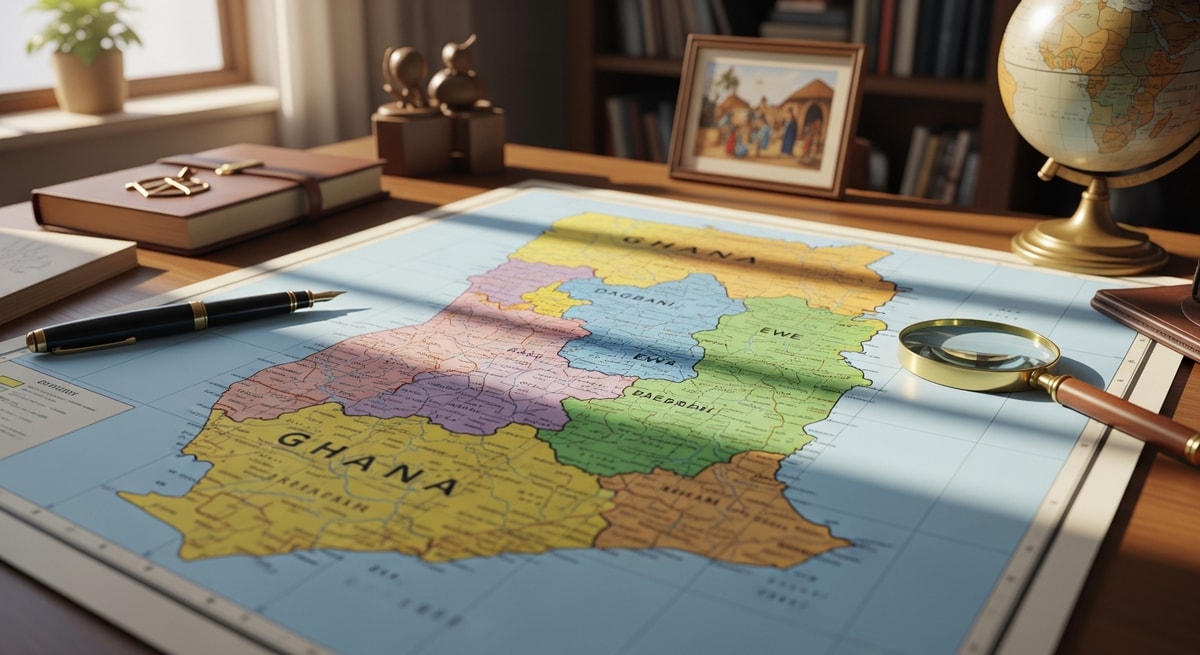
Ghana's 80+ indigenous languages make it one of the most linguistically diverse nations in West Africa
Consular Legalization: Getting Ghanaian Documents Accepted Abroad
Ghana is not a member of the Hague Apostille Convention, which means Ghanaian documents cannot receive the simplified apostille stamp used by the Convention's 125+ member states. Instead, Ghanaian documents intended for international use must undergo a full consular legalization process — a multi-step authentication chain that verifies the document's origin and the authority of the person who signed it. While some African nations including South Africa, Morocco, Rwanda, and Senegal have joined the Apostille Convention, Ghana has not yet acceded.
The legalization chain for Ghanaian documents follows a specific sequence. First, the document (or certified translation) must be notarized by a Commissioner for Oaths or Notary Public. Second, the notarized document is submitted to the Judicial Service of Ghana, which verifies the signature of the Notary Public and issues its own attestation. Third, the Judicial Service-authenticated document goes to the Ministry of Foreign Affairs and Regional Integration in Accra, which confirms the signature of the Judicial Secretary and applies its endorsement. Fourth, the fully authenticated document is presented to the embassy or consulate of the destination country for final legalization.
A critical requirement is that only documents from recognized issuing authorities are eligible for the authentication chain. For birth and death certificates, this means those issued by the Births and Deaths Registry (BDR), established under Act 1027 of 2020 within the Ministry of Local Government, Decentralization and Rural Development. For academic certificates, only those from institutions recognized by the National Accreditation Board (NAB) are accepted. Document attestation at the Ministry typically takes 1-3 business days, while the complete legalization chain including embassy processing takes 7-15 business days. DoVisa manages the complete legalization chain on your behalf, from Notary Public coordination to Ministry submission and embassy liaison.
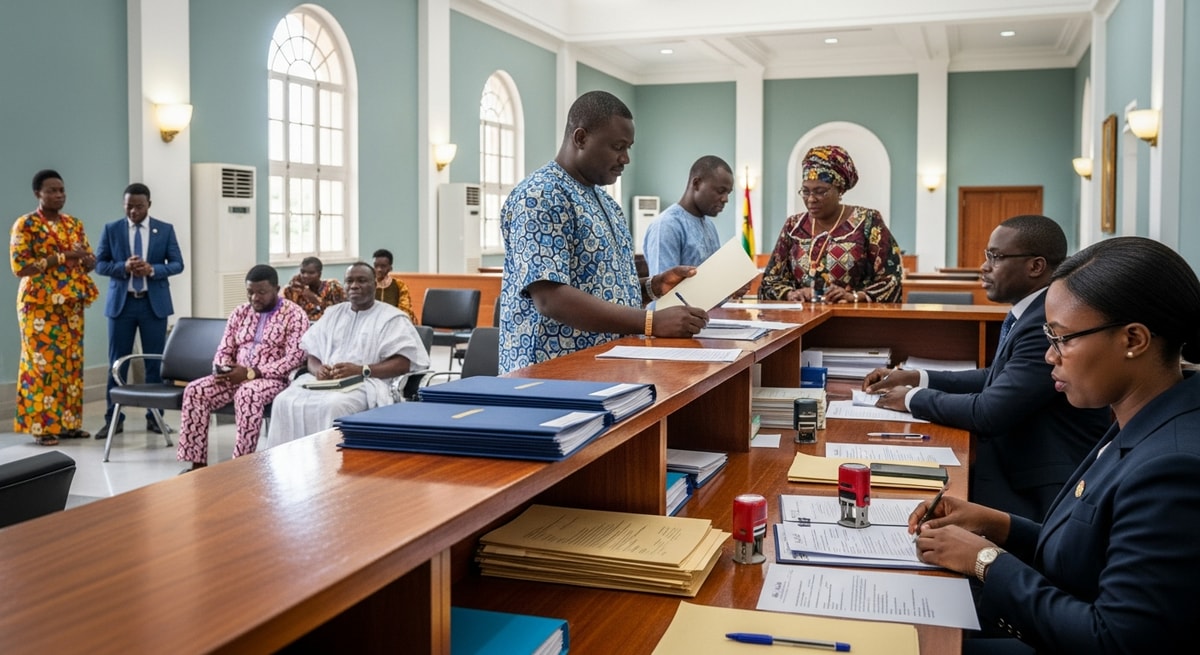
Ghana's Ministry of Foreign Affairs and Regional Integration in Accra processes all document authentication for international use
Ghanaian Academic and Professional Credential Translation
Ghana's education system produces several standard document types that frequently require translation for international use. The Basic Education Certificate Examination (BECE) is taken at the end of Junior High School, while the West African Senior School Certificate Examination (WASSCE), administered by the West African Examinations Council (WAEC), is the primary secondary school leaving qualification. WAEC uses a grading scale from A1 (Excellent) to F9 (Fail) that our translators explain clearly for foreign credential evaluators. In 2022, WAEC launched a digital certificate access and confirmation platform enabling secure electronic verification of certificates, which international institutions increasingly rely on alongside translated hard copies.
At the tertiary level, Ghanaian university transcripts and degree certificates follow formats established by institutions accredited by the National Accreditation Board (NAB). With major public universities including the University of Ghana (Legon), Kwame Nkrumah University of Science and Technology (KNUST), University of Cape Coast (UCC), University for Development Studies (UDS), and University of Education, Winneba (UEW), document formats vary across institutions. Our translators maintain reference materials for these universities ensuring accurate translation of institutional terminology and grading conventions. The National Service Secretariat (NSS) completion certificate, issued after the mandatory one-year national service programme for graduates, is also frequently translated for immigration and employment applications abroad.
Professional certifications from Ghanaian regulatory bodies also require translation for international credential recognition. These include certificates from the Medical and Dental Council of Ghana (MDC), the Nursing and Midwifery Council of Ghana (NMC), the Ghana Institution of Engineers (GhIE), the Institute of Chartered Accountants, Ghana (ICAG), and the Ghana Bar Association (GBA). Each body uses specialized terminology and formatting that our translators handle with precision, facilitating professional credential evaluation in destination countries.

Ghanaian academic credentials from WAEC, NAB-accredited universities, and professional bodies require specialized translation expertise
"Translated my Births and Deaths Registry birth certificate and WASSCE certificate into French for my Canadian immigration application. IRCC accepted both translations on first submission. The translator handled the WAEC grading system explanation perfectly."
"Needed my University of Ghana transcript and NSS completion certificate translated into German for a master's programme in Munich. The translations were precise and professionally formatted. The university admissions office accepted them immediately."
"Good translation of my Ghanaian marriage certificate and birth certificates for our UK spousal visa. The British High Commission accepted everything without questions. Took 5 business days which was within the quoted timeframe."
"DoVisa translated my nursing credentials from the Nursing and Midwifery Council of Ghana for UK NMC registration. The translator understood Ghanaian nursing terminology perfectly. My NMC application with the DoVisa translations was successful."
"Excellent service translating my police clearance certificate and birth certificate for my Australian immigration application. The Department of Home Affairs accepted the certified translations on first review. Very professional service throughout."
"Had my WASSCE certificate and KNUST degree translated for a WES credential evaluation. WES processed the evaluation without requesting any corrections to the translations. Good turnaround time and clear communication throughout the process."
"Translation of my company registration documents from the Registrar General's Department was accurate, but the initial delivery had a small error in the director's middle name. DoVisa corrected it within a few hours after I flagged it. Final version was fine."
"Translated my medical degree from UCC and Medical and Dental Council registration for my licensing application in the US. The ECFMG accepted the translations with no issues at all. Very thorough handling of medical terminology."
"Good translation of my Ghanaian birth certificate and academic transcripts into Arabic for a job application in Dubai. The employer's HR department accepted everything. Would recommend for Gulf state applications."
"DoVisa translated my birth certificate and marriage certificate for my USCIS green card application. Both translations were accepted without any requests for additional information. The certified format met all USCIS requirements perfectly."
"Needed my Ghanaian customary marriage certificate and supporting documents translated into French for use in Ivory Coast. The translator handled the customary law terminology accurately. The Ivorian authorities accepted everything without issues."
"Translated my Births and Deaths Registry birth certificate and WASSCE certificate into French for my Canadian immigration application. IRCC accepted both translations on first submission. The translator handled the WAEC grading system explanation perfectly."
"Needed my University of Ghana transcript and NSS completion certificate translated into German for a master's programme in Munich. The translations were precise and professionally formatted. The university admissions office accepted them immediately."
"Good translation of my Ghanaian marriage certificate and birth certificates for our UK spousal visa. The British High Commission accepted everything without questions. Took 5 business days which was within the quoted timeframe."
Ghanaian Document Translation FAQs
What types of Ghanaian documents can be translated?
We translate all types of Ghanaian documents including birth certificates and death certificates from the Births and Deaths Registry (BDR), marriage certificates (civil, customary, and Mohammedan ordinance), WAEC/WASSCE certificates, BECE certificates, university transcripts and degree certificates, NSS completion certificates, police criminal record clearance certificates from the Ghana Police Service, affidavits and statutory declarations, company registration documents from the Registrar General's Department (Office of the Registrar of Companies), Ghana Card (National Identification Authority) documentation, and professional certifications from bodies such as MDC, NMC, ICAG, and GhIE.
Are the translations certified and accepted by immigration authorities?
Yes. Every DoVisa translation includes a signed certification statement attesting to the accuracy and completeness of the translation. Our certified translations of Ghanaian documents are accepted by USCIS (United States), UK Visas and Immigration, IRCC (Canada), the Australian Department of Home Affairs, and credential evaluation agencies such as WES and ECE. Within Ghana, our translations are accepted by foreign embassies and high commissions in Accra. Ghana does not have a statutory sworn translator system — the Ghana Association of Translators and Interpreters (GATI) provides professional accreditation but is not backed by legislation.
How long does Ghanaian document translation take?
Standard delivery is 4-6 business days for most Ghanaian document types. Single-page vital records such as birth certificates often complete in 3-4 business days. Express 2-3 day service and rush 24-hour service are available for select document types. Less common language pairs (e.g., English-to-Chinese, English-to-Japanese) may require additional time. If you also need notarization and Ministry of Foreign Affairs authentication for the consular legalization chain, add 7-15 business days for the complete process depending on the destination embassy's processing speed.
What languages can Ghanaian documents be translated into?
We translate Ghanaian documents into over 100 languages. The most commonly requested translations are from English into French (for Francophone West African and European destinations), German, Arabic (for Gulf state applications), Spanish, Chinese, Portuguese, and Italian. We also translate foreign-language documents into English for use in Ghana. For documents involving Ghanaian indigenous languages such as Akan (Twi), Ewe, Ga, or Dagbani — sometimes found in customary court records, traditional authority documents, or religious certificates — we maintain a network of qualified linguists.
Will the translation be accepted by embassies in Ghana?
Yes. Our certified translations are accepted by all major foreign embassies and high commissions in Ghana, including the US Embassy, British High Commission, Canadian High Commission, German Embassy, French Embassy, and Australian High Commission in Accra. For documents submitted as part of visa applications, our translations meet the formatting and certification standards required by each embassy. If the embassy requires notarization or consular legalization, DoVisa coordinates the full authentication chain through the Judicial Service and the Ministry of Foreign Affairs and Regional Integration.
Do I need notarization with my Ghanaian translation?
It depends on the purpose and destination. A certified translation alone is sufficient for most immigration applications to the US, UK, Canada, and Australia. However, if your translated document will be used in a non-English-speaking country that requires the consular legalization chain, notarization by a Commissioner for Oaths or Notary Public is the first step. The notarized document then goes to the Judicial Service of Ghana for verification and the Ministry of Foreign Affairs and Regional Integration for endorsement. DoVisa advises on whether notarization is needed based on your specific destination and purpose, and coordinates the process when required.
Can Ghanaian documents get an apostille?
No. Ghana is not a member of the Hague Apostille Convention (officially the Convention Abolishing the Requirement of Legalisation for Foreign Public Documents, 1961). While 129 countries worldwide are parties to the Convention — including African nations such as South Africa, Morocco, Rwanda, and Senegal — Ghana has not acceded. As a result, Ghanaian documents cannot receive an apostille stamp. Instead, documents intended for international use must undergo the traditional four-step consular legalization process: (1) notarization by a Commissioner for Oaths, (2) authentication by the Judicial Service of Ghana, (3) endorsement by the Ministry of Foreign Affairs and Regional Integration in Accra, and (4) legalization at the destination country's embassy. DoVisa manages this entire chain on your behalf.
How much does Ghanaian document translation cost?
DoVisa's Ghana translation pricing follows a per-page structure with volume discounts that apply automatically for larger orders. Pricing varies based on language pair, document complexity, and processing speed. Express and rush service options are available at additional cost for time-sensitive projects. Notarization and Ministry of Foreign Affairs authentication for the consular legalization chain are quoted separately based on the number of documents and destination embassy requirements. Upload your documents on our order page to receive an instant detailed quote — no hidden fees.
Can you translate handwritten Ghanaian documents?
Yes. Some Ghanaian documents, particularly older birth certificates, customary court records, and traditional authority documents, contain handwritten entries that can be difficult to read. Our translators are experienced with Ghanaian handwriting conventions and administrative form formats. If any section of a document is illegible, we clearly mark it as [illegible] in the translation and note it in the translator's certification rather than guessing at the content. If a scan is too unclear to translate reliably, we contact you within 2 hours to request a clearer image or discuss alternative approaches.
What format will I receive the translation in?
All translations are delivered as high-resolution digitally signed PDFs via email. The PDF includes the complete certified translation with the translator's signed certification statement. For documents requiring physical copies — particularly for the consular legalization chain or court submissions — we dispatch hard copies with original ink signatures via tracked international courier to your location in Ghana or abroad. We can also provide translations in editable formats upon request for specific document types.
What is the difference between civil and customary marriage certificates in Ghana?
Ghana recognizes three main types of marriage. A civil marriage (ordinance marriage) is registered under the Marriages Act (CAP 127) and produces a marriage certificate from the Registrar General's Department. A customary marriage is registered under the Customary Marriage and Divorce (Registration) Act, 1985 (PNDC Law 112) and produces a certificate reflecting traditional customs. A Mohammedan (Islamic) marriage is registered under the Marriage of Mohammedans Ordinance. Each type has distinct terminology and formatting. DoVisa translates all three types of Ghanaian marriage certificates, and can coordinate Ministry of Foreign Affairs authentication for any of them.
Can DoVisa help with document authentication at Ghana's Ministry of Foreign Affairs?
Yes. DoVisa coordinates the complete consular legalization chain for Ghanaian documents. This includes arranging notarization through our network of Commissioners for Oaths and Notaries Public, submitting the notarized document to the Judicial Service of Ghana for verification of the notary's signature, forwarding to the Ministry of Foreign Affairs and Regional Integration in Accra for endorsement, and liaising with the destination country's embassy for final legalization. Document attestation at the Ministry typically takes 1-3 business days, while the complete legalization chain takes 7-15 business days depending on embassy processing times.
Get Your Ghanaian Documents Translated Today
Certified translations with Ministry of Foreign Affairs authentication and embassy legalization support for Ghanaian documents worldwide