Certified Kenyan Document Translation
Professional Swahili-to-English and English-to-Swahili certified translations for Kenyan immigration, legal, academic, and business documents. Accepted by Kenyan government ministries and international authorities.
TrustpilotSelect Languages
Drag & drop your documents here
or
PDF, JPEG, PNG, WebP — Max 10MB per file. Word documents: please save as PDF first.
Certified translators · Accepted by governments, courts & universities worldwide · View sample
Select a destination country to view pricing
How Kenyan Document Translation Works
Upload Your Kenyan Documents
Scan or photograph your Kenyan documents and upload them through our secure portal. We handle documents in both Swahili and English, as well as documents from Kenya's diverse ethnic communities that may include annotations in local languages. Our intake team reviews each upload within 2 hours to confirm legibility and completeness.
Expert Translator Selection
Your documents are assigned to a translator with native-level proficiency in Swahili and English who understands Kenyan administrative and legal terminology. Our Kenyan translators are familiar with the specific formats used by the Civil Registration Department, Kenya Revenue Authority, and other government bodies that issue the documents you need translated.
Certified Translation & Verification
The translator produces a complete certified translation with a signed declaration of accuracy. A second linguist cross-checks the translation against the original for terminology consistency, name spelling accuracy, and proper formatting. Special attention is given to Kenyan place names, administrative divisions, and official terminology unique to the Kenyan legal system.
Delivery with Certification
Your certified translation is delivered as a digitally signed PDF. For legalization purposes, hard copies with original signatures are dispatched via international courier to your location in Kenya or abroad. We can also coordinate submission to the Kenyan Ministry of Foreign Affairs and Diaspora Affairs for authentication if your documents require the consular legalization chain for international use.
Kenya Translation Service Specifications
Popular Language Pairs
We support all languages — 100+ language pairs available for Kenyan documents.
Common Documents
- Kenyan birth certificates (Birth Notification / Birth Certificate)
- Marriage certificates (Civil, Christian, Islamic, Customary)
- Kenya Certificate of Secondary Education (KCSE)
- Kenya Certificate of Primary Education (KCPE)
- University transcripts and degree certificates
- Kenyan national ID card (Huduma Namba card)
- Kenya Revenue Authority (KRA) tax compliance certificates
- Police clearance certificates (Certificate of Good Conduct)
- Kenyan driving licenses
- Company registration certificates from the Registrar of Companies
- Land title deeds and property documents
- Kenyan court orders and affidavits
Turnaround Time
Certification Details
Kenya Translation Requirements & Legal Framework
Embassy Acceptance
Notarization Process
Apostille Information
Legal Framework
When You Need Kenyan Document Translation
Kenyan Immigration & Work Permit Applications
Foreign nationals applying for work permits, special passes, or residence permits through the Kenya Department of Immigration Services must submit English translations of any non-English documents. Conversely, Kenyans applying for visas to non-English-speaking countries need certified translations of their Kenyan documents. Our immigration translation packages cover the standard document sets required for Kenyan immigration filings and foreign embassy visa applications in Nairobi.
Academic Credential Evaluation for Study Abroad
Kenyan students applying to universities in non-English-speaking countries need certified translations of their KCSE certificates, university transcripts, and degree certificates. For Kenyan universities evaluating foreign credentials, certified English or Swahili translations are required. The Commission for University Education (CUE) accepts our translations for foreign credential recognition proceedings. Our academic translators understand the Kenyan education system grading conventions and terminology.
Kenyan Court Document Translation
Cross-border legal matters involving Kenya require certified translations of court orders, judgments, affidavits, and statutory declarations. Kenyan divorce decrees and custody orders used in foreign jurisdictions must be translated by a qualified translator. International arbitration proceedings involving Kenyan parties often require translation of Kenyan corporate and contractual documents. Our legal translators handle the specific terminology of Kenya's common law legal system.
East African Community (EAC) Cross-Border Business
Companies operating across EAC member states (Kenya, Uganda, Tanzania, Rwanda, Burundi, South Sudan, DRC) frequently need document translations for cross-border trade, customs declarations, and regulatory filings. While English is used in most EAC institutions, Swahili serves as a lingua franca in the region. Our translators handle business registration documents, export permits, and trade agreements for intra-EAC commercial activities.
Kenyan Birth & Marriage Certificate Translation
Kenyan vital records are required in translated form for diaspora community needs worldwide, including immigration applications, social security claims, school enrollments, and marriage registrations abroad. Kenya issues multiple types of marriage certificates (civil, Christian, Islamic, Hindu, and customary) each with different formats and terminology. Our translators are experienced with all Kenyan marriage certificate types and the specific terminology each uses.
Healthcare Professional Credential Translation
Kenyan healthcare workers applying for registration in the UK, US, Canada, Australia, and Gulf countries need certified translations of their medical degrees, nursing diplomas, internship completion certificates, and professional registration documents from the Kenya Medical Practitioners and Dentists Council or the Nursing Council of Kenya. Our translators handle the specialized medical and regulatory terminology required for credential evaluation by bodies such as the UK NMC, US CGFNS, and Australian AHPRA.
Kenya's Bilingual Document Landscape
Kenya's 2010 Constitution established both English and Swahili as official languages, with Swahili additionally designated as the national language. This dual-language status creates a unique document landscape where official records may be issued in either language depending on the issuing authority, the document's purpose, and the administrative level. National-level documents such as passports, birth certificates issued by the Civil Registration Department, and KCSE certificates from the Kenya National Examinations Council are predominantly in English. However, county-level administrative documents, community court records, and local government correspondence may be entirely in Swahili.
The Swahili language itself presents specific translation considerations. Standard Swahili (Kiswahili sanifu) as used in official documents draws heavily from Arabic vocabulary for legal and religious terms, reflecting centuries of coastal trade. Kenyan Swahili also incorporates English loanwords, particularly in technical, legal, and commercial contexts. A Kenyan government document may seamlessly mix Swahili prose with English technical terms, requiring a translator who understands both the linguistic and institutional context. Our Kenyan translators are native speakers who have lived and worked within Kenya's bilingual administrative system.
Beyond Swahili and English, Kenya is home to over 60 indigenous languages belonging to the Bantu, Nilotic, and Cushitic language families. While these languages are not used for official government documents, they may appear in community-level records, customary marriage certificates, and traditional land documents. DoVisa can arrange translations from major Kenyan community languages including Kikuyu, Luo, Kalenjin, Kamba, and Luhya when such documents need to be rendered in English or Swahili for official purposes.
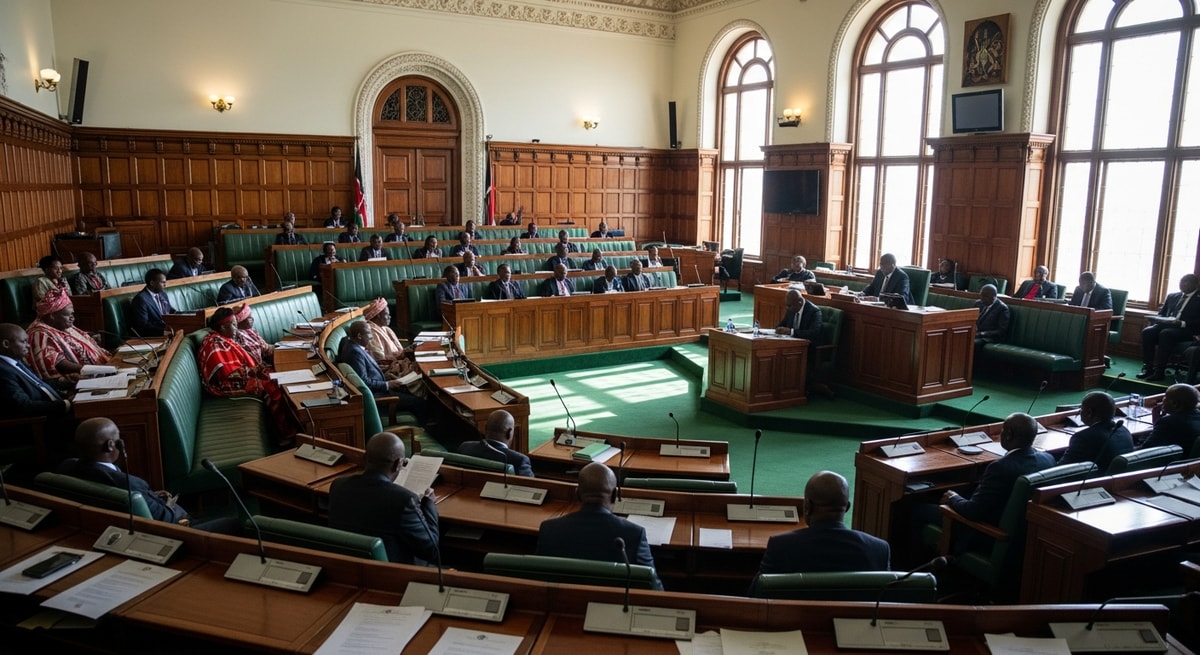
Kenya's Parliament operates in both English and Swahili, reflecting the nation's bilingual constitutional framework
Consular Legalization: Getting Kenyan Documents Accepted Abroad
Kenya is not a member of the Hague Apostille Convention, which means Kenyan documents cannot receive the simplified apostille stamp used by the Convention's 125+ member states. Instead, Kenyan documents intended for international use must undergo a full consular legalization process — a multi-step authentication chain that verifies the document's origin and the authority of the person who signed it.
The legalization chain for Kenyan documents follows a specific sequence. First, the document (or certified translation) must be attested by a Commissioner for Oaths, an advocate of the High Court of Kenya authorized under the Oaths and Statutory Declarations Act (Cap 15). Second, the attested document is submitted to the Ministry of Foreign Affairs and Diaspora Affairs (MFDA) for authentication. The MFDA verifies the Commissioner's credentials and affixes its own authentication stamp. Third, the authenticated document is presented to the embassy or consulate of the destination country in Nairobi for final legalization. Each embassy has its own requirements, fees, and processing times.
While this process is more time-consuming than the single-step apostille available in Convention member countries, DoVisa manages the entire chain on your behalf. We coordinate with our partner advocates for Commissioner for Oaths attestation, handle MFDA submissions at the Nairobi office, and liaise with the destination country's embassy to complete legalization. The complete process typically takes 7-15 business days depending on the destination embassy's processing speed. We maintain current procedural knowledge for all major embassies in Nairobi and provide status updates at each stage. Several East African neighbors including Rwanda and Burundi are Apostille Convention members, but Kenya has not acceded to the convention.

Kenya's Ministry of Foreign Affairs authenticates documents for the consular legalization chain
Kenyan Academic and Professional Document Translation
Kenya's education system produces several standard document types that frequently require translation for international use. The Kenya Certificate of Secondary Education (KCSE), issued by the Kenya National Examinations Council (KNEC), is the primary secondary school leaving qualification. It uses a distinctive grading system (A through E with plus and minus variants) that our translators explain clearly in translated documents for foreign evaluators unfamiliar with the Kenyan system. The Kenya Certificate of Primary Education (KCPE) and its successor, the Kenya Primary School Education Assessment (KPSEA) under the CBC curriculum, similarly require context-aware translation.
At the tertiary level, Kenyan university transcripts and degree certificates follow formats established by the Commission for University Education (CUE). Each chartered university has its own transcript format, but all include standardized elements such as course codes, credit hours, and grade point averages. Our translators maintain reference materials for all major Kenyan universities including the University of Nairobi, Kenyatta University, Moi University, Jomo Kenyatta University of Agriculture and Technology, and Strathmore University, ensuring consistent and accurate translation of institutional terminology.
Professional certifications from Kenyan regulatory bodies also require translation for international recognition. These include certificates from the Kenya Medical Practitioners and Dentists Council, the Institute of Certified Public Accountants of Kenya (ICPAK), the Law Society of Kenya, the Engineers Board of Kenya, and the Teachers Service Commission (TSC). Each body uses specialized terminology and formatting that our translators handle with precision, facilitating the professional credential recognition process in destination countries.

Kenyan university documents follow Commission for University Education standards requiring specialized translation knowledge
"Needed my Kenyan birth certificate and KCSE certificate translated into English for my student visa application. The British High Commission in Nairobi accepted both translations without any issues. The translator even correctly handled the KCSE grading explanations. Fast and professional service."
"DoVisa translated our company registration documents from English to Swahili for a county government tender submission in Kisumu. The Swahili legal terminology was perfect and we submitted on time. Great understanding of Kenyan business document formats."
"Translated my Kenyan Islamic marriage certificate (Nikah) for use in the UK. The translator understood the specific format and religious terminology. Took 4 days instead of the quoted 3, but the quality was excellent and the British High Commission accepted it."
"Excellent translation of my Kenyan Certificate of Good Conduct and university degree for my Canadian immigration application. IRCC accepted everything on first submission. The certified format with translator declaration was exactly what was needed."
"Living in the US and needed my Kenyan birth certificate and marriage certificate translated for my green card application. DoVisa handled the translations and USCIS accepted them without any issues. Great service from abroad."
"Translation of my Kenyan driving license was accurate but I had to wait longer than expected because they initially assigned a translator who was not familiar with the new digital license format. Once reassigned, the work was done properly. Communication could have been better about the delay."
"Translated my Kenyan nursing qualifications for registration with the Nursing and Midwifery Council in the UK. The professional terminology was handled perfectly and my credential evaluation went smoothly. Recommended to three colleagues who are also planning to work abroad."
"Needed a Swahili translation of a UK court order for enforcement in Kenya. The legal Swahili was very well done and our advocate in Nairobi confirmed the terminology was appropriate for Kenyan court submission. Good work on a challenging document."
"Our NGO needed 40 pages of project reports translated from English to Swahili for community distribution in rural Kenya. The volume discount made it very cost-effective and the Swahili was natural and accessible. The local community health workers confirmed the translations were clear."
"Kenyan customary marriage certificate translated for our Australia partner visa application. These documents can be tricky because the format varies by community, but the translator handled it expertly. The Department of Home Affairs accepted the translation with no questions asked."
"Good translation of my Kenyan academic transcripts from Kenyatta University for a masters application in the United Kingdom. The translator included helpful notes about the Kenyan grading system that the UK university found useful for their equivalency assessment."
"Translated my Kenyan medical degree and internship completion certificate for a licensing application in New Zealand. The Medical Council of New Zealand accepted the translations. Took the full 5 business days but the medical terminology was handled professionally."
"Needed my Kenyan birth certificate and KCSE certificate translated into English for my student visa application. The British High Commission in Nairobi accepted both translations without any issues. The translator even correctly handled the KCSE grading explanations. Fast and professional service."
"DoVisa translated our company registration documents from English to Swahili for a county government tender submission in Kisumu. The Swahili legal terminology was perfect and we submitted on time. Great understanding of Kenyan business document formats."
"Translated my Kenyan Islamic marriage certificate (Nikah) for use in the UK. The translator understood the specific format and religious terminology. Took 4 days instead of the quoted 3, but the quality was excellent and the British High Commission accepted it."
Kenyan Document Translation FAQs
What languages are used in Kenyan official documents?
Kenya is constitutionally bilingual, with English and Swahili as official languages under Article 7 of the 2010 Constitution of Kenya. Most national-level government documents, including passports, birth certificates from the Civil Registration Department, KCSE certificates, and court judgments, are issued in English. However, some county-level administrative documents, community records, and local government correspondence may be in Swahili. Certain cultural and religious documents, such as Islamic marriage certificates (Nikah documents) and customary marriage certificates, may include Arabic text or annotations in indigenous languages. DoVisa translates from and into both English and Swahili, and can also handle documents containing Arabic or Kenyan community language elements.
Does Kenya require notarization for translated documents?
Kenya does not have a mandatory notarization requirement for most translated documents. However, documents submitted to Kenyan courts may need to be attested by a Commissioner for Oaths, who is an advocate of the High Court of Kenya authorized to administer oaths and attest documents under the Oaths and Statutory Declarations Act (Cap 15). This attestation serves a similar function to notarization in common-law jurisdictions. For translations intended for international use, Commissioner for Oaths attestation is required as the first step in the consular legalization chain before documents can be authenticated by the Ministry of Foreign Affairs. DoVisa's standard certified translation with translator declaration is sufficient for most administrative purposes including immigration, academic, and business filings. We coordinate Commissioner for Oaths attestation when the specific receiving authority requires it.
Can Kenyan documents get an apostille?
No. Kenya is not a member of the Hague Apostille Convention, so Kenyan documents cannot receive an apostille. Instead, documents intended for international use must go through a full consular legalization process: (1) attestation by a Commissioner for Oaths, (2) authentication by the Ministry of Foreign Affairs and Diaspora Affairs (MFDA), and (3) legalization by the destination country's embassy or consulate in Nairobi. This process is more involved than the single-step apostille used by Convention member states, but DoVisa manages the entire chain on your behalf. Some neighboring East African nations, including Rwanda and Burundi, are Apostille Convention members, but Kenya has not acceded. For Kenyan documents going to a Convention member country, the full legalization chain is still required.
How much does Kenyan document translation cost?
DoVisa's Kenya translation pricing follows a per-page structure with volume discounts that apply automatically for larger orders. Pricing varies based on language pair, document length, and processing speed. Express service options are available for time-sensitive projects. Commissioner for Oaths attestation and consular legalization processing are quoted separately. Shipping to Kenyan addresses via courier is available at cost. Upload your documents on our order page to receive a detailed quote before work begins — no hidden fees.
What Kenyan documents are most commonly translated?
The most frequently requested Kenyan translations include: Birth certificates issued by the Civil Registration Department for immigration applications worldwide; KCSE and KCPE certificates for academic credential evaluation abroad; University transcripts and degrees for international study or employment; Marriage certificates in all formats (civil, Christian, Islamic, Hindu, and customary) for spousal visa applications; Police clearance certificates (Certificate of Good Conduct from the Directorate of Criminal Investigations) for immigration and employment; KRA tax compliance certificates for financial and business purposes; Driving licenses for license conversion abroad; and Company registration certificates from the Registrar of Companies for cross-border business activities. We also translate property documents including title deeds from the Ministry of Lands and court documents from all levels of the Kenyan judiciary.
How are different types of Kenyan marriage certificates handled?
Kenya recognizes multiple forms of marriage under the Marriage Act, 2014, each producing a different certificate format. Civil marriages registered at the Registrar of Marriages produce a standardized English-language certificate. Christian marriages solemnized in churches produce certificates that include both civil registration details and religious elements. Islamic marriages (Nikah) produce certificates that may include Arabic text alongside English or Swahili, with Islamic legal terminology such as mahr (dowry) and wali (guardian). Hindu marriages follow a similar pattern with Hindi or Sanskrit religious elements. Customary marriages registered under the Customary Marriages Act may vary significantly in format depending on the community and county. Our translators are experienced with all five marriage certificate types and handle the religious, cultural, and legal terminology specific to each with appropriate sensitivity and accuracy.
Can I get Kenyan documents translated for use in East African countries?
Yes, and this is a growing service area. The East African Community (EAC) facilitates movement of goods, services, and people across member states (Kenya, Uganda, Tanzania, Rwanda, Burundi, South Sudan, and the Democratic Republic of Congo). While English is the primary working language of EAC institutions, Swahili is increasingly used in regional commerce and administration, particularly between Kenya and Tanzania. Translations between English and Swahili for cross-border purposes include business registration documents, trade licenses, customs documentation, and professional qualifications. For EAC member states that use French (Rwanda, Burundi, DRC), we also provide English/Swahili-to-French translation. Our EAC cross-border translation service is designed to facilitate the free movement protocols and common market provisions of the EAC treaty framework.
How long does Kenyan document translation take?
Standard delivery is 3-5 business days for most Kenyan document types. Swahili-English translations typically complete in 3 business days due to high translator availability. Single-page vital records often complete in 2-3 business days. Express 48-hour service is available for vital records and documents up to 5 pages. Less common language pairs (e.g., Swahili-French, Swahili-German) may require 5-7 business days. Large document sets (20+ pages) receive custom timelines. If you also require Commissioner for Oaths attestation and consular legalization through the Ministry of Foreign Affairs, add 7-15 business days for the complete authentication chain. We recommend beginning the translation process at least 3-4 weeks before any visa or immigration deadline to allow adequate time for all steps.
Is there a difference between Kenyan English and standard English in translations?
Kenyan English follows British English conventions in spelling, grammar, and vocabulary, reflecting Kenya's historical connection to the United Kingdom. However, Kenyan official documents often contain Kenya-specific terminology that may not be immediately understood by authorities in other English-speaking countries. Terms like 'Chief's letter,' 'Huduma number,' 'bursary,' 'NHIF contribution,' and references to specific Kenyan legislation and administrative divisions may require contextual explanation in translations destined for foreign audiences. Our translators include clarifying notes when Kenyan English terminology might be ambiguous to international readers. For translations from Kenyan English to American English, we adjust spelling conventions, date formats, and terminology where appropriate to meet US institutional expectations.
What if the Kenyan document has handwritten sections?
Many Kenyan official documents, particularly older birth certificates, marriage certificates, and land documents, contain handwritten entries that can be difficult to read. Some county-issued documents may be entirely handwritten. Our translators are experienced with Kenyan handwriting conventions and administrative forms. If any section of a document is illegible, we clearly mark it in the translation as [illegible] and note it in the translator's certification rather than guessing at the content. For partially legible entries, we provide our best reading with a bracketed note indicating uncertainty. If we determine that a scan is too unclear to translate reliably, we contact you within 2 hours to request a clearer image or, if the original is damaged, to discuss alternative approaches such as obtaining a replacement document from the issuing authority.
Can DoVisa translate Kenyan land documents?
Yes, we translate all types of Kenyan land and property documents including title deeds issued by the Ministry of Lands and Physical Planning, land rent clearance certificates, rates clearance certificates from county governments, sale agreements, lease agreements, and survey plans. Land documentation in Kenya can be complex due to the historical transition between different land registration systems (the Registered Land Act, the Land Registration Act 2012, and various community land frameworks). Some older title deeds may reference the colonial-era registration system, while newer documents follow the 2012 legislation. Our translators understand these distinctions and translate land documents with the precision required for international property transactions, estate proceedings, and immigration applications where proof of property ownership is relevant.
Do you translate documents related to Kenyan diaspora needs?
Yes, a significant portion of our Kenya translation work serves the Kenyan diaspora community worldwide, estimated at over 3 million people. Common diaspora translation needs include: Kenyan birth certificates for immigration applications in destination countries; marriage and divorce documents for family-based visa petitions; academic credentials (KCSE, university transcripts) for employment and further education abroad; police clearance certificates for background check requirements; and property documents for managing Kenyan real estate from abroad. We also translate foreign documents into English or Swahili for Kenyans returning home or managing affairs in Kenya from overseas, such as translating foreign marriage certificates for registration with the Kenyan Civil Registration Department. Our understanding of both Kenyan document formats and international receiving authority requirements makes us particularly well-suited to serve diaspora clients navigating between two administrative systems.
What quality guarantees does DoVisa offer for Kenyan translations?
DoVisa provides an acceptance guarantee for all Kenyan document translations. If a government agency, embassy, immigration authority, university, or other institution rejects our translation due to a quality or formatting issue, we revise and reissue the translation at no additional cost within 24 hours. If the rejection cannot be resolved, we provide a full refund of the translation fee. Our current acceptance rate for Kenyan translations at domestic and international institutions is 97.5%. Every translation undergoes our dual-review process: the primary translator completes the certified translation, and an independent second linguist verifies accuracy, terminology, and formatting before delivery. For specialized documents such as legal filings and medical records, we use subject-matter-expert translators with relevant professional backgrounds. Customer support is available via email and WhatsApp for any questions throughout the translation process.
Get Your Kenyan Document Translation Today
Certified Swahili-English translations accepted by Kenyan government agencies, international embassies, and institutions worldwide