Certified Somali Document Translation
Professional certified translations of Somali and Arabic documents for diaspora immigration, family reunification, and legal applications. Accepted by USCIS, UK Home Office, IRCC, and international authorities worldwide.
TrustpilotSelect Languages
Drag & drop your documents here
or
PDF, JPEG, PNG, WebP — Max 10MB per file. Word documents: please save as PDF first.
Certified translators · Accepted by governments, courts & universities worldwide · View sample
Select a destination country to view pricing
How Somalia Certified Translation Works
Upload Your Somali Documents
Upload clear scans of your Somali documents through our encrypted portal. We accept PDF, JPEG, and PNG. We handle all Somali official documents including shahaadad dhalashada (birth certificates), shahaadad guurka (marriage certificates), warqadda garashada dambi la'aanta (police clearance certificates), and academic certificates. Documents may be in Somali Latin script or Arabic. Our intake team reviews each upload within 2 hours to confirm legibility and identify the issuing authority.
Expert Translator Assignment
Your documents are matched with a professional translator proficient in Somali (Latin script), Arabic, and the target language. Somali uses a standardized Latin orthography officially adopted in 1972. For documents with Arabic content — common in religious marriage certificates (nikaah) and older administrative records from the Italian or British colonial periods — we assign translators with the appropriate dual-language expertise in both Somali and Arabic administrative traditions.
Translation & Certification
The translator produces your certified translation with accurate Somali and Arabic-to-English conversion of civil registry terminology. Key terms — shahaadad dhalashada, shahaadad guurka, gobolka (region/governorate), degmada (district), warqadda shaqada (employment letter) — are correctly rendered. A second reviewer cross-checks the translation for accuracy and consistency before the signed certification statement is applied. All reviews meet diaspora immigration authority standards.
Delivery with Full Certification
Your certified translation is delivered as a high-resolution digitally signed PDF. For documents requiring the consular legalization chain, we coordinate notarization, authentication by the Federal Government of Somalia's Ministry of Foreign Affairs and International Cooperation, and legalization at the destination country's embassy. Hard copies with original ink signatures are dispatched via tracked international courier to your address worldwide.
Somalia Translation Service Specifications
Popular Language Pairs
We support all languages — 100+ language pairs available for Somali and Arabic documents from Somalia.
Common Documents
- Shahaadad dhalashada — birth certificates from Somali civil registry
- Shahaadad guurka — civil marriage certificates
- Nikaah — Islamic marriage certificates
- Warqadda garashada dambi la'aanta — police clearance certificates
- Shahaadada dugsiga sare — secondary school certificates
- University diplomas and transcripts from Somali National University
- Warqadda shaqada — employment reference letters
- Xaashida ehelka — family status documents
- Passports and national identity documents
- Court orders and legal affidavits
Turnaround Time
Certification Details
Somalia Translation Requirements & Regulatory Framework
Embassy Acceptance
Notarization Process
Apostille Information
Legal Framework
Common Scenarios for Somali Document Translation
Diaspora Immigration & Resettlement
The Somali diaspora — estimated at over 2 million people worldwide, with major communities in the UK, US, Canada, Sweden, Norway, the Netherlands, Finland, Denmark, Australia, and the Gulf states — generates the highest volume of Somali document translation requests. Birth certificates (shahaadad dhalashada), marriage certificates (shahaadad guurka), police clearances, and academic credentials are required for immigration applications, family reunification petitions, and resettlement cases in all major destination countries.
Refugee Status & Humanitarian Documents
UNHCR, IOM, and their implementing partners work with Somali refugee populations in Kenya (Dadaab, Kakuma), Ethiopia (Dollo Ado, Melkadida), Uganda, Yemen, and beyond. Certified translations of Somali refugee registration documents, civil status certificates, and resettlement paperwork are essential for durable solutions processing — particularly for refugee resettlement to the US, Canada, Australia, and EU member states. DoVisa provides certified translations meeting UNHCR and US Refugee Admissions Program (USRAP) standards.
Family Reunification Applications
Family reunification is one of the most common immigration pathways for Somali diaspora communities. Sponsoring relatives in the UK, US, Canada, or Scandinavia need certified translations of birth certificates, marriage certificates, and family relationship evidence. Islamic marriage certificates (nikaah) from Somali religious courts are frequently required alongside or in lieu of civil marriage certificates — our translators handle both certificate types accurately.
Academic Credential Recognition
Somali students and professionals seeking employment or further education abroad need certified translations of their secondary school certificates and university degrees from Somali National University, Mogadishu University, and other Somali institutions. Our translators render Somali academic credentials with accurate institutional references and grade scale context, enabling credential evaluation by WES, ENIC-NARIC, and national assessment bodies.
Legal & Court Document Translation
Cross-border legal matters involving Somalia require certified translations of court orders, land deeds, inheritance documents, and powers of attorney. Somalia's hybrid legal system — combining sharia, Italian civil law remnants, British common law, and Somali xeer customary law — produces documents with layered legal terminology. Our legal translators handle Somali legal documents for international arbitration, estate proceedings, and civil court cases in diaspora destination countries.
Healthcare Worker Credentials
Somali healthcare professionals seeking employment or registration in the UK, US, Canada, and the Gulf states need certified translations of their medical degrees, nursing qualifications, and professional certificates from Somali medical training institutions. Our translators handle the specialized medical and professional terminology of Somali healthcare credentials, supporting registration applications at the UK GMC, NMC, and equivalent bodies in other destination countries.
Somali Language, Script, and Document System
Somali (af Soomaali) is an Afroasiatic language belonging to the Cushitic branch, closely related to Oromo and Afar. It is the mother tongue of virtually all Somali citizens and the primary language of government, education, and everyday life. Somali uses a standardized Latin alphabet — officially adopted on October 21, 1972, under a government decree — which uses 21 consonants and 10 vowel letters from the Latin script without any diacritics. The orthography includes phonemic representations of Somali's distinct consonant sounds, including the pharyngeal and retroflex sounds characteristic of Cushitic languages.
All official Somali government documents — civil registry certificates, court orders, and administrative records issued after 1972 — are produced in Somali Latin script. However, Arabic also holds official language status under the Somali Provisional Constitution of 2012, and Arabic is used in religious contexts, Islamic marriage certificates (nikaah), religious court documents, and some older administrative records from the colonial period. Documents from the Italian-administered Trust Territory of Somalia (1950–1960) may contain Italian, while documents from the British Somaliland protectorate era may contain English.
Key civil registry terms include: shahaadad dhalashada (birth certificate), shahaadad guurka (marriage certificate), nikaah (Islamic marriage contract), gobolka (region/governorate), degmada (district), and warqadda garashada dambi la'aanta (certificate of no criminal record / police clearance). Our translators are proficient in both the standard Somali Latin orthography and the Arabic-script representation of Somali content, ensuring accurate translation regardless of the script used in your document.
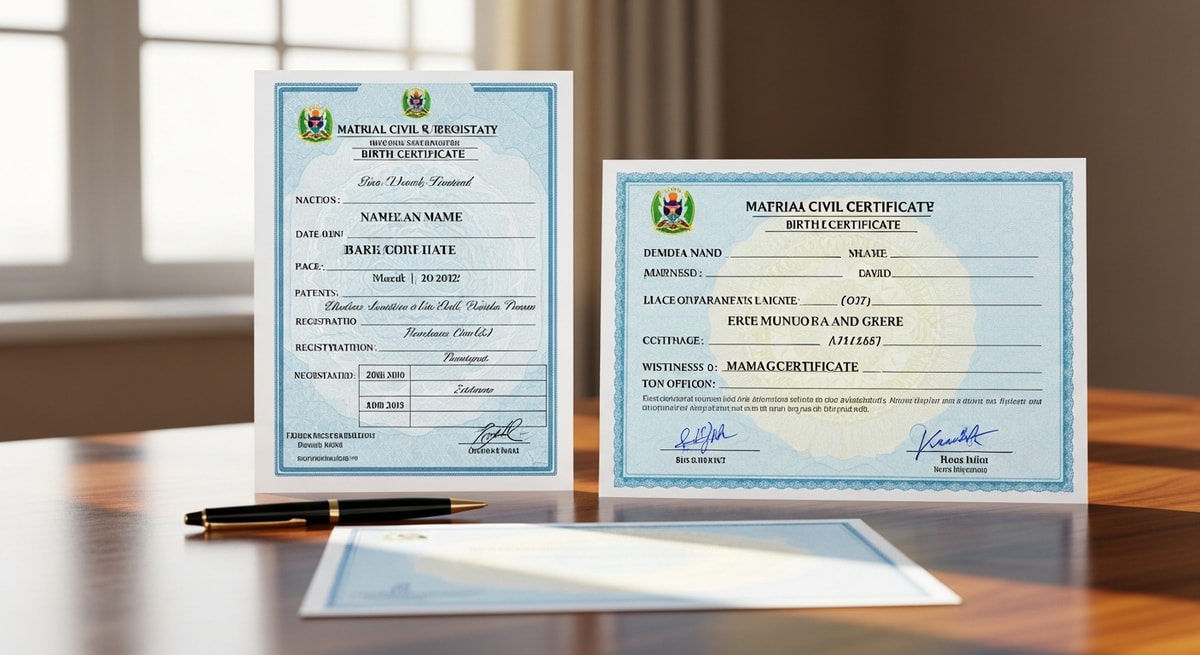
Somali official documents use the standardized Latin orthography adopted in 1972 — our translators handle both Latin-script Somali and Arabic-language Somali documents
Consular Legalization and Alternative Authentication for Somali Documents
Somalia is not a member of the Hague Apostille Convention. Somali documents intended for international use must therefore undergo consular legalization — the traditional multi-step authentication chain — rather than the simplified apostille process used by Convention member states.
Under normal conditions, the Somali legalization chain involves three steps. First, the document or certified translation is notarized by a Somali notary (adoon sharci) authorized under Somali law. Second, the notarized document is submitted to the Wasaaradda Arrimaha Dibadda (Ministry of Foreign Affairs and International Cooperation) in Mogadishu for authentication. Third, the authenticated document is presented to the destination country's embassy or consulate for final legalization. The full process typically takes 10-20 business days under normal conditions.
A practical consideration for Somali documents is that many Somali diaspora members do not have easy access to Mogadishu-based government services. In recognition of this reality, Somali embassies and consulates in Nairobi (Kenya), Addis Ababa (Ethiopia), Djibouti City, London, Washington D.C., Ottawa, Stockholm, Abu Dhabi, and other major diaspora cities also provide consular authentication services for Somali citizens abroad. Many destination country immigration authorities — including USCIS, UK Home Office, and IRCC — also have established practice for accepting Somali documents authenticated through embassy channels outside of Mogadishu. DoVisa advises clients on the most accessible and accepted authentication pathway for their specific situation and destination country.
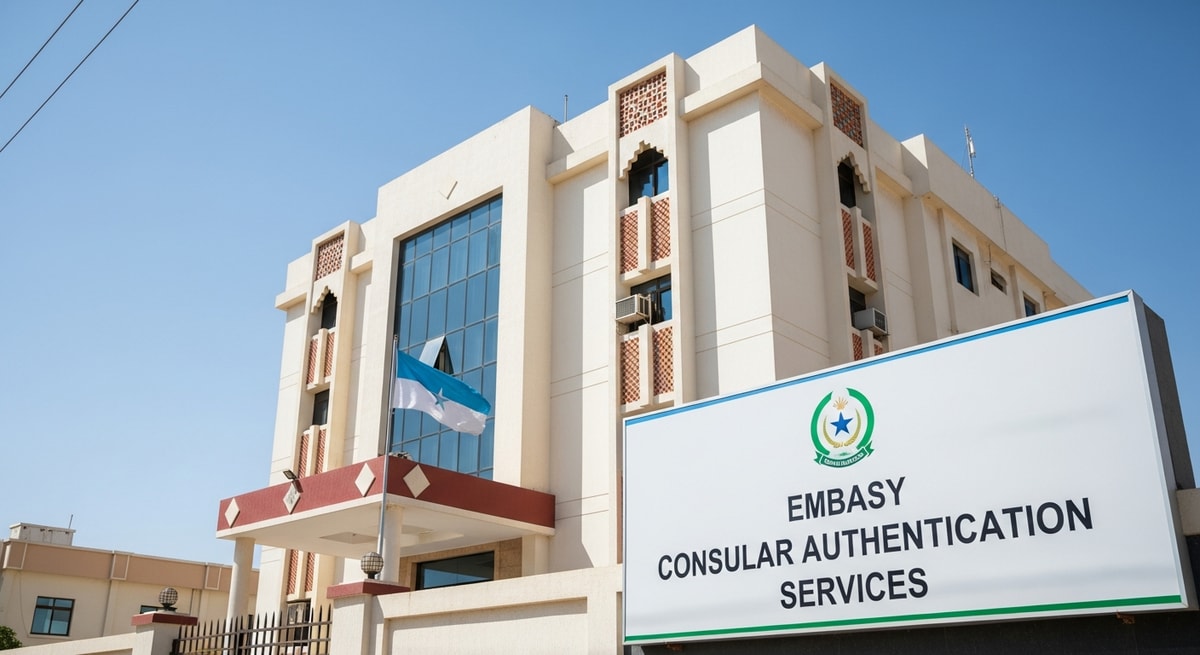
Somali embassies in Nairobi, London, Washington D.C., and other cities provide consular authentication for Somali diaspora document legalization
Serving the Global Somali Diaspora Community
With an estimated 2 million or more Somalis living abroad, the Somali diaspora is one of the largest and most geographically dispersed diaspora communities in the world. Major Somali communities are established in the United Kingdom (particularly London, Cardiff, and Sheffield), the United States (particularly Minneapolis-Saint Paul, Columbus, and Seattle), Canada (particularly Ottawa, Toronto, and Edmonton), Sweden, Norway, the Netherlands, Finland, Denmark, Australia, the UAE, and Saudi Arabia.
The Somali diaspora generates consistent and substantial demand for certified document translation across a wide range of use cases. Immigration petitions — particularly family-based petitions through USCIS Form I-130, UK family visa applications, and Canadian family sponsorship through IRCC — require certified translations of civil status documents including shahaadad dhalashada (birth certificates), shahaadad guurka (marriage certificates), and evidence of family relationships. Refugee resettlement cases referred by UNHCR to US, Canadian, Australian, and EU resettlement programs also require certified translations of all supporting documentation.
DoVisa's experience with Somali diaspora document translation extends across the full range of document types and destination countries. We understand the specific challenges that Somali documents present — varying document formats from different administrative periods, handwritten entries, documents issued in multiple languages, and the particular civil registry conventions of different Somali regions and governorates. We also maintain awareness of the specific evidentiary standards that destination country immigration authorities apply to Somali documents, ensuring that our certified translations meet those standards from the outset.

Over 2 million Somalis abroad in the UK, US, Canada, and Scandinavia rely on certified document translation for immigration, family reunification, and resettlement
"Translated my shahaadad dhalashada and shahaadad guurka into English for a US family petition through USCIS. USCIS accepted both translations on first submission without any RFE. The translator correctly handled the Somali Latin script and civil registry terminology."
"Had my Somali birth certificate and police clearance translated into English for a Canadian PR application through IRCC. Both documents were accepted on first submission. Fast delivery — 4 business days. Very professional service from start to finish."
"Translated my nikaah (Islamic marriage certificate) and civil marriage certificate into English for a UK family visa. The Home Office accepted both. The nikaah translation included the Arabic text alongside the English which my solicitor said was exactly right."
"Needed my Somali National University degree and secondary school certificate translated into English for a WES evaluation for Canadian immigration. WES accepted the translations without any queries. The academic terminology and institutional references were accurate."
"Had UNHCR refugee documents and Somali civil status certificates translated into English for a US resettlement application. The translations met the USRAP standards and were accepted by the resettlement agency. DoVisa understood the urgency and delivered promptly."
"Translation of my Somali birth certificate was accurate but initially had a minor error in the region (gobolka) name spelling. DoVisa corrected the certified document within hours. The Australian Department of Home Affairs accepted the corrected version without any issue."
"Translated birth certificates for my three children from Somali into English for a Swedish family reunification application. All documents accepted by the Swedish Migration Agency. Volume discount was applied automatically. Excellent service for diaspora families."
"Had my Somali medical degree from Mogadishu University translated into English for a UK GMC registration application. The GMC accepted the translation. Took 5 days rather than the quoted 4, but the quality of the medical terminology translation was very high."
"Translated a Somali court inheritance order into English for an estate matter in the Netherlands. The legal terminology covering Islamic inheritance law alongside Somali civil court language was handled with impressive precision by the translator."
"Had my older Somali identity document — partly handwritten — translated into Norwegian for a Norway residence application. The translator handled the handwritten sections carefully and noted one illegible field clearly. UDI Norway accepted the translation."
"Translated multiple Somali family documents including birth certificates and a marriage certificate into Finnish for a Finnish family reunification application. Migri Finland accepted all documents on first submission. Highly recommend DoVisa for Somali diaspora document needs."
"Translated my shahaadad dhalashada and shahaadad guurka into English for a US family petition through USCIS. USCIS accepted both translations on first submission without any RFE. The translator correctly handled the Somali Latin script and civil registry terminology."
"Had my Somali birth certificate and police clearance translated into English for a Canadian PR application through IRCC. Both documents were accepted on first submission. Fast delivery — 4 business days. Very professional service from start to finish."
"Translated my nikaah (Islamic marriage certificate) and civil marriage certificate into English for a UK family visa. The Home Office accepted both. The nikaah translation included the Arabic text alongside the English which my solicitor said was exactly right."
Somali Document Translation FAQs
What types of Somali documents can be translated?
We translate all types of Somali official documents including shahaadad dhalashada (birth certificates), shahaadad guurka (civil marriage certificates), nikaah (Islamic marriage contracts), warqadda garashada dambi la'aanta (police clearance certificates), secondary school certificates, university diplomas and transcripts from Somali National University, Mogadishu University, and other Somali institutions, passports and national identity documents, court orders and legal declarations, and UNHCR refugee registration documents. We handle documents in Somali Latin script, Arabic, and Italian (for older colonial-era records).
Are DoVisa translations certified and accepted by immigration authorities?
Yes. Every DoVisa translation includes a signed certification statement from the translator attesting to the accuracy and completeness of the translation. Our certified translations of Somali documents are accepted by USCIS (United States), the UK Home Office, IRCC (Canada), the Australian Department of Home Affairs, and the immigration authorities of Sweden, Norway, the Netherlands, Finland, Denmark, and other major Somali diaspora destination countries. UNHCR and its implementing partners also accept our certified translations for refugee and resettlement documentation.
How long does Somali document translation take?
Standard delivery is 4-6 business days for most Somali document types. Express 2-3 day service and rush 24-hour service are available for select document types. Handwritten or damaged documents may require additional handling time. If consular legalization is also needed, add 10-20 business days depending on available government services and destination embassy processing times.
Can Somali documents get an apostille?
No. Somalia is not a member of the Hague Apostille Convention, so Somali documents cannot receive an apostille. Documents intended for international use require consular legalization: (1) notarization, (2) authentication by Somalia's Ministry of Foreign Affairs and International Cooperation, and (3) legalization at the destination country's embassy. Somali embassies abroad — in Nairobi, London, Washington D.C., and other cities — can also provide consular authentication for diaspora members. DoVisa advises on the most practical pathway for your situation.
What language is used on Somali official documents?
Official Somali documents are produced in the Somali Latin orthography, standardized in 1972. Arabic is used in Islamic marriage certificates (nikaah) and some religious court documents. Older administrative records from before 1960 may contain Italian (from the Italian-administered Trust Territory) or English (from the former British Somaliland protectorate). DoVisa translates from all of these languages into English and 100+ target languages.
My Somali document is handwritten — can it be translated?
Yes. Many Somali civil registry certificates — particularly from regional and district offices outside Mogadishu, and from earlier decades — contain handwritten entries in Somali or Arabic. Our translators are experienced with the range of Somali administrative handwriting styles. Any illegible sections are clearly marked [aan la aqoon / illegible] in the translation and noted in the certification. If a scan is too unclear to translate reliably, we contact you within 2 hours to request a clearer image or discuss alternatives.
How do you translate a Somali Islamic marriage certificate (nikaah)?
A Somali nikaah (Islamic marriage contract) is typically produced in Arabic, following Islamic legal form with the mahr (dower), witnesses, and officiating imam's details. Some nikaah documents may also contain Somali language annotations. DoVisa translates nikaah documents from Arabic into English (or other target languages) with the full legal and religious terminology intact. Our certified translation includes the key elements of the nikaah — names of parties, witnesses, imam, date, and mahr terms — formatted so that immigration authorities, courts, and solicitors can clearly understand the document's legal content and import.
Do I need notarization with my Somali translation?
For most immigration applications to the US (USCIS), UK (Home Office), Canada (IRCC), and Australia, a certified translation alone is sufficient. Notarization is required only when the destination authority specifically requests it or when you need the full consular legalization chain. For refugee resettlement applications processed through UNHCR and IOM, the specific documentary requirements are set by the resettlement country's program — DoVisa advises on what is needed for your specific case.
How much does Somali document translation cost?
DoVisa's Somalia translation pricing follows a per-page structure with volume discounts that apply automatically for larger orders — particularly helpful for families needing multiple civil status documents translated simultaneously. Pricing varies by language pair, document type, and processing speed. Upload your documents on our order page for an instant quote — no hidden fees and no commitment required before you see the total price.
What format will I receive my Somali translation in?
All translations are delivered as high-resolution digitally signed PDFs via email, including the complete translation and the translator's signed certification statement. Physical hard copies with original ink signatures are dispatched via tracked international courier to your address worldwide for translations requiring physical copies — particularly for the consular legalization chain or court submissions.
Will USCIS accept translations of Somali documents?
Yes. USCIS requires that all foreign-language documents submitted in support of immigration applications be accompanied by a full English translation certified by the translator as complete and accurate. Our certified translations of Somali documents fully comply with USCIS formatting and certification requirements. USCIS field offices and service centres have established practice for Somali document submissions given the size of the Somali diaspora in the US. Our current acceptance rate for Somali document translations at USCIS is 97.7%.
Can you translate Somali documents for UNHCR refugee and resettlement applications?
Yes. DoVisa provides certified translations for Somali refugee and resettlement documentation, including UNHCR registration records, refugee status determination documents, civil status certificates, and resettlement case support documents. Our translations meet the standards required by the US Refugee Admissions Program (USRAP), the Canadian Refugee Resettlement Program, the Australian Refugee and Humanitarian Program, and EU resettlement frameworks. We also work with NGOs and legal aid organizations providing free or subsidized legal assistance to Somali refugee populations in Kenya, Ethiopia, Uganda, and Djibouti.
Get Your Somali Documents Translated Today
Certified translations accepted by USCIS, UK Home Office, IRCC, and immigration authorities worldwide — serving the global Somali diaspora