
Certified Ethiopian Document Translation
Professional Amharic-to-English and multilingual certified translations for Ethiopian vital records, academic credentials, and legal documents. Accepted by USCIS, IRCC, UK Visas and Immigration, and international institutions worldwide.
TrustpilotSelect Languages
Drag & drop your documents here
or
PDF, JPEG, PNG, WebP — Max 10MB per file. Word documents: please save as PDF first.
Certified translators · Accepted by governments, courts & universities worldwide · View sample
Select a destination country to view pricing
How Ethiopian Certified Translation Works
Upload Your Ethiopian Documents
Scan or photograph your Ethiopian documents and upload them through our encrypted portal. We accept documents written in Amharic (using the Ge'ez/Fidel script), Oromo, Tigrinya, and other Ethiopian languages. Our intake specialists review each upload within 2 hours for legibility, confirming that all Fidel characters, stamps, and handwritten annotations are clearly captured.
Expert Translator Assignment
Your documents are matched with a translator who has native-level proficiency in Amharic and expert knowledge of the Ge'ez syllabary. Our Ethiopian translators are familiar with the specific formats used by the Immigration and Citizenship Service (ICS), the Vital Events Registration Agency, and other government bodies. For documents in Oromo or Tigrinya, we assign linguists with the corresponding expertise.
Translation & Certification
The translator produces a complete certified translation with a signed declaration of accuracy. A second linguist cross-checks the translation against the original, paying particular attention to the accurate romanization of Amharic names from Fidel script, correct conversion of Ethiopian calendar dates to Gregorian equivalents, and proper handling of Ethiopia-specific administrative terminology and place names.
Delivery with Full Certification
Your certified translation is delivered as a high-resolution digitally signed PDF. For consular legalization purposes, hard copies with original signatures are dispatched via tracked international courier to your location in Ethiopia or abroad. We can also coordinate authentication through the Ethiopian Ministry of Foreign Affairs for documents requiring the full legalization chain for international use.
Ethiopia Translation Service Specifications
Popular Language Pairs
We support all languages — 100+ language pairs available for Ethiopian documents.
Common Documents
- Birth certificates (የልደት ምስክር ወረቀት / yelidet miskir wereqet)
- Marriage certificates (የጋብቻ ምስክር ወረቀት / yegabicha miskir wereqet)
- Academic transcripts and degree certificates
- Ethiopian passport biographical pages
- Police clearance certificates from the Federal Police Commission
- Divorce decrees and family court orders
- Business licenses and trade registration certificates
- Land use certificates (የመሬት ይዞታ ማረጋገጫ / yemeret yizota maregagecha)
- Medical records and hospital discharge summaries
- Kebele identification documents
- Death certificates (የሞት ምስክር ወረቀት / yemot miskir wereqet)
Turnaround Time
Certification Details
Ethiopia Translation Requirements & Regulatory Framework
Embassy Acceptance
Notarization Process
Apostille Information
Legal Framework
Common Scenarios for Ethiopian Document Translation
Immigration & Visa Applications
Ethiopian nationals applying for visas and immigration benefits abroad need certified English translations of their Amharic-language documents. Common filings include USCIS family-based petitions, UK settlement visas, Canadian permanent residence applications through IRCC, and Australian skilled migration visas. Our immigration translation packages cover the standard document sets required by each destination country, including birth certificates, marriage certificates, police clearances, and educational credentials — all with proper romanization of Amharic names from Fidel script.
Academic Credential Evaluation
Ethiopian students and professionals applying to international universities or seeking professional credential evaluation need certified translations of their academic records. These include degree certificates and transcripts from institutions such as Addis Ababa University, Bahir Dar University, and Jimma University, as well as secondary school leaving certificates (Ethiopian Higher Education Entrance Certificate). Our academic translators understand Ethiopian grading systems and institutional terminology, ensuring smooth evaluation by agencies like WES, ECE, and NACES members.
Family Reunification & Marriage
Ethiopian families navigating international reunification processes require translations of vital records including birth certificates, marriage certificates (both civil and religious), adoption decrees, and death certificates. Ethiopia's diverse marriage traditions — civil, Orthodox Christian, Islamic, and customary — each produce distinct certificate formats with unique terminology. Our translators handle all Ethiopian marriage certificate types, including church-issued certificates (ye'tikdem miskir) from the Ethiopian Orthodox Tewahedo Church and Islamic Nikah certificates.
Business & Investment Documents
Ethiopia's growing economy attracts significant international investment, particularly in manufacturing, agriculture, and technology sectors. Foreign companies establishing operations in Ethiopia need translations of business licenses, trade registrations from the Ministry of Trade and Regional Integration, tax identification documents from the Ethiopian Revenues Authority, and commercial contracts. Ethiopian businesses expanding internationally require English translations of their corporate documents for partner companies, banks, and foreign regulatory bodies.
Legal Proceedings & Court Documents
Cross-border legal matters involving Ethiopia require certified translations of court orders, judgments, affidavits, and powers of attorney. Ethiopian divorce decrees, custody orders, and inheritance documents used in foreign jurisdictions must be translated by qualified translators who understand the terminology of Ethiopia's civil law system. Our legal translators handle documents from all levels of the Ethiopian judiciary, from woreda courts to the Federal Supreme Court.
The Ge'ez Script: Translating Ethiopia's Unique Writing System
Ethiopia uses one of the world's oldest continuously used writing systems — the Ge'ez script, also known as Fidel (ፊደል). This syllabic writing system, with over 230 unique characters, is used for Amharic, Tigrinya, and several other Ethiopian languages. Unlike the Latin alphabet where individual letters represent consonants or vowels, each Fidel character represents a consonant-vowel combination called a syllable. The base script contains 33 consonant families, each with 7 vowel variants, creating a visual complexity that demands specialized translation expertise.
Translating from Fidel script presents unique challenges that go beyond simple language conversion. Name romanization is particularly critical for identity documents — the same Amharic name can be transliterated into English in multiple ways depending on the system used. For example, the common Ethiopian name ተስፋ can be rendered as Tesfa, Tasfa, or Tesfah. DoVisa translators follow the BGN/PCGN romanization standard for Amharic, ensuring consistency with international naming conventions used by immigration authorities. When an existing English spelling appears on the original document (as on bilingual Ethiopian passports), we preserve that exact spelling for consistency.
Beyond romanization, the Ge'ez script lacks standard punctuation marks used in English. Amharic uses its own punctuation system, including the hulet netib (፡) as a word separator and the arat netib (።) as a full stop. Ethiopian numerals (based on Ge'ez numerals) may also appear in older documents alongside or instead of Arabic numerals. Our translators accurately interpret these orthographic elements and convert them to appropriate English equivalents, preserving the full meaning and structure of the original document.
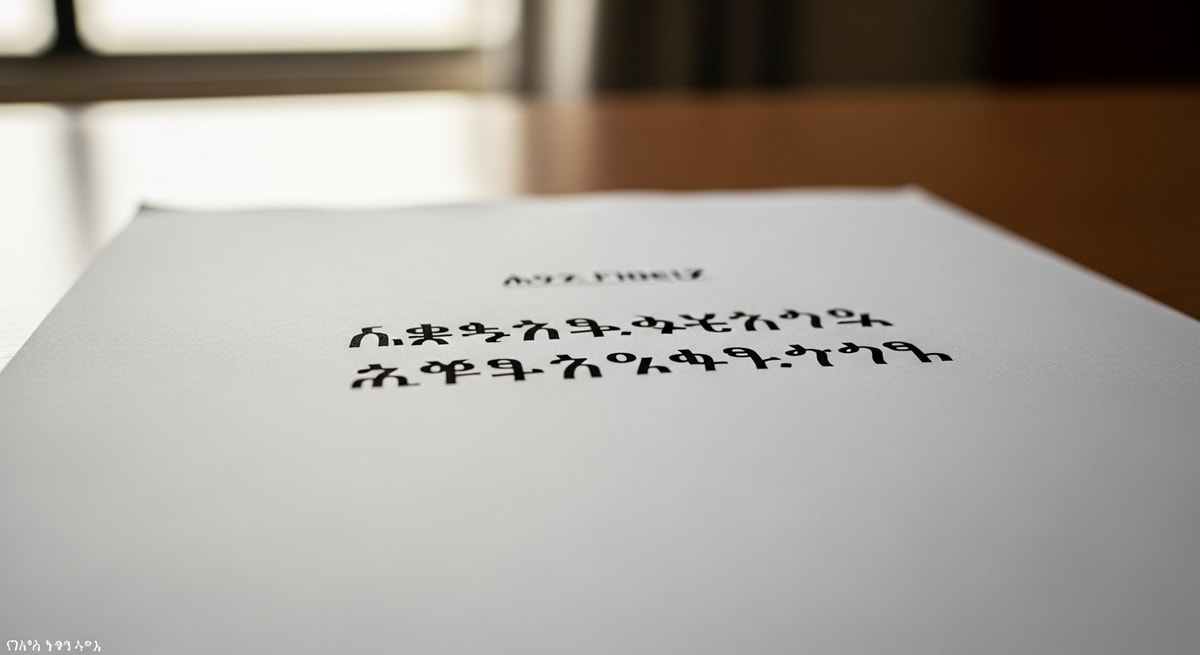
Ethiopia's Fidel script contains over 230 syllabic characters, requiring specialized expertise for accurate translation
The Ethiopian Calendar: Navigating Date Conversion in Documents
Ethiopia follows its own unique calendar system — the Ethiopian calendar (also called the Ge'ez calendar), which is approximately 7 to 8 years behind the Gregorian calendar used in most of the world. The calendar has 13 months: twelve months of 30 days each and a thirteenth short month called Pagumē (ጳጉሜን) of 5 or 6 days. The Ethiopian New Year, Enkutatash (እንቁጣጣሽ), falls on September 11 in the Gregorian calendar (or September 12 in Gregorian leap years).
This calendar difference is one of the most critical aspects of Ethiopian document translation. A birth date written as 15/03/2010 on an Ethiopian document actually corresponds to approximately November 24, 2017 in the Gregorian calendar. Incorrect date conversion can cause visa denials, identity mismatches, and legal complications. Every date on Ethiopian official documents — birth dates, marriage dates, issue dates, expiry dates — must be accurately converted. Our translators use verified conversion tables and include both the original Ethiopian calendar date and the Gregorian equivalent in parentheses, ensuring full transparency for the receiving authority.
Ethiopian months have names that may appear on documents: Mäskäräm (መስከረም), Ṭəqəmt (ጥቅምት), Ḫədar (ኅዳር), Taḫśaś (ታኅሣሥ), Ṭərr (ጥር), Yäkatit (የካቲት), Mägabit (መጋቢት), Miyazya (ሚያዝያ), Gənbot (ግንቦት), Säne (ሰኔ), Ḥamle (ሐምሌ), Nähase (ነሐሴ), and Pagumē (ጳጉሜን). Our translators are trained to recognize these month names in both written-out and abbreviated forms, ensuring no date is missed or misinterpreted during the translation process.

Ethiopia's 13-month Ge'ez calendar runs 7-8 years behind the Gregorian calendar, requiring careful date conversion in all translations
Consular Legalization: Getting Ethiopian Documents Accepted Abroad
Ethiopia is not a member of the Hague Apostille Convention, which means Ethiopian documents cannot receive the simplified apostille stamp recognized by the Convention's 120+ member states. Instead, Ethiopian documents intended for international use must undergo a full consular legalization process — a multi-step authentication chain that verifies the document's origin and the authority of the issuing official.
The legalization chain for Ethiopian documents follows a specific sequence. First, the document must be authenticated by the original issuing authority — for example, the Vital Events Registration Agency for birth and marriage certificates, or the relevant educational institution for academic records. Second, the authenticated document is submitted to the Ministry of Foreign Affairs (MoFA) of Ethiopia for further authentication. The MoFA verifies the issuing authority's credentials and affixes its own authentication stamp. Third, the MoFA-authenticated document is presented to the embassy or consulate of the destination country in Addis Ababa for final legalization. Each embassy maintains its own requirements, fees, and processing timelines.
The complete legalization process typically takes 10-20 business days, depending on the destination embassy's processing speed. DoVisa manages the entire chain on your behalf. We coordinate with the issuing authorities for initial authentication, handle Ministry of Foreign Affairs submissions at the Addis Ababa office, and liaise with the destination country's embassy to complete legalization. We provide status updates at each stage and maintain current knowledge of procedural requirements for all major embassies in Addis Ababa, including the US Embassy, British Embassy, Canadian Embassy, and German Embassy.

The Ethiopian Ministry of Foreign Affairs authenticates documents as part of the consular legalization chain for international use
"Needed my Ethiopian birth certificate translated from Amharic to English for my USCIS green card application. The translator correctly converted my Ethiopian calendar birth date to Gregorian and the Fidel name romanization matched my passport exactly. USCIS accepted it without questions."
"DoVisa translated my Addis Ababa University degree and transcripts for a WES credential evaluation. The academic terminology was handled perfectly and WES processed my evaluation without any issues. Highly recommend for Ethiopian academic documents."
"Translated my Ethiopian Orthodox Church marriage certificate for a UK spouse visa. The translator understood the religious terminology and the British High Commission accepted the translation. Took 5 days instead of the quoted 4, but quality was excellent."
"Excellent service translating my Ethiopian police clearance certificate and birth certificate for Canadian permanent residence through IRCC. The Amharic to English translation was accurate and the certified format met all IRCC requirements. Fast turnaround too."
"Living in Australia and needed my Ethiopian birth certificate and marriage certificate translated for my partner visa application. The Department of Home Affairs accepted both translations on first submission. Great handling of the Ge'ez script."
"The translation of my Ethiopian driving license was accurate but there was a delay because the original scan was too dark to read some Fidel characters clearly. They asked for a rescan which added 2 extra days. Once the clearer image was provided, the work was completed properly."
"Translated my Jimma University pharmacy degree for credential evaluation in New Zealand. The translator included helpful notes about the Ethiopian grading system that the evaluating body appreciated. Professional service overall."
"Our company needed 25 pages of Ethiopian trade registration documents translated from Amharic to English for an international joint venture. The volume discount made it affordable and the business terminology was spot-on. Our legal team confirmed the accuracy."
"Good translation of my Ethiopian birth certificate and kebele ID for my US diversity visa application. The Ethiopian calendar date conversion was done correctly and the name romanization matched my other documents. Received the PDF within 4 business days."
"Needed my Ethiopian divorce decree translated for a family court matter in the UK. The legal terminology from the Amharic original was translated precisely and the court accepted the certified translation without any issues. Very professional service."
"Needed my Ethiopian birth certificate translated from Amharic to English for my USCIS green card application. The translator correctly converted my Ethiopian calendar birth date to Gregorian and the Fidel name romanization matched my passport exactly. USCIS accepted it without questions."
"DoVisa translated my Addis Ababa University degree and transcripts for a WES credential evaluation. The academic terminology was handled perfectly and WES processed my evaluation without any issues. Highly recommend for Ethiopian academic documents."
"Translated my Ethiopian Orthodox Church marriage certificate for a UK spouse visa. The translator understood the religious terminology and the British High Commission accepted the translation. Took 5 days instead of the quoted 4, but quality was excellent."
Ethiopian Document Translation FAQs
What types of Ethiopian documents can be translated?
We translate all types of Ethiopian documents including birth certificates (የልደት ምስክር ወረቀት), marriage certificates (የጋብቻ ምስክር ወረቀት), divorce decrees, death certificates, academic transcripts and degree certificates from all Ethiopian universities, secondary school leaving certificates, police clearance certificates from the Federal Police Commission, business licenses, trade registration certificates, Ethiopian passports, kebele identification documents, land use certificates, medical records, court orders, powers of attorney, and adoption decrees. We handle documents issued by all levels of Ethiopian government — federal, regional, and woreda — as well as documents from religious institutions including the Ethiopian Orthodox Tewahedo Church and Islamic courts.
Are Ethiopian translations certified?
Yes. Every Ethiopian document translation from DoVisa includes a signed certification statement from the translator attesting to the accuracy and completeness of the translation. This certification is accepted by international immigration authorities including USCIS, UK Visas and Immigration, IRCC (Canada), and the Australian Department of Home Affairs, as well as credential evaluation agencies like WES and ECE. Ethiopia does not have a formal sworn translator system like some European countries. Our certified translations meet the international standard required for immigration, academic, legal, and business purposes worldwide.
How long does Ethiopian document translation take?
Standard delivery is 4-6 business days for most Ethiopian document types. Amharic-English translations of single-page vital records often complete in 3-4 business days. Express processing is available for 2-3 business days, and rush delivery within 24 hours is offered for select document types. Translations from Oromo or Tigrinya may require an additional 1-2 business days due to specialist translator scheduling. If you also require authentication through the Ethiopian Ministry of Foreign Affairs and consular legalization, add 10-20 business days for the complete legalization chain. We recommend beginning the translation process at least 4-5 weeks before any visa or immigration deadline to allow adequate time for all steps.
What languages do you translate Ethiopian documents to and from?
We translate Ethiopian documents from Amharic, Oromo (Afaan Oromoo), Tigrinya, Somali, Afar, and other Ethiopian regional languages into English and over 100 other target languages. The most requested pairs are Amharic to English and English to Amharic. We also handle translations between Ethiopian languages and Arabic, French, German, Spanish, Chinese, Portuguese, Italian, and Dutch. For documents containing text in multiple Ethiopian languages — which occurs in some regional government documents — our translators identify and translate all language elements accurately.
Will the translation be accepted by immigration authorities?
Yes. Our certified translations of Ethiopian documents are accepted by all major international immigration authorities. USCIS accepts our translations for green card applications, diversity visa filings, and naturalization petitions. UK Visas and Immigration accepts them for settlement, spouse, and work visa applications. IRCC (Canada) accepts them for permanent residence and citizenship applications. The Australian Department of Home Affairs, Immigration New Zealand, and European immigration authorities also accept our certified translations. Our current acceptance rate for Ethiopian translations at international institutions is 98.1%.
How do you handle Ethiopian calendar date conversions?
This is one of the most critical aspects of Ethiopian document translation. Ethiopia uses the Ge'ez calendar, which has 13 months and runs approximately 7-8 years behind the Gregorian calendar. Every date on an Ethiopian document — birth dates, marriage dates, issue dates, expiry dates — must be accurately converted. Our translators use verified conversion tables and include both the original Ethiopian calendar date and the Gregorian equivalent in each translation. For example, a birth date of 15 Mäskäräm 2003 (Ethiopian calendar) is translated with the Gregorian equivalent of September 25, 2010 in parentheses. This dual-date approach ensures full transparency and prevents the identity mismatches and visa complications that can result from incorrect date conversion.
Do I need notarization with my Ethiopian translation?
For most international immigration and academic purposes, DoVisa's standard certified translation with translator declaration is sufficient without additional notarization. However, if you are submitting documents to an authority that specifically requires notarization, we can coordinate this as an additional service. For documents requiring full consular legalization for international use, authentication through the Ethiopian Ministry of Justice and the Ministry of Foreign Affairs is required as part of the legalization chain. DoVisa handles the entire process on your behalf when legalization is needed.
Can Ethiopian documents get an apostille?
No. Ethiopia is not a member of the Hague Apostille Convention, so Ethiopian documents cannot receive an apostille. Instead, documents intended for international use must go through a full consular legalization process: (1) authentication by the issuing Ethiopian authority, (2) authentication by the Ministry of Foreign Affairs of Ethiopia, and (3) legalization by the destination country's embassy or consulate in Addis Ababa. This process is more involved than the single-step apostille used by Convention member states, but DoVisa manages the entire chain on your behalf. The complete legalization process typically takes 10-20 business days depending on the destination embassy.
How much does Ethiopian document translation cost?
DoVisa's Ethiopian translation pricing follows a per-page structure with volume discounts that apply automatically for larger orders. Pricing varies based on language pair, document complexity, and processing speed. Amharic documents with Ge'ez script require specialized translators, and less common language pairs such as Oromo-English or Tigrinya-English are quoted individually. Express and rush delivery options are available at an additional fee. Authentication and consular legalization services are quoted separately. Upload your documents on our order page to receive a detailed quote before work begins — no hidden fees.
Can you translate handwritten Ethiopian documents?
Yes. Many Ethiopian official documents, particularly older birth certificates, marriage certificates, and court records, contain handwritten Amharic entries in Fidel script. Our translators are experienced with Ethiopian handwriting conventions and the variations in Fidel character forms that appear in handwritten text. If any section is illegible, we clearly mark it as [illegible] in the translation rather than guessing. For partially legible entries, we provide our best reading with a bracketed note indicating uncertainty. If a scan is too unclear to translate reliably, we contact you within 2 hours to request a clearer image.
What format will I receive the Ethiopian translation in?
You receive your certified translation as a high-resolution PDF delivered via email, which includes the full translated text, the translator's certification statement, and an original signature. This digital format is accepted by most immigration authorities and institutions for initial filings. For authorities that require original hard copies, we ship certified translations with original wet signatures and stamps via tracked international courier to your address in Ethiopia or anywhere worldwide. The physical package includes the certified translation, the translator's declaration, and a copy of the original document for reference.
How do you handle Ethiopian names written in Fidel script?
Name romanization from Ge'ez/Fidel script is one of the most important aspects of Ethiopian document translation. The same Amharic name can be transliterated multiple ways in English — for example, ተስፋየ could be rendered as Tesfaye, Tasfaye, or Tesfayeh. Our translators follow established romanization standards and, critically, match the English spelling on the individual's existing identity documents such as their Ethiopian passport or foreign-issued ID. When a bilingual Ethiopian document already shows a Latin-script spelling, we preserve that exact form. If no prior English spelling exists, we apply the BGN/PCGN romanization standard for Amharic and note the romanization method used in the translator's certification.
Get Your Ethiopian Documents Translated Today
Professional certified Amharic-English translations accepted by USCIS, IRCC, UK Visas and Immigration, and international institutions worldwide