
Certified Saint Helena Document Translation
Professional certified translations of Saint Helena documents accepted by the UK Home Office, USCIS, the Australian Department of Home Affairs, and international immigration authorities worldwide.
TrustpilotSelect Languages
Drag & drop your documents here
or
PDF, JPEG, PNG, WebP — Max 10MB per file. Word documents: please save as PDF first.
Certified translators · Accepted by governments, courts & universities worldwide · View sample
Select a destination country to view pricing
How Saint Helena Certified Translation Works
Submit Your Documents Securely
Upload clear scans of your Saint Helena documents through our encrypted portal. We accept PDF, JPEG, and PNG formats. Our intake specialists review each upload for legibility, ensuring stamps and seals from the Civil Registry of Saint Helena, Ascension and Tristan da Cunha, and court seals from the Supreme Court of Saint Helena, are clearly visible before assignment.
Translator Assignment
Saint Helena documents are issued in English — the island's only language. Your documents are matched with a certified translator experienced in translating English into the required target language. Saint Helena vital records may include historical formatting, older civil registry conventions, and references to the island's multicultural heritage drawn from Africa, Asia, and Europe.
Translation & Certification
The translator produces a complete certified translation accompanied by a signed certification statement. As a British Overseas Territory, Saint Helena documents are certified under UK standards — accepted by the UK Home Office, UKVI, and international immigration authorities. Our translations meet USCIS, IRCC Canada, and Australian Home Affairs requirements for UK territorial documents.
Delivery with Full Certification
Receive your certified translation as a high-resolution PDF via email, with a physical signed copy shipped by tracked courier if required. For documents needing apostille, DoVisa coordinates the full process through the <strong>Registrar of the Supreme Court of Saint Helena</strong>, the designated Hague Apostille competent authority under the UK's extended membership.
Saint Helena Translation Service Specifications
Popular Language Pairs
We support all languages — 100+ language pairs available for Saint Helena documents.
Common Documents
- Birth certificates from the Civil Registry of Saint Helena, Ascension and Tristan da Cunha
- Marriage certificates from the Saint Helena Civil Registry
- Death certificates from the Saint Helena Civil Registry
- Saint Helena, Ascension and Tristan da Cunha (BOTC) passports
- Police clearance certificates from the Saint Helena Police Service
- Academic transcripts and records from Prince Andrew School
- Court orders and judicial documents from the Supreme Court of Saint Helena
- Employment references and professional certificates
- Property title records
- Historical civil registry records from the island's 500-year colonial heritage
- Government correspondence from the Saint Helena Government
- UK passport records for Saints with Right of Abode
Turnaround Time
Certification Details
Saint Helena Translation Requirements & Regulatory Framework
Embassy Acceptance
Notarization Process
Apostille Information
Legal Framework
Common Scenarios for Saint Helena Document Translation
UK Residency & British Citizenship Applications
Saints (Saint Helena residents and passport holders) who gained full British citizenship under the British Overseas Territories Act 2002 frequently relocate to the UK. UK government agencies, employers, universities, and professional licensing bodies may require certified translations of Saint Helena vital records when these documents are submitted for official purposes in non-English contexts.
South African Work & Residency Visas
Saint Helena has historically maintained close links with South Africa, and many Saints work in the South African commercial and maritime sectors. South African immigration authorities, employers, and credential evaluation bodies may require certified translations of Saint Helena documents for work permits, professional recognition, and residency applications.
International Academic Credentials
Students from Saint Helena applying to universities in the UK, South Africa, Australia, or elsewhere need certified translations of academic records from Prince Andrew School for international university admissions and credential evaluation. Our translations are accepted by WES and international university admissions offices.
Historical Records & Genealogy
Saint Helena has a 500-year colonial history as a critical waypoint on the East India trade route. Historical civil registry records, East India Company documents, and early British colonial records from the island are sought by genealogy researchers and family historians worldwide. These older documents may require specialist knowledge of historical British colonial administrative formats.
Business & Maritime Documentation
Saint Helena's strategic mid-Atlantic location and St Helena Airport (opened 2016) make it increasingly significant for regional commerce and tourism. Businesses operating on Saint Helena, and international companies partnering with local enterprises, need certified translations of commercial agreements, licensing documents, and regulatory filings for South African, UK, and international counterparts.
Saint Helena's Unique Heritage and Historical Documents
Saint Helena is one of the most remote permanently inhabited islands in the world, located approximately 1,950 km west of Angola in the South Atlantic Ocean. Discovered by the Portuguese in 1502, it became a strategic waypoint for East India trade routes and was administered by the British East India Company from 1659 until 1834, when it became a Crown Colony. Its most famous resident was Napoleon Bonaparte, exiled to Saint Helena from 1815 until his death in 1821.
This 500-year colonial history — spanning Portuguese discovery, Dutch occupation, English East India Company administration, and Crown Colony status — has created an extraordinary documentary heritage. Civil registration records from the earliest English colonial period, East India Company administrative records, military records from the island's garrison, and the personal records of the thousands of sailors, merchants, and administrators who passed through or settled on the island are among the most sought-after historical documents by genealogy researchers worldwide.
The population of Saint Helena — known as Saints — reflects the island's multicultural heritage, drawing from St. Helena's enslaved African population (emancipated in 1792, 41 years before the rest of the British Empire), Chinese indentured labourers brought by the East India Company, Indian workers, and European settlers. This diverse ancestry is reflected in unusual and distinctive surname and personal name patterns in Saint Helena documents that require translators with specialist knowledge of the island's linguistic and cultural history.

Saint Helena's 500-year colonial heritage creates a rich and unique documentary archive sought by genealogists and historians worldwide
Apostille Certification for Saint Helena Documents
The United Kingdom has extended the Hague Apostille Convention to Saint Helena, Ascension and Tristan da Cunha. The designated competent authority for apostille certification on Saint Helena is the Registrar of the Supreme Court of Saint Helena, located in Jamestown. This enables Saint Helena public documents to receive apostille certification for international use across all 125+ Hague Convention member countries.
The apostille process applies to Saint Helena public documents including birth and marriage certificates from the Civil Registry, court orders from the Supreme Court, and documents bearing the official seals or signatures of Saint Helena public authorities. Apostille processing at the Supreme Court Registrar's office typically takes up to 14 business days. The apostille certificate is issued in the standard Hague Convention format.
Given Saint Helena's extreme remoteness — accessible only by irregular sea access or the relatively new St Helena Airport opened in 2016 — DoVisa's managed apostille service is particularly valuable for the large community of Saints now living in the UK, South Africa, Ascension Island, and elsewhere. We handle certified translation, coordinate notarization where required, and manage submission to the Supreme Court Registrar — eliminating the need to travel to Jamestown in person. Electronic apostille (e-apostille) is not currently available for Saint Helena documents.
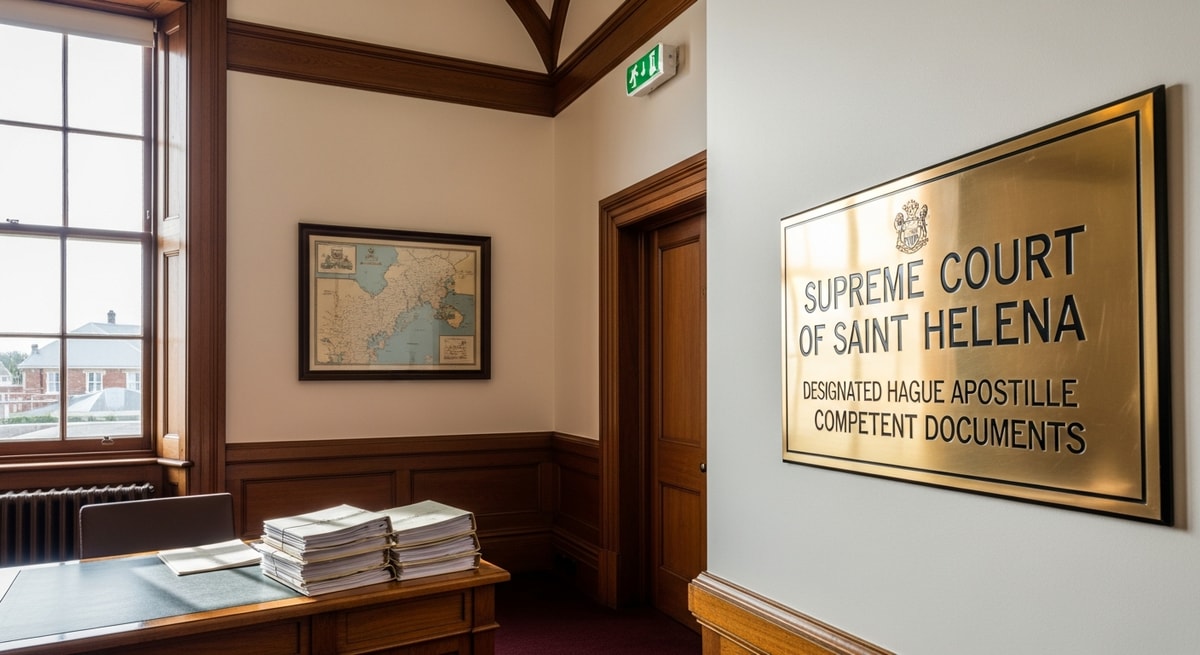
The Registrar of the Supreme Court of Saint Helena in Jamestown serves as the Hague Apostille competent authority for this remote British Overseas Territory
"Saint Helena birth certificate translated to German for a residency application in Germany. The German immigration authority accepted the certified translation on first submission. DoVisa's knowledge of the British Overseas Territory document format was evident."
"Academic records from Prince Andrew School translated for a South African university application. The university processed my application without any requests for additional documentation. Professional and fast — delivered in 4 days."
"Historical East India Company era document from Saint Helena translated for genealogy research. The translator's expertise with early colonial English administrative documents was impressive. Exactly what I needed for my family history project."
"Marriage certificate translated to French for an immigration application in France. The French prefecture accepted the certified translation without requesting any further authentication. Took 5 days which was within the standard timeframe."
"The translation of an older handwritten birth register entry took an extra day due to the archaic formatting. DoVisa kept me informed throughout. The certified translation was accepted by the UK Home Office for a citizenship application."
"Death certificate translated and apostilled for an estate proceeding in Portugal. DoVisa managed the complete process including the Supreme Court Registrar apostille. Professional service and the apostille was accepted by the Portuguese notary."
"Saint Helena birth certificate translated to German for a residency application in Germany. The German immigration authority accepted the certified translation on first submission. DoVisa's knowledge of the British Overseas Territory document format was evident."
"Academic records from Prince Andrew School translated for a South African university application. The university processed my application without any requests for additional documentation. Professional and fast — delivered in 4 days."
"Historical East India Company era document from Saint Helena translated for genealogy research. The translator's expertise with early colonial English administrative documents was impressive. Exactly what I needed for my family history project."
Saint Helena Document Translation FAQs
What types of Saint Helena documents can DoVisa translate?
Are DoVisa's Saint Helena translations accepted by the UK Home Office?
How long does Saint Helena document translation take?
What is the status of Saint Helena as a British Overseas Territory?
Does Saint Helena have its own apostille system?
Is electronic apostille (e-apostille) available for Saint Helena documents?
Can you translate historical Saint Helena documents from the East India Company era?
Do I need notarization with my Saint Helena translation?
What languages do you translate Saint Helena documents into?
How much does certified translation of Saint Helena documents cost?
What format will I receive my translation in?
Get Your Saint Helena Documents Translated Today
Certified translations accepted by the UK Home Office, USCIS, and international authorities — including historical East India Company era records