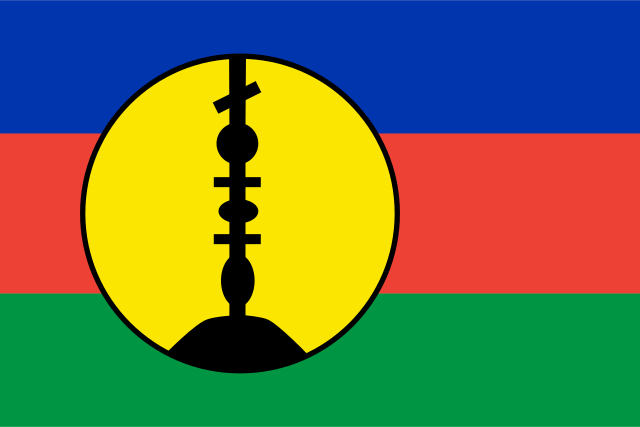
Certified New Caledonia Document Translation
Professional certified translations of French-language documents from New Caledonia (Nouvelle-Calédonie), a French special collectivity in the southwest Pacific. Accepted by USCIS, UK Home Office, Canada IRCC, and Australian immigration. Apostille available through France's e-Apostille system.
TrustpilotSelect Languages
Drag & drop your documents here
or
PDF, JPEG, PNG, WebP — Max 10MB per file. Word documents: please save as PDF first.
Certified translators · Accepted by governments, courts & universities worldwide · View sample
Select a destination country to view pricing
How New Caledonia Certified Translation Works
Submit Your Documents Securely
Upload clear scans of your New Caledonia documents through our encrypted portal. We accept PDF, JPEG, and PNG. New Caledonia (Nouvelle-Calédonie) is a French special collectivity (sui generis) in the southwest Pacific, adjacent to Australia and New Zealand. Civil status documents are issued by local mairies in Nouméa, Mont-Dore, Dumbéa, and other communes under French état civil standards. Our intake team verifies legibility before translation begins.
Translator Assignment
Your documents are assigned to a French-language specialist experienced with Pacific French administrative documents. New Caledonia documents are primarily in French but frequently include Kanak names and place names from Melanesian languages such as Drehu (Lifou), Nengone (Maré), and Paicî. Our translators accurately preserve these names and apply standard French état civil translation practices.
Translation & Certification
The assigned translator produces your certified translation with a formal accuracy statement, professional credentials, signature, and date. A peer reviewer checks for accuracy and completeness. All mentions marginales, official stamps from local mairies, and any Kanak-language elements are accurately addressed in the certified translation with appropriate contextual notes.
Delivery with Full Certification
Receive your certified translation as a high-resolution PDF for immediate submission, with the signed hard copy via tracked courier. For apostille requests, DoVisa coordinates with France's e-Apostille system through Notaires de France. New Caledonia documents fall under French apostille jurisdiction, formerly under the Procureur Général près la Cour d'appel de Nouméa.
New Caledonia Translation Service Specifications
Popular Language Pairs
We support all languages — 100+ language pairs available for New Caledonia documents.
Common Documents
- Birth certificates (acte de naissance / copie intégrale)
- Marriage certificates (acte de mariage)
- Death certificates (acte de décès)
- Divorce decrees (jugement de divorce)
- Family record booklets (livret de famille)
- Criminal record extracts (extrait de casier judiciaire, bulletin n° 3)
- Academic diplomas and transcripts (diplôme / relevé de notes)
- Single-status certificates (certificat de célibat)
- Customary status documents (related to Kanak customary law)
- Driver's licenses (permis de conduire)
Turnaround Time
Certification Details
New Caledonia Translation Requirements & Regulatory Framework
Embassy Acceptance
Notarization Process
Apostille Information
Legal Framework
Common Scenarios for New Caledonia Document Translation
Australian and New Zealand Immigration
New Caledonia's proximity to Australia and New Zealand makes these the most common immigration destinations. Australian DHA and New Zealand Immigration require certified translations of all non-English documents. DoVisa provides certified French-to-English translations of état civil records, academic credentials, and criminal records for all visa categories.
US Immigration Applications
French nationals from New Caledonia applying for US visas or green cards must submit certified English translations to USCIS. Common documents include birth certificates, marriage certificates, criminal records, and academic diplômes. DoVisa's certified translations meet USCIS requirements without a French traduction assermentée.
Kanak Customary Status Documentation
New Caledonia's dual civil status system — common French civil law for settlers and Kanak customary law for indigenous Melanesians — creates unique translation needs. Customary status documents issued by customary senates may accompany standard French état civil records for international proceedings. DoVisa's translators are experienced with New Caledonia's unique legal duality.
Academic Credential Evaluation
Academic credentials from New Caledonia follow the French national education system. Degrees from the Université de la Nouvelle-Calédonie and secondary school certificates submitted to Australian, New Zealand, or US institutions or credential evaluation agencies require certified translations. DoVisa academic translators are fluent in French higher education terminology.
Mining Industry and Corporate Documentation
New Caledonia holds a significant share of the world's nickel reserves, and its mining industry generates substantial international business documentation. Corporate contracts, employment agreements, and regulatory documents from the mining sector require certified translations for international investors, partners, and regulatory authorities in Australia, the US, and Europe.
New Caledonia's Dual Civil Status System
New Caledonia (Nouvelle-Calédonie) has a distinctive legal feature not found in any other French territory: a dual civil status system established under the Accord de Nouméa (1998). Most residents — settlers of European descent, recent immigrants, and naturalized citizens — fall under the statut civil de droit commun (common French civil law), with civil status documents issued by local mairies under the Code civil. Indigenous Kanak Melanesians may choose to retain their statut civil coutumier (customary status), governed by ancestral customary law and administered by customary senates (sénat coutumier).
For international translation purposes, civil status documents under common French law follow standard French état civil formats — acte de naissance, acte de mariage, livret de famille — and are handled by DoVisa in the same way as documents from metropolitan France. Customary status documents, when they exist alongside common-law records, require additional expertise. DoVisa translators familiar with New Caledonian customary status terminology ensure accurate translation of these specialized documents.
Academic credentials from the Université de la Nouvelle-Calédonie follow the French Licence-Master-Doctorat (LMD) system and are recognized internationally. Criminal record extracts for New Caledonia residents are issued by the Casier judiciaire national in Nantes.
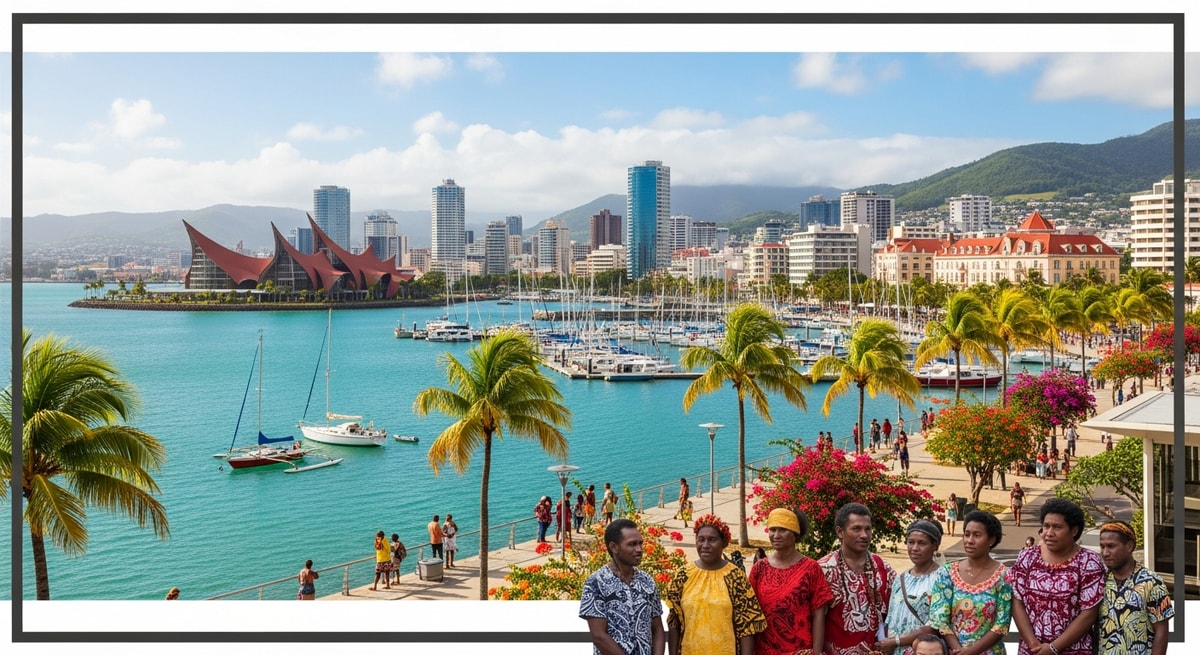
Nouméa is the capital of New Caledonia and home to the Cour d'appel de Nouméa, which maintains the register of sworn translators
Kanak Languages and Translation in New Caledonia
New Caledonia is home to approximately 30 Kanak Melanesian languages, including Drehu (Lifou), Nengone (Maré), Paicî (central mountains), Ajië, and others. These languages belong to the Austronesian family and are distinct from French and Polynesian languages. While official administrative documents in New Caledonia are in French, Kanak names, place names, and clan names frequently appear in civil status records.
Translating New Caledonia documents requires careful handling of Kanak proper nouns, tribal affiliations (clans), and place names that may include diacritics and special characters specific to Kanak orthography. DoVisa translators preserve these names accurately in their original form, providing phonetic context where helpful for the receiving authority.
French is the sole official language for administrative and judicial purposes under French national law. All civil status documents, court judgments, and notarial acts are in French regardless of the parties' native Kanak language. However, customary status proceedings before customary senates may incorporate Kanak terminology that requires specialist translation for international legal proceedings.

New Caledonia's Kanak customary law creates a unique dual civil status system that affects document translation requirements
"New Caledonia birth certificate and livret de famille translated to English for an Australian skilled visa. DHA accepted both translations. The translator correctly handled the Kanak surname in the document. Excellent service."
"Acte de mariage from Nouméa translated for a New Zealand partner visa. Immigration New Zealand accepted the translation on first submission. Fast turnaround and good quality from a team familiar with Pacific French documents."
"Academic transcript from Université de la Nouvelle-Calédonie translated for a Canadian credential evaluation. WES processed the evaluation without requesting any corrections. Translator correctly identified the French LMD credit system."
"Birth certificate with Kanak names translated to English for a USCIS petition. USCIS accepted the translation. The translator preserved all the Kanak names accurately and added clear notes about the New Caledonian customary status system."
"Extrait de casier judiciaire from Nantes translated to English for an Australian visa. DHA accepted it. The team correctly explained that criminal records for New Caledonia residents are issued centrally from Nantes — very knowledgeable."
"Jugement de divorce from New Caledonia family court translated for a US legal proceeding. The legal terminology was handled accurately and my US attorney confirmed the translation quality was high."
"Corporate contract from New Caledonia mining company translated for UK business purposes. Initial version had a minor terminology issue with a Kanak clan name. DoVisa corrected it quickly and the UK solicitor accepted the revised translation."
"Five documents translated and apostilled for use in Japan. DoVisa coordinated the French e-Apostille through Notaires de France and translated everything to Japanese. The Tokyo authority accepted all documents without any issues."
"New Caledonia birth certificate and marriage certificate translated for a Canadian Express Entry application. IRCC accepted both translations. Professional quality and the certification package was complete and well-organized."
"Employment references from New Caledonia nickel company translated for a US job application. The employer in the US accepted the translations. Good quality and competitive pricing for Pacific territory documents."
"Medical degree from New Caledonia translated for a professional licensing application in Australia. AHPRA accepted the translation. The translator handled the specialized French medical terminology accurately. Highly recommended."
"New Caledonia birth certificate and livret de famille translated to English for an Australian skilled visa. DHA accepted both translations. The translator correctly handled the Kanak surname in the document. Excellent service."
"Acte de mariage from Nouméa translated for a New Zealand partner visa. Immigration New Zealand accepted the translation on first submission. Fast turnaround and good quality from a team familiar with Pacific French documents."
"Academic transcript from Université de la Nouvelle-Calédonie translated for a Canadian credential evaluation. WES processed the evaluation without requesting any corrections. Translator correctly identified the French LMD credit system."
New Caledonia Document Translation FAQs
What types of New Caledonia documents can be translated?
DoVisa translates all documents issued in New Caledonia, including birth certificates (acte de naissance), marriage certificates (acte de mariage), divorce decrees, death certificates, family record booklets (livret de famille), criminal record extracts, academic diplomas and transcripts, customary status documents, and corporate or notarial deeds. We handle documents from Nouméa, the Loyalty Islands, the Northern Province, and all other communes.
What is New Caledonia's legal status?
New Caledonia is a French collectivité sui generis (special collectivity) with extensive autonomy under the Accord de Nouméa (1998) and the Loi organique n° 99-209 du 19 mars 1999. Civil status, judicial matters, and international conventions remain under French national jurisdiction. Its residents hold French passports.
What is the Kanak customary status and how does it affect document translation?
Indigenous Kanak Melanesians in New Caledonia may choose to retain statut civil coutumier (customary status) under ancestral law, administered by customary senates. This creates a dual system alongside standard French civil law. For most international purposes, the relevant documents are the French état civil records. DoVisa translators are familiar with New Caledonian customary status terminology when it appears in translated documents.
Is New Caledonia covered by the Hague Apostille Convention?
Yes. New Caledonia falls under French apostille jurisdiction. France joined the Hague Apostille Convention on 24 January 1965. The former competent authority was the Procureur Général près la Cour d'appel de Nouméa. Since 1 May 2025, all French apostilles — including for New Caledonia documents — are issued as e-Apostilles through apostille.notaires.fr operated by Notaires de France.
Are DoVisa translations accepted by Australian immigration?
Yes. Australia's Department of Home Affairs requires certified translations of non-English documents. DoVisa's certified translations of New Caledonia documents meet all DHA requirements for skilled, partner, and other visa categories. Our translations include the translator's credentials, signed accuracy statement, contact details, and date.
How long does New Caledonia document translation take?
Standard certified translation is delivered within 4-6 business days. Express processing is available for 2-3 business days, and rush delivery within 24 hours for select document types. Apostille coordination through Notaires de France adds approximately 5-10 business days.
How are Kanak names handled in translations?
Kanak Melanesian names — drawn from languages such as Drehu, Nengone, Paicî, and Ajië — are preserved in their original form in DoVisa translations, with accurate spelling of any special characters. Clan names, tribal affiliations, and place names from Kanak languages are treated with the same precision as French proper nouns. Contextual notes are added where helpful for the receiving authority.
Do I need a sworn translator for New Caledonia documents?
For submission to French domestic authorities, a traduction assermentée by a translator registered with the Cour d'appel de Nouméa is required. For submission to international authorities such as USCIS, UK Home Office, IRCC, or Australian DHA, DoVisa's certified translations are the correct and accepted format.
How much does New Caledonia document translation cost?
DoVisa uses a transparent per-page pricing model with automatic volume discounts. Pricing varies by document length, language pair, and processing speed. Upload your documents on our order page for an instant, itemized quote — no hidden fees.
Can you translate handwritten New Caledonia documents?
Yes. Older civil status records from New Caledonia may be handwritten, particularly from rural communes or the Loyalty Islands. DoVisa translators are experienced with French handwritten administrative documents, including those with Kanak names. Any illegible portions are noted clearly in the translation.
Where can I get my New Caledonia civil status documents?
Civil status records are maintained by the local mairie of each New Caledonian commune. For Nouméa residents, the Mairie de Nouméa holds records. Criminal record extracts (extrait de casier judiciaire) for New Caledonia residents are issued centrally by the Casier judiciaire national in Nantes for all French nationals.
Get Your New Caledonia Documents Translated Today
Certified translations of French Pacific documents from New Caledonia accepted by USCIS, UK Home Office, Canada IRCC, Australian DHA, and New Zealand Immigration