
Certified French Document Translation for Mali
Professional certified translations of Malian documents — actes d'état civil, diplômes, and legal records. Accepted by USCIS, UKVI, IRCC, and embassies worldwide, with Ministry of Foreign Affairs authentication support.
TrustpilotSelect Languages
Drag & drop your documents here
or
PDF, JPEG, PNG, WebP — Max 10MB per file. Word documents: please save as PDF first.
Certified translators · Accepted by governments, courts & universities worldwide · View sample
Select a destination country to view pricing
How Mali Certified Translation Works
Upload Your Malian Documents
Upload clear scans of your Malian documents through our encrypted portal. We accept PDF, JPEG, and PNG. We handle all Malian civil documents including actes de naissance (birth certificates), actes de mariage, casiers judiciaires (police clearance), and diplômes issued by the Malian state education system. Our intake team reviews each upload within 2 hours to confirm legibility, identify the issuing CRDENA (Centre de Ressources pour le Développement de l'État Civil) or district court, and flag any handwritten sections requiring specialist handling.
Translator Assignment
Your documents are matched with a professional translator fluent in both French and the target language, with expertise in Malian civil registration terminology and the administrative language of Mali's état civil system. For documents containing terminology or annotations in Bambara, Fula, or Tamasheq — common in community-level records from rural cercles — we assign translators with competence in the relevant Malian language.
Translation & Certification
The translator renders your certified translation with accurate French administrative terminology — including jugement supplétif (court-issued birth declaration), acte de naissance (birth certificate), extrait d'acte de naissance, and livret de famille. A second reviewer verifies consistency across all sections, including correct diacritics and accurate rendering of Malian personal names, place names, and district (cercle) references before the signed certification statement is applied.
Delivery with Full Certification
Your certified translation is delivered as a high-resolution digitally signed PDF. For documents requiring the consular legalization chain, we coordinate notarization, authentication by the Ministère des Affaires Étrangères et de la Coopération Internationale in Bamako, and legalization at the destination country's embassy. Hard copies with original ink signatures are dispatched via tracked international courier to your address in Mali or abroad.
Mali Translation Service Specifications
Popular Language Pairs
We support all languages — 100+ language pairs available for Malian documents.
Common Documents
- Acte de naissance (birth certificate) issued by état civil offices
- Jugement supplétif d'acte de naissance (court-issued birth declaration)
- Acte de mariage (marriage certificate)
- Casier judiciaire (police clearance certificate)
- Diplômes and transcripts from the Université des Sciences, des Techniques et des Technologies de Bamako (USTTB)
- Baccalauréat and CAP certificates from the Direction Nationale de l'Enseignement Secondaire
- Livret de famille (family record booklet)
- Acte de décès (death certificate)
- Extraits d'actes de naissance (birth certificate extracts)
- Business registration documents (extrait RCCM)
Turnaround Time
Certification Details
Mali Translation Requirements & Regulatory Framework
Embassy Acceptance
Notarization Process
Apostille Information
Legal Framework
Common Scenarios for Malian Document Translation
Immigration & Visa Applications
Malian nationals applying for visas to non-Francophone countries need certified translations of their actes d'état civil, casier judiciaire, and academic certificates. The large Malian diaspora in France, Italy, the US, Canada, and the Gulf states generates consistent demand for French-to-English, French-to-Arabic, and French-to-Italian translations of vital records and police clearances. Our immigration packages cover full document sets for the most common destination countries.
Academic Credential Evaluation
Malian students and professionals applying to international universities or seeking credential evaluation through WES or ENIC-NARIC need certified translations of their Baccalauréat, CAP, and university diplomas from the Université des Sciences, des Techniques et des Technologies de Bamako (USTTB) and other Malian institutions. Our translators accurately render Mali's French-language academic grading system and institutional terminology, providing the explanatory context evaluators require.
Family & Vital Records
Malian vital records — actes de naissance, actes de mariage, and livrets de famille — are frequently needed in translated form for diaspora immigration petitions, family reunification applications, and inheritance proceedings worldwide. A key challenge in Mali is the widespread use of jugements supplétifs (court-issued birth declarations) where formal birth registration was not completed at the time of birth. Our translators handle both standard actes de naissance and jugements supplétifs with accurate legal terminology.
Business & OHADA Corporate Documentation
Malian businesses operating across ECOWAS or entering into international agreements need certified translations of business registration documents (extraits RCCM), corporate statutes, contracts, and tax clearances. Mali's membership in OHADA facilitates cross-border trade with 16 other West and Central African states. For businesses engaging with Anglophone markets in Ghana, Nigeria, or beyond, French-to-English translation of Malian commercial documents is essential.
Legal & Court Document Translation
Cross-border legal matters involving Mali require certified translations of court orders, judgments, actes notariaux, land titles, and statutory declarations. Mali's French civil law heritage produces documents with distinctive notarial and court terminology. Our legal translators handle the specific vocabulary of Malian civil, family, and commercial law, supporting international arbitration, estate matters, and cross-border legal proceedings.
Healthcare & NGO Document Translation
Malian healthcare workers seeking employment abroad and NGOs operating in Mali both require certified document translations. Medical diplomas from Malian training institutions and clinical records need translation for international credential recognition. NGOs working with displaced and vulnerable populations in Mali — including UNHCR, MSF, and IRC — frequently need certified translations of identity and civil status documents for resettlement and protection applications.
Mali's État Civil System and the Challenge of Birth Registration
Mali's civil registration system — the état civil — was established on the French model and is administered through a network of centres de l'état civil (CEC) at the commune level across Mali's 9 regions, 1 district (Bamako), and 703 communes. The system is governed by Ordinance 2011-023/P-RM and overseen by the CRDENA (Centre de Ressources pour le Développement de l'État Civil). Civil documents are produced in French, the sole official language of Mali, using standardized formats derived from the French administrative tradition.
A critical aspect of Malian civil documentation is the widespread prevalence of jugements supplétifs d'acte de naissance — court-issued birth declarations substituting for a standard état civil birth registration. In Mali, historical birth registration rates have been low, particularly in rural cercles where births were often not registered at the commune level at the time of occurrence. As a result, many Malians — especially older generations — do not possess an acte de naissance in the conventional sense, but instead hold a jugement supplétif delivered by a local court following a hearing in which witnesses testified to the birth event. The jugement supplétif is legally valid in Mali and for most international purposes, but its format is distinctly different from a standard birth certificate, with legal court language specifying the judge, witnesses, and declaration date. Our translators are experienced with both document types and produce translations that clearly explain the nature of the jugement supplétif to foreign receiving authorities unfamiliar with the Malian system.
Beyond the jugement supplétif, the livret de famille (family booklet) is a central civil document issued at the time of marriage, in which births, deaths, and marriages within the family unit are recorded. The livret de famille is widely used in Mali and across Francophone Africa as a composite family identity document and is frequently requested for diaspora immigration applications.
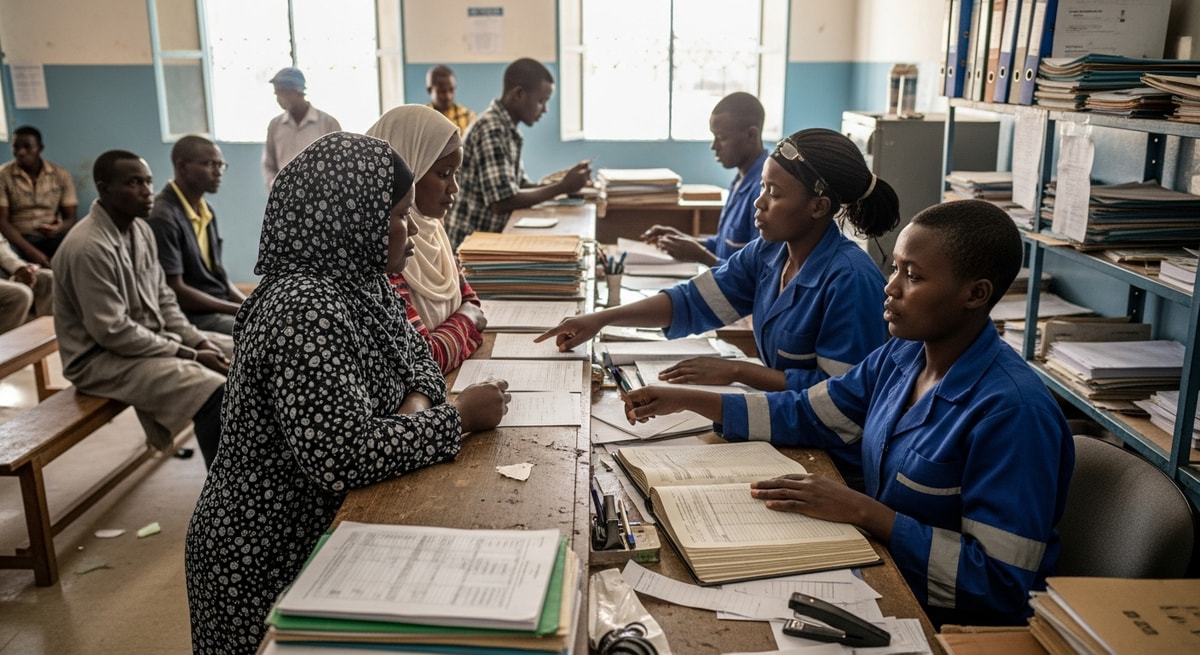
Mali's état civil offices at the commune level issue the vital records that underpin all civil status documentation in the country
Consular Legalization: Getting Malian Documents Accepted Abroad
Mali is not a member of the Hague Apostille Convention. Malian public documents cannot receive an apostille and must instead go through the traditional consular legalization chain when intended for international use. This process establishes the document's authenticity through a sequential chain of official attestations recognized by foreign authorities.
The Mali consular legalization chain follows three steps. First, the document or certified translation is notarized by a notaire (Malian civil law notary) — a highly qualified legal professional under Malian law who can authenticate documents, certify copies, and attest the translator's certification declaration. Second, the notarized document is submitted to the Ministère des Affaires Étrangères et de la Coopération Internationale in Bamako, which authenticates the notaire's credentials and applies its official authentication stamp. Third, the authenticated document is presented to the embassy or consulate of the destination country in Bamako — or, if no mission is present in Mali, at a regional consulate — for final legalization.
The complete process typically takes 10-20 business days, though this depends on the destination embassy's current workload. For comparison, neighbouring Senegal is a member of the Apostille Convention and can issue apostilles through the Ministère de la Justice; however, Malian documents must still use the full consular legalization chain. DoVisa manages all three steps of the Mali legalization chain on your behalf, working with notaires in Bamako and coordinating with destination embassies.

Mali's Ministère des Affaires Étrangères et de la Coopération Internationale in Bamako is the key step in the consular legalization chain
"Translated my acte de naissance and Baccalauréat from French into English for my Canadian student visa. IRCC accepted both translations on first submission. The translator correctly handled the jugement supplétif format and provided clear context notes. Excellent service."
"Needed my Malian marriage certificate and livret de famille translated into English for a UK family reunion visa. UK Visas and Immigration accepted both documents. Delivery was fast — 4 business days from upload to certified PDF in my inbox."
"Had my USTTB university diploma and transcripts translated into English for a WES credential evaluation. WES processed my Canadian application without querying the translations. One handwritten section was difficult to read — DoVisa flagged it clearly and it was accepted."
"Translated my acte de naissance, casier judiciaire, and Baccalauréat into German for a work visa application to Germany. The German consulate in Bamako accepted all three translations on first submission. Clear formatting and professional certification statement."
"Had business registration documents and commercial contracts translated from French into English for a trade agreement with a Nigerian partner. The corporate OHADA terminology was rendered precisely. Very professional — I will use DoVisa for all future international business documentation needs."
"The translation of my acte de mariage was accurate but the initial delivery was missing the translator's signature page. DoVisa resent the complete certified document within 2 hours of me flagging the issue. The US Embassy accepted the corrected version without any problems."
"Translated my casier judiciaire and two actes de naissance from French to Arabic for a work permit in Saudi Arabia. The Arabic legal terminology was precise and the Saudi authority processed my application without any requests for revision. Recommended."
"Good translation of my jugement supplétif d'acte de naissance for my USCIS family petition. USCIS accepted the translation without additional evidence requests. The explanatory note about the jugement supplétif format was particularly helpful for the officer reviewing my file."
"Translated multiple Malian court documents into English for an international arbitration case. The legal terminology was precise and my legal counsel in London confirmed the translations were fit for purpose. Fast delivery and professional throughout."
"Had my Malian nursing diploma and transcripts translated into English for a UK NMC registration application. The NMC accepted the translations and my registration was approved. The service was straightforward and I appreciated the clear communication about the process."
"Translated my acte de naissance and Baccalauréat from French into English for my Canadian student visa. IRCC accepted both translations on first submission. The translator correctly handled the jugement supplétif format and provided clear context notes. Excellent service."
"Needed my Malian marriage certificate and livret de famille translated into English for a UK family reunion visa. UK Visas and Immigration accepted both documents. Delivery was fast — 4 business days from upload to certified PDF in my inbox."
"Had my USTTB university diploma and transcripts translated into English for a WES credential evaluation. WES processed my Canadian application without querying the translations. One handwritten section was difficult to read — DoVisa flagged it clearly and it was accepted."
Malian Document Translation FAQs
What types of Malian documents can be translated?
We translate all types of Malian official documents including actes de naissance (birth certificates), jugements supplétifs d'acte de naissance (court-issued birth declarations), actes de mariage, livrets de famille, casiers judiciaires (police clearance), actes de décès, diplômes and transcripts from Malian universities including the Université des Sciences, des Techniques et des Technologies de Bamako (USTTB), Baccalauréat and CAP certificates from the national education system, court orders and notarial acts, and business registration documents (extraits RCCM from the Registre du Commerce et du Crédit Mobilier).
Are DoVisa translations certified and accepted by immigration authorities?
Yes. Every DoVisa translation includes a signed certification statement from the translator attesting to the accuracy and completeness of the translation. Our certified translations of Malian documents are accepted by USCIS (United States), UK Visas and Immigration, IRCC (Canada), the Australian Department of Home Affairs, credential evaluation agencies such as WES, and foreign embassies and high commissions in Bamako. Mali does not operate a statutory sworn translator system (traducteurs assermentés), so certified professional translations are the applicable standard.
How long does Malian document translation take?
Standard delivery is 4-6 business days for most Malian document types. Express 2-3 day service and rush 24-hour service are available for select document types. If you also need notarization and Ministère des Affaires Étrangères authentication for the consular legalization chain, add 10-20 business days depending on the destination embassy's processing speed.
What languages are Malian documents written in?
French is the official language of Mali and all government-issued documents — actes d'état civil, academic certificates, casiers judiciaires, and court orders — are produced in French. However, community-level records and older handwritten documents from rural cercles may contain annotations in Bambara (the most widely spoken domestic language), Fula (Fulfulde), Tamasheq (spoken by the Tuareg communities in northern Mali), or other local languages. DoVisa translates from French into all major target languages, and can also handle documents containing Bambara or other Malian language elements for full accuracy.
What is a jugement supplétif and can it be translated?
A jugement supplétif d'acte de naissance is a court-issued declaration of birth that substitutes for a standard état civil birth certificate when formal registration was not completed at the time of birth — a common situation in rural Mali historically. The jugement supplétif is issued by a Malian tribunal and bears the court's seal, the judge's signature, and the testimony of witnesses. It is legally valid in Mali and accepted by most international immigration authorities as equivalent to a birth certificate when accompanied by a certified translation. Our translators are experienced with the specific legal language of Malian jugements supplétifs and provide contextual notes to help foreign receiving authorities understand the document's legal status.
Can Malian documents get an apostille?
No. Mali is not a member of the Hague Apostille Convention, so Malian documents cannot receive an apostille. Instead, documents intended for international use require full consular legalization: (1) notarization by a Malian notaire, (2) authentication by the Ministère des Affaires Étrangères et de la Coopération Internationale in Bamako, and (3) legalization at the destination country's embassy or consulate. This process typically takes 10-20 business days. DoVisa manages the entire chain on your behalf.
Do I need notarization with my Malian translation?
For most immigration applications to the US (USCIS), UK, Canada (IRCC), and Australia, a certified translation alone is sufficient. Notarization by a Malian notaire is required only when: (a) the destination authority specifically requests notarization, or (b) you need the full consular legalization chain for use in countries that require authentication. DoVisa advises on whether notarization is needed for your specific destination and coordinates it when required.
What is the consular legalization process for Malian documents?
Since Mali is not an Apostille Convention member, the standard authentication path for international use involves three steps: Step 1 — notarization by a notaire in Mali, who verifies and attests the document. Step 2 — authentication by the Ministère des Affaires Étrangères et de la Coopération Internationale in Bamako, which confirms the notaire's credentials. Step 3 — legalization by the destination country's embassy or consulate. The full process takes 10-20 business days. DoVisa manages all three steps.
How much does Malian document translation cost?
DoVisa's Mali translation pricing follows a per-page structure with volume discounts that apply automatically for larger orders. Pricing varies by language pair, document type, and processing speed. Express and rush service options are available at additional cost for time-sensitive applications. Notarization and Ministère des Affaires Étrangères authentication fees are quoted separately. Upload your documents for an instant online quote with no obligation.
Can you translate handwritten Malian documents?
Yes. Older Malian état civil records and some rural commune documents contain handwritten entries. Our translators are experienced with French colonial-era and modern Malian administrative handwriting styles. Any illegible sections are clearly marked [illisible] in the translation, and the certification statement notes any limitations. If a scan is too unclear to translate reliably, we contact you within 2 hours to request a clearer image or discuss alternatives.
What format will I receive my Malian translation in?
All translations are delivered as high-resolution digitally signed PDFs via email, including the certified translation and the translator's signed declaration. For translations requiring physical hard copies — particularly for the consular legalization chain or court submissions — we dispatch originals with ink signatures via tracked international courier to your address in Mali or abroad.
Does DoVisa translate documents for the Malian diaspora?
Yes. The Malian diaspora is estimated at over 4 million people, with major communities in France, Côte d'Ivoire, Senegal, Mauritania, the US, and the Gulf states. DoVisa regularly translates Malian vital records, academic certificates, and legal documents for diaspora members managing immigration applications, family petitions, academic enrollment, and cross-border legal matters. Our understanding of both Malian document formats and international receiving authority requirements makes us well positioned to serve diaspora clients wherever they are based.
Get Your Malian Documents Translated Today
Certified French-to-English and 100+ language pair translations, with Ministère des Affaires Étrangères authentication and consular legalization support