
Certified French Document Translation for Guinea
Professional certified translations for Guinean documents — French to English and 100+ language pairs. Accepted by USCIS, UKVI, IRCC, and embassies worldwide. Authentication and consular legalization support included.
TrustpilotSelect Languages
Drag & drop your documents here
or
PDF, JPEG, PNG, WebP — Max 10MB per file. Word documents: please save as PDF first.
Certified translators · Accepted by governments, courts & universities worldwide · View sample
Select a destination country to view pricing
How Guinea Certified Translation Works
Upload Your Guinean Documents Securely
Scan or photograph your Guinean documents and upload them through our encrypted portal. We accept all document types issued by Guinean état civil offices, ministries, and academic institutions — in PDF, JPEG, or PNG format. Our intake specialists review each upload within 2 hours to confirm legibility and determine the appropriate certification pathway for your specific destination authority.
Expert Translator Assignment
Your documents are matched with a translator who has native-level proficiency in French and deep expertise in Guinean administrative and legal terminology. Our team understands the specific conventions used by Guinean état civil registrars, the Ministère des Affaires Étrangères, and academic institutions such as the Université Gamal Abdel Nasser de Conakry — ensuring precise, contextually accurate translations.
Translation & Quality Certification
The translator produces a certified translation (traduction certifiée) with full attention to Guinean French administrative conventions, correct diacritics, and état civil formatting. A second qualified linguist verifies terminology, name spellings, and formatting. Each translation includes a signed certification statement attesting to accuracy and completeness, accepted by immigration authorities, universities, and courts internationally.
Delivery with Full Certification
Receive your certified translation as a high-resolution PDF for immediate use, with the original stamped hard copy dispatched via tracked international courier. For documents requiring the full legalization chain — authentication by the Ministère des Affaires Étrangères de la République de Guinée followed by destination country embassy legalization in Conakry — DoVisa coordinates each step on your behalf.
Guinea Translation Service Specifications
Popular Language Pairs
We support all languages — 100+ language pairs available for Guinean documents.
Common Documents
- Birth certificates (acte de naissance / extrait de naissance)
- Marriage certificates (acte de mariage / certificat de mariage)
- Death certificates (acte de décès)
- National identity card (carte nationale d'identité)
- Academic diplomas and transcripts (diplôme / relevé de notes)
- Police clearance certificates (casier judiciaire / certificat de bonne vie et mœurs)
- Single-status certificates (certificat de célibat)
- Divorce judgments (jugement de divorce)
- Residence certificates (certificat de résidence)
- Commercial registration extracts (registre du commerce et du crédit mobilier)
- Powers of attorney (procuration)
- Military service records (livret militaire)
Turnaround Time
Certification Details
Guinea Translation Requirements & Regulatory Framework
Embassy Acceptance
Notarization Process
Apostille Information
Legal Framework
Common Scenarios for Guinean Document Translation
Immigration & Visa Applications
Guinean nationals applying for visas or residency in the United States, Canada, the United Kingdom, France, or other destinations must submit certified English or local-language translations of their birth certificates (acte de naissance), marriage certificates, police clearance certificates, and academic diplomas. Our certified translations meet USCIS, UKVI, and IRCC requirements, and our consular legalization service handles the full authentication chain required for Guinean documents.
Academic Credential Evaluation
Guinean students and professionals applying to universities or credential evaluation agencies abroad need certified translations of their diplômes, relevés de notes, and baccalauréat certificates issued by the Ministère de l'Enseignement Supérieur et de la Recherche Scientifique. Our academic translators understand Guinean grading conventions and the institutional terminology of the Université Gamal Abdel Nasser de Conakry and other Guinean universities, providing evaluation agencies like WES and ICES with complete and accurate translations.
Family & Marriage Documentation
Guinean diaspora communities worldwide need certified translations of actes de naissance, actes de mariage, and related état civil documents for family reunification visa applications, spousal visa petitions, and registration of foreign marriages in Guinea. Our translators are experienced with Guinean état civil document formats, including documents that reference both the Gregorian and Islamic (Hijri) calendars, which appear in some community and religious records.
Business & OHADA Commercial Law
Guinea is a member of OHADA (Organisation pour l'Harmonisation en Afrique du Droit des Affaires), which harmonizes commercial law across 17 West and Central African states. Companies operating in Guinea or entering the Guinean market need translations of RCCM registration extracts, statuts de société, and financial documents. Our translators understand both OHADA-specific commercial terminology and Guinean business practices, facilitating cross-border corporate transactions.
Legal Proceedings & Court Documents
International legal matters involving Guinea require certified translations of court judgments (jugements), powers of attorney (procurations), notarial deeds (actes notariés), and inheritance documents (actes de succession). These documents often require consular legalization before they can be submitted in foreign courts. Our legal translators are experienced with French civil law terminology as applied in the Guinean judicial system.
Mining & Natural Resource Industry
Guinea possesses significant natural resources including some of the world's largest bauxite reserves and major iron ore deposits. International mining companies, investors, and contractors operating in Guinea regularly need translations of mining convention documents, environmental impact studies, regulatory filings with the Ministère des Mines et de la Géologie, and joint venture agreements. Our specialized translators handle the technical and legal vocabulary of Guinea's extractive industries.
Guinea's État Civil System and Document Landscape
Guinea's official documentation system is rooted in the état civil (civil status) framework inherited from French colonial administration and maintained through independence in 1958 under Sékou Touré. All vital records — births (naissances), marriages (mariages), and deaths (décès) — are registered at local centres d'état civil administered by the Ministère de l'Administration du Territoire et de la Décentralisation. The resulting documents, known as actes d'état civil, form the backbone of Guinean legal identity and are the documents most frequently required for international immigration and administrative purposes.
The acte de naissance (birth certificate) is Guinea's primary identity document for international use. It may be issued in two forms: the acte de naissance intégral (full birth record showing all registered details) and the extrait de naissance (extract containing key details only). Both are issued in French with handwritten or typed entries by the registrar. Older documents may include handwritten Arabic numerals or annotations where the registrant's name has an Arabic origin, reflecting Guinea's majority Muslim population. Our translators carefully handle name transcription, ensuring that Arabic-origin personal names such as Mamadou, Fatoumata, Ibrahima, and Aïssatou are rendered with correct diacritics and standard romanizations accepted by international authorities.
Beyond French, Guinea's four major language groups — Pular (Fula), Mandinka (Malinké), Susu, and various smaller languages — do not appear in official documents but are reflected in names and cultural context. The Pular language has its own written form using both Arabic script (Ajami) and a Latin-based orthography, which may appear in community-level religious documents. DoVisa can arrange translations from Pular and other Guinean languages when such documents require rendering into French or English for official use.
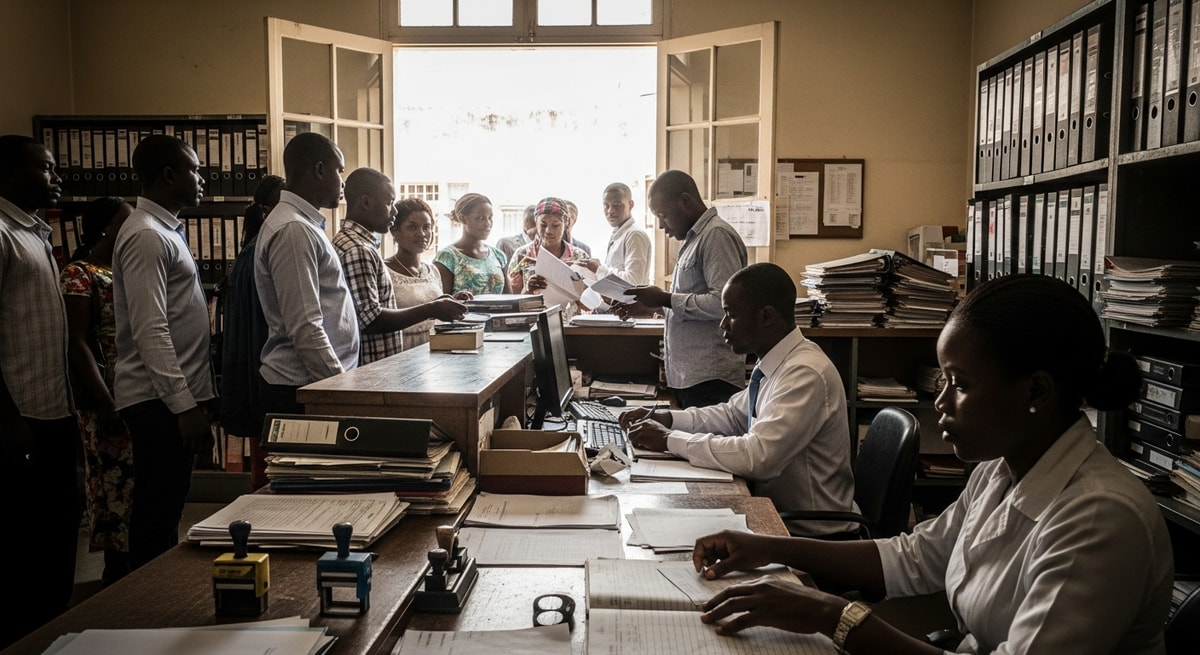
Guinea's état civil system issues vital records in French, the country's sole official language, following French civil law traditions
Consular Legalization: Getting Guinean Documents Accepted Abroad
Guinea is not a member of the Hague Apostille Convention, which means that Guinean documents cannot receive the simplified apostille stamp used by the Convention's 130+ member states. Instead, Guinean documents intended for international use must undergo full consular legalization — a multi-step authentication chain that verifies the document's authenticity and the authority of the official who signed it.
The legalization process for Guinean documents follows a defined sequence. First, the document may require attestation by a notaire (notary public) or the issuing authority to confirm its authenticity. Second, the attested document is submitted to the Ministère des Affaires Étrangères de la République de Guinée in Conakry, which affixes an official authentication stamp confirming the document's origin. Third, the authenticated document is presented to the embassy or consulate of the destination country in Conakry — or the Guinean embassy in the destination country — for final legalization. Each embassy operates on its own schedule and fee structure.
This process is more involved than the single-step apostille available in Convention member states, but DoVisa manages the complete legalization chain on your behalf. We coordinate notarial attestation through our partner advocates, handle Ministère des Affaires Étrangères submissions in Conakry, and liaise with the relevant destination country embassy. The complete process typically takes 10-18 business days from document receipt. Neighboring Senegal joined the Apostille Convention in 2023, but Guinea has not yet acceded to the Convention. We recommend beginning the process at least four weeks before any immigration deadline to allow adequate processing time at each stage.

The Guinean Ministry of Foreign Affairs authenticates documents for the consular legalization chain required for international use
Academic and Professional Credentials from Guinea
Guinea's higher education system is overseen by the Ministère de l'Enseignement Supérieur et de la Recherche Scientifique. The country's flagship institution is the Université Gamal Abdel Nasser de Conakry (UGANC), the oldest and largest university in Guinea. Other notable institutions include the Université Général Lansana Conté de Sonfonia, the Université Julius Nyerere de Kankan, and various professional schools. Academic documents — diplômes, relevés de notes, and attestations de réussite — are issued in French and follow French-origin academic formatting.
Secondary education is certified through the baccalauréat, the national school-leaving examination administered by the Office du Baccalauréat. Guinean baccalauréat certificates specify the series (série scientifique, série littéraire, série technologique) and the mention (passable, assez bien, bien, très bien). Our translators provide full contextual explanations of these designations for foreign evaluation agencies and universities.
Healthcare workers trained in Guinea applying for registration abroad require translations of their diplôme de docteur en médecine or diplôme d'État d'infirmier along with internship records. Our translators maintain up-to-date knowledge of Guinean institutional terminology to ensure that professional credential translations meet the standards of foreign regulatory bodies including the UK NMC, US CGFNS, and Health Canada.

Guinean university diplomas and transcripts follow French-origin academic formatting and require expert certified translation for international use
"Needed my Guinean birth certificate (acte de naissance) and police clearance translated into English for my US immigrant visa application. USCIS accepted both documents on first submission. The translator handled the diacritics in my name perfectly — no issues at the embassy."
"Had my Guinean university diploma and relevé de notes from UGANC translated for a WES credential evaluation in Canada. The academic terminology was handled very professionally and WES confirmed the translation was complete and accurate. Highly recommend for Guinean academic documents."
"Translated my Guinean marriage certificate (acte de mariage) and birth certificates for a UK family visa application. UKVI accepted everything without questions. The service took five business days rather than four, but quality was excellent and the French administrative terminology was handled correctly."
"DoVisa translated my Guinean baccalauréat certificate and school transcripts for a university application in Germany. The admissions office confirmed the translation met their requirements. The translator explained the baccalauréat series and mention grading, which was very helpful."
"The translation of my Guinean commercial documents was accurate but there was an initial delay because the intake team needed extra time to confirm the RCCM registration number format. Once clarified, the work was completed correctly and our Canadian business partners accepted the documents."
"Living in the United States and needed my Guinean birth certificate and mother's death certificate translated for my green card application. USCIS accepted both without any requests for evidence. The translator correctly handled the handwritten sections of the older death certificate."
"Our mining company needed translations of Guinean Ministère des Mines regulatory documents and joint venture agreements. The technical and legal terminology was handled with high precision. Our legal counsel in London confirmed the quality was professional grade."
"Translated my Guinean nursing diploma and internship records for an application to the Nursing and Midwifery Council in the UK. The NMC accepted the translations. The process was straightforward and the medical terminology was accurate."
"Used DoVisa for certified French-to-English translations of Guinean court documents for an international arbitration case. The legal terminology drawn from French civil procedure was precisely rendered and our legal team in New York confirmed the translations met the tribunal's requirements."
"Needed translations of my Guinean divorce judgment and children's birth certificates for a custody matter in Canada. The legal French terms were handled accurately and our Canadian lawyer was satisfied with the certified translation. Good professional service for a sensitive document type."
"Translated my Guinean certificat de résidence and acte de naissance for an Australian partner visa application. The Department of Home Affairs accepted both without any issues. Fast turnaround and the translator correctly handled my name's diacritics throughout the document."
"Needed my Guinean birth certificate (acte de naissance) and police clearance translated into English for my US immigrant visa application. USCIS accepted both documents on first submission. The translator handled the diacritics in my name perfectly — no issues at the embassy."
"Had my Guinean university diploma and relevé de notes from UGANC translated for a WES credential evaluation in Canada. The academic terminology was handled very professionally and WES confirmed the translation was complete and accurate. Highly recommend for Guinean academic documents."
"Translated my Guinean marriage certificate (acte de mariage) and birth certificates for a UK family visa application. UKVI accepted everything without questions. The service took five business days rather than four, but quality was excellent and the French administrative terminology was handled correctly."
Guinean Document Translation FAQs
What types of Guinean documents can DoVisa translate?
DoVisa translates all types of official Guinean documents, including: birth certificates (acte de naissance / extrait de naissance), marriage certificates (acte de mariage), death certificates (acte de décès), police clearance certificates (casier judiciaire / certificat de bonne vie et mœurs), academic diplomas and transcripts from the baccalauréat through university level, national identity cards (carte nationale d'identité), residence certificates (certificat de résidence), divorce judgments (jugement de divorce), powers of attorney (procuration), commercial registration documents (extrait RCCM), mining and regulatory documents from the Ministère des Mines et de la Géologie, and notarial deeds (actes notariés). All translations are certified and accepted by USCIS, UKVI, IRCC, and authorities worldwide.
Are DoVisa's translations certified for official use?
Yes. Every translation includes a signed certification statement from the translator attesting to the accuracy and completeness of the translation from the original French (or other source language) Guinean document. This certification format is accepted by USCIS (United States), UK Visas and Immigration, Immigration, Refugees and Citizenship Canada (IRCC), the Australian Department of Home Affairs, and credential evaluation agencies including WES and ICES. For submission to Guinean domestic authorities, additional notarization or attestation by a Guinean notaire may be required depending on the specific authority — DoVisa can coordinate this on request.
Can Guinean documents get an apostille?
No. Guinea is not a member of the Hague Apostille Convention, so Guinean documents cannot receive an apostille. Instead, documents intended for international legal use must undergo full consular legalization: (1) notarization or attestation in Guinea, (2) authentication by the Ministère des Affaires Étrangères de la République de Guinée, and (3) legalization by the destination country's embassy in Conakry. This process typically takes 10-18 business days. Neighboring Senegal joined the Apostille Convention in 2023, but Guinea has not yet acceded. DoVisa manages the complete legalization chain on your behalf.
How long does Guinean document translation take?
Standard delivery is 4-6 business days for most Guinean documents. Express service delivers in 2-3 business days, and rush service in 24 hours for select single-page documents. French–English translations complete fastest due to high translator availability. If you also require the full consular legalization chain through the Ministère des Affaires Étrangères, add 10-18 business days for the complete authentication process. We recommend beginning the translation and legalization process at least four weeks before any immigration deadline.
What languages are Guinean official documents issued in?
All Guinean official documents are issued in French, Guinea's sole official language. While Pular (Fula), Mandinka, and Susu are widely spoken, they do not appear in government-issued documents. However, personal names in Guinean documents often derive from Arabic and Pular origins, and correct diacritics and romanization are critical. Names such as Aïssatou, Thierno, and Boubacar must be accurately transcribed. Some community-level religious records may include Arabic-language sections alongside the French administrative text. DoVisa handles all these variations with the precision required by international authorities.
Will DoVisa's translations be accepted by USCIS and immigration authorities?
Yes. Our certified translations of Guinean documents are accepted by USCIS for US visa, green card, and citizenship applications; by UK Visas and Immigration (UKVI) for all UK visa categories; by Immigration, Refugees and Citizenship Canada (IRCC) for Canadian immigration applications; and by the Australian Department of Home Affairs. Our acceptance rate with international immigration authorities stands at 98.1%. If any authority rejects a translation due to a quality or formatting issue, we revise and reissue at no extra cost within 24 hours. If the issue cannot be resolved, we provide a full refund.
Do I need notarization with my Guinean translation?
For most international immigration and administrative uses — including USCIS, UKVI, and IRCC submissions — notarization is not required. DoVisa's standard certified translation with the translator's signed declaration is sufficient. However, for documents being submitted to Guinean courts or used as part of the consular legalization chain, additional attestation by a Guinean notaire (notary public) may be required. DoVisa can coordinate this step through our partner advocates in Conakry when your specific receiving authority requires it.
How much does Guinean document translation cost?
DoVisa uses a per-page pricing model with automatic volume discounts for larger orders — the per-page rate decreases as the total number of pages increases. Processing speed (standard, express, or rush) affects pricing. Consular legalization fees, embassy fees, and courier charges are quoted separately where applicable. Upload your Guinean documents on our order page to receive a transparent, itemized quote before you commit — there are no hidden fees or surprise charges.
Can DoVisa translate handwritten Guinean documents?
Yes. Many Guinean état civil documents — particularly older birth and marriage certificates — contain handwritten entries by the civil registrar. Our translators are experienced with French administrative handwriting and Guinean registrar conventions. If a section is genuinely illegible, we mark it clearly as [illisible] in the translation with a note in the certification, rather than guessing at the content. If the scan quality is insufficient for reliable translation, we contact you within 2 hours of upload to request a clearer image or to discuss alternatives such as obtaining a fresh certified extrait from the issuing état civil office.
What format will I receive the Guinean translation in?
You receive your certified translation as a high-resolution PDF via email — suitable for immediate submission to USCIS, UKVI, IRCC, and most online portals. For applications requiring a physical original, we dispatch a hard copy with the translator's original signature and stamp via tracked international courier. Delivery is available to addresses in Guinea and worldwide. Express courier options (DHL, FedEx) are available for urgent submissions. Digital and physical copies are both included in the standard service.
Does DoVisa translate documents from Pular, Mandinka, or Susu?
Official Guinean government documents are always issued in French, so most clients require French-to-English or French-to-other-language translation. However, DoVisa can arrange translation of community-level documents, religious records, and informal documents in Pular (Fula), Mandinka, and Susu when required. Pular in particular has a written tradition using both Arabic-script Ajami and a Latin-based orthography. If you have a non-French Guinean document that needs translation, contact us with details and we will confirm availability and pricing.
Can you translate Guinean academic documents for university applications abroad?
Yes, academic translation is one of our most common services for Guinean documents. We translate baccalauréat certificates (including series designation and mention grading explanation), university diplomas (diplôme de licence, maîtrise, master, doctorat) from institutions including the Université Gamal Abdel Nasser de Conakry and the Université Général Lansana Conté de Sonfonia, plus relevés de notes (transcripts) for all levels. We provide contextual explanations of the Guinean grading scale for evaluation agencies such as WES (Canada), ICES, and NARIC (UK).
What is the consular legalization process for Guinean documents?
Since Guinea is not a Hague Apostille Convention member, international legal use of Guinean documents requires consular legalization. The process involves: Step 1 — attestation or notarization of the document (or its certified translation) by a competent authority or notaire in Guinea. Step 2 — authentication by the Ministère des Affaires Étrangères de la République de Guinée in Conakry, confirming the document's origin. Step 3 — legalization by the embassy or consulate of the destination country in Conakry. The full process takes approximately 10-18 business days. DoVisa coordinates all three steps, providing status updates at each stage.
Can DoVisa help with OHADA commercial law documents from Guinea?
Yes. Guinea is a member of OHADA (Organisation pour l'Harmonisation en Afrique du Droit des Affaires), which harmonizes commercial law across 17 West and Central African states. Guinean commercial documents — including RCCM registration extracts, statuts de société, procès-verbaux d'assemblée générale, and bilans financiers — use OHADA-standardized terminology. Our translators are experienced with OHADA commercial law vocabulary, ensuring that translated Guinean business documents are understood correctly by foreign partners, investors, law firms, and regulatory bodies. We also handle translation of mining convention documents for the bauxite and mineral extraction sector.
Get Your Guinean Documents Translated Today
Certified French-English translations of Guinean documents — accepted by USCIS, UKVI, IRCC, and international authorities worldwide