
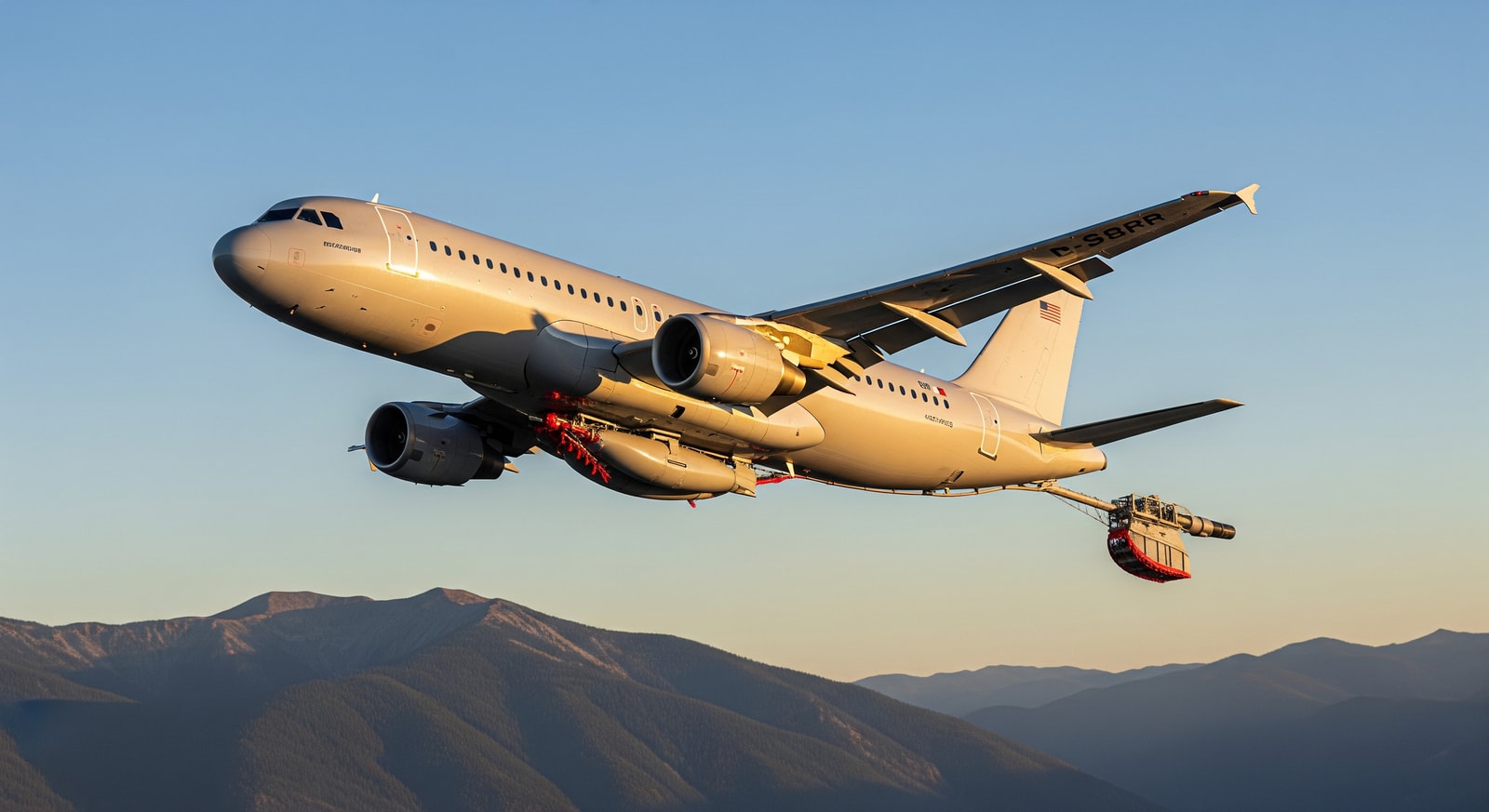
Airbus A319 wildfire fighter: Neptune Aviation is converting the A319 into a 4,500-gallon aerial tanker to strengthen wildfire response in the United States.
Summary: Neptune Aviation is converting the Airbus A319 into a 4,500-gallon aerial tanker, partnering with Aerotec & Concept. The program begins in 2026, with operational plans tied to the 2026–2027 rollout and a goal of 10–15 A319 tankers by 2029.
Neptune Aviation of Missoula is reworking the Airbus A319 for frontline wildfire suppression, converting the short-haul airliner into a jet-powered aerial tanker with a 4,500-gallon (approximately 17,000-litre) retardant capacity. The project addresses growing global demand for more capable firefighting aircraft and begins in 2026, with operational milestones planned through 2027 and beyond.
A New Role for the Airbus A319
Once a staple of short-haul passenger routes, the A319 will be repurposed to carry large volumes of fire-retardant chemicals. Neptune says the conversion yields a tanker capable of holding 4,500 gallons — a marked increase over the company’s BAe 146 jets, which carry about 3,000 gallons — enabling larger drops and fewer sorties during suppression operations.
- Converted Airbus A319 retardant capacity: 4,500 gallons (approx. 17,000 litres)
- Existing BAe 146 capacity: 3,000 gallons
- Conversion program start: 2026
Engineering Changes and Technical Partners
Neptune has teamed with Aerotec & Concept to design and install a purpose-built tank system that fits the A319’s airframe and higher maximum takeoff weight. The conversion also requires significant integration work to marry the tanker system with the A319’s fly-by-wire flight controls and modern avionics.
Beyond tanks and controls, Neptune will add extra fuel capacity so the A319 can reach remote incidents and operate at distance from bases. These modifications are intended to preserve safety and performance while delivering the larger payloads demanded by current wildfire seasons.
Fleet Strategy and Timelines
The A319 conversion is part of Neptune’s broader effort to modernise and enlarge its tanker fleet. The company currently operates jet-powered BAe 146s and aims to supplement them with multiple A319s to improve surge capacity during peak fire seasons.
Neptune has stated a target fleet of 10 to 15 A319 aerial tankers. Each converted aircraft must complete an interagency airtanker evaluation before being cleared for operational firefighting missions. The company plans staged deliveries through 2029 to reach its fleet goals.
On scheduling, Neptune will begin transformations in 2026. The company says the A319s will first operate during the 2027 wildfire season; the reporting also notes the first converted A319 is scheduled for deployment in 2026, with additional aircraft joining the fleet by 2029.
Global Relevance and Operational Advantages
Repurposing A320-family airframes like the A319 has international appeal because these models have widespread parts availability, established maintenance networks and experienced technicians. That ecosystem can reduce lifecycle costs and simplify support for operators deploying converted airliners in multiple countries.
- Larger payloads enable bigger single drops and fewer sorties
- Improved range and extra fuel let aircraft reach remote fires
- Established global support for Airbus A320-family aids maintenance
Neptune’s Experience and Capabilities
Based at Missoula International Airport (MSO), Neptune Aviation has long specialised in aerial firefighting with its BAe 146 jets. The company operates globally for governments and agencies, maintains surge readiness during peak seasons and provides maintenance and avionics services that support its operational mission.
Why this matters: converting the Airbus A319 into a larger, faster tanker gives wildfire agencies a new tool that can deliver heavier loads over greater distances. For the aviation and firefighting industries, Neptune’s program demonstrates a path to scale airborne suppression using widely supported commercial airframes; for communities threatened by fires, it promises more capable and rapid response options.
Sources