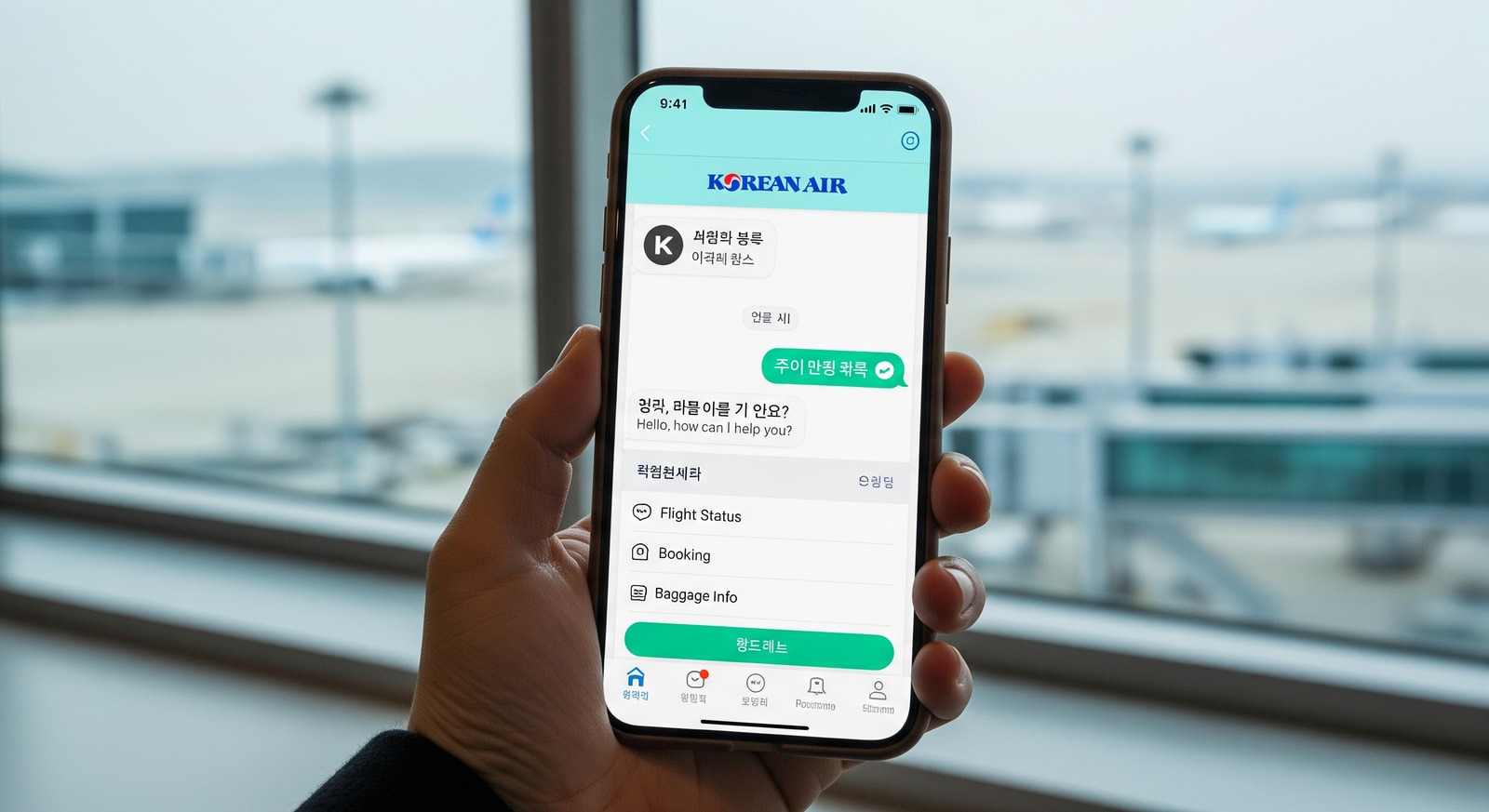
Korean Air AI Chatbot is now live on the airline's website and app, offering context-aware, source-linked answers and multilingual support to speed traveller assistance.
Summary: Korean Air AI Chatbot is now available on the airline’s website and mobile app, using generative AI trained on airline rules and policies to provide context-aware, source‑linked answers in 13 languages and seamless escalation to human agents.
Korean Air has introduced the Korean Air AI Chatbot, a generative AI customer‑support assistant embedded in the carrier’s official website and mobile application. The system applies advanced natural language processing and is trained on a comprehensive dataset of airline regulations, operational policies, and official service information to deliver tailored, itinerary‑specific guidance.
Built on official airline rules and verification
Unlike conventional scripted chatbots that rely on keyword matching, Korean Air’s new assistant was trained on verified airline documents and regulatory guidelines so responses align with published procedures. The airline has implemented a specialised verification database to reduce inaccuracies and to provide links and citations with each reply, aiming to boost transparency and reliability.
How the chatbot understands passenger needs
The chatbot accepts conversational questions and interprets traveller intent and context in real time. It can answer queries that reference specific itineraries, cabin classes, and routes, providing quicker, more relevant guidance than rule‑based assistants.
For example, a traveller could ask,
“I’m flying economy from Incheon to Paris. How many bags can I check in?”
Multilingual reach and agent handoff
Korean Air expanded language support from four to 13 languages to serve its global customer base. The service now covers Korean, English, Simplified Chinese, Japanese, French, German, Spanish, Portuguese, Russian, Thai, Italian, Traditional Chinese, and Vietnamese. The chatbot also offers a straightforward route to live assistance when needed.
“connect to an agent”
Typing the phrase above prompts a transfer to a human representative. At launch, live agent escalation is available in Korean and English only.
Key traveler benefits
- Context‑aware answers tailored to a passenger’s itinerary and cabin class
- Transparent responses with source citations and links to official policies
- Faster access to information across 13 languages
- Built‑in escalation to human agents for unresolved or complex issues
Limitations and next steps
While the chatbot improves informational support, it is primarily focused on guidance and policy information at present. Korean Air plans future updates to add transactional features such as ticket purchasing and reservation management, but complex operations like refunds, itinerary changes, and special requests may still require direct human assistance.
Digital literacy is another consideration: travellers who are less comfortable with AI interfaces may find the tool challenging, and agent handoff beyond Korean and English remains limited for now.
Why this matters for travellers
Korean Air’s AI chatbot represents a meaningful step toward faster, more accurate digital support. For travellers, the immediate impact is easier access to clear, itinerary‑specific answers in multiple languages and greater confidence due to source‑linked responses. Over time, as transactional features are added and language escalation expands, passengers can expect smoother end‑to‑end online interactions that complement in‑person service.
So what? If you fly Korean Air, use the AI chatbot for quick policy checks (baggage, boarding, fees) and language support — but keep human support in mind for complex changes or refunds.
Sources