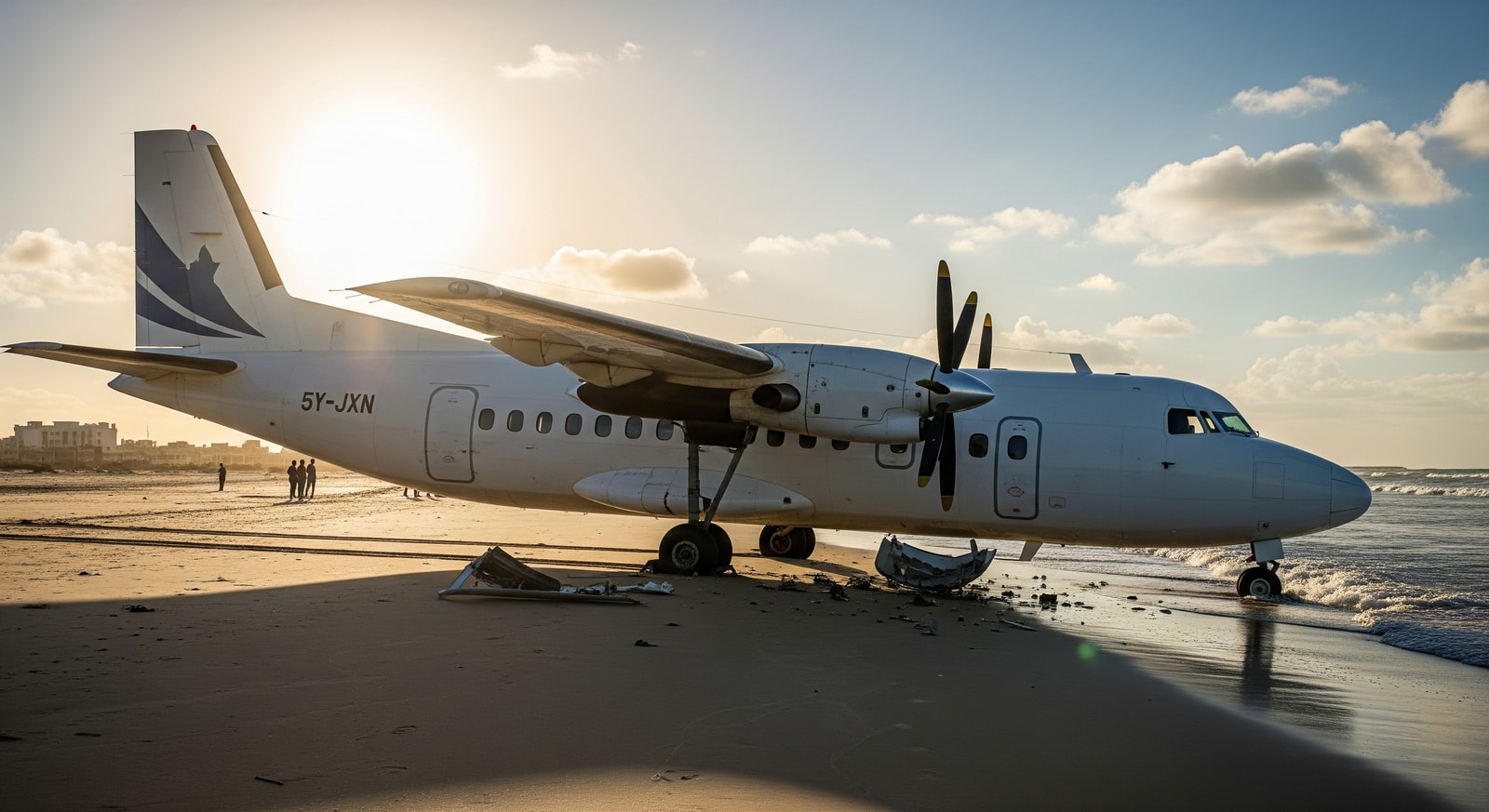
A Fokker 50 overran the runway at Mogadishu's Aden Adde International Airport and came to rest on a beach after an emergency return; the Mogadishu runway overrun left all 55 people on board uninjured.
Summary: The Mogadishu runway overrun on 10 February 2026 involved a Starsky Aviation Fokker 50 (registration 6O-YAS) that returned after a technical problem and could not stop on landing, coming to rest on a beach; all 55 people on board survived without serious injury.
On 10 February 2026 a Starsky Aviation Fokker 50 operating from Mogadishu experienced a technical issue shortly after takeoff, returned to Aden Adde International Airport, and overran the runway, ending up on a beach adjacent to the airport. The Mogadishu runway overrun resulted in no fatalities and no serious injuries among the 55 people aboard.
Incident details and flight information
The aircraft was a Fokker 50 turboprop registered 6O-YAS and operated by Starsky Aviation on a domestic service. About 15 minutes after departure from Mogadishu’s Aden Adde International Airport the flight crew reported a technical malfunction and decided to return to the airport, a common safety choice when in-flight issues arise shortly after takeoff.
- Aircraft: Fokker 50 (registration 6O-YAS)
- Operator: Starsky Aviation
- On board: 50 passengers and 5 crew (total 55 people)
- Date: 10 February 2026
- Location: Aden Adde International Airport, Mogadishu, Somalia
Landing, overrun and beach stop
After returning to Aden Adde International Airport the aircraft conducted a landing but was unable to stop within the available runway distance. It continued past the paved surface and finally came to rest on the beach beside the Indian Ocean, benefiting from the airport’s coastal surroundings that, in this case, prevented the aircraft from entering the water.
Emergency responders and airport teams assisted passengers with a prompt evacuation. Authorities confirmed there were no fatalities and no serious injuries; all occupants were taken for medical checks as a precaution following the stress and potential for minor injuries in such events.
- All 55 people on board evacuated safely
- No fatalities reported
- No serious injuries reported; passengers received medical evaluations
- Aircraft sustained substantial damage to wing and fuselage
Investigation launched by Somalia’s Civil Aviation Authority
Somalia’s Civil Aviation Authority has opened a formal probe into the incident to determine the technical fault that prompted the return and the factors that led to the runway overrun. Investigators will analyse flight and maintenance records, cockpit voice and data recordings, and crew reports to reconstruct the sequence of events.
- Aircraft mechanical systems and engine performance
- Braking and hydraulic function
- Runway surface condition and available stopping distance
- Weather and wind at landing
- Pilot decision-making and landing configuration
- Aircraft weight, including fuel and load at time of landing
Regional context: older turboprops and coastal runways
The Fokker 50 remains common in many regional markets because of its short-field performance and efficiency. In parts of East Africa and other developing regions, older turboprops continue to underpin domestic connectivity despite operating in demanding environments with high temperatures, variable runway quality and limited maintenance infrastructure.
Aden Adde International Airport’s coastal location reduces available runoff beyond the runway; when overruns occur near waterlines, the margin for error is small. The aircraft stopping on sand rather than entering the ocean likely reduced the risk of a more severe outcome, but the episode underscores the importance of runway safety zones and perimeter design at coastal airports.
What this means for travellers and the aviation industry
So what? For passengers and industry observers the Mogadishu runway overrun is a reminder that prompt crew decision-making, robust emergency response and regular maintenance are vital to safety—especially where older regional aircraft serve essential routes. While the safe evacuation of all 55 people aboard demonstrates effective emergency procedures, the incident may prompt renewed scrutiny of maintenance standards, runway safety areas at coastal airports, and the operational risks of ageing turboprop fleets in the region. Travelers should monitor official airline and civil aviation updates if they plan to fly in the area, and airlines and regulators may use findings from this investigation to improve procedures and infrastructure.
Sources